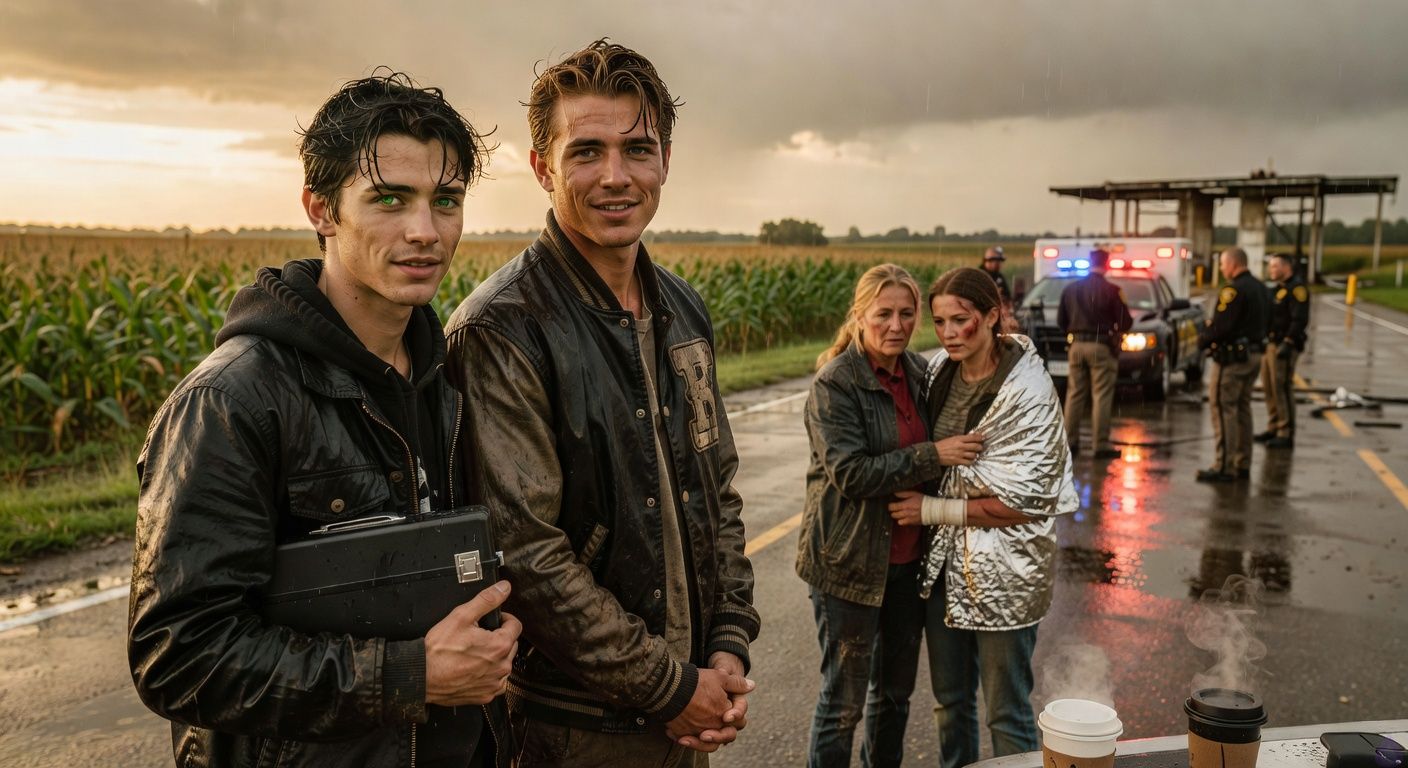
Published Story
The Fields Remember Blood
Mercy Mill appears after three hours of county road and cornfields: water towers, church steeples, and sun-bleached storefronts flattened beneath a sky too wide to trust. Your aunt’s truck smells of old coffee, dog hair, hot vinyl, and the pine air freshener twitching from the mirror like a little green corpse. She has barely spoken since the bus station.
You’ve been grateful.
Words feel like loose teeth. Touch one, and it might come out bloody.
Aunt Lila keeps both hands on the wheel, her knuckles pale beneath freckles and old work scars. She is your mother’s older sister, though grief has made the resemblance cruel. Same hard jaw. Same hazel eyes. Different mouth. Tighter. Trained by years of not expecting the world to soften. Now and then she glances over as if checking you are still there, as if boys can vanish from passenger seats the way families vanish from split-level houses during robberies gone wrong.
Aunt Lila: “School starts Monday. I talked to Principal Voss. He knows you’ve had a hard time, but he expects attendance. This town’s got opinions, Drake. Best thing is to keep your head down until they find something else to chew on.”
You look out the window instead of answering. Beyond the ditch, corn ripples gold and green, tall stalks shifting in a wind you cannot feel through the glass. For a moment, the rows seem to lean toward the truck. Listening. Then you pass a roadside memorial: a white wooden cross hammered into black dirt beside a leaning fence. Plastic flowers rattle in the breeze. A ribbon, rain-faded and frayed, reads EMILY in purple marker.
Aunt Lila’s jaw flexes.
She doesn’t slow down.
The house sits where town thins out and the pavement gives up to gravel. Narrow. White. Tired. The porch sags in the middle, and dust films the storm windows like cataracts. A rusted grain silo rises beyond the backyard, tall and hollow as a watchman with no eyes. Past it, fields stretch in every direction, whispering against themselves.
You carry your duffel inside. It holds everything you were allowed to salvage after police tape, insurance forms, and strangers in latex gloves turned your life into evidence.
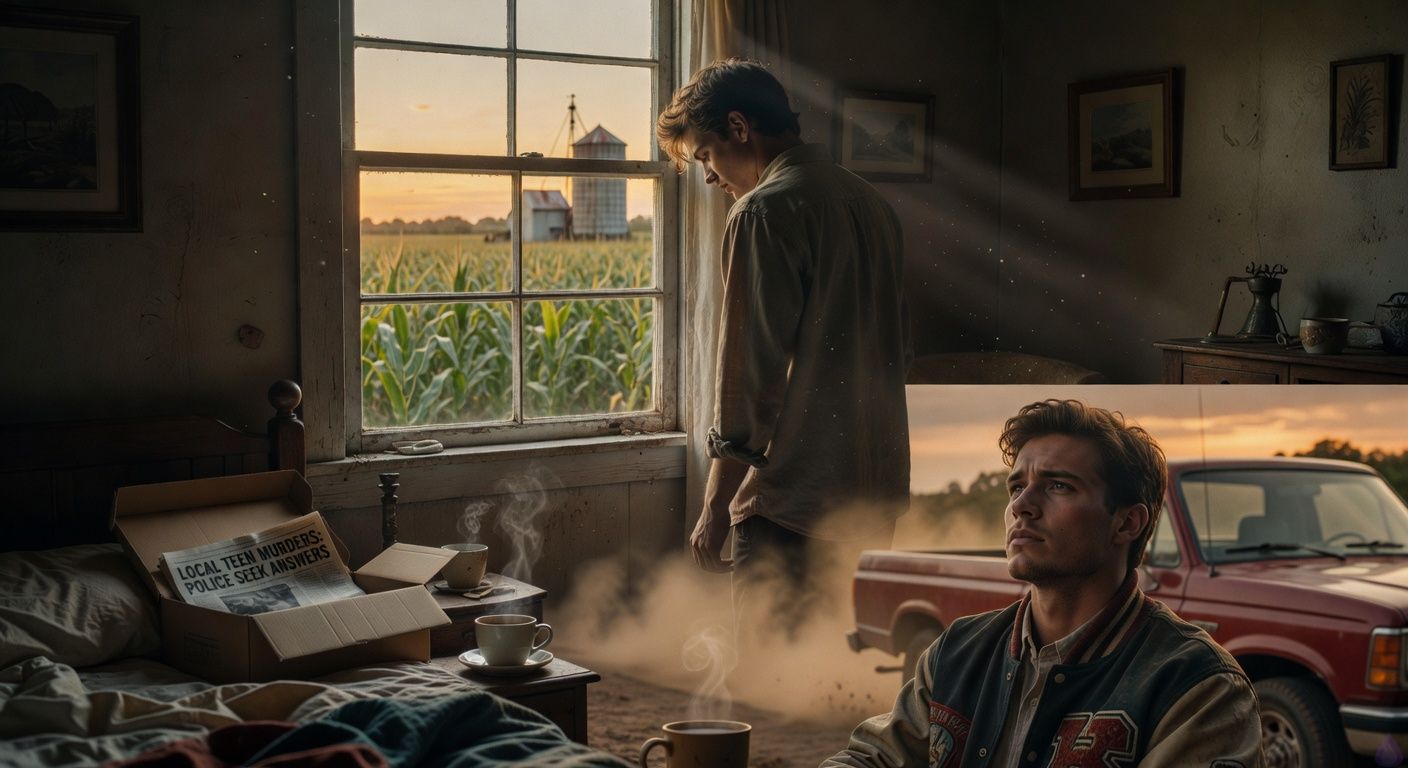
Your room used to be storage. Lila has cleared space for a bed, a dresser, and a desk under a window facing the corn. The room smells of bleach, old cardboard, and sun-warmed wood. A box sits on the quilt. Inside are clothes, towels, a flashlight, and a key on a blue plastic tag. Beneath them lies a folded newspaper, not old enough to be yellowed but handled enough for the edges to go soft.
THIRD TEEN FOUND NEAR HOLLOW CREEK. NO SUSPECT NAMED.
Your fingers tighten before you can stop them.
Three dead here. Three dead back home, if you count Mom, Dad, and June, whose strawberry shampoo still crawls into your dreams and makes you wake with your throat locked shut. You force air in. Hold it. Let it out.
You came here because there was nowhere else.
You came here because the detective said justice takes time, which sounded like something people say when they have no intention of bleeding with you while you wait.
A knock taps the doorframe. Lila stands there with a folded stack of sheets in her arms, her eyes already fixed on the paper.
Aunt Lila: “I should’ve thrown that out. People leave things everywhere when they’re scared.”
Drake: “People get murdered everywhere too, apparently.”
The sarcasm hits harder than you meant. Lila takes it without flinching, and somehow that makes it worse.
Aunt Lila: “Mercy Mill has problems. But it also has people trying to stop them. Sheriff Calder is one of them.” She shifts the sheets higher against her chest. “You want to be a cop, your mama told me. Maybe watch him. Learn what not to become.”
Before you can ask what that means, tires crunch outside.
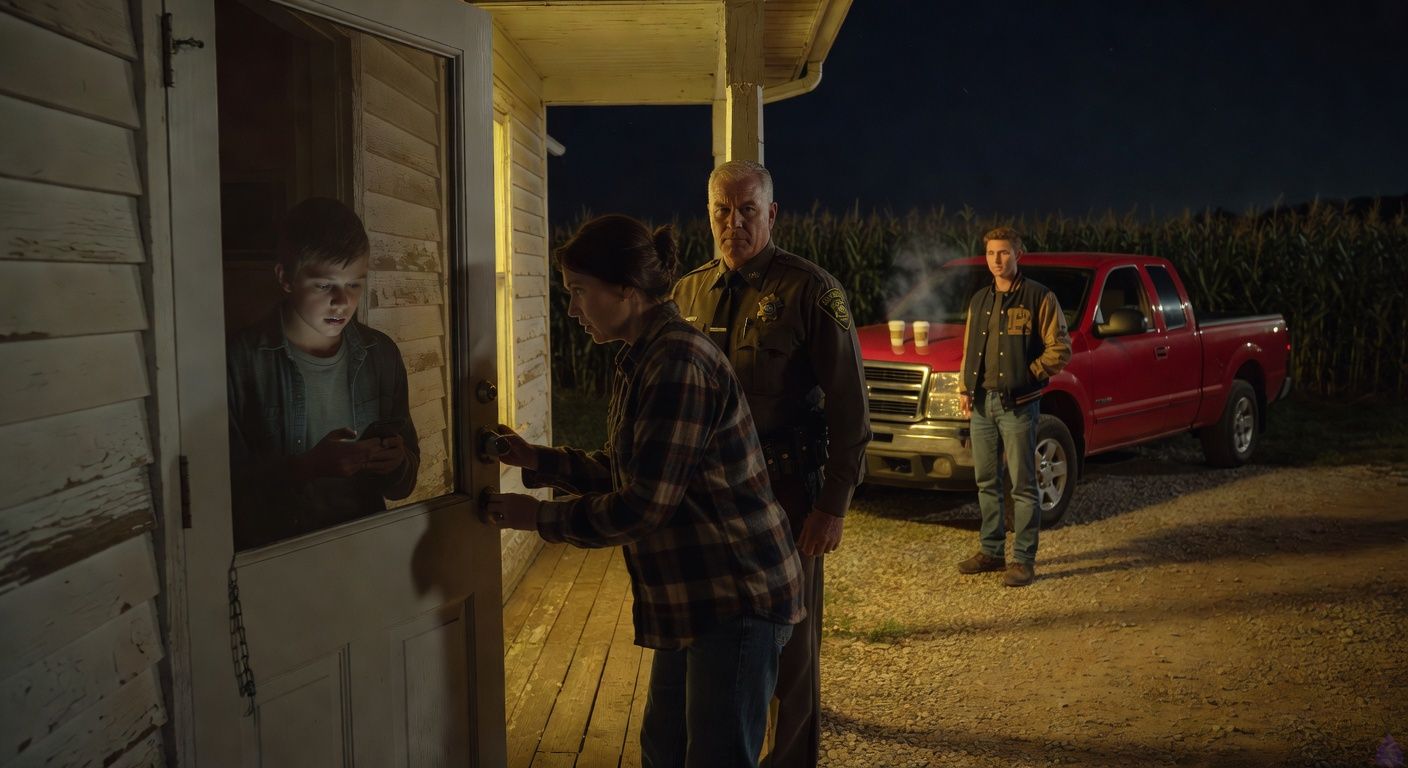
You glance through the window. A red pickup slows by the mailbox, dust curling around its wheels. Two boys sit inside. The driver is broad-shouldered, sun-browned, handsome in that effortless, infuriating way some guys are, like the world has been arranging light around his face since birth. His letterman jacket hangs open over a white T-shirt. One hand rests high on the wheel. The passenger says something. The driver laughs.
Then he looks toward your window.
His smile dies.
For one strange second, neither of you looks away. His expression shifts too quickly to name. Curiosity. Recognition of a stranger. Something guarded beneath it, sharp as barbed wire under weeds. Then the passenger shoves his shoulder, and the driver’s mouth bends into a grin that never reaches his eyes. He says something you cannot hear.
The truck rolls on.
Dust rises behind it, brown and thick as smoke.
Aunt Lila: “That was Shane Riley. Football captain. Town golden boy, depending who you ask. Stay clear if he starts acting like his father.”
The corn hisses against the window. Somewhere far off, a crow screams once, then stops.
You set the newspaper back in the box, but the headline stays in your mind, black ink pressed behind your eyes. Mercy Mill is not a refuge. It is another crime scene waiting for the chalk outline.
And you have just stepped inside the tape.
What readers chose (1 choices)
Aunt Lila almost leaves anyway.
You see the urge pass through her shoulders: the old country habit of escaping feeling by finding work. Dishes. Laundry. A pot that needs scrubbing until her knuckles ache. Her hand tightens around the folded sheets. The hallway behind her is dim and smells faintly of lemon cleaner, floor dust, and the chicken soup cooling on the stove, but your room holds still around the newspaper, the box of donated necessities, and the black headline sagging too heavy for cheap print.
Aunt Lila: “Truth is a big thing to ask for on your first night.”
She says it softly. Not unkindly.
That makes something in your chest twist.
People have been soft around you since the robbery. Nurses. Detectives. Funeral home staff. Teachers who looked at you like grief might spread if they stood too close. But softness has mostly meant distance, a padded room built from careful phrases. Lila studies your face for a long moment, then steps inside and lowers herself onto the edge of the desk chair. The sheets stay in her lap like a shield.
Aunt Lila: “Emily Harker was the first one they found. Seventeen. Worked part-time at the diner, sang in church, wanted out so bad you could see it in how she walked. Then Mason Bell. Then Carla Reyes.”
Her eyes flick toward the window, where the corn crowds dark against the last smear of light.
Aunt Lila: “All three disappeared near fields or back roads. All three turned up somewhere they had no reason to be. No robbery. No ransom. No sense. Sheriff Calder keeps saying there’s a pattern, but if he knows what it is, he hasn’t told the rest of us.”
The names settle in the room with you.
Emily. Mason. Carla.
Not headlines now. Not town gossip. People with schedules, bad mornings, favorite songs, sweatshirts left on bedroom floors. You feel the familiar cold anger stir beneath your ribs, the only part of grief that ever feels useful. Your family’s killer had wanted money, or drugs, or a thrill, or whatever hollow excuse people use when they turn living rooms into slaughterhouses.
This feels different.
Patient.
Local.
A hand reaching from the dark and choosing.
Drake: “Why didn’t you tell me before I came?”
Lila flinches as if the words hit bone. Outside, gravel pops under tires somewhere beyond the house, too far off to be the driveway but close enough to make both of you listen. The sound fades down the road. She exhales through her nose, slow and hard, then sets the sheets on the bed beside you. Her fingers are rough. Nails cut short. One knuckle swollen from old work.
Aunt Lila: “Because your parents were dead. Because you were eighteen years old and standing in a police station with blood on your shoes, and I wasn’t going to tell you the only place I could take you was already scared half to death.”
Her voice cracks once.
It changes the whole room.
Aunt Lila: “I thought if I got you here, fed you, put a roof over you, maybe that would be enough for one week. Maybe I could give you one quiet night before Mercy Mill crawled under your skin.”
You want to hate her for hiding it. That would be easier. Cleaner. Easier than seeing the grief she is trying to shoulder through, easier than admitting she is not a stranger stealing you from your old life, but the last adult standing close enough to catch some of the wreckage. Downstairs, the old house creaks as the evening cools. Through the window, the fields darken row by row, and the silo becomes a black column against a bruised violet sky.
Aunt Lila: “There’s more.”
She looks down at her hands.
Aunt Lila: “Your mother called me two weeks before it happened. Said she found something in your dad’s files. Something about Mercy Mill. Old case notes, maybe. She wouldn’t say much over the phone. Your father used to know Sheriff Calder, years back, before you were born. They had a falling out.”
Lila swallows. Her throat works like the words have thorns.
Aunt Lila: “I don’t know if it connects to what happened to them. I don’t know if I’m a frightened woman making ghosts out of coincidences. But when Calder heard you were coming, he called me personally. Told me to keep you away from police business. Didn’t ask. Told.”
The room tilts.
Your father’s locked filing cabinet still sits in a house sealed by detectives. Sheriff Calder is already a name with a shadow stuck to it. Your mother’s last unfinished warning traveled through a phone line and died with her before it could become proof.
You stand without meaning to. Restless heat burns through your legs.
On the road outside, an engine growls again, slower this time. Headlights slide across the far wall, thin and pale as knife marks, then disappear.
A second later, your phone buzzes in your pocket.
Unknown local number.
You look down.
One message.
DON’T ASK HER ABOUT THE FIELDS.
Lila sees your face change before you can hide it. She rises from the chair, and for the first time since you arrived, she looks truly afraid.
Not worried.
Not stern.
Afraid.
Aunt Lila: “Drake, what is it?”
Outside, beyond the glass, the corn shifts.
The wind has stopped.
What readers chose (1 choices)
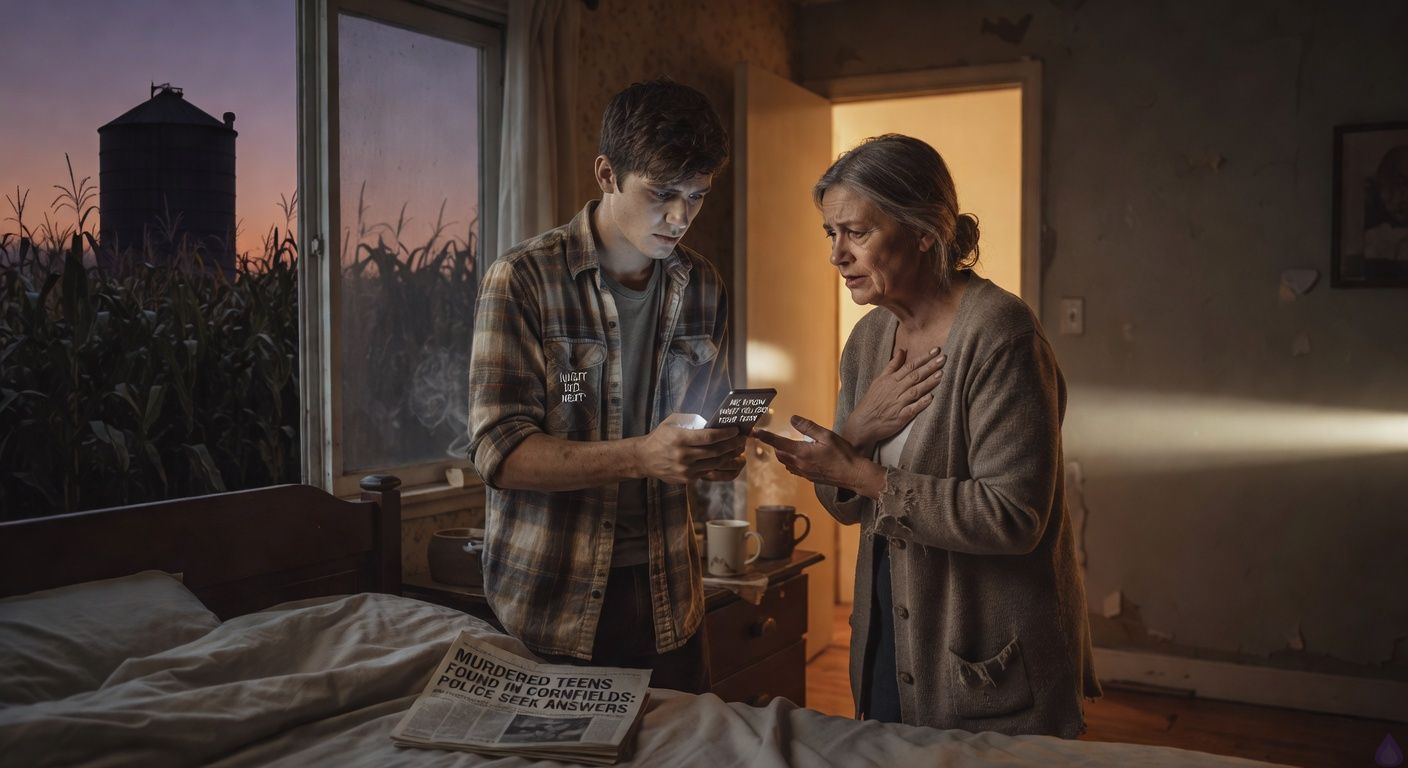
You turn the phone toward Lila before either of you can pretend the message is anything less than a threat. The screen burns cold between you in the dim bedroom, blue-white and cruel, and your fingers shake just enough to make the words shiver.
DON’T ASK HER ABOUT THE FIELDS.
For one stupid second, you think if you tilt the phone away, lock it, shove it deep into your pocket, the message might stop being real. Like a candle snuffed. Like a curse denied before it takes root.
But Lila reads it.
You watch the blood leave her face.
Aunt Lila: “Give it to me.”
Her voice is quiet. Not calm.
She takes the phone with both hands, careful as if the glass might blister her palms, and stares at the unknown number. The work-worn hardness of her face breaks apart into something older than fear. Recognition, maybe. Dread. The kind people carry in their bones and never name aloud. She taps the number, then stops before the call can connect. Her thumb hangs there, trembling less than yours.
Not by much.
Drake: “You know who sent it.”
It is not a question.
Lila closes her eyes. Outside, the fields have gone silent, and after hours of whispering corn, that silence feels wrong. Deliberate. The whole farmhouse seems to be holding its breath with you. Pipes tick inside the walls. Somewhere downstairs, the refrigerator hums, stutters, and dies. The space it leaves behind is huge.
Lila hands the phone back only after taking a picture of the screen with her own battered cell.
Aunt Lila: “I don’t know. Not for certain.” She swallows. You hear it. “But after Emily died, her mother said she got calls. Breathing. Once, a song playing real faint in the background. An old hymn. Sheriff Calder told her grief makes people hear things. Then Mason’s brother said he saw headlights in their driveway at two in the morning, three nights before Mason vanished.” Her mouth tightens. “Nobody believed him either. Said he was drunk. He was thirteen.”
The anger comes fast, because anger is easier than terror. It catches under your skin like a match struck in a gas station bathroom, bright and dangerous and one breath from flame.
You think of detectives back home telling you not to interfere. Not to obsess. Not to poison yourself with questions. You think of your mother calling Lila, scared enough to reach across years of family distance, and of your father’s name hooked to Sheriff Calder’s like wire under the jaw. Mercy Mill is supposed to be a town. Tonight it feels like a locked room where everyone knows there is a body under the rug, and no one wants to bend down.
A sharp knock hits the front door downstairs.
Lila jerks so hard the chair legs scrape the floor.
You both freeze.
The knock comes again, firmer this time. Not frantic. Not polite. Someone who expects the door to open.
Headlights bleed through the lace curtains, laying white bars across your bedroom walls. They shift as an engine idles in the yard, rough and low. You move toward the window before Lila can stop you and angle yourself beside the frame, not in front of it. The glass is cold near your cheek. Outside, a cruiser sits in the gravel drive.
Black and white.
MERCY MILL SHERIFF painted along the side.
Sheriff Calder stands on the porch below, hat in hand, his face turned toward the door. He is tall and square, built to look reassuring in uniform, with silver at his temples and a jaw that probably helped win elections. Beside the cruiser, half swallowed by shadow, Shane Riley leans against the red pickup you saw earlier.
He is not laughing now.
His letterman jacket hangs open. His posture is too stiff for boredom, too tight for confidence. When he glances up at your window, his eyes catch the porch light like an animal’s at the edge of the road.
For one breath, the room narrows to that look.
Shane seems startled to find you watching. Then his gaze flicks toward the corn behind the house, and something crosses his face that is not cruelty.
Warning.
He lifts one hand, barely, palm low at his side where Calder cannot see.
Not a wave.
A signal.
Stay back.
Aunt Lila: “Drake.” Her hand clamps around your wrist. Her fingers are cold. “Listen to me. If Calder asks about that message, you don’t give him your phone unless he has a warrant. If he asks about your parents, you say you’re tired. If he asks what I told you, you say nothing.”
The knock becomes three hard blows that rattle the frame downstairs.
Lila’s grip tightens, then loosens, as if she has remembered you are not a child she can drag behind her anymore. She turns toward the hallway, shoulders squared by habit, fear tucked beneath the stubborn line of her back.
But you can still see it.
The truth has not saved either of you. It has opened the door, and the town is standing on the porch.
Outside, the cruiser radio crackles once. A voice spits through static. Then a broken phrase slips into the night.
“...Hollow Creek... another one...”
Shane’s head snaps toward the cruiser.
Calder stops mid-knock.
Downstairs, the porch boards groan beneath his boots as he turns slowly toward the sound. And beyond the backyard, in the black seam where the corn meets the trees, a distant light blinks once.
Then vanishes.
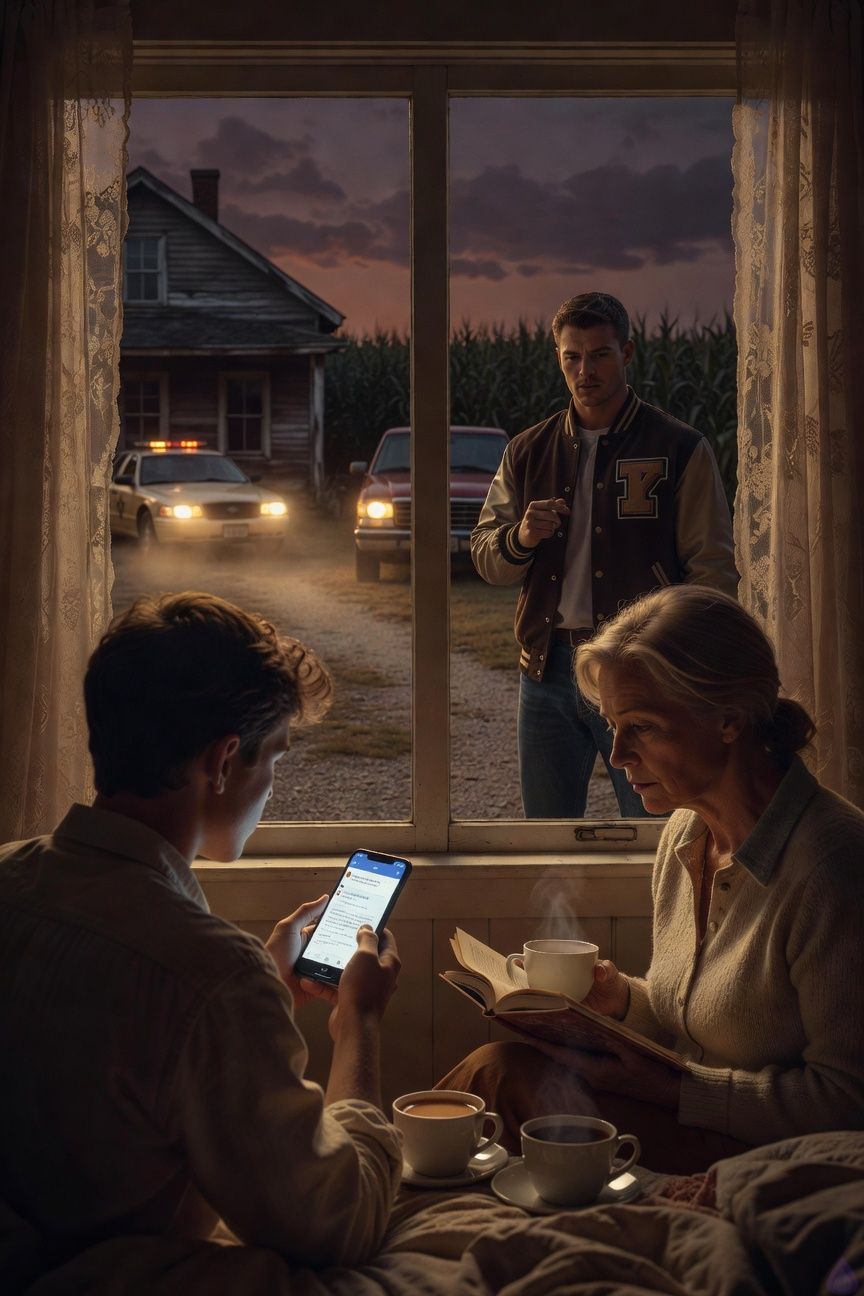
Lila moves first—not for the stairs, but for the bedroom window, where you stand half-hidden behind the curtain, shoulder pressed to cold glass. Her hand catches your sleeve. Hard. When you look at her, the fear in her eyes has sharpened into command.
Downstairs, Sheriff Calder’s boots scrape across the porch boards.
The radio in his cruiser spits static, hisses, then dies, as if the night has put a black hand over its mouth.
Aunt Lila: "Do not go outside unless I tell you. Do you understand me?"
You almost laugh.
The order lands in a room where your whole life has become proof that adults cannot keep doors shut against the worst things. Locks break. Promises rot. Graves open.
But the laugh dies in your throat.
Calder is on the porch. Shane is in the driveway, doing a poor job of pretending he just happened to be there. Somewhere near Hollow Creek, someone has said another one, and the phrase crawls under your skin until it finds the fresh graveyard inside you.
Lila starts down the stairs before you answer.
You follow close enough to see the set of her shoulders, close enough to smell the starch in her shirt and the old woodsmoke caught in her hair. The farmhouse groans around you. Pine boards. Settling nails. Wind worrying at the eaves like fingernails.
Every step sounds too loud.
At the bottom, Lila pauses, looks back, and points two fingers toward the shadow beside the hall closet.
Stay there.
For once, you obey.
She opens the door with the chain still latched.
Yellow porch light slants across Calder’s uniform, turning the badge on his chest into a small, hard star. Up close, he looks less like the man from campaign signs and more like someone who has gone too long without sleep and still been trusted with a gun. His face is gray under the tan. His eyes flick past Lila at once, searching the dim entry behind her.
They land near your hiding place.
Not on you.
Near enough.
The corner of his mouth tightens.
Sheriff Calder: "Evening, Lila. Sorry for the hour. I heard the boy got in today. Thought I should introduce myself."
Aunt Lila: "You came with your lights off and one of Riley’s boys in my driveway to introduce yourself?"
Calder turns his head a fraction.
Shane straightens beside the red pickup as if her words have yanked a string through his spine. In the yard light, he is all sharp edges—broad shoulders, pale face, mouth pressed thin. His eyes find the doorway.
This time, they find you.
No smirk. No schoolyard act. Just urgency, raw and barely held down.
Shane: "I told him I saw someone by the creek road. That’s all."
Sheriff Calder: "You told me a lot of things, Shane. Most of them after you decided to leave a scene you had no business being near."
Shane’s jaw works.
He looks away first, but not like he is ashamed. More like he is weighing how much truth he can spend in front of a man with a badge.
The cruiser radio crackles again. This time the dispatcher’s voice cuts through, thin and strained.
Dispatcher: "Unit Three, confirm possible remains at Hollow Creek access. Repeat, possible remains. Coroner en route."
The words hit the porch and kill the air.
Lila inhales once. Small. Sharp.
Calder closes his eyes.
Not in grief. Not exactly.
Frustration.
It passes so quickly you might have missed it, if you had not spent the last few weeks learning how people behave around death. Real shock makes people clumsy. It knocks cups from hands. It empties faces. Calder looks inconvenienced before he remembers to look sad.
Then his face resets.
Sheriff Calder: "Lila, I need Drake to come with me. Just to the station. A few questions."
The hallway seems to shrink around you. Wallpaper. Coat hooks. The smell of rain-soaked wool from the closet. Your pulse hammers against the tender places grief left inside your chest.
Lila’s hand stays on the door, but her body shifts enough to block the opening completely.
Aunt Lila: "Absolutely not."
Sheriff Calder: "This is not an arrest."
Aunt Lila: "Then it can wait until morning, and it can happen with me present."
Calder’s gaze hardens.
For one second, the friendly-town-sheriff mask slips, and beneath it is something flat, patient, and practiced. Your phone feels heavy in your pocket. The threatening text seems to burn through the denim, evidence and bait at once.
Shane pushes off the truck.
Shane: "Sheriff, I said I’d show you where I saw the light. You need to go now."
Calder turns on him so fast Shane stops mid-step.
Sheriff Calder: "You need to learn when to keep your mouth shut."
Silence.
Even the insects seem to hold still in the wet grass.
There it is.
Not quite a confession. Not quite a threat.
Enough.
Lila’s hand finds the chain latch and grips it like a charm against evil. You step out of the shadow before fear can talk you back into it.
Calder sees you fully now.
Something unreadable moves through his eyes. Recognition without warmth. Like touching an old scar and finding it still hurts.
You wonder if he sees your father in your face.
You wonder if he hates that.
Drake: "You knew my dad."
Calder’s expression does not change.
Shane’s does. His eyes widen, just a little, as if some missing piece has slid into place.
Sheriff Calder: "I knew a lot of people. Your father made choices. Some men do."
Lila makes a sound under her breath.
Almost your name.
Almost a warning.
Before you can answer, your phone buzzes again.
Everyone hears it.
That tiny vibration is louder than the insects in the yard, louder than the cruiser’s low idle, louder than your breathing. Calder’s eyes drop to your pocket. Shane looks at you with sudden alarm. Lila goes still as a held breath.
You pull the phone out.
Unknown number.
A photo loads slowly, pixel by pixel, as if the town means to make you suffer each piece into being.
First darkness.
Then weeds.
Then creek stones slick with black water.
Then a strip of muddy bank caught in the white glare of a flashlight beam.
At the edge of the frame lies a blue plastic key tag.
The same kind as the one upstairs in your room.
A new message appears beneath it.
ASK CALDER WHAT YOUR FATHER BURIED.
What readers chose (1 choices)
The phone stays lit in your hand, throwing corpse-blue light across your knuckles and the message under the photo.
ASK CALDER WHAT YOUR FATHER BURIED.
For one second, no one moves.
Sheriff Calder’s gaze fastens to the screen with a hunger he almost hides. Almost. Aunt Lila sees it too. Her fingers tighten around the door chain until the little brass links sink into her palm. You feel the old reflex rise in your chest, hot and stupid—the need to demand answers, to hurl your grief like a brick through Calder’s carefully arranged face.
You don’t.
You lower the phone slowly, as if the message has only confused you. As if you are still stunned. Harmless.
Your eyes slide past Calder’s shoulder.
Shane stands beside his truck with one hand on the open driver’s door, his face washed pale under the porch light. He is watching you, not the sheriff.
That matters.
You brush your fingers against your thigh twice, then tip your chin toward the side yard, where the porch light dies and the corn begins. It is not a plan. Barely a signal. But Shane’s expression changes—quick, sharp,and he looks away at once, like he understands that pretending has become the only thing keeping either of you alive.
Sheriff Calder: "That your phone, Drake?"
Drake: "Usually how phones work."
Lila makes the smallest sound, half warning, half worn-out pride. Calder steps closer to the door. The chain draws taut between him and your aunt, a bright line scratched across the night. Up close, his cologne seeps through the gap—cedar and aftershave over something metallic. Rain on his uniform buckle, maybe. Or maybe your mind has started finding blood in everything.
His eyes lift from your hand to your face.
Sheriff Calder: "If someone is threatening you, I can help. But I need to see the message."
Aunt Lila: "You can help by answering your radio. There’s a scene at Hollow Creek."
The cruiser crackles again, all static and clipped voices, but Calder does not turn.
That is when Shane moves.
He does not run. Running would drag the sheriff’s attention like a hook. Instead, he stoops, swears loudly, and kicks gravel near his tire.
Shane: "Damn it. I think I hit something on Creek Road. Tire’s leaking."
Calder’s head snaps toward him. The irritation on his face is instant. Real. It makes Shane’s lie better.
Shane crouches by the front tire, hiding his hands with his body. For a heartbeat, his fingers flash low in the dark, pointing toward the old barn at the edge of Lila’s property, then curling twice.
Come around.
Hurry.
Sheriff Calder: "Get back in your truck, Riley. I’m not in the mood."
Shane: "Yeah, well, neither was Emily when people told her to shut up."
The words land like a slap.
Calder goes still.
Lila sucks in a breath. You understand at once that Shane has done something reckless. Maybe the most reckless thing available. He has set a dead girl’s name between himself and the sheriff, and the whole night seems to lean closer, listening.
Calder turns fully away from the door. His shoulders square. One hand drops near his belt—not onto the gun, not yet, but close enough that your pulse kicks hard against your ribs.
That is your opening.
Lila sees you shift. Her eyes widen. She does not stop you. Instead, she pushes the door harder against the chain, making it rattle, making Calder glance back for one precious second.
Aunt Lila: "You take your hand away from that belt on my porch."
You slip into the narrow hallway shadow, then through the kitchen, moving by a memory your body seems to own before your mind can reach it, guided by the cold rectangle of the back door. The farmhouse smells of soup gone lukewarm, damp wood, and the faint sourness of old rain trapped in the walls. Your sneakers whisper over faded linoleum. Behind you, voices rise on the porch—Calder’s low and controlled, Lila’s sharp enough to cut twine.
You ease the back door open.
Wet grass swallows your shoes.
The night outside is huge.
Crickets restart in frantic bursts. The cornfield looms past the yard, rows black and whispering though there is no wind. The old barn crouches ahead, roof bowed, boards silvered by moonlight, a tired animal pretending to sleep. You keep low as you cross behind the house, phone clutched tight, every nerve waiting for Calder to shout your name.
A hand catches your sleeve from beside the rain barrel.
You twist hard, ready to swing.
Shane lifts both hands fast, clamping one over his own mouth to signal silence rather than touching you. Up close, he smells like cut grass, engine oil, and fear-sweat buried under expensive detergent. His letterman jacket is damp at the shoulders. His eyes are too bright.
Shane: "Don’t yell. Please."
The please hits stranger than the warning.
He looks toward the front of the house, then back at you. All the swagger from the red pickup is gone. Without it, he seems younger. Rawer. Like a boy standing too close to a deep well in the dark.
Shane: "I saw that key tag at Hollow Creek before Calder got the call. Someone put it there after I left practice. And the light in the field—it wasn’t a flashlight."
His voice drops until the corn almost eats it.
Shane: "It was a phone screen. Somebody was watching your aunt’s house from the rows."
Your own phone buzzes again in your hand.
Shane flinches.
This time the message is only three words.
BOTH OF YOU RUN.
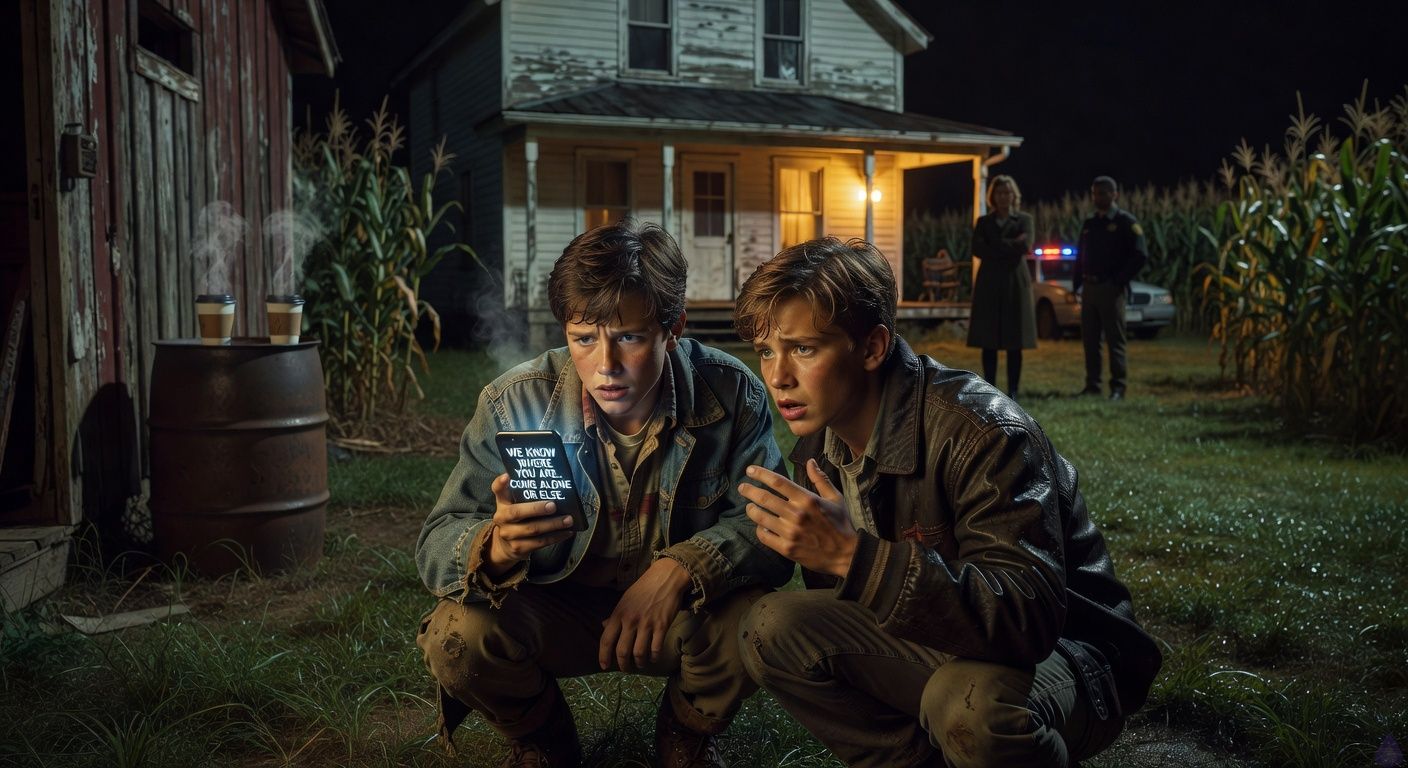
The words glow between you and Shane, small enough to fit inside your palm, large enough to turn the whole yard into a snare.
BOTH OF YOU RUN.
For one breath, neither of you does.
Fear does not always move the body. Sometimes it pins you where you stand and makes the world cruelly clear: the silver bead of rain sliding down the barrel, the jump of Shane’s pulse in his throat, the porch voices muffled at the front of the house, Calder’s calm menace scraping against Lila’s fury like a knife on bone. Beyond the barn, the corn stands in black walls. Each row waits with its mouth open.
Shane: “That’s not from me. I swear to God, Drake, that’s not from me.”
His whisper breaks on your name.
It should not matter. You have known him less than a day, and most of that has been glances, warnings, and the ugly armor he wears in daylight. But his face is bare now. No grin. No practiced cruelty. Just panic, and something too close to guilt to ignore.
A sharp crack snaps from the field.
Not a gunshot.
Wood breaking.
Close.
Shane grabs your wrist, then drops it at once, as if he has remembered he has no right. He looks toward the barn instead, eyes cutting across the yard with athlete’s speed, measuring distance, shadow, danger. The porch light flares as the front door opens wider. Lila’s voice rises, fierce and cracked, buying seconds with every word.
Aunt Lila: “He is not leaving this house with you, Calder. Not tonight. Not without a lawyer.”
Sheriff Calder: “You are making this harder than it needs to be.”
The sheriff’s voice carries around the corner of the farmhouse, low and almost bored. That scares you more than shouting. Men who shout are still trying to prove power. Calder sounds like he already knows where all the exits end.
Another sound comes from the corn.
A ringtone.
Thin. Warbling. Familiar enough to make your stomach drop before your mind catches up. An old default melody, tinny and sweet, drifts out from the rows behind the barn. Then, beneath it, a woman’s recorded voice begins to sing through static, soft as a lullaby played underwater.
Phone Recording: “Shall we gather at the river...”
Shane goes white.
Shane: “Emily’s mom said the calls played a hymn.”
You want to ask how he knows that. You want to ask why he was near Hollow Creek, why he came here, why he looked at you earlier as if he had been waiting for you and dreading you at the same time.
But the ringtone stops.
The silence after it is worse. It spreads over the yard like wet cloth.
Then the barn door creaks open by itself.
Only a hand’s width. Enough to show the dark inside.
Shane steps in front of you before he seems to decide to move. His shoulders square. His letterman jacket catches the thin porch light, and for one sick second the town’s golden boy is nothing but a trembling shield between you and the old wood. It is stupid. Brave. Infuriating.
Something in you aches at the sight.
Bravery should not look so lonely.
At the front of the house, Calder’s radio erupts again.
Dispatcher: “Sheriff, Unit Two is requesting immediate backup at Hollow Creek. We have an unidentified witness fleeing east through the fields. Repeat, east through the fields.”
Calder curses. One word, bitten short, and more revealing than anything he has said all night. His boots pound down the porch steps. Gravel spits under his heels. The cruiser door opens.
It does not close.
Lila appears around the side of the house with a flashlight clenched in one hand and a kitchen knife in the other. It would almost be funny, if her face were not the color of flour. She stops when she sees you with Shane by the barn. Then she looks past you, toward the corn.
Aunt Lila: “Inside. Both of you. Now.”
Shane shakes his head once, eyes fixed on the barn door.
Shane: “There’s someone in there. Or they want us to think there is.”
The open barn breathes cold air at your backs. It smells of wet hay, old manure, and something metallic under the rot, like pennies held too long in a fist.
From inside comes a tiny mechanical click.
A phone screen lights up on the dirt floor.
Its glow shows a blue plastic key tag tied to a length of red twine. Beneath it, scratched into the dust with something sharp, are three words.
CAINE KNEW FIRST.
Lila makes a sound like her heart has been kicked.
The cruiser engine revs out front. Calder is leaving for Hollow Creek, or pretending to. The corn whispers again, this time with no wind at all, dry leaves rubbing together like dead hands. Shane looks at you, and the fear in his eyes is threaded with trust he has not earned but is offering anyway.
Shane: “Tell me what to do.”
For the first time since Mercy Mill swallowed you, someone is not telling you to stay quiet. Stay safe. Stay out of it.
Someone is asking you to choose.
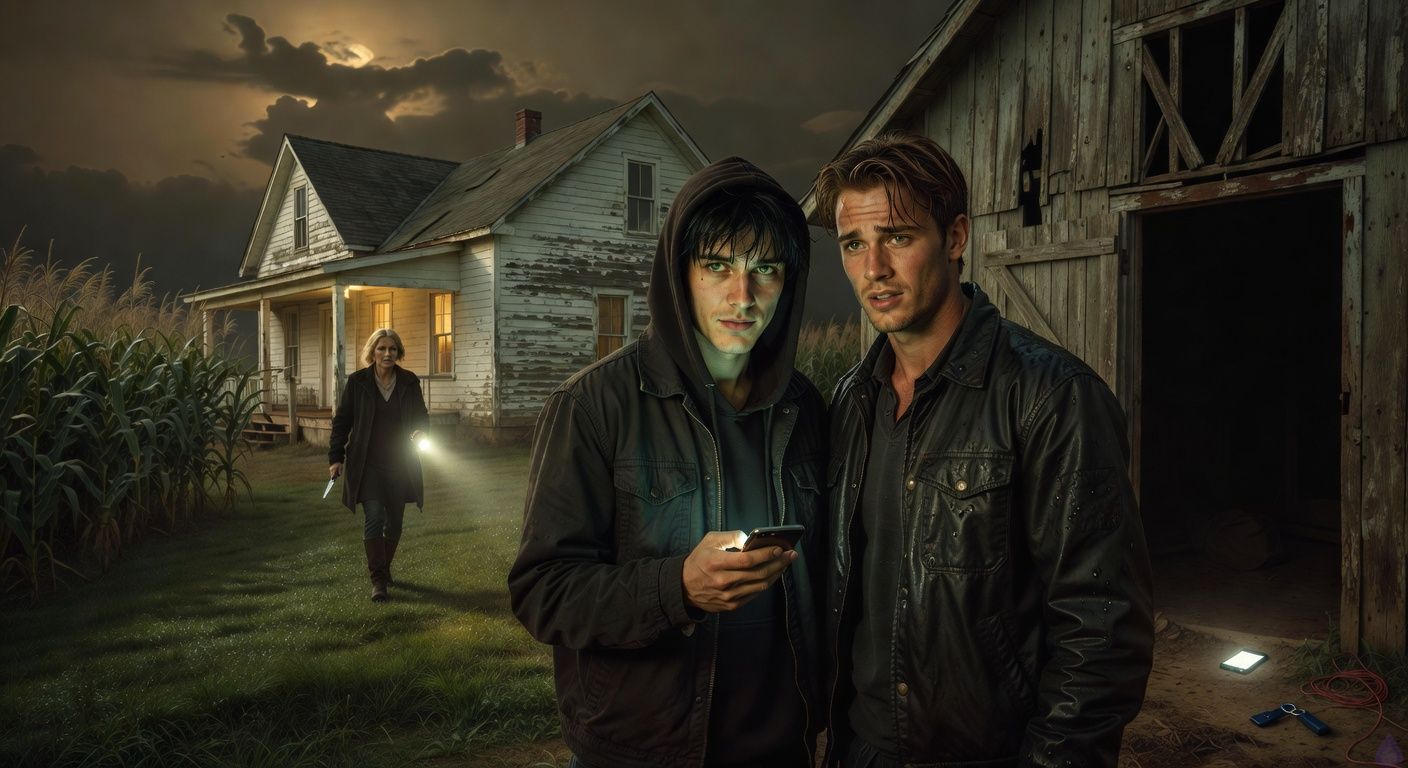
The barn waits with its mouth cracked open, phone-glow shivering on the dirt like a trapped firefly. Cold air seeps from between the warped boards. It smells of old hay, mouse droppings, engine oil, and the sour rot of apples left too long in a barrel. The words scratched beneath the blue key tag seem to sink deeper the longer you stare, each letter cut through dust into hard-packed earth.
CAINE KNEW FIRST.
Your last name has no business being here.
Not in Aunt Lila’s barn. Not beside red twine and a dead girl’s hymn. Not tied to some buried thing your father may have carried all the way to his grave.
Aunt Lila steps closer, her flashlight beam juddering despite the white-knuckled force of her grip. The kitchen knife hangs at her side, absurd and heartbreaking, a farm woman’s answer to a nightmare that has learned how to use phones. Her face stays fixed on the message, but her eyes are gone somewhere else. Years back, maybe. To your mother’s phone call. To your father before he became a framed photograph, a closed coffin, a name people lowered their voices around.
Aunt Lila: “Your dad came here once. After you were born. He and Calder met out by Hollow Creek, and when he came back to my place, he had mud up to his knees and a look like he’d seen hell smiling at him.” Her throat works. The flashlight dips, catches the knife, flashes white along its edge. “He told me if anything ever happened, I should remember the fields keep what men hide. I thought he was drunk or scared or both. I should have listened.”
The cruiser out front peels away in a spray of gravel. No siren. Just the engine growling down the drive, red taillights bleeding through the dust until the dark swallows them on the road to Hollow Creek.
Calder is leaving.
The air does not feel safer. It feels abandoned. Like the moment after a prayer goes unanswered. Like the thin breath before something steps from the corn because the sheriff has gone, or because the sheriff was never protecting you in the first place.
Shane shifts beside you, his shoulder nearly brushing yours. The heat of him startles you in the cold yard. He smells like rain-damp denim and sweat and the cinnamon gum he always chews when he is trying not to look afraid.
Shane: “We can go inside, lock every door, and pretend this waits politely until morning.” His voice reaches for sarcasm and falls short. Badly. “Or we can grab that phone before whoever left it wipes it, because that’s what Calder would do. Evidence disappears around him.” A beat. “People too.”
Lila’s flashlight snaps to his face.
For a second, Shane looks ready for her to slap him with every rumor the Riley name has earned in Mercy Mill. Rich boy. Sheriff’s favorite. Golden son with clean shoes and dirty friends. Instead, she studies him with a wary, bone-deep exhaustion. You see the calculation in her eyes, sharp as a needle.
Shane Riley, football captain, sharp-mouthed golden boy, shaking in her side yard and still standing between you and the dark.
Whatever she decides, it costs her.
Aunt Lila: “You know more than you told Calder.”
Shane swallows. Loudly. His gaze drops to the dirt, to the scratched name, to the phone pulsing blue in the barn’s throat. Then he drags his eyes back to yours, and the shame there feels too close, too naked, like a door opening where there should have been a wall.
He looks furious. At himself. At Mercy Mill. At whatever fear has had its hand on the back of his neck for years.
Shane: “Emily called me the night she died. I didn’t answer.” The words come out flat, but his hands are trembling. “I thought if people saw her name on my phone, they’d ask why she was calling, and then they’d ask who else I talked to when nobody was around.” His mouth twists hard enough to hurt. “She left a voicemail. Just breathing and corn rustling, then she said, ‘Ask Caine.’ I deleted it because I’m a coward.”
The confession lands harder than another threat.
Not because it makes Shane guilty of murder. It doesn’t. It makes him human in the ugliest way. Frightened. Selfish. Sick with the memory of a choice he cannot remake. You want to hate him for it. You want to trust him because he said it now, here, with the barn open and the fields listening, when lying would have been easier.
Both wants scrape together inside you.
Sparks. Teeth. Blood.
Inside the barn, the lit phone vibrates once.
The screen brightens.
A thin, high sound threads through the air, like a fingernail circling the rim of a glass. The blue key tag twitches on the dirt. Aunt Lila’s breath catches. Shane goes very still.
A new message begins to type itself across the screen, letter by letter, though no hand touches the device.
COME TO HOLLOW CREEK.
The phone flickers. The barn seems to lean closer.
Then another line appears.
BRING THE CAINE BOY.
The corn behind you parts with a soft, deliberate whisper.
Not wind.
Lila raises the knife. The blade shakes, but it stays up. Shane’s hand finds your sleeve again, not gripping this time, just touching, asking without words whether you are still there. Whether he is.
In the barn’s blue glow and the porch light’s failing reach, the three of you stand caught between the house, the fields, and the road to the creek where the dead keep surfacing. The night presses in, damp and watchful. Somewhere far off, a siren finally begins to wail.
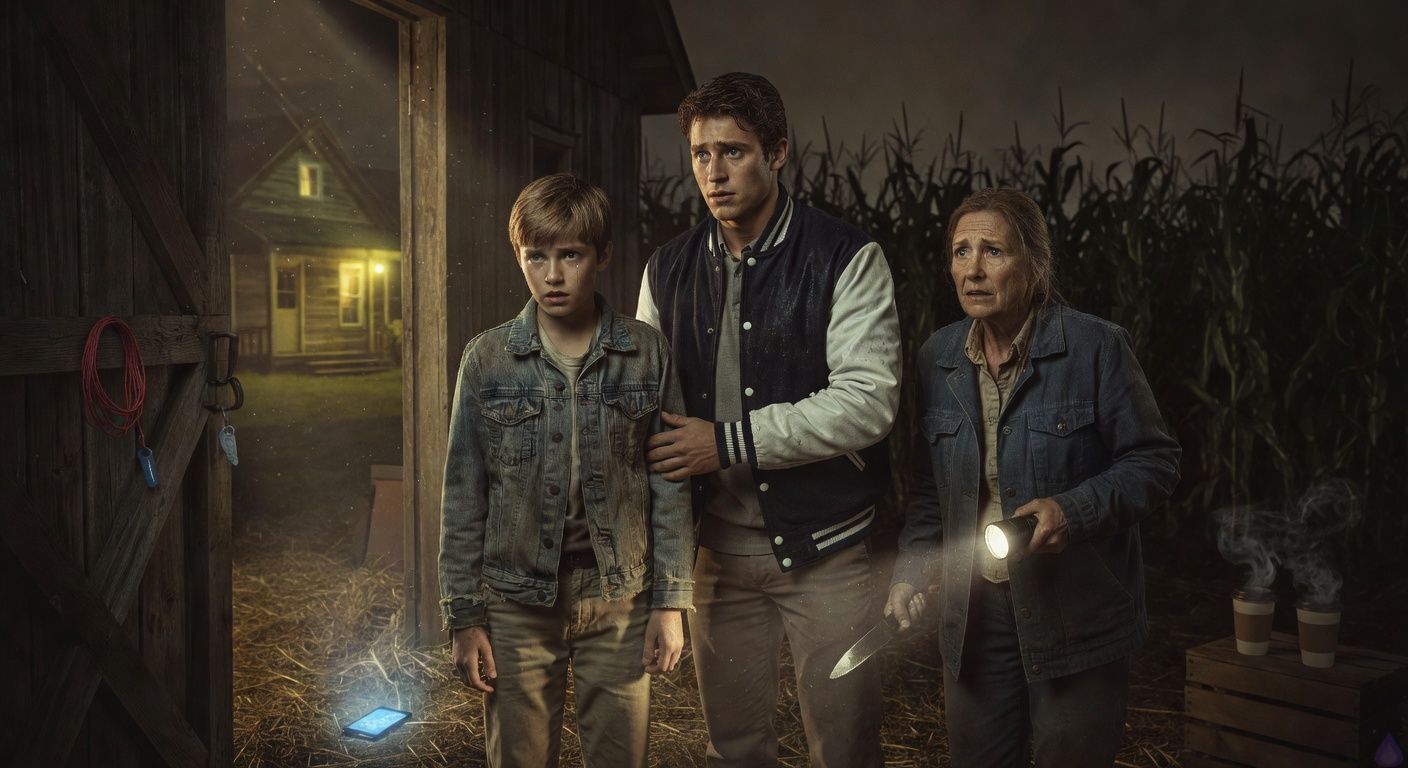
The siren swells and fades at once, bent thin by distance and the rows of corn, until it sounds less like help coming and more like something crying under the earth. The phone in the barn keeps glowing.
COME TO HOLLOW CREEK. BRING THE CAINE BOY.
The words sit there with patient cruelty, as if whoever sent them knows you’ll read them again and again, hunting for a seam in the trap.
Aunt Lila steps back first, dragging the flashlight beam with her. It scrapes over rafters, hanging chains, rusted hooks where bridles once hung, then drops to the dirt floor and catches the red twine tied around the blue key tag. Her mouth trembles once. Then she clamps it shut. Whatever your father buried, whatever he warned her about, has stopped being family history.
It is a hand at your throat.
Aunt Lila: “Inside. We call the state police. Not Calder. Not the county desk. State. Then we wait in the kitchen with every light on until someone with a badge I don’t hate shows up.”
Shane lets out a laugh with no humor in it. He looks toward the road where Calder’s cruiser vanished, then toward the corn, where the stalks still shift in brief, wrong ripples, leaf against leaf like dry fingernails. His shoulder stays near yours. Close enough that the warmth of him makes the cold air feel sharper.
Shane: “They won’t get here fast. My dad says state patrol takes forty minutes on a good night, and that’s if dispatch doesn’t route them through Calder first.”
Lila turns the flashlight on him like a weapon.
Aunt Lila: “Your father says a lot of things. Most of them after two beers and before blaming someone poorer.”
Shane flinches.
Small. Quick.
You see it, and so does she. For a heartbeat, the popular boy’s armor splits in a place that has nothing to do with killers or creek beds. Then he swallows it down and looks at you instead, as if your judgment is the one that matters now.
That should feel ridiculous.
It doesn’t.
It feels dangerous.
Before anyone can speak again, your phone buzzes in your hand. Not the barn phone. Yours. The screen lights your palm with another unknown number, but this time there’s no text. Just an incoming call. No ringtone. Only vibration, a frantic insect trapped against your skin.
Lila’s eyes widen.
Shane shakes his head once, fast.
Shane: “Don’t answer.”
You stare at the number. Local. Unlisted. A town-shaped ghost. The call ends before you decide, then a voicemail appears at once. The icon sits on your screen like a bead of poison.
Your thumb hovers.
The memory of your mother’s last unheard warning claws up your chest. Calls matter here. Ignored calls become graves. Deleted voicemails become guilt wearing a letterman jacket, trembling in the dark.
You hit play.
At first there’s only static. Then corn rustling. Close, wet, intimate, like the microphone is being dragged through the rows. A girl’s voice rises beneath it, thin and strained, but not singing. Crying too softly. Trying not to be heard.
Voicemail: “Drake Caine. If this reaches you, don’t trust the sheriff. Don’t trust the creek. Your father found the first place. He marked it under the millstone where the water turns red after rain. Calder made him choose.”
The recording crackles. A breath shudders against the receiver. Beside you, Shane goes utterly still. Aunt Lila presses one hand to her mouth, the flashlight sagging toward the grass, its beam shaking over weeds silvered with dew.
Voicemail: “Emily knew. I told Emily. I thought she could help because everyone loved her. I was wrong. He watches from the corn when the hymn plays. He waits for people to come looking.”
A sharp sound cuts through the message.
Not static.
A knock.
Three blows, slow and hollow.
The girl whispers one last thing.
Voicemail: “If Shane is with you, make him remember the bridge.”
The message ends.
Shane staggers back as if shoved. His heel catches on a root near the rain barrel, and you reach without thinking, catching his sleeve before he hits the ground. He grabs your forearm in return, fingers tight enough to hurt, breath harsh through his teeth.
His face has changed.
Not pale now.
Empty.
Shock scraped clean.
Drake: “What bridge?”
He shakes his head. Once. Twice. His eyes shine, but nothing falls.
Shane: “I don’t know. I mean, I do, but I don’t.” He drags in air, fighting something inside himself that looks bigger than fear. “There’s an old service bridge near Hollow Creek, past the mill ruins. We used to dare each other to cross it when we were kids. Emily, Mason, me. Some others. There was a night when we found something under it, but my dad told me it was trash. Calder came. He told us we didn’t see anything.”
Aunt Lila lowers her hand from her mouth. Her voice comes out scraped raw.
Aunt Lila: “How old were you?”
Shane: “Nine. Maybe ten.”
The corn whispers again.
This time it comes from the side yard, then the back field, then the far edge near the silo, moving in a slow circle around the house. The air smells of damp leaves, old manure, and the sour metal stink of the rain barrel. Somewhere inside the barn, the abandoned phone glows on, cold and blue.
Lila’s flashlight sweeps the rows.
For the briefest instant, the beam catches a shape standing between the stalks. Human height. Still. A pale oval where a face might be.
Then the light jerks back.
Only corn.
Swaying gently in air gone dead still.
Shane steps closer to you, done pretending he isn’t scared.
Shane: “Drake, we have to move. If we stay, they can box us in. If we go, we might be walking straight into it. But that voicemail came from someone alive, or someone who was alive recently.”
Aunt Lila lifts the knife again, but her eyes are on you. Not commanding now. Pleading, though she would hate that you can tell.
The farmhouse glows behind her, warm and fragile, every lit window a square of yellow against the dark. The barn yawns open beside you, holding the planted phone and your father’s name scratched into dirt. Beyond the fields, Hollow Creek waits with Calder, a possible body, an old bridge, and the place where your father may have learned something terrible enough to get your family killed.
The night gives you no safe choices.
Only yours.
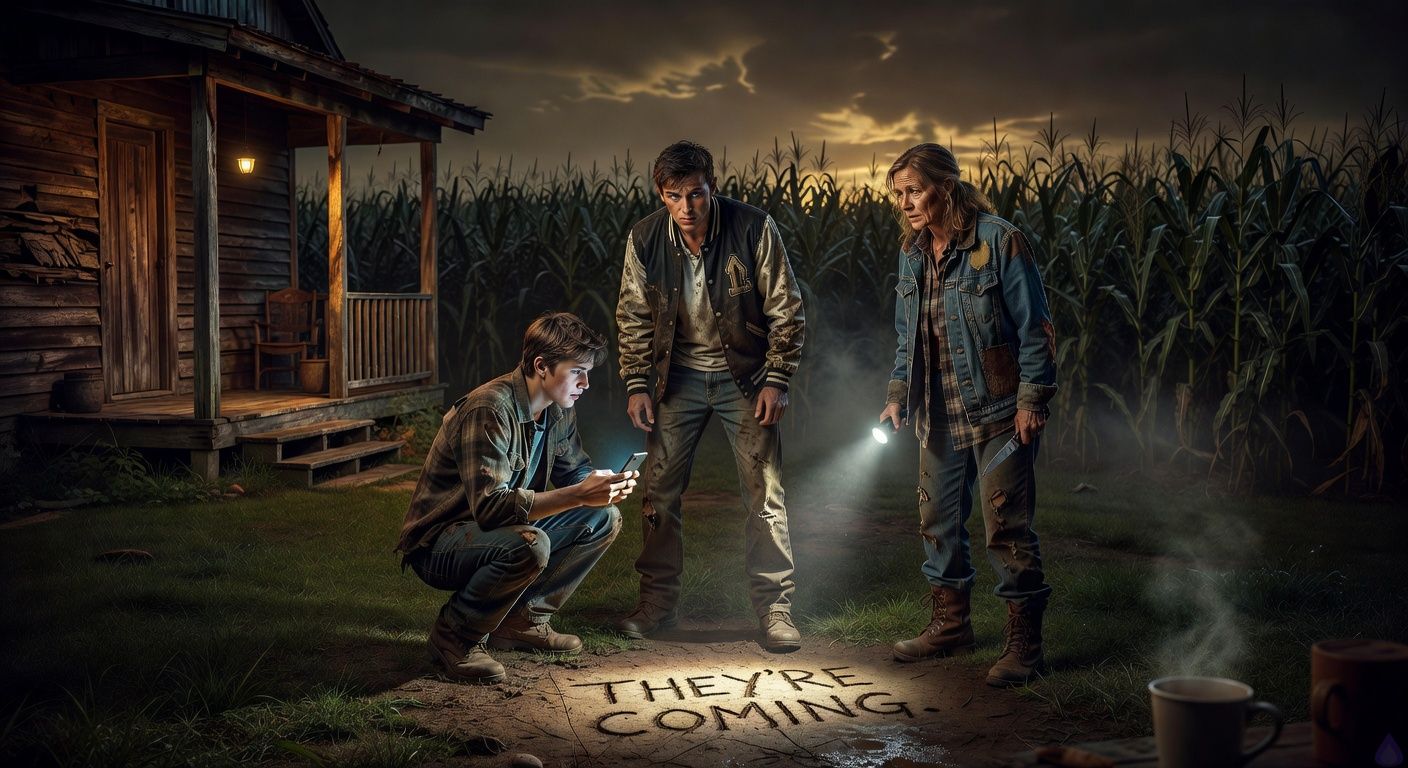
What readers chose (1 choices)
Drake: "Could Calder be part of some cult in this town?"
The question comes out sharper than you mean it to, slicing across the yard before the corn can answer. Aunt Lila’s flashlight locks on the field. Shane turns toward you slowly, rain-dark hair pasted to his forehead, his eyes still hollow from the voicemail and its mention of the bridge.
For a breath, neither of them speaks.
That silence tells you the question isn’t as impossible as it ought to be. In a sane place, someone would laugh. In Mercy Mill, the barn phone glows blue behind you, your father’s name is cut into dirt, and a hymn has just dragged itself out of the corn.
Aunt Lila: "Don’t use that word loud. Not here."
Her voice is low. Urgent. Almost angry. But the anger is only there to keep the fear from spilling out. She steps closer, knife in one hand, flashlight in the other, putting herself between you and the rows. The beam shakes over tassels beaded with rain, over leaves slick as tongues, over the narrow black gaps where a person could stand and not breathe.
"When I was a girl, people talked about the Harvest Men. Not to outsiders. Not even to each other if there were children in the room." Her mouth tightens. "My mother called it old farm nonsense. Men in feed-sack masks. Bonfires in dry creek beds. Blood worked into the soil after bad years, so the fields would come back green. Scare stories. That’s what everyone called them."
Shane laughs once, sick and airless. "My dad called it town heritage."
Lila’s eyes cut to him.
Shane looks like he wishes he could swallow the words back down, but he doesn’t. He drags both hands over his face, forcing himself toward whatever memory the voicemail has hooked in him. His letterman jacket hangs heavy with rain, the school colors blackened by night and mud.
"Not cult," he says. "Not when he said it. It was always civic pride. Old families. Protecting Mercy Mill. Making hard choices so the town survives." His voice frays. "He’d say that after town council dinners, when he thought I was asleep. Calder was there sometimes. So were the Bell brothers. Judge Harker before Emily died. Mr. Voss from school. A couple farmers who act like they own every road past the grain silos."
He swallows.
"They had a hymn they’d sing when they were drunk. Shall We Gather at the River." His eyes shine hard in the dark. "I hated that song before I knew why."
The yard seems to shift under your feet.
Not one killer in the corn, then. Maybe not one sheriff hiding evidence. Something larger. A town with rooms inside rooms. Men who smiled over paper plates at pancake breakfasts, who clapped at football games, who bowed their heads in church while old vows rotted behind their teeth.
Your father found something here. Emily learned enough to die for it. Mason. Carla. Maybe others whose names never reached the papers. Your family’s murders stop feeling like a separate wound and start feeling like the same blade, turned toward home.
Inside the barn, the abandoned phone buzzes again.
No one moves.
The sound rattles against the dirt floor, stops, then starts once more. Not random. Never random. Three vibrations. Pause. Three vibrations. Pause.
Shane’s breath catches.
"That’s how we knocked on the service bridge boards when we were kids," he whispers. "Three times to prove you weren’t scared. Emily made it up."
Aunt Lila swings the flashlight toward the barn.
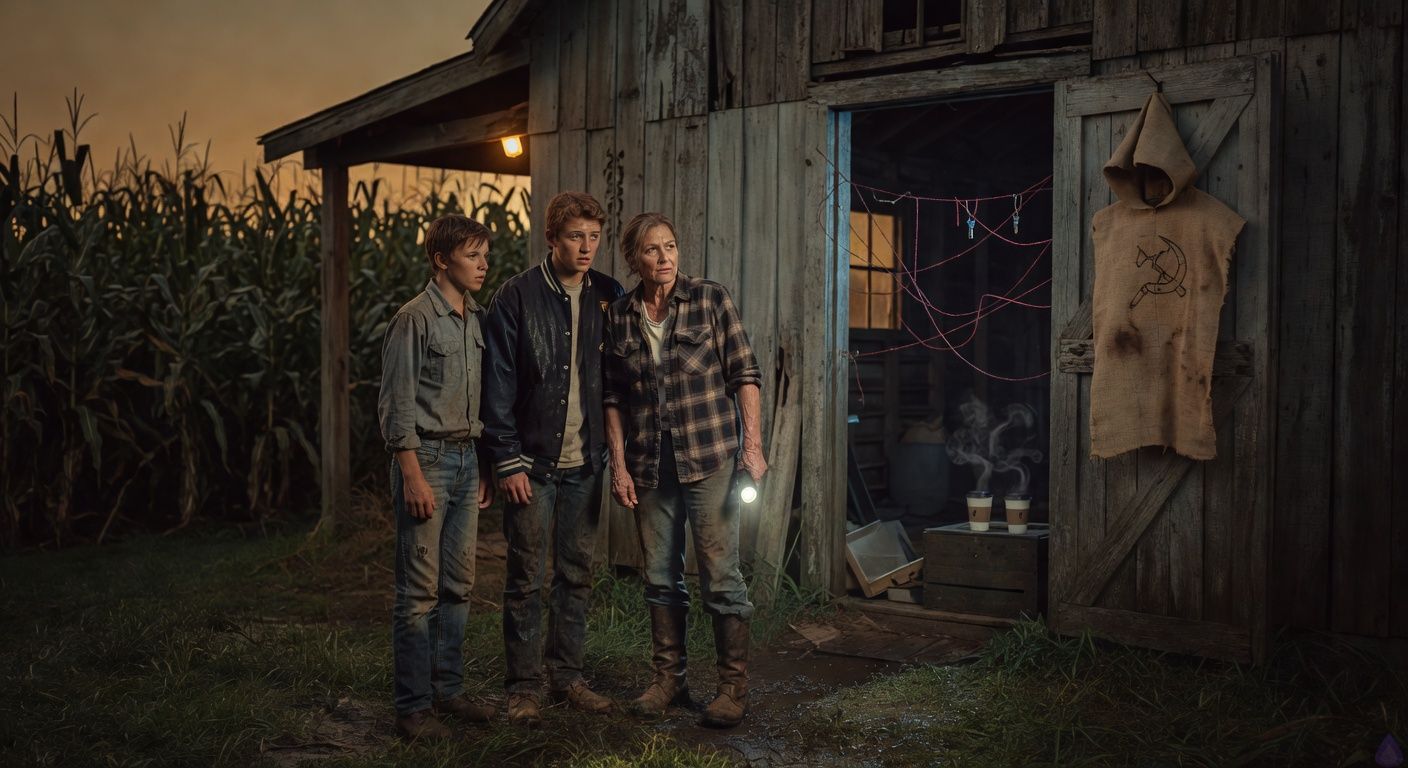
The blue phone light pulses brighter, then dimmer, throwing the red twine across the dust like a thin vein. Beyond it, something hangs from a nail in the back wall. Something you couldn’t see before.
A strip of burlap.
No.
A hood.
Weather-stained. Stiff with old damp. Stitched in dark thread with a crude mark: a sickle curved around a creek line. The sight hits Lila so hard the air leaves her lungs. Shane goes rigid beside you, and his shoulder brushes yours.
Not by accident.
This time, he stays.
Aunt Lila: "Harvest Men was supposed to be dead." Her voice has gone flat, emptied out. "My father said Calder’s generation buried it."
Rain ticks softly on the barn roof.
"Maybe they didn’t bury it." She looks at you, and the porch light catches the wet shine in her eyes. "Maybe your father found where they put the bodies, and they buried him instead."
A twig snaps in the corn to your left.
Then another to your right.
Slow. Circling. Patient.
Lila raises the knife, but her hand shakes too badly to make it mean safety. Shane takes half a step in front of you again, stops himself, and looks back. Shame and defiance pull tight across his face.
"I’m done running from what I know," he says. "But I don’t know if that means we go to the bridge, call state police, or drag that hood into the street and make the whole town look at it."
From the field, very softly, a man begins to hum the hymn.
What readers chose (1 choices)
The humming in the corn follows you for three steps before it cuts off.
The silence is worse.
You move toward Lila. Not the barn. Not the hood. Not the bait laid out in blue phone-light and red twine. Her mouth opens, ready to argue, but you take the flashlight from her shaking hand and touch her elbow with the other. Not a shove. Not an order. A promise with weight behind it.
Shane understands before she does.
He circles to her other side, careful not to crowd her, his broad shoulders turned toward the corn as if flesh and bone could wall off a field full of ghosts.
Drake: “Inside. State police. Together. No one goes anywhere alone.”
Lila looks back at the barn.
The burlap hood hangs from the nail in the rear wall, swaying though the air is dead still. Her eyes cling to it with the fixed horror of someone watching an old childhood warning ripen into proof. The knife lowers an inch.
That is all the permission you get.
You take it.
The three of you cross the wet grass, slow enough not to bolt, fast enough to feel hunted. Mud sucks at your shoes. Cold rainwater slides down the back of your neck. Behind you, the corn whispers once — dry, close, deliberate , like someone trailing a hand along every stalk while walking parallel to your path.
The farmhouse door shuts behind you with a hard wooden clap.
Lila throws the deadbolt. Then the chain. Then she presses her back to the door as if she means to hold the whole dark outside by force. Her breath comes through her teeth. Sharp. Furious.
Shane moves through the kitchen without being told, checking the back window, the mudroom latch, the side door by the pantry. His hands fumble at first. Slip. Try again. Then they steady. The golden boy is gone. In his place stands someone frightened enough to be useful.
You set the flashlight on the table, beam aimed at the ceiling, and the kitchen fills with a thin, ghost-pale wash beneath the warmer overhead bulb. It makes the old yellow curtains look sickly. It catches on the rain dripping from Shane’s hair onto Lila’s clean floor.
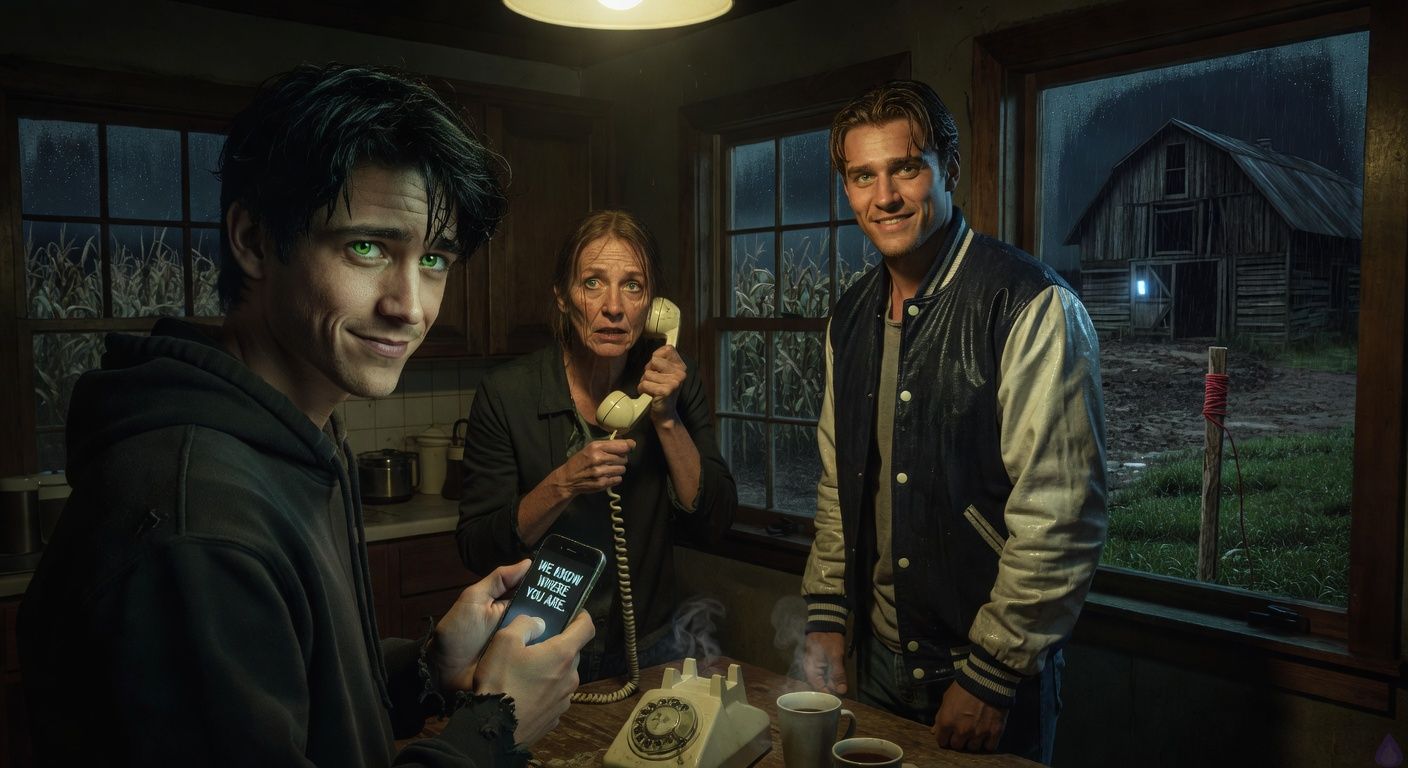
Lila snatches the landline from its cradle with the kind of urgency people use in old films, before cell towers, before unknown numbers could creep into your pocket and speak in the voices of the dead. Her fingers punch 911.
She stops.
Curses under her breath.
Then she dials a longer number from memory.
State police dispatch.
Her voice, when someone answers, is scraped raw but clear. She gives her name. The address. Your name. Calder’s visit. Hollow Creek. The threatening messages. The planted phone. The hood hanging in her barn like butchered skin.
She does not say cult. Not at first.
Then she looks at you, at Shane standing guard by the window with his jaw clenched and water darkening the shoulders of his shirt, and something in her face goes flat and hard.
Aunt Lila: “I am reporting possible ritual activity connected to multiple homicides, and I am telling you Sheriff Robert Calder may be compromised. If this call gets routed back to him, I will consider that deliberate endangerment. Record that. Every word.”
The kitchen seems to hold its breath while she listens.
You hear only the faint insect buzz of the receiver and the blood rushing in your ears. The house smells of wet denim, old coffee, lemon soap, and the metallic tang of fear. Somewhere in the walls, the pipes tick as they cool.
Shane glances at you from the window, then down, as if being seen this afraid shames him.
You should let him look away.
You don’t.
You hold his gaze.
Something small passes between you. Not comfort. Not forgiveness. Recognition, maybe. You are both terrified. You are both still here.
Then the line clicks.
Lila goes still.
Aunt Lila: “Hello? Trooper Vance? Hello?”
For one breath, there is nothing.
Then a soft hymn rises through the receiver.
Shall we gather at the river...
Lila drops the phone as if it has bitten her.
It swings from the cord, knocking against the cabinet in slow, hollow taps. Tap. Tap. Tap.
Shane steps back from the window at the same instant, the color draining out of his face.
You turn toward him.
He points.
No words.
Outside, every light in the barn has gone out except the blue phone on the dirt floor. It glows through the open door like an eye under black water. Between the farmhouse and the barn, planted upright in the wet grass where nothing stood a minute ago, is a wooden stake wrapped in red twine.
Nailed to it is a strip of paper.
Bright white.
Too white.
The kitchen light spills through the window and catches it, making the wet paper shine like bone.
Lila forces herself forward, one hand braced on the counter, squinting through the glass. You already know there are words before you can read them. The handwriting is blocky. Careful. Familiar in the way nightmares become familiar after the third time they visit.
NO STATE. NO SHERIFF. BRIDGE BEFORE DAWN.
Shane’s breathing turns shallow.
His fingers curl around the counter’s edge until his knuckles pale. The old service bridge has stopped being a memory he can half-deny, something buried under jokes and bruised pride and the stink of river mud.
It is a summons now.
A countdown.
Lila reaches for the fallen phone, but before she can lift it, your cell buzzes on the kitchen table.
Once.
A small, ugly sound.
One new image.
Your hand feels numb when you pick it up.
This one is not Hollow Creek.
It is Lila’s porch, photographed from the corn only seconds ago. The angle is low, half-hidden behind rain-black stalks. Through the kitchen window, small and blurred by glass, you can see the three of you standing together beneath the yellow light.
Lila at the counter.
Shane by the window.
You, phone in hand, already looking down.
Under the image is a message.
GOOD. KEEP HIM CLOSE.
What readers chose (1 choices)
You shiver so hard your teeth nearly click, but you turn from the photo on your phone and face Shane.
He is still by the window, one hand braced on the counter, staring out at the stake in the grass as if it has pinned him in place instead of the paper. When you reach for him, he flinches before he can stop himself.
Your hand settles on his shoulder anyway. Light. Giving him room to step away.
He doesn’t.
Under your palm, his muscles are hard as fence wire. His shirt is soaked and cold beneath your fingers, rainwater seeping into your skin, but his breath catches in a way that sounds almost like relief.
Drake: “Shane. Look at me. Can you remember anything useful about the bridge? Anything at all?”
For a moment, he seems not to hear you. The kitchen light turns his face pale, then gold, then pale again, catching the rain in his hair and the wet shine in his eyes. Outside, the barn phone glows like a drowned star. Aunt Lila stands beside the dangling landline, one hand clamped around the receiver so hard the plastic creaks, her gaze jumping from the two of you to the dark beyond the glass.
Shane swallows. His throat works against something buried deep.
Shane: “There were boards missing. Three near the middle. Emily used to jump them like it was nothing.” His voice comes slowly, each word dragged up through mud. “Mason would knock three times on the rail before crossing. For luck. Or to make everybody laugh. The creek ran under it, but there was a drainage tunnel too. Concrete pipe, half-choked with weeds. We dared each other to crawl through it once.”
He shuts his eyes.
“I remember initials scratched inside. E.H. M.B. S.R.” His mouth twists. “And another mark. Not initials. That sickle thing. The one on the hood.”
Lila lowers the receiver without hanging it up. From the earpiece, faint and tinny, the hymn keeps going under the static, a ghost with its mouth pressed to copper wire. She moves closer to Shane. Not gently, exactly. Carefully, the way you’d approach a horse tangled in barbed wire.
Her knife lies on the table now, close enough to grab, no longer pretending it can solve anything.
Rain ticks at the kitchen windows. The house smells of wet clothes, old soup, and the hot, dusty stink of the bulb flickering overhead.
Aunt Lila: “Did Calder find you kids there?”
Shane nods once.
Then shakes his head, furious at himself.
“He came after. My dad first. I remember Dad grabbing my arm so hard I had bruises.” He rubs his forearm like the fingers are still there. “Emily was crying, but she was angry too. She kept saying, ‘That’s a person.’ Mason threw up by the weeds.”
He presses his fingers to his mouth, as if the memory has a taste.
“There was a tarp under the bridge. Green. Muddy. Something under it.” His voice thins. “Not trash. Not an animal. Calder pulled up with no lights, and he told us there had been a flood, that dead deer get bloated and look wrong. But the tarp had a shoe sticking out.”
Silence gathers around him.
“A white sneaker,” he says. “Red laces.”
Your hand tightens on Shane’s shoulder before you realize it. He doesn’t pull away. Instead, he leans the smallest fraction toward you—not enough for anyone to call it comfort, if anyone asked, but enough that you feel the tremor running through him.
You think of him at nine years old, bright and scared, taught by his father and the sheriff to bury what he saw until it became a locked room inside his own head. You think of Emily calling him years later, desperate, and of him too afraid of exposure to answer.
The anger is still there.
So is pity.
Neither one eats the other.
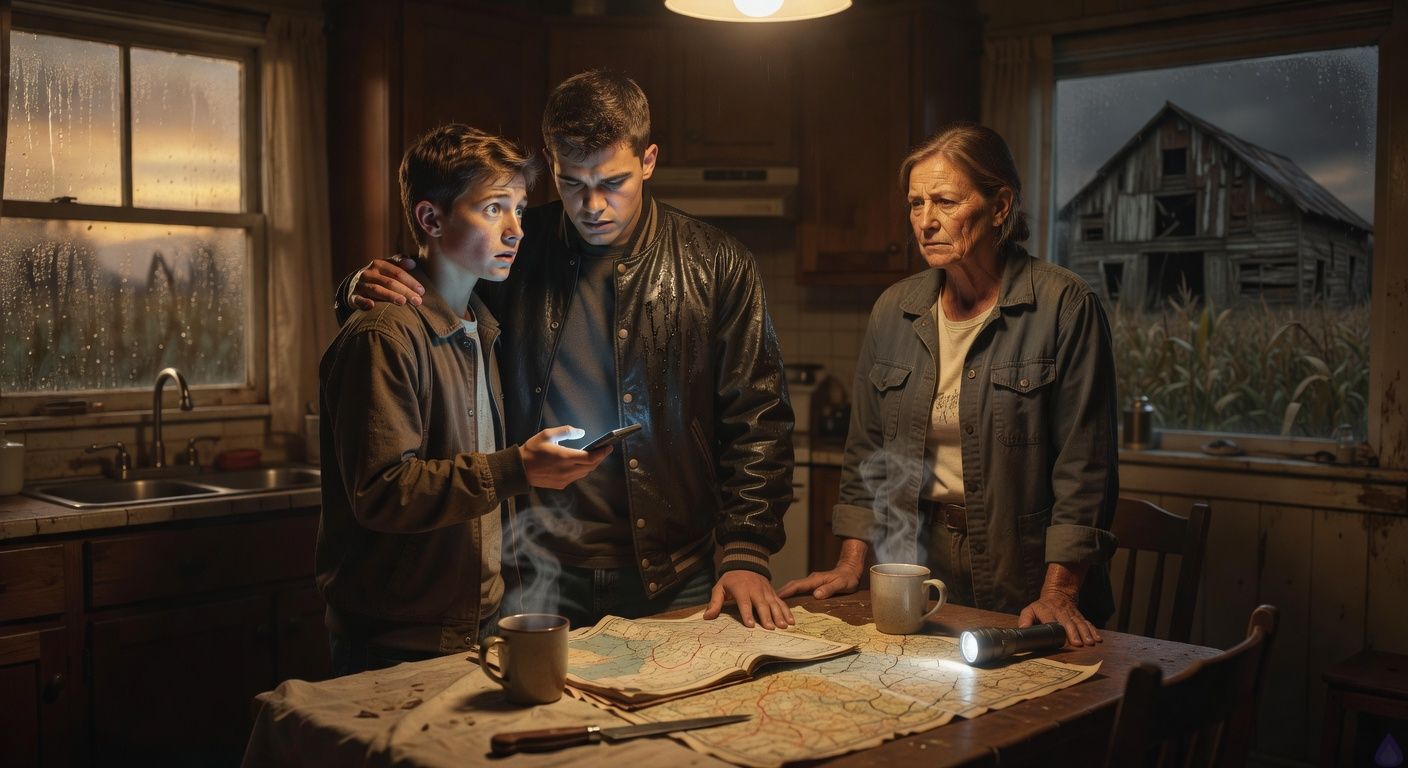
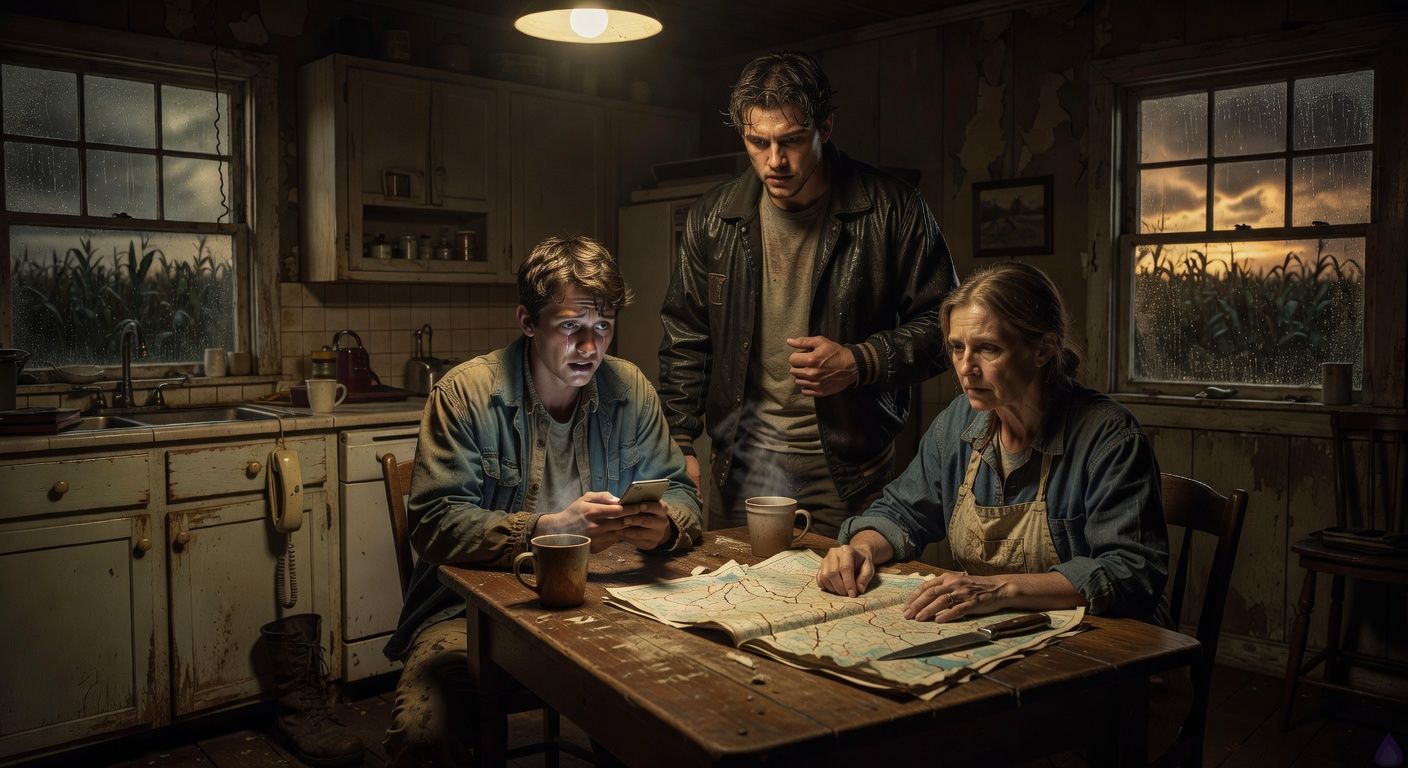
Aunt Lila turns toward the pantry, suddenly all motion. She yanks open a drawer and pulls out a road atlas, the kind with cracked plastic binding and county routes marked in fading highlighter. It lands on the kitchen table with a slap. She flips pages with damp fingers, smearing a little rain across the paper.
“Old service bridge is here,” she says, tapping a blue-threaded bend near Hollow Creek. “Main road comes in from the west. Calder will expect that.”
Her finger shifts.
“But there’s a farm lane behind the abandoned mill. Your father used it once.” She looks at you then, and something in her face tightens. “If the bridge is a trap, the tunnel may be the only way to see before being seen.”
The landline hymn cuts off mid-verse.
Every light in the kitchen blinks once.
Then your cell buzzes again.
Not an unknown number this time. A voicemail notification. From your father’s old contact, a number that should have been disconnected after the funeral. The name on the screen is impossible and plain as a nail.
DAD.
Lila makes a broken sound.
Shane’s eyes snap to yours, wide and wet with fear, but his shoulder stays under your hand. Solid. Shaking. Real.
Outside, somewhere beyond the barn, three knocks strike wood.
Then three more answer from deeper in the corn.
What readers chose (1 choices)
You press play before courage can leak out of you.
Aunt Lila moves close enough for her sleeve to brush your arm, damp wool rasping against your skin. Shane stays on your other side, his shoulder still under your hand for one held second before he turns toward the phone. He does not pull away. He makes room, as if the three of you might survive the hearing better shoulder to shoulder.
The kitchen feels too small for the dead.
Yellow light shivers over the atlas, the knife, the fallen landline, the rain crawling down the window glass in silver threads. Outside, the three knocks fade into the corn. Nothing answers except the slow drip from the eaves.
Static first.
Then breath.
Not the thin, frightened breathing from the unknown girl’s message. This is heavier. Familiar. It breaks something open behind your ribs before you are ready for the pain. You know that breath from car rides after his late shifts, from your father asleep in his recliner while the ball game muttered blue and white across the television, from the night he sat at the kitchen table back home and told you that wanting a badge did not mean kneeling to one.
Dad: “Drake. If you’re hearing this, I failed to keep it buried, or I failed to keep you away. Maybe both. I’m sorry, son. I am so damn sorry.”
Lila clamps both hands over her mouth. Her eyes shine, wide and ruined. Shane’s jaw tightens, and whatever bitterness he carried about fathers and secrets vanishes beneath the blunt, terrible fact of your dead father’s voice filling the room.
The recording crackles.
Under it, for one breath, comes another sound: running water, low and steady, like a creek moving through the dark with stones in its mouth.
Dad: “Mercy Mill has old roots. Older than Calder. Older than the men who dress it up as duty and harvest and sacrifice. They call themselves the Harvest Men, but don’t let the name fool you. It’s not faith. It’s power. It’s land deeds, elections, missing evidence, scared boys taught to lie, and girls punished for learning too much. Calder wasn’t born into it. He chose it. That made him worse.”
Shane inhales hard at scared boys.
His hand finds the table edge and grips until the tendons rise like cords. You feel the words hit him. Not forgiveness. Not blame washed clean. Something harder. Kinder, maybe. A shape for the trap he grew up inside, with its rusted teeth and church-supper smiles. Lila lowers her hands. Grief closes into fury across her face.
Dad: “The first body I found was under the old service bridge. White sneaker. Red laces. Her name was Ruthie Vale, fifteen years old, missing since 1998. They told everyone she ran off. She didn’t. I took photographs. I hid copies under the millstone where the creek stains red after rain. Calder found out before I could go federal. He gave me a choice. Leave town, stay quiet, or watch your mother get dragged into it. I left. I told myself leaving saved you. I was wrong.”
The kitchen tilts.
Ruthie Vale becomes a name. Then a girl. Then a white sneaker in mud beneath Shane’s childhood bridge, red laces dark with creek water. Your father’s silence shifts inside you, old boards lifting after a flood. Not cowardice. A wound. One that never sealed. He did not abandon the truth. He carried it away and bled around it for years, until it found the road home.
The voicemail pops with interference. Your father’s voice drops lower, urgent now, as if he is speaking from inside a locked room while footsteps come down the hall.
Dad: “If Lila is with you, trust her. If Shane Riley is with you, listen to what he remembers. His father was not the only one who made that boy afraid. The bridge has a crawlspace behind the north support, covered with sheet metal and creek silt. That’s where I left the second key. Blue tag. It opens a lockbox beneath the mill office floor. Inside are names, photos, and a cassette labeled HARVEST HOME. Do not give it to Calder. Do not call the county. Get it to Trooper Mara Vance with the state police, badge number 4172. In person. No phones.”
Aunt Lila snatches the atlas and flips it back toward the mill, her fingers shaking but exact. Paper whispers. Rain taps the glass. Shane leans in, eyes fixed on the bend in Hollow Creek where the bridge, the abandoned mill, and the farm lane make a crooked triangle. His fear is still there.
But it has changed.
It has direction now.
Dad: “Drake, I know you want justice. I know what kind of man you are trying to become. But justice is not a badge. It is what you protect when the badge turns its back. Keep your head. Keep Lila safe. And if you hear the hymn, do not follow it into the corn. The corn is how they split people apart.”
The recording ends in a burst of static.
Then comes one last sound, and every muscle in your body locks.
Three knocks.
Not from the phone.
From beneath the kitchen floor.
Lila’s face goes white. Shane steps closer so fast his arm presses against yours, warm and shaking. The atlas lies open between you, the route to the bridge marked in faded blue, the paper soft at the folds from years of hands and weather.
Beneath the floorboards, something knocks again.
Slow.
Hollow.
As if an answer has been waiting under the house all along.
What readers chose (1 choices)
You move before the third knock has finished dying.
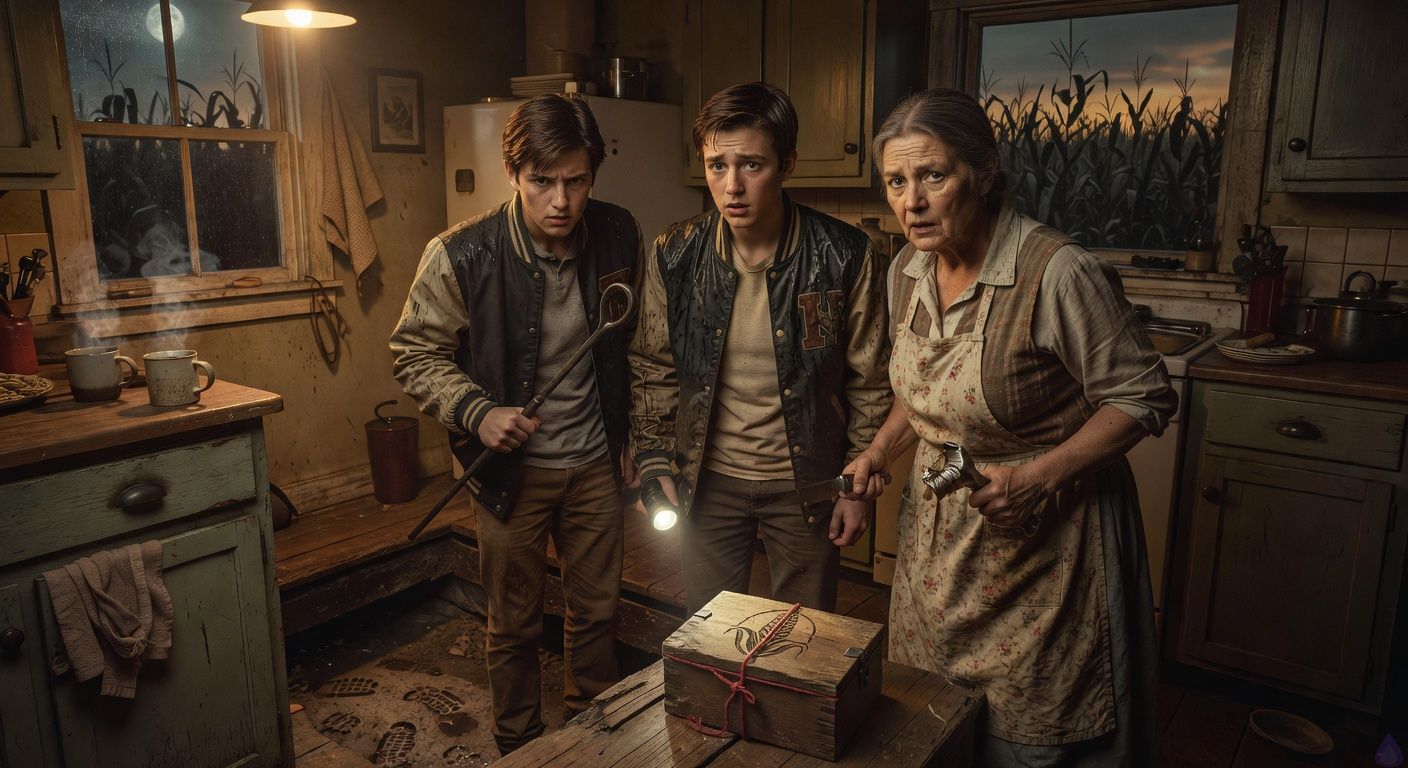
The kitchen turns savage with purpose. Anything with weight. Anything with an edge. Anything that can keep teeth, hands, or worse from finding skin. You shove the knife toward Lila, handle first, because she already knows how to hold it without opening her own palm. Shane yanks the drawer beside the stove so hard the spoons jump. He comes up with a heavy meat tenderizer in one hand and the long iron poker from the hearth in the other. He offers you the poker without a grin, without swagger, rain still drying in dark streaks through his hair, his face drawn tight and bloodless.
Shane: "Take the long one. You look like you’d actually think before swinging."
It is the closest thing to humor the room can bear.
You take it. The iron bites cold into your hand, pitted with age, heavier than it should be. It smells faintly of ash. Lila snatches up the flashlight again, then thinks better of it and thrusts it at Shane so both her hands can lock around the knife. He angles the beam low, toward the warped floorboards near the pantry, where the knocking came from.
The light shakes.
Not as badly as before.
Beneath your feet, something scrapes.
Not a knock this time.
A drag.
Wood against wood, slow enough to know it is being heard.
Lila’s kitchen has a cellar door hidden under a braided rug near the back wall, one of those old farmhouse features that seems charming in daylight and turns into a mouth after midnight. Shane hooks the rug with the toe of his sneaker and peels it back. Dust rises in a gray breath, dry and sour. Beneath it, a square trapdoor sits flush with the floor, its iron ring blackened by years of damp hands. Someone has scratched three short vertical lines into the wood beside it.
Not fresh.
Not old either.
Aunt Lila: "That wasn’t there this morning."
Her voice is almost gone.
Outside, rain threads down the windows. The barn phone still glows through the glass, a blue pinprick in the dark, and beyond it the corn stands stiff and silent, all those wet leaves holding still as if listening. You crouch beside the trapdoor, poker raised badly in one hand, and hook the iron ring with the other.
Cold lances your fingers.
Cold enough to sting bone.
Shane steps closer with the flashlight. Too close, maybe, but you do not tell him to move. His shoulder brushes yours as the beam finds the seam around the door, and the touch steadies you more than you want it to. More than you can afford.
Drake: "On three. If something reaches up, hit it."
Shane: "That is a terrible plan."
Aunt Lila: "It’s the plan we have."
You pull.
The trapdoor opens with a groan that climbs up from the house’s buried bones. Damp cellar air rolls out, cold and earthy, carrying clay, mildew, rust, mouse droppings, and old potatoes gone sweet with rot. The flashlight drops into a narrow stairwell. Wooden steps descend into black. Mud stains the lower treads, fresh and wet, each print pressed by the ridged sole of a boot.
Someone has been under Lila’s house tonight.
Your pulse turns brutal.
Lila whispers your mother’s name. Not like a prayer. Like an apology.
Shane’s jaw locks so hard his teeth click.
Then the knocking comes again.
From below.
Three slow hits against something hollow.
Shane lowers the beam.
At the bottom of the stairs, half-hidden behind stacked mason jars and a rusted washtub, sits a small wooden box. It does not belong to the cellar. The pine is pale, newly cut, raw enough that you can almost smell sap through the rot. Its lid has been marked in dark red paint with the Harvest Men symbol: a sickle curved around a creek line. Red twine wraps the box in a tight cross, wet-looking in the light. Wedged beneath the twine is an envelope with your name written across it in block letters.
DRAKE CAINE.
Before anyone can stop you, a sound breaks from inside the box.
A phone vibrating.
Then a muffled recording begins to play, warped by wood and static. A girl’s voice. The unknown voicemail girl. Closer now. Crying harder, but alive when she made it, breath hitching around every word.
Voice in Box: "If you found this, they already moved the bridge key. Don’t trust the blue tag in the barn. It’s bait. The real one is where Shane fell. Under the old service bridge. Ask him why he never crossed after that."
Shane makes a sound like he has been struck in the ribs.
The flashlight beam drops. It skids across jars, spiderwebs, wet boot prints, the rusted washtub, and his own hand clamped over his mouth. His eyes go glassy and unfixed. The cellar, the kitchen, the storm, all of it drains away from him. He is nine or ten again, standing at the edge of a bridge with Emily laughing too loudly, Mason knocking three times, a tarp below, a white sneaker sunk in mud, and something else waiting in the place where memory tore itself open.
Shane: "I fell through."
Thin voice. Shredded.
Shane: "I didn’t just see the shoe. I fell through the boards. There was a space under the bridge. I saw masks hanging there. Names carved into the wood. Ruthie’s. Emily’s name was already there, years before she died."
Lila grips the doorframe, knife angled down. Her knuckles shine white. Horror tightens her face until she looks older than she did a minute ago, smaller too, as if the house has taken a bite out of her.
Aunt Lila: "Predestination. Or a list."
You look back into the cellar.
The boot prints lead from the stairs to the box, then keep going toward the far stone wall, where shelves of canned peaches lean in dusty rows. Behind them, something has scraped a clean line through the grime. Fresh. Straight. Too deliberate for rats. A hidden panel, maybe. Or an old coal chute. From that direction comes a thread of colder air, wet as creek water, smelling faintly of iron.
Then the house phone upstairs rings.
Once.
Twice.
Shane lifts the flashlight toward you. His eyes are wet and terrified.
But present again.
Lila looks from the cellar to the ringing phone, then to the black windows where the corn presses close, each stalk bowed beneath the rain like something waiting to be called by name.
The weapon in your hand feels suddenly very small.
What readers chose (1 choices)
You do not go down into the cellar.
Not yet.
The urge burns through you, stupid and hot: chase the boot prints, rip open the hidden panel, drag whatever Mercy Mill buried into the light by its throat. But Shane is breathing like the kitchen has no air left. His hands clamp around the flashlight so hard his knuckles shine, and the beam judders over the cellar stairs, making the raw pine box below twitch in the dark.
You lower the poker and step between him and the open trapdoor. Cold rolls out against your ankles, wet and rotten with mildew, black mud, and that thin creek-water tang of iron. Below, the box keeps shivering in short, frantic bursts. A beetle in a coffin. Upstairs, the phone rings again and again, patient as knuckles on bone. Aunt Lila looks ready to split herself in three—knife toward the stairs, eyes toward the windows, heart aimed straight at you.
Drake: “Lila, help me close it. Shane, look at me. Not down there. Me.”
For a second, Shane does not move. His stare stays fixed past your shoulder, down into that black throat under the kitchen, where his childhood has opened raw. Then your hand closes around his wrist. Firm. Not cruel. His eyes jerk up to yours.
Wet. Furious. Ashamed.
Alive.
You hold him there until he sees you seeing him, until the memory loosens one finger and the present gets its grip.
Shane: “Emily’s name was already there.” His voice cracks on the last word. “I didn’t remember. I swear I didn’t remember.”
Drake: “I believe you.”
The words leave before you can test them for danger. Shane flinches anyway, but not from fear this time. Something unguarded crosses his face—almost pain, almost gratitude,and he nods once, as if anything larger would break him open. You guide him back two steps. Lila moves fast, wedges her shoulder beside yours, and together you slam the trapdoor down over the cellar’s cold mouth.
The kitchen shudders.
Below, the vibration turns thick and muffled. The wood jumps once beneath the braided rug, as if something under the floor has struck upward with a fist.
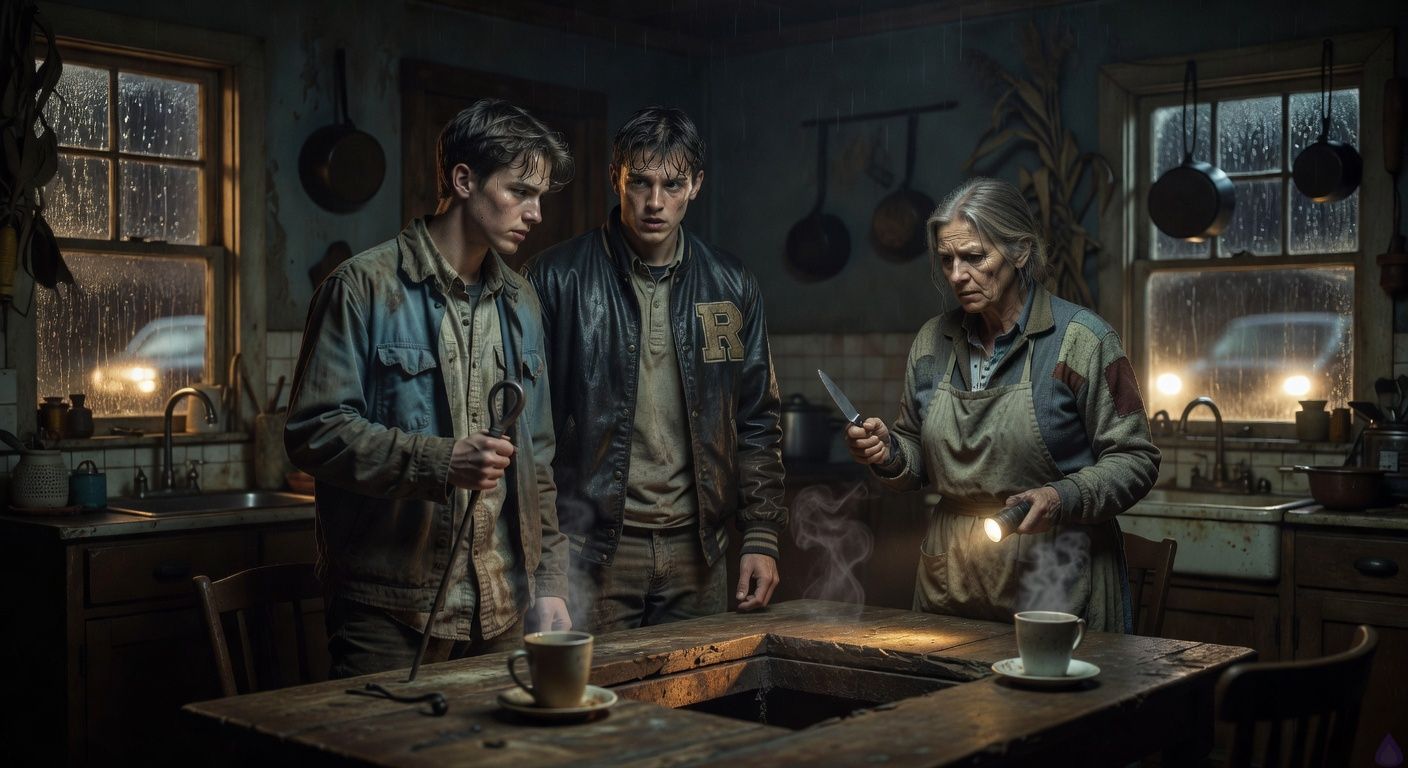
Lila drags the kitchen table over with a strength that seems borrowed from every woman in your blood who ever survived a hungry winter and a mean man. Its legs scream across the boards. You and Shane shove it over the trapdoor, then Lila stacks on a flour sack, a toolbox, and two cast-iron pans that land with dull, final clangs. It looks absurd. It looks flimsy. It looks like the only line left between the living and the dark.
The house phone stops ringing.
Silence drops hard enough to bruise. All three of you hear the rain again, the slow drip from Shane’s jacket, the refrigerator coughing itself awake, the dry scrape of corn leaves along the siding like fingernails testing for a seam.
Then your cell phone lights on the counter.
No buzz. No chime. Just the screen blooming white in the dark, and a new photo appearing by itself.
It shows the kitchen from below.
The angle is low, peering up through a narrow crack between floorboards. You see the underside of the table. Lila’s boots. Shane’s muddy sneakers. Your own legs planted wide, poker in hand. The picture is so recent the cast-iron pan has not stopped rocking where Lila dropped it.
Beneath the image, a message types itself slowly.
YOU CLOSE DOORS LIKE YOUR FATHER.
Aunt Lila makes a sound caught between a sob and a curse. Shane steps closer to you, not hiding it now, his shoulder pressed to yours in deliberate, shaking defiance. The touch is brief. Warm. Real.
Outside, through the rain-threaded window, the corn bends in a wave traveling from the barn toward the road, as if something unseen is walking away through the rows.
Then headlights bloom at the far end of the farm lane.
Not Calder’s cruiser. These sit higher, white and cruel, bouncing over ruts behind the abandoned mill road Lila marked on the atlas. An engine growls through the rain, low as an animal behind a door. Aunt Lila snatches the flashlight and kills the kitchen overhead with one slap of the switch.
Darkness takes the room.
Only the phone glows now. That, and the thin gray wash from the window, and the three of you pressed close around the ridiculous barricade.
Shane leans near your ear. His voice is barely breath.
Shane: “If that’s Calder, he came the back way. If it’s not, then someone else knows the farm lane.”
Lila’s hand finds your sleeve in the dark. Her knife catches the sweep of headlights once as they slide across the kitchen wall, turning the hanging pots into black, swaying moons.
Beneath the table, under the floor, something knocks three times.
From outside, three answering knocks strike the back door.
What readers chose (1 choices)
The third knock on the back door dies in the rain, and instead of freezing, you lower yourself toward the barricaded trapdoor.
Aunt Lila’s hand catches your sleeve. Hard. You shake your head once.
Not because you are brave.
Your heart is hammering so violently it feels ready to split itself against your ribs. Shane crouches beside you without being asked, close enough for his shoulder to steady yours, close enough that you can hear the thin, ragged pull of his breathing. The phone on the counter still glows with the image taken from beneath the floor—dark boards, a sliver of table leg, the impossible angle of something looking up.
Something below has eyes.
Or a way in.
Or both.
You lift the iron poker. Its handle is slick against your palm. You tap the floorboards three times.
Knock. Knock. Knock.
Silence swallows the kitchen so completely that even the rain seems to hold its breath. Outside, the headlights stop moving. Their white glare pins the back windows, turning Lila’s faded curtains into pale, hanging ghosts. At the door, whoever knocked gives no answer.
Beneath the table, beneath the cast iron pan and flour sack and toolbox, something shifts in the cellar.
A slow scrape.
Wood over stone.
Then the knocking below replies.
Three knocks. Pause. One knock. Pause. Three more.
Shane’s breath catches against your ear. His face is inches from yours in the dark, all sharp cheekbone and rain-wet hair, his eyes wide with memory returning in broken pieces he does not want. He lays two fingers against the floor—not on the trapdoor, not quite,and listens as if the old boards are speaking a language beaten into him years ago.
Shane: “That’s bridge code. We used it when we were kids.”
Aunt Lila’s whisper cuts from behind you, thin as a drawn blade.
Aunt Lila: “What does it mean?”
Shane swallows. His throat works hard.
Outside, the back doorknob turns once. Slow. Testing. The lock holds. The headlights dim, then flare again, as if someone has opened and shut a truck door behind the house. Wet gravel crunches. One set of footsteps.
Maybe two.
You tap the floor again, copying the rhythm as best you can.
Three. One. Three.
The cellar answers at once.
Two knocks. Two knocks. Four.
Shane closes his eyes.
Shane: “Not safe. Under.”
The words hit colder than the cellar air.
Your phone lights again on the counter. This time, no photograph. Just a text from the same impossible source, the letters stark and white against the black screen.
STOP PLAYING WITH DEAD THINGS.
At the back door, something slams hard enough to rattle the window in its frame. Lila jolts but does not scream. She moves to the side of the door instead of standing before it, knife held low, body angled the way she might brace against a kicking goat or a drunk man with bad intentions. Her fear has not left her.
It has become useful.
Aunt Lila: “Drake, whatever you’re doing, do it faster.”
You tap once with the poker, then twice.
You do not know what you are asking. Maybe who. Maybe help. Maybe prove you are not the thing outside.
For a long moment, nothing answers.
Then the floor beneath Shane’s hand vibrates—not from knocking, but from a voice. Muffled. Faint. It comes through the boards, through the cellar, through the raw pine box or something behind the wall. A girl’s voice, alive or recorded so closely that the difference turns useless in your chest.
Girl’s Voice: “Bridge before dawn. Don’t take the road. Don’t trust the blue tag.”
Shane goes rigid.
His hand finds your wrist under the table. He grips hard enough to hurt, and you let him, because his face says he knows that voice.
Shane: “That’s Kara Bell.”
Lila turns from the door, stunned.
Aunt Lila: “Mason’s sister?”
Shane nods, eyes fixed on the barricaded floor. His voice breaks lower, scraped raw with horror.
Shane: “She vanished last spring. Her parents said she went to live with cousins after Mason died. Everyone believed them because everyone wanted to.”
The back door slams again.
This time, the upper hinge screams.
Rain blows in through a crack in the frame, cold as needles across the kitchen. The house smells of wet wood, old flour, knife-steel, and the sour stink of fear. The headlights outside cut off all at once, plunging the yard into a thicker black.
In that instant, with only your phone lighting the room from the counter, a shape passes the window.
Tall.
Burlap over the head.
A curved sickle mark dark on the chest.
Lila sees it. Shane sees it. You see it.
Then it is gone.
Below, three frantic knocks explode against the underside of the floor.
Not code now.
Warning.
The landline, still dangling from its cord, begins to play the hymn again, soft and warped, each note stretched like something pulled from a grave. Shane’s hand stays locked around your wrist. Lila backs toward you both, knife raised, eyes bright and furious in the dark.
Outside the back door, a man’s voice starts humming along.
Patient.
Tuneless.
As if he has all night.
But he does not.
Dawn is still hours away, and Hollow Creek has become more than a trap. It is where your father hid proof, where Shane lost his memory, where Kara Bell may still be breathing, and where the Harvest Men expect you to arrive afraid.
They are right about the fear.
They may be wrong about what you do with it.
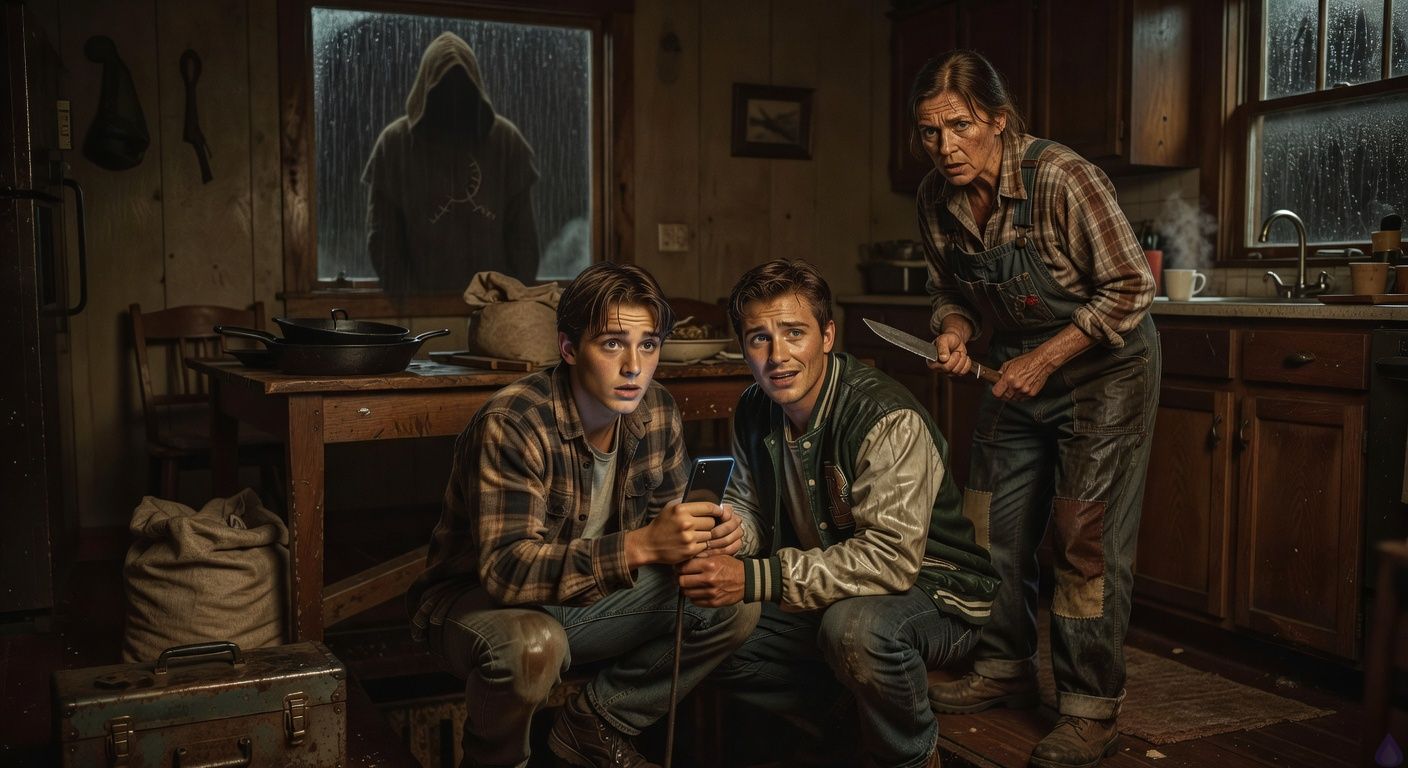
What readers chose (1 choices)
The back door shudders under another blow, and the old wood gives a splintering cry around the upper hinge.
You choose before fear can get its hands around your throat. The thing outside wants in. The voice below wants to be found. Between a masked man humming in the rain and a girl tapping warnings from under the floor, you choose the dark that is begging.
Drake: "Move the table. Now."
Aunt Lila stares at you as if you have asked her to cut open her own chest and check whether her heart is still there.
Then the back door takes another hit.
Harder.
The chain jumps, one screw tearing loose with a bright metallic snap. Shane is already moving. He drags the toolbox off the trapdoor, then the flour sack, then the cast-iron pans one by one, each landing with a dull black clang. His hands shake. He keeps going. You help him shove the table aside just far enough to bare the iron ring set into the boards.
Under the floor, the frantic knocking stops.
That silence has teeth.
Lila plants herself between the trapdoor and the back entrance, knife in one hand, flashlight in the other. The landline hymn warbles from its dangling receiver, thin and sickly, until she kicks the cord from the wall with a sharp crack of plastic. The kitchen drops into a hush made of rain, your breathing, Shane’s breathing, and the soft scrape of something outside dragging itself along the siding toward the window.
Aunt Lila: "You go down, you keep one hand on the rail. You do not chase anything into a tunnel. You hear me, Drake? Not one step past where I can see you."
You pull up the trapdoor.
Cold cellar air rolls out, stronger than before, damp enough to wet your lips. It smells of turned earth, rust, and creek stones dragged up after years underwater. Shane lowers the flashlight beam over your shoulder. The stairs fall away into a warped rectangle of black. Muddy boot prints still mark the lower steps, but now there is something else: a smear along the wall, not blood, not quite, more like red clay pressed there by fingers.
Three vertical lines.
A pause.
One line.
Three more.
Bridge code.
Shane whispers the pattern under his breath like a prayer he hates remembering.
Shane: "Three-one-three. That was Emily’s signal for someone waiting on the far side. Two-two-four meant don’t cross." His voice cracks on the last word. "She made codes for everything. Kara must have learned them from Mason."
You descend with the poker raised. The stairs complain under your weight. Shane comes right behind you, close enough that his breath warms the back of your neck, close enough that when your foot slips on the fifth step, his hand catches your elbow before you go down. Neither of you says a word. Above, Lila’s silhouette holds at the kitchen threshold, a blade-shaped shadow against the rain-lit window.
At the bottom, the cellar crouches beneath the farmhouse, low and mean: stone foundation, sagging beams, jars furred gray with dust, roots threading through cracks like black veins. The pine box sits where you saw it, red twine gleaming damply around the Harvest Men mark. Its phone has gone quiet. The envelope with your name remains tucked beneath the twine.
But the knocking is not coming from the box.
It comes from behind the shelves of canned peaches.
Three soft taps.
Then a girl’s voice, so faint you feel it in your teeth more than hear it.
Kara: "Not the box. Wall. Hurry."
Shane slips past you before you can stop him. Not far. Just to the shelf. He grips the old wood and pulls. The whole rack fights him, jars clinking together like teeth in a cold mouth, then swings outward on hidden hinges with a groan so loud it seems to shake dust from every year Lila has lived here.
Behind it waits a narrow crawlspace lined in stone, barely tall enough to crouch through. Cold air breathes from it. Creek mud. Old metal. Something sour and underground.
At the entrance lies a cassette tape in a cracked plastic case.
HARVEST HOME is written across the label in your father’s handwriting.
Your chest tightens so hard the cellar blurs.
Shane picks it up with trembling fingers and holds it out to you like a holy relic. Like a bomb. Before you can take it, the back door upstairs bursts inward with a wooden scream.
Lila shouts.
The flashlight beam jerks wild across the cellar ceiling.
A heavy step lands in the kitchen above.
Then another.
The masked man has entered the house.
Lila’s voice cuts down through the open trapdoor, fierce and shaking.
Aunt Lila: "Drake, Shane, go! Through the wall!"
From the crawlspace, Kara whispers again, closer now. Desperate.
Kara: "Bridge before dawn. Bring the tape. He can’t let it play."
Shane’s eyes meet yours in the cellar dark. Terror shines there, wet and raw, but decision burns beneath it. His fingers brush yours as he presses the cassette into your palm, and the touch lingers half a heartbeat longer than fear requires.
Above you, the humming begins again.
Inside Lila’s kitchen.
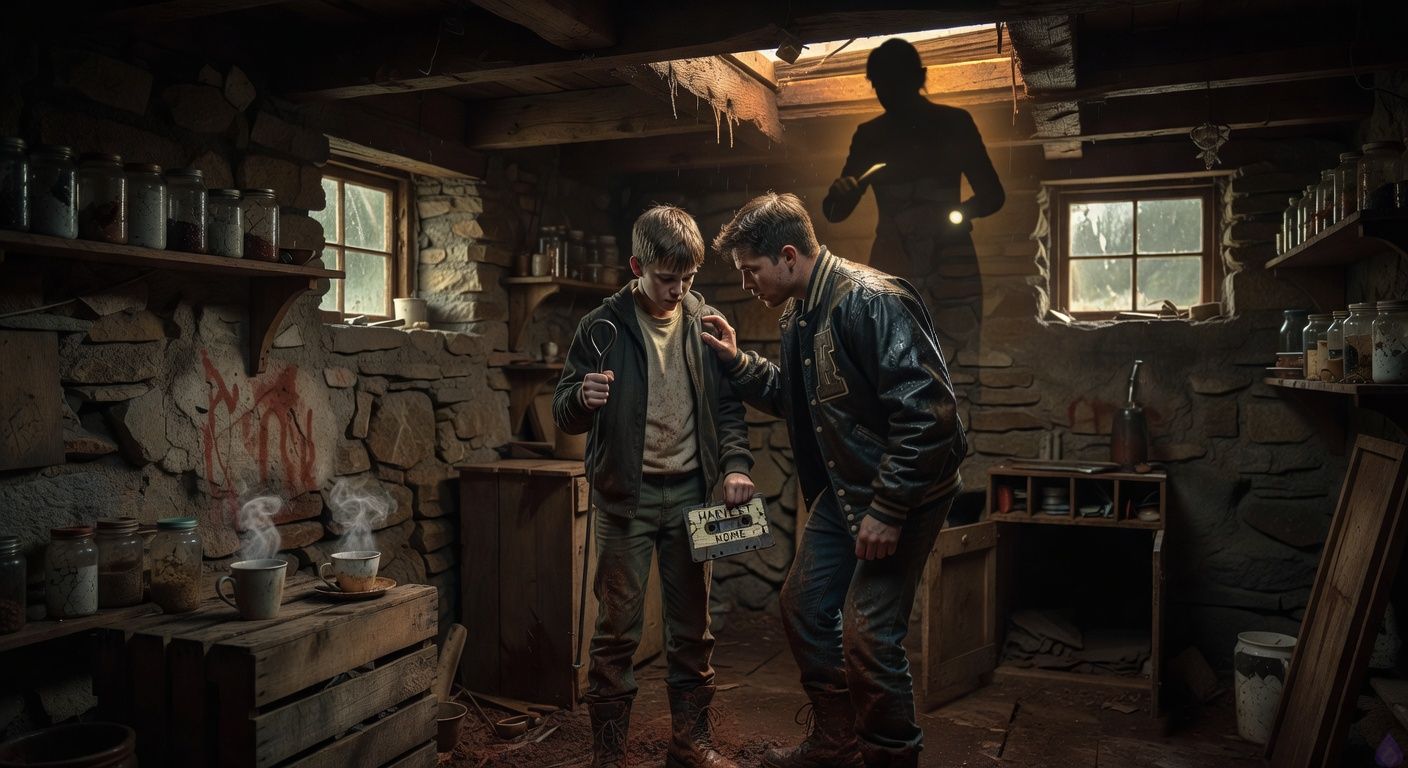
What readers chose (1 choices)
You twist back before Shane can drag you fully into the crawlspace, the cassette clenched so hard in your fist that cracked plastic cuts a crescent into your palm. The stone throat behind the shelves breathes cold against your spine. But all you can see is Aunt Lila at the top of the cellar stairs, a black shape framed by the broken kitchen door, and the masked figure behind her moving like something cut from the cornfield and taught to stand.
Drake: "Lila! Down here. Now!"
She does not come.
Of course she does not.
Lila plants herself on the kitchen side of the trapdoor with the knife raised, one foot braced in the torn rug, her whole body shaking with fear and fury. The masked man tilts his burlap head toward her. Rain drips from his sleeves onto her floorboards. Plink. Plink. Plink. The sickle-and-creek mark on his chest hangs dark and wet, painted or stitched or soaked through from some old wound, and the hymn threads through the room in a low, tuneless hum that makes your teeth ache.
Aunt Lila: "Go, Drake!"
Drake: "Not without you!"
Something in your voice reaches her where sense cannot. Maybe your mother’s blood. Maybe your father’s mule-stubborn streak. Maybe only the terror of losing one more person and surviving with the shape of them burned into you. Lila looks down. Her face breaks for one heartbeat, grief and love and rage splitting it open.
Then Shane lunges up three steps, snatches the flashlight from where it rolled near the bottom, and cuts the beam across the kitchen.
White glare.
The masked man flinches. Lila kicks backward and catches him in the knee hard enough to make him buckle. She drops through the trapdoor as Shane catches her arm, and for a breath they both pitch toward the dark.
They fall anyway.
The three of you crash into the cellar in a knot of elbows, breath, mud, and curses. Above, the masked man slams into the trapdoor frame. The beams shudder. Dust sifts down like dry ash. Shane shoves the swinging shelf wider, jars clattering and cracking against each other, and pushes Lila toward the crawlspace. She goes first because there is no time left for pride. Then Shane, shoulders hunched, flashlight clamped between his teeth for one awkward second before he spits it into his hand and passes it back to you.
You follow last.
The stone closes around your shoulders, and the world shrinks to the width of your panic.
Too narrow.
Too low.
Stone scrapes both sides of your jacket. Earth presses down inches above your head, damp and old, with roots hanging from the ceiling like black veins. The air is wet enough to chew. You try to breathe and get creek mud, mildew, rust, and the sour taste of your own fear. Your chest locks. The cassette knocks against your ribs with every crawl.
Behind you, something heavy lands at the bottom of the cellar stairs.
Ahead, Lila crawls with short, brutal movements, muttering curses like prayers. Shane twists halfway back toward you in the impossible dark.
Shane: "Drake. Hey. Look at me. Just me."
You can barely see him. The flashlight beam jams between his shoulder and the stone, catching one eye, one cheekbone, rain still bright in his lashes. His voice shakes. He pins it down anyway, for you, and that does something strange inside the panic.
It does not stop.
It takes a shape.
Shane: "Breathe when I breathe. In. Hold. Out. You’re not buried. You’re moving. I’ve got you."
Your hands claw mud. Your elbow cracks against stone. For one awful second you are under another kind of weight again — funeral air, police tape, the stink of lilies, all the unsaid things pressing the lid down. A strangled sound tears out of you before you can bite it back.
Shane reaches behind him and finds your wrist. His fingers lock around you, warm and trembling.
He does not drag you.
He holds.
Ahead, Lila stops and turns as much as the tunnel allows, her flashlight beam catching the wet tracks on your face.
Aunt Lila: "Drake Caine, you listen to that boy and move. Your mama did not raise you to die in a hole under my kitchen."
It is harsh.
It is love.
It works better than gentleness.
You suck in one ragged breath. Then another. Shane breathes, and you follow. The passage bends. Colder air slides over your face, carrying the sound of running water and, underneath it, a girl whispering your name.
Kara: "This way. Hurry. He knows the old tunnel too."
Behind you, in the cellar, the masked man knocks three times against stone.
Slow.
Patient.
Answering the bridge code with a promise.
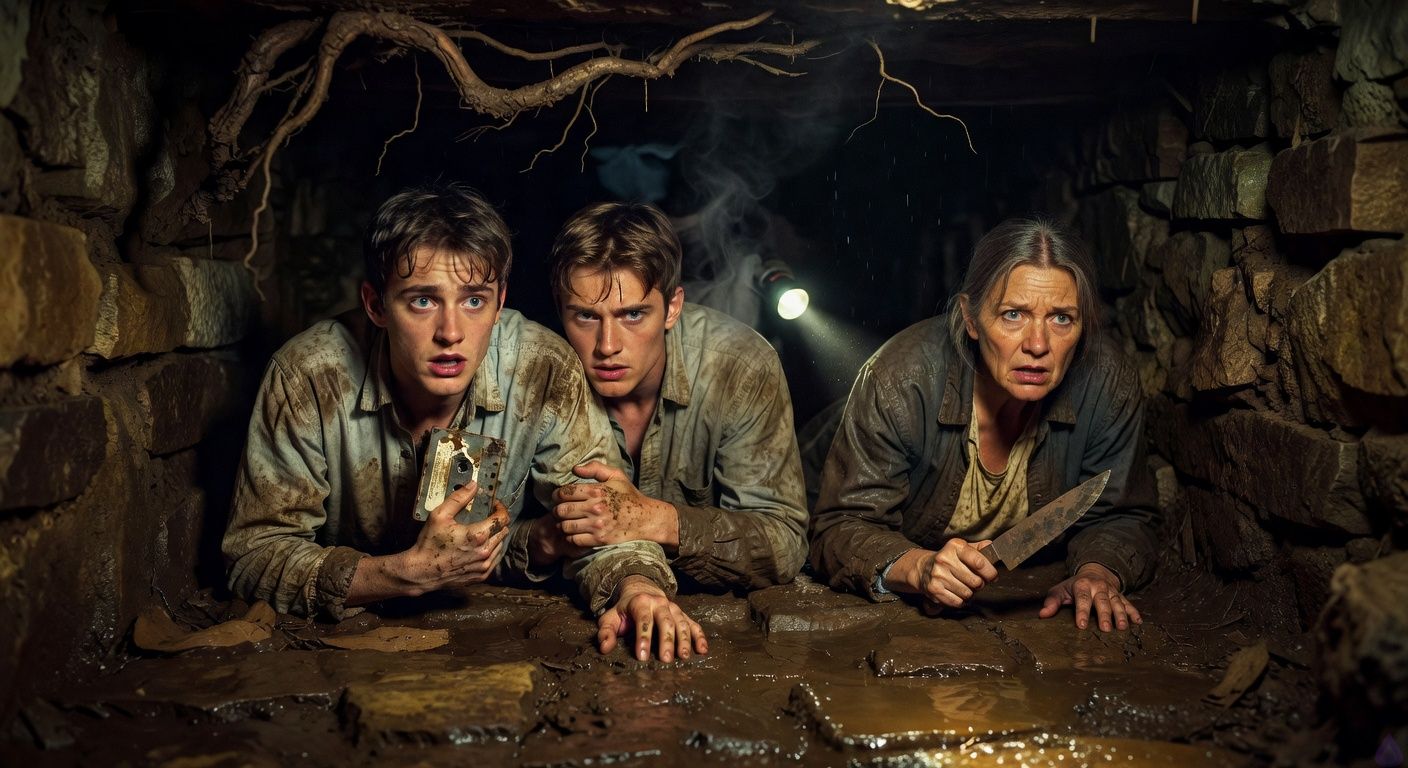
What readers chose (1 choices)
Shane’s hand stays locked around your wrist, warm against the cold mud greasing your skin. He crawls backward two awkward feet, refusing to turn away until your breathing catches his rhythm.
In. Hold. Out.
The tunnel presses at your shoulders as if the earth wants to keep you. Roots comb your neck. Stone scrapes your jacket. Wet clay stinks of rot and iron. But Shane’s voice cuts a narrow track through the panic.
Shane: "That’s it. Don’t think about the walls. Think about my hand. Think about the next foot. Just one. Then one more."
You hate how much you need the words. You hate the cracked sound your breath makes. You hate that Aunt Lila can hear it, that Shane can feel your pulse kicking under his fingers, that fear has made you small in a place where smallness might keep you alive.
But Shane does not laugh.
He does not use it against you. He pulls only when you move with him, matching you, waiting when your chest locks, steadying you when the tunnel dips and your palm sinks into a runnel of icy water.
Ahead, Lila’s silhouette crawls through the low passage with the knife clenched between her teeth like some furious farm-wife ghost. The flashlight beam shakes in her muddy hand, catching wet stone, old brickwork, and scratched symbols furred with moss. The sickle and creek line. Three vertical marks. Names cut so shallow they look like wounds trying to close.
Ruthie. Mason. Emily. Carla.
Some are old, softened by damp years. Some look fresh enough to accuse.
Behind you, the masked man enters the crawlspace.
You do not see him at first.
You feel him.
The tunnel changes. Air shifts backward. Mud sucks under a heavier body. A low hum threads through the dark behind you, hardly louder than breath, the hymn bent by stone until it seems to seep from the walls, from the roots, from the black water under your hands. Shane hears it too. His grip tightens.
His voice stays level by force.
Shane: "Drake, keep moving. Do not look back."
Of course you look back.
The flashlight catches only a sliver past your shoulder: burlap dragging over stone, one gloved hand planted in the mud, the dark curve of the Harvest mark across a rain-soaked chest. The mask has no expression. Still, the tilt of his head feels intimate. Patient. Like the thing behind you has crawled through a hundred tunnels and knows exactly how long terror takes to ripen.
Aunt Lila curses around the knife and surges forward. The tunnel widens near an old brick drain, just enough for her to twist and kick at a rusted grate ahead. It groans.
It does not open.
Beyond it, you hear water moving fast. Hollow Creek. The old drainage tunnel must spill near the mill ruins, or under the service bridge, or into some black seam your father once used to hide proof from men who owned the roads.
Aunt Lila: "Shane, help me with this thing! Drake, hold him off if you have to!"
The sentence is impossible.
The poker is still in your hand, clumsy in the crawlspace, more weight than weapon. Shane looks from you to Lila, torn so hard it shows in his face. Then he squeezes your wrist once and lets go.
The absence of his hand hits like creek water in winter.
He crawls to Lila and drives his shoulder into the grate. Metal screams. The sound fills the tunnel, drowning the hymn for one blessed second.
You twist onto your side as much as the cramped passage allows, brace your feet in mud, and angle the poker toward the darkness behind you. Your hands shake so badly the iron taps stone.
Tap. Tap. Tap.
The masked figure stops just out of reach.
From somewhere ahead, beyond the grate, a girl’s voice slices through the roar of water.
Kara: "The hinge pin! Bottom right! Hurry!"
Shane drops flat, fingers searching the rust. Lila holds the flashlight on the hinge while creek spray needles through the grate and spatters his face. His hands slip once. Twice. Then catch the corroded pin.
He yanks.
Nothing.
He bares his teeth and yanks again, a strangled sound tearing out of him.
Behind you, the masked man speaks for the first time.
Masked Man: "Caine boys always make others bleed first."
The voice is muffled by burlap, low and male, but something in its cadence snags deep in you. Not Calder. Older? Younger? Your mind claws at the sound and finds only fear.
The figure lunges.
You jab the poker forward. It strikes his shoulder with a dull, solid thud. Not enough to break bone. Enough to drive him into the wall.
He grunts.
Human.
Hurt.
The discovery burns through you like air after drowning.
Human things can be stopped.
Shane rips the hinge pin loose.
The grate bursts outward under Lila’s kick, and creek-cold air floods the tunnel. Beyond it waits a narrow concrete lip over black water, rain falling in silver lines through a cracked culvert mouth. Kara Bell crouches on the far side, filthy, hollow-eyed, alive, one hand pressed against a bleeding cut on her forehead. Behind her, the old service bridge rises in the storm, broken boards black against the predawn sky.
Shane reaches back for you again.
Shane: "Drake. Come on. I’ve got you."
The masked man starts crawling forward once more, one gloved hand dragging through the mud toward your ankle.
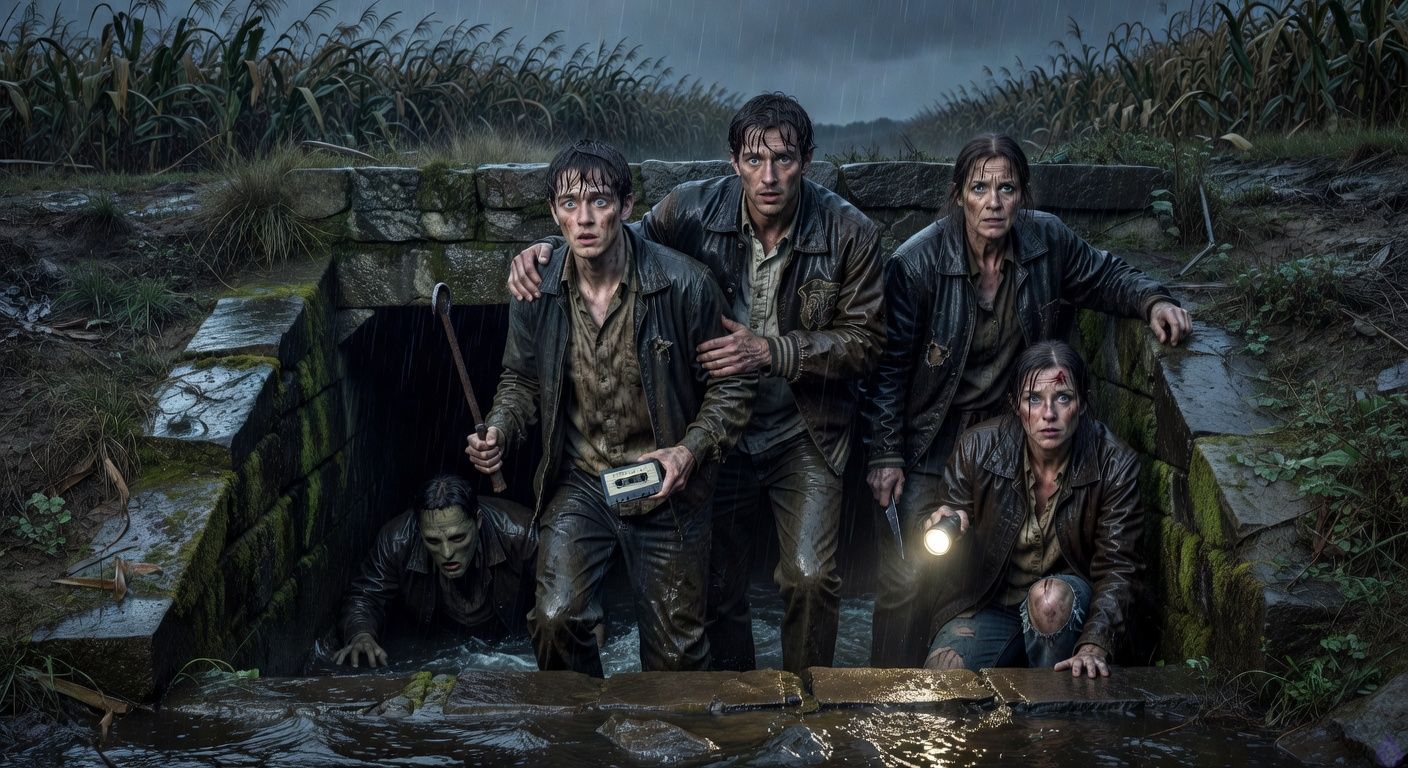
What readers chose (1 choices)
You do not crawl away fast enough to be safe.
You turn instead, twisting in the narrow gut of the tunnel until stone bites your ribs and cold mud fills the hollow of your hip. The masked man’s gloved hand clamps around your ankle. Crushing. Wet leather grinds bone, and for one bright second panic wipes the world white.
Then Shane shouts your name from the culvert mouth.
It drags you back into your skin.
You swing the iron poker with every scrap of grief you have carried since the robbery. Every hospital hallway. Every funeral lily gone brown at the edges. Every adult voice telling you to wait while justice took its sweet, rotten time. The blow catches the masked man across the side of the head. Burlap snaps sideways. His skull cracks against the tunnel wall with a sound that turns your stomach but does not finish him.
He lets go.
The mask slips.
Not all the way.
Enough.
A slice of jaw. Gray stubble. A scar running from the corner of his mouth toward his ear like a pale fishhook. You do not know the face, but Aunt Lila does. She sees it from the culvert opening, flashlight clutched in one muddy hand, rain silvering her hair, and all the blood leaves her cheeks.
Aunt Lila: "Earl Harker."
The name hits Shane like a thrown stone.
Shane: "Emily’s uncle?"
The masked man—Earl,snarls and drags the burlap back into place. The sound is animal only because men become animals when shame catches them in the dark. Behind you, creek water roars through the culvert, swollen black by rain and full of snapped twigs, bottle glass, drowned leaves. Ahead, Kara Bell reaches through the busted grate with one trembling hand, her eyes too large in her mud-streaked face.
Kara: "Move. He’s not alone. He never comes alone."
That breaks the spell.
Shane lunges into the tunnel, half crawling, half throwing himself over the concrete lip. His fingers close around your wrist, the same grip as before, only harder now. Desperate. Furious. You kick backward as Earl reaches again. Your heel catches his forearm. Bone under leather. Lila grabs the back of your jacket from the culvert side, and between them they haul you out of the crawlspace and into rain so cold it feels like punishment.
You hit the concrete lip on your shoulder and nearly slide into Hollow Creek.
Shane catches you around the middle before you go over.
Mud gives way beneath both of you. His soaked letterman jacket presses against your chest. For one breath you are tangled together in the storm, his face inches from yours, fear and relief split open in his eyes. He smells like rain, creek muck, and the sharp copper bite of blood from where the tunnel scraped him raw.
His hand stays at your back longer than it has to.
Then Earl slams against the broken grate behind you.
Lila kicks it back into place from the outside. It does not latch, but it jams crooked across the opening. Earl’s gloved fingers shove through the gap, clawing at rusted metal. Kara snatches up a creek stone and smashes it down near his hand.
Not on the fingers.
Close enough.
He recoils with a curse swallowed by thunder.
Kara: "I said move."
She is alive, but barely standing. Her hair has been hacked short unevenly, as if someone cut it with a knife in the dark. A strip of flannel is tied tight around her forehead, black with rain and blood. Her clothes hang from her in muddy layers. Her eyes keep flicking to the service bridge above, then to the tree line beyond the old mill, then back again, counting exits like prayers. She has the look of someone who has been surviving minute by minute for so long that morning has become a rumor.
The old service bridge looms over the creek like a broken spine. Its wooden planks shine black under the rain, several missing near the middle. Rusted rails sag inward. Beneath the north support, half-buried in silt and weeds, a sheet of corrugated metal covers a crawlspace exactly where your father said it would be. The creek below runs dark and fast, churning around stones, carrying pale foam stained faintly red by clay washed down from the banks.
Shane sees the bridge.
He stops breathing.
You see the child inside him rise to the surface again—the boy who fell through rotten boards and looked into a place where names were written before bodies were found. His hand finds yours without looking. This time, it is not just to steady you.
You hold on.
Lila notices.
Says nothing.
Her silence is a shelter.
From above, tires grind over wet gravel.
Headlights sweep across the mill ruins, cutting through the rain in hard white bars. One vehicle. Then another. Not close enough to see clearly yet, but close enough for doors to open. For voices to carry. For men to start moving through the dark toward the bridge.
Kara’s face tightens with raw terror.
Kara: "They brought Calder."
A radio crackles somewhere above the bank, tinny beneath the rain.
Sheriff Calder: "Drake Caine. Step away from the creek and show me your hands."
The cassette labeled HARVEST HOME is still inside your jacket, hard against your ribs. The real key is somewhere under the bridge, where Shane fell, where Ruthie Vale’s white sneaker surfaced from mud, where your father hid the first door to the truth.
Earl Harker hammers once against the bent grate behind you.
Calder’s boots crunch on gravel above.
Dawn is still a bruise on the horizon.
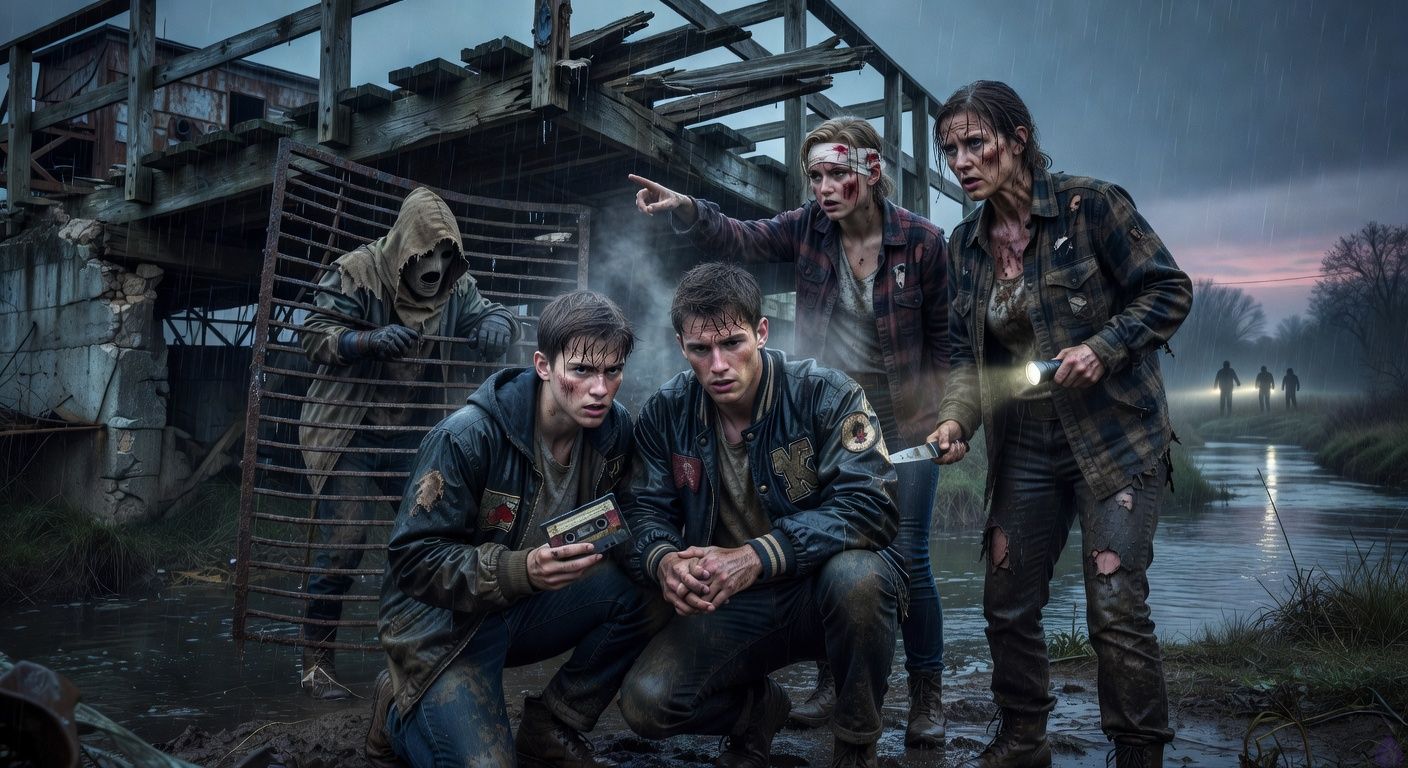
What readers chose (1 choices)
You turn toward the north support with Shane beside you because the key is real, the tape is real, and Trooper Mara Vance is the only name your dead father trusted enough to leave behind.
Calder’s order cracks through the rain from above.
You do not raise your hands.
You duck your head into the storm and push toward the sheet metal half-buried under the bridge, shoulder pressed close to Shane’s as he follows you into the wet, rotting place that stole part of his childhood.
His breathing frays the nearer you get. The old service bridge groans overhead, rain-heavy planks creaking in the wind, and the missing boards near the middle gape like broken teeth. Beneath them, the creek churns black and red-brown, swollen with runoff, clawing at the bank with muddy fingers. It smells of iron, drowned leaves, and old oil.
Shane’s hand brushes yours once.
Then catches.
Hard. Shaking. He does not look at you when he does it. You do not let go.
Drake: “One foot at a time. Like you said in the tunnel. Just one, then one more.”
His face twists at hearing his own words come back to him, but they land. You see him drag air into his lungs like it hurts. Behind you, Aunt Lila and Kara hold near the culvert: Lila with the knife low against her thigh, Kara clutching a creek stone in one hand and pressing the other to the cut at her scalp. Blood threads between her fingers, pinking in the rain.
Earl Harker snarls behind the bent grate, gloved fingers worrying at rusted metal.
Above, flashlights cut white wounds through the downpour. Calder’s boots strike the bridge planks with a hollow boom.
Sheriff Calder: “Last warning, Drake. That girl is unstable, and Riley’s been lying all night. Bring me the cassette and step into view.”
Kara laughs once. A small broken sound. Poisoned all the same.
Kara: “He said that before he locked me under the mill. Said unstable girls make better ghosts.”
Calder’s flashlight jerks toward her voice, and Lila moves at once, hauling Kara back into the bridge support’s shadow.
That gives you three seconds.
Maybe four.
You drop to your knees in the mud beside the corrugated sheet metal. Cold sludge soaks through your jeans. The metal is slick with algae and creek silt, its lower edge buried deep, and Shane stares at it like it might lift its head and speak. His pupils are wide and black. Rain runs down his face. His jaw is clenched so tight it trembles.
Shane: “I fell here. I remember my hands slipping. Emily screaming. Mason knocking on the rail like that could save me.” He swallows. Fails once. Tries again. “There were masks under here, Drake. Little ones too. Kid-sized.”
Your stomach goes cold.
You wedge the iron poker beneath the sheet metal and pry. It gives a soft, awful scream, like some rusted animal trying not to wake. Shane flinches.
Then he drops beside you.
He grabs the edge with both hands. For one breath, he freezes. Then he pulls.
Mud sucks loose. Roots snap. The metal peels back far enough to expose a low hollow behind the support, packed with silt, pale roots, bottle glass, and a black metal lockbox no bigger than a shoebox. Taped to its underside is a blue plastic key tag, cracked white at the corners, its brass key filmed green with age.
Shane reaches in.
Stops.
His whole body locks. His fingers hover over the key, not touching it, caught on a memory older than words. You cover his hand with yours. Not forcing. Holding him here. In the rain. In the now.
Together, you close your fingers around the key and tear it free.
A gunshot cracks overhead.
Not at you.
Into the air.
The sound splits the storm and sends crows shrieking from the mill roof, black scraps flung into the gray sky. Aunt Lila yells your name. Kara ducks hard against the concrete. Shane collapses forward over the lockbox, shielding it with his body before he seems to know he has moved.
Calder’s voice drops. All the porch-light warmth is gone from it.
Sheriff Calder: “That evidence belongs to an active investigation. Hand it over now.”
You shove the key into your pocket and the cassette deeper inside your jacket, close enough to feel its hard corner bite your ribs. Shane grabs the lockbox, mud and all, and staggers upright with you. His face is still terrified.
But the hollow look is gone.
In its place burns rage, bright and young and wounded. He looks up at Calder, then at you.
Shane: “Trooper Vance. In person. No phones.”
Kara points downstream, where the creek bends beneath a collapsed cattle fence and vanishes toward a ragged line of willows.
Kara: “There’s an old pump road past the trees. Mason and I used it to sneak to the quarry. Comes out near Route 9. If Calder parked up top, he can’t cut us off fast enough unless someone’s already waiting.”
Lila grips your shoulder as you pass, fierce enough to bruise.
Aunt Lila: “Then we do not stop. Not for Calder. Not for Earl. Not for any hymn in the dark.”
Behind you, Earl slams the grate open with a metallic shriek. Above, Calder starts down the embankment, flashlight and pistol aimed into the rain. Ahead, the willows thrash like they are trying to warn you away, their leaves flashing silver-green in the storm.
Beyond them waits the only road that might lead to someone your father trusted.
Shane’s hand finds yours again.
The four of you run along the creek through mud, rain, and the stink of Mercy Mill, carrying the tape, the key, and the first real proof the place has failed to bury.
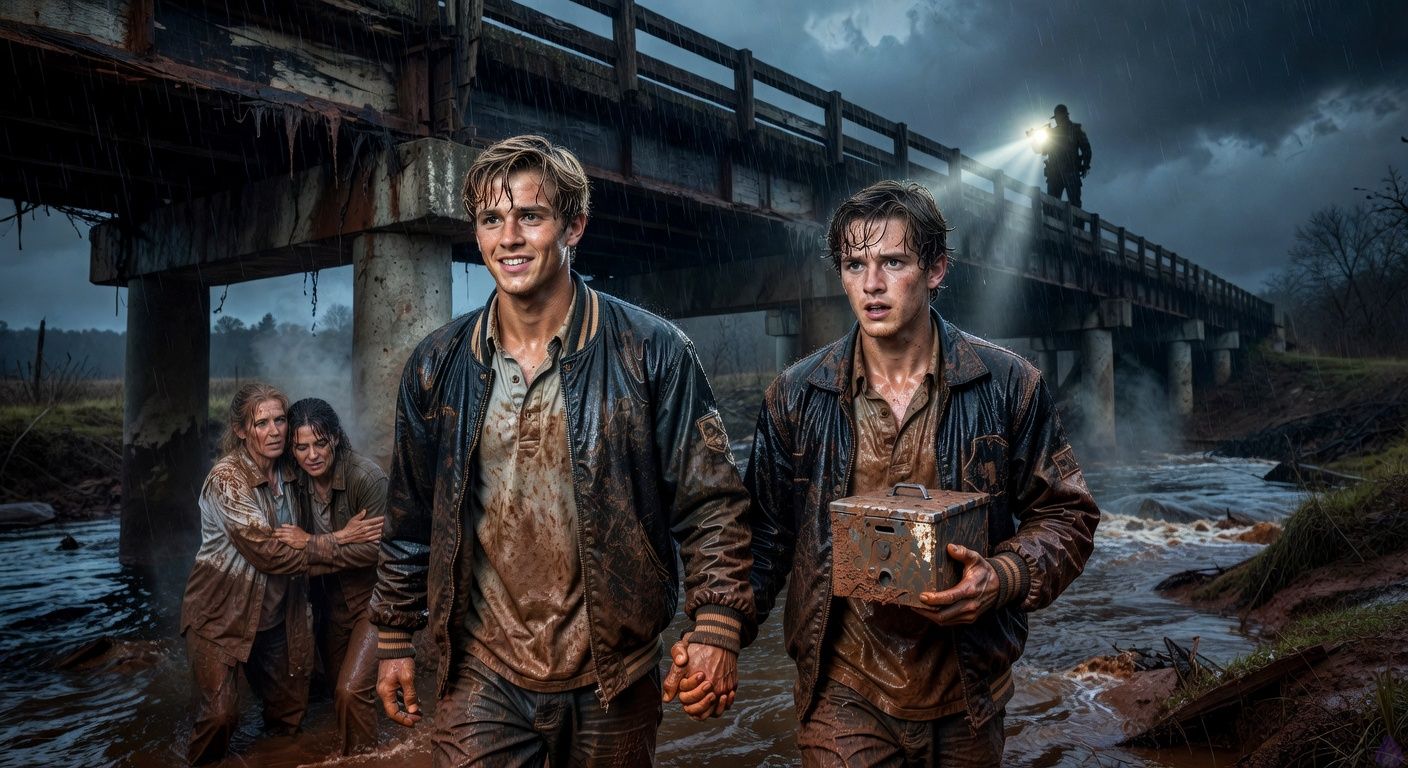
What readers chose (1 choices)
You keep Shane close enough that your shoulders knock whenever the creek path pinches narrow, close enough to feel the hitch in his stride when roots, buried under flood-mud, catch at his boots. Every few seconds, you look back for Lila and Kara.
Lila runs like anger has taken the place of blood in her veins, one arm locked around Kara’s waist when the girl slips, the kitchen knife still gripped backward in her free hand. Kara is quick despite the split on her forehead, but she’s wavering. Twice she nearly drops. Twice Lila wrenches her upright with a grunt and a curse sharp enough to slice through rain.
Behind you, Calder’s flashlight cuts the bank in hard white strips. His voice carries through the storm, all command and fury now that the mask of law has torn loose. Earl Harker crashes somewhere higher on the slope, ripping through brush with more hatred than skill. The creek snarls beside you, swollen and black, chewing at the mud shelf beneath your feet. One bad step. That’s all. Water that fast would break bones on the rocks before it dragged a body under the willows.
Drake: “Stay together. No gaps. Shane, left side. Lila, keep Kara between us.”
Shane nods, breath ragged, the lockbox hugged tight against his ribs. Mud has smeared his face and letterman jacket until the school colors are nearly gone, washed into something dark and nameless. He looks down at your joined hands as if startled they’re still locked together.
Then he grips harder.
Not romantic. Not safe. Something rougher than either. A promise made at full sprint in the rain.
Shane: “If I freeze, pull me. If you freeze, I’ll pull you. Deal?”
You don’t have time to answer.
Kara makes a strangled sound behind you. You turn and find her staring past Lila, toward the field beyond the creek road. Between the thrashing willow branches, three figures stand in the rain, spaced evenly along the rise.
Burlap hoods. Dark coats.
Still as fence posts.
They aren’t chasing. They’re waiting. One lifts a hand and taps three times against the trunk of a dead tree.
Knock. Knock. Knock.
Shane hears it and nearly goes down. You drag him forward, hard, and he comes with you, teeth bared around a sound that might be pain, might be fury. Lila shoves Kara ahead, then swings the flashlight back toward the figures. The beam catches the sickle-and-creek mark on one chest. Then another.
Not one killer.
Not two.
The Harvest Men have stepped out of rumor and into the rain, and Mercy Mill suddenly feels less like a town than a body gone rotten to the bone.
Kara grabs your sleeve when you reach the collapsed cattle fence. Her fingers are icy, slick with rainwater and blood. “Not over,” she gasps. “Under. Mason cut the wire years ago.”
She drops to her knees and tears aside a mat of weeds. Beneath the rusted fence, a low gap waits in the mud, worn smooth by older escapes. Beyond it, a narrow pump road runs between willow trunks and blackberry bramble, two tire ruts filled with brown water leading away from Hollow Creek toward the faint gray smear of Route 9.
A gunshot cracks behind you.
Closer.
Bark explodes from a willow at shoulder height. Lila throws herself over Kara and drives the girl flat into the mud. Shane yanks you down by the hand, and the two of you hit the ground together beneath the fence. For one breath, his body is pressed along yours in the cold sludge, his face inches away, eyes wide and alive and terrified.
Then he shoves the lockbox through the gap.
Aunt Lila: “Move, boys! Unless you plan to flirt in a drainage ditch while murderers reload.”
The sheer stupidity of it punches a broken laugh out of Shane. It punches one out of you too, small and breathless and half-mad, and somehow that makes your legs remember what they’re for.
You crawl under the fence. Drag the lockbox through. Turn back for Kara.
Shane does the same without hesitation. Together, you pull her beneath the wire while Lila backs through last, knife raised toward the rain and the flashlights bearing down from the creek.
The pump road opens ahead, black and slick, lined with trees that lash in the wind. Far off, barely visible through the rain, a pair of headlights moves along Route 9.
Not turning in.
Not yet.
Maybe a truck. Maybe state police. Maybe another trap wearing a different face.
Inside your jacket, the cassette digs into your ribs. In your pocket, the real key feels small, cold, and impossibly heavy. Shane rises beside you, mud on his cheek, one hand still reaching for yours even as danger closes from behind.
For now, no one has fallen behind.
For now, all four of you are still moving.
That has to be enough.
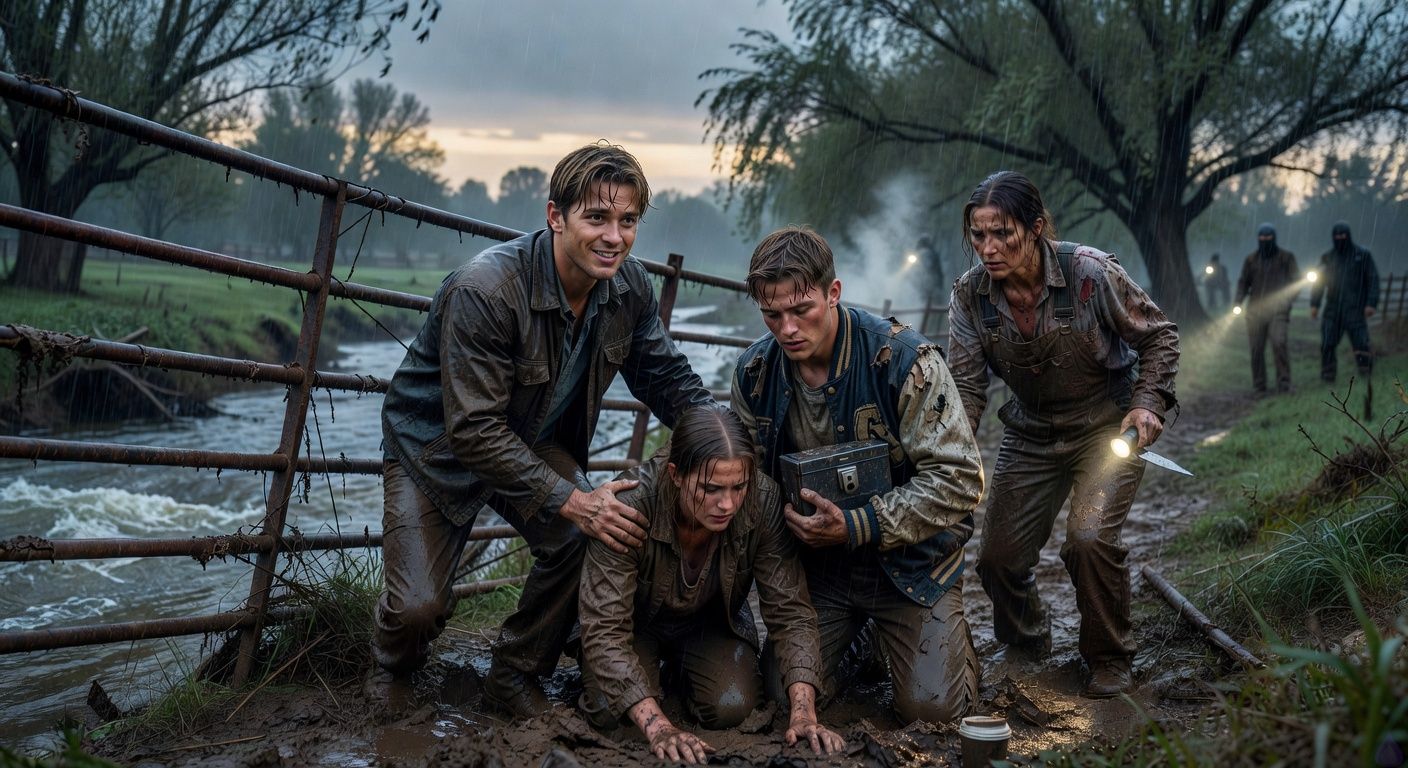
What readers chose (1 choices)
The willows swallow you like a guilty secret, their wet fingers dragging over your shoulders and mouth as you haul Shane, Lila, and Kara off the pump road into a hollow screened by roots and rain. Mud sucks at your shoes. Pale stones gleam under black water. Old beer cans lie half-eaten by moss, their labels silvered to ghosts. For the first time since the farmhouse door broke, the four of you stop moving.
Not resting.
Never that.
Just stopping long enough to hear who is still breathing.
Shane bends over the lockbox, both hands braced on his knees, sucking air through clenched teeth. His soaked letterman jacket clings to him like peeled skin. His face has gone gray with shock, but his hand keeps finding your sleeve, your wrist, the edge of your jacket, as if he has to keep proving you have not vanished into the rain. You let him. You need the proof too.
Aunt Lila crouches beside Kara and rips a strip from the hem of her own shirt. The cloth tears with a wet snarl. She ties it tighter around the girl’s forehead with quick, merciless tenderness.
Kara: "Route 9 is past the next bend. There’s a gas station by the grain elevator, but don’t go in. Owner plays cards with Calder every Thursday. There’s a payphone outside, though. If it still works."
Lila gives a bitter little laugh, breathless and shaking.
Aunt Lila: "A payphone. Of course. Whole town goes haunted, and the safest thing left is a filthy relic with gum under the shelf."
You slide your father’s cassette from inside your jacket just far enough to make sure it is still there, then press it back against your ribs. Plastic. Tape. A dead man’s last weight. The blue-tagged key in your pocket feels colder than the rain, so cold it seems to bite through the denim and into your skin.
Shane lowers the lockbox into the mud between the roots.
For a moment, all of you stare.
Small. Black. Scratched. The kind of thing a person might keep fishing lures in, or old deeds, or a pistol wrapped in oilcloth. It should not be heavy enough to bend a town around it for decades.
Behind you, faint through the storm, comes the distant chop of voices near the creek. Calder is organizing them now. Not chasing blindly. Men like him do not have to run if they can make roads close, phones lie, witnesses disappear. Flashlights flare and vanish between the willow trunks, still far but not far enough. Somewhere, a dog barks once.
Then it whines itself silent.
Drake: "Dad said Trooper Mara Vance. Badge four-one-seven-two. In person. No phones. But if we can’t call safely, how do we know where she is?"
Kara wipes rain from her eyes with a filthy sleeve. Her pupils flick from you to Shane, then down to the lockbox.
Kara: "Vance came before. After Mason. She asked questions Calder didn’t like. He got her pulled from the county liaison office, but she left a card with my aunt." Her jaw tightens. "I stole it before they locked me under the mill. It’s in my shoe."
For one second, no one speaks.
Rain ticks on leaves. Water drips from Shane’s sleeve. Your own pulse thuds so hard it seems to shake the cassette against your ribs.
Then Kara sits hard in the mud, yanks off one ruined sneaker, and peels back the inner sole with trembling fingers. The smell rises sour and human. Sweat, creek water, blood. From beneath the sole she draws a plastic-wrapped business card, soft at the corners but dry.
Lila takes it. Holds it under the weak gray light leaking through the willow canopy. Reads the number.
Not dispatch.
A direct line.
Beneath it, handwritten in blue ink, are three words: If Calder calls, run.
Shane looks at the card, then at Kara, and the guilt on his face is almost too naked to watch.
Shane: "I should’ve helped Emily. I should’ve helped Mason. I should’ve known you didn’t leave."
Kara’s expression hardens, but not cruelly.
Kara: "Yeah. You should have." Rain runs down her jaw and drips from her chin. "So help now."
The words land.
Shane takes them.
No excuse. No collapse. He nods once, then looks at you, eyes raw and steady in the willow-dark. The space between you is soaked, terrified, and alive with everything neither of you can afford to say. He reaches into his jacket, pulls out his cracked phone, and kills the power completely.
The screen goes black.
Shane: "My truck has a booster bag in the back. Emergency kit, old road flares, maybe my dad’s burner phone if he forgot it after hunting season. It’s parked at Lila’s, though. Calder may have it watched."
Lila tucks Vance’s card into her bra like it is a saint’s medal and grips the knife again. Mud streaks her knuckles.
Aunt Lila: "We’ve got three options, none of them pretty. Payphone by the gas station, farm lane to the highway, or open that box right here and find out whether your father left us anything better than panic."
A flashlight beam sweeps across the pump road just beyond the willow curtain.
Everyone drops.
Fast.
Shane presses close at your side, one arm braced behind you without touching too much, sheltering but not trapping. Kara clamps a hand over her own mouth. Lila’s knife rises, rain sliding down the blade in thin, shining lines.
The beam pauses.
Your lungs lock.
Then it passes.
In the breath after, something knocks three times from inside the lockbox.
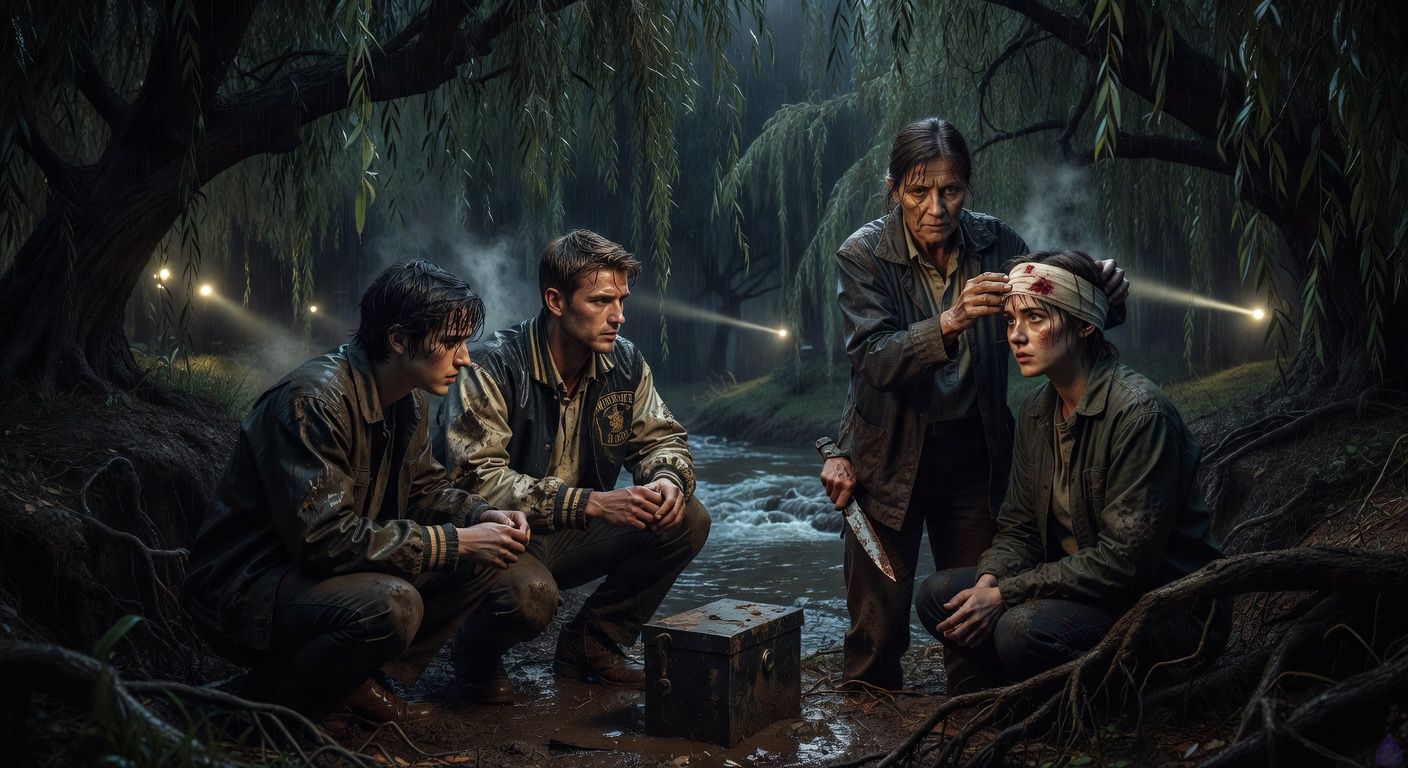
What readers chose (1 choices)
The knock inside the lockbox turns the willow hollow colder than the rain.
Shane’s hand clamps over the lid before it can sound again. Palm flat. Jaw locked so tight a muscle jumps in his cheek. He looks at you, and the question in his eyes is the same one crawling through your skull. Evidence does not knock. Tapes do not beg. Whatever your father left behind may not be the only thing someone hid in that box.
You do not open it.
Not here. Not with flashlights sweeping the pump road and Calder’s men combing the creek like hunters after a wounded deer. Aunt Lila reaches the same answer. She pulls Vance’s plastic-wrapped card from her pocket, wipes rain off the front with her thumb, and presses it into your hand as if she is handing you a coal still red at the heart.
Aunt Lila: "Payphone. Fast. If anyone answers but Vance, hang up. If you hear the hymn, hang up. If Calder’s voice comes on that line, you run until your lungs tear."
Kara shoves her ruined sneaker back on and forces herself upright. She sways. Lila catches her by the elbow. Mud streaks the girl’s face in black-brown lines, and beneath the fear sits a hard, furious will that reminds you of a match refusing to die in rain. Shane lifts the lockbox and tucks it under his jacket, awkward and heavy against his ribs. His other hand finds yours in the dark.
This time, neither of you pretends it is only practical.
You move beneath the willows in a crouched line, Kara leading by memory, Lila behind her with the knife held low, you and Shane shoulder to shoulder at the rear. The pump road sinks into a drainage ditch choked with reeds, beer cans, and a child’s cracked red shovel half-buried in mud. Route 9 hums somewhere ahead, a wet black strip hidden behind the grain elevator and the gas station’s dying sign. Every sound grows teeth: your shoes sucking free of muck, Kara’s thin breathing, rain ticking on Shane’s letterman jacket, the lockbox thudding softly against his chest.
The gas station appears through the rain like a place someone forgot to close before the end of the world. One sodium lamp buzzes over the pumps, throwing yellow light across puddles filmed with oil. The store windows are dark except for a beer sign burning red and blue in the corner. Beyond the ice machine, beneath a little metal awning dented by hail, stands the payphone. Its chrome shell is freckled with rust. The receiver hangs in place. A dead moth clings inside the cracked light above it, wings powdered gray.
Kara: "Owner sleeps in back sometimes. Don’t let the bell on the door ring. Don’t step in front of the window."
Aunt Lila pulls Kara behind the ice machine, then gestures for Shane to watch the road. He does. Mostly. His eyes keep cutting back to you. Rain has flattened his hair and washed mud down the side of his neck. He looks wrecked, scared, and stubbornly here. When you step under the payphone awning, he follows close enough that his shoulder brushes your back.
Shane: "If it goes bad, I’m pulling you out. Don’t argue."
You feed the phone with coins from Lila’s pocket. Each one drops with a sharp metallic clack that seems loud enough to reach every porch in Hollow Creek. Your fingers are numb as you dial the number on Kara’s card. The receiver smells of wet metal, old cigarettes, and a thousand frightened mouths.
One ring.
Two.
On the third, someone picks up.
No hymn.
No static.
A woman’s voice comes through low and alert, as if she was already awake with a gun across her knees.
Trooper Vance: "Vance. Identify yourself."
Your throat tightens around your father’s name, your own name, the whole impossible weight of the night. You give her the badge number first. Then your name. Drake Caine. The cassette. The blue-tagged key. Kara Bell alive beside the gas station on Route 9. Sheriff Calder compromised. Harvest Men. Hollow Creek. Your father’s voicemail, still burning a hole through you.
Vance does not interrupt.
When she speaks again, there is no sleep in her voice. Maybe there never was.
Trooper Vance: "Listen carefully, Drake. Do not go to the state barracks. Calder has friends on dispatch and at least one inside county records. There’s an old weigh station two miles north of you. Abandoned scale house, green roof. I can be there in seventeen minutes with two troopers I trust. Stay off the road until you see my headlights flash twice, then once, then twice. Do you understand?"
Before you can answer, Shane stiffens.
Across the wet asphalt, on the far side of the grain elevator, headlights slide into view, beams dimmed low, crawling slow. A dark sheriff’s cruiser rolls past the gas station entrance and stops near the shoulder. Not Calder’s voice. Not yet. But the shape behind the wheel wears a brimmed hat, and the passenger door opens without any interior light.
Inside the payphone receiver, Vance hears your silence.
Trooper Vance: "Drake. Talk to me."
The lockbox under Shane’s jacket knocks three times against his ribs.
From the cruiser, a figure in a raincoat steps out and turns toward the payphone.
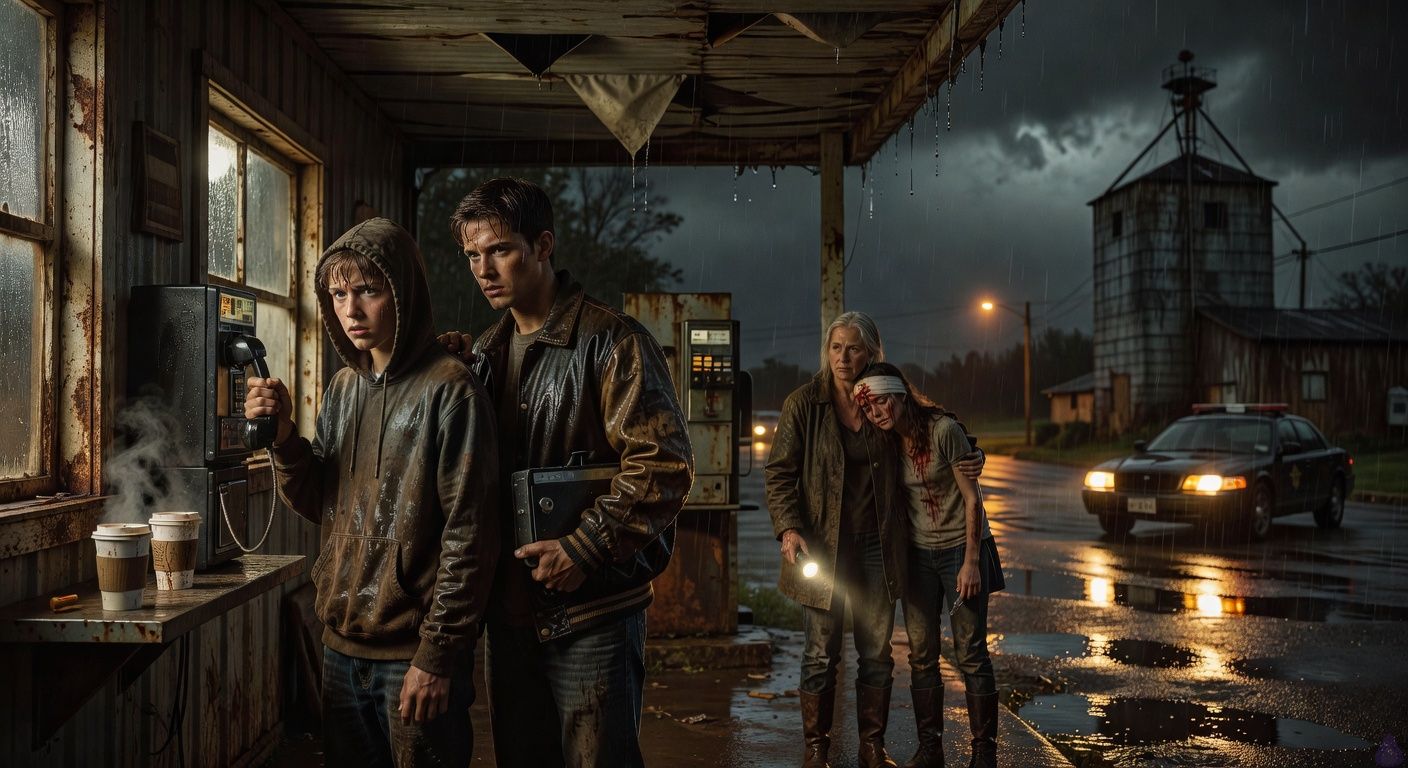
What readers chose (1 choices)
You jam the receiver hard against your ear and force the words out in a whisper so tight it rasps your throat raw.
Drake: “They’re here. Cruiser at the gas station. We’ll try for the weigh station. Two-one-two flash pattern. If we don’t make it, look near the grain elevator. Kara Bell is alive. Shane has the lockbox. I have the tape and key.”
Trooper Vance: “Stay hidden. Do not let them separate you. If you see Calder, assume he is armed and desperate. Seventeen minutes, Drake. Survive seventeen minutes.”
You hang up before the line can betray you.
The receiver settles into its cradle with a small plastic click.
Obscene. Ordinary.
Across the lot, the figure in the raincoat pauses beside the cruiser, head tilted toward the payphone as if that tiny sound has traveled straight through the rain and into his ear. Shane’s hand closes on your jacket and yanks you backward under the awning’s black lip. Fast, not rough. He drags you behind the ice machine, where Lila has one arm locked around Kara’s shoulders and the knife ready in her other hand, its cheap handle slick with rain. The lockbox knocks once beneath Shane’s soaked letterman jacket, metal against bone, muffled at his ribs. He clamps it tighter and winces.
The cruiser’s headlights stay dim. Two dull eyes in the rain.
A deputy steps into the sodium glow, young and narrow-faced, not Calder, but dressed in county brown with his hand resting too close to his holster. Water drips from the brim of his hat onto his chin. Behind him, another shape sits in the passenger seat, broad hat low, face erased by windshield glare. Calder might be watching from inside. Or something wearing his patience. The deputy scans the pumps, the dark store windows, the payphone. His flashlight rises.
The beam skates over the cracked metal awning.
Over wet concrete.
Over the dangling cord.
Then it drifts toward the ice machine, where the four of you crouch in a tight line of breath, mud, and panic.
Kara’s knees give.
Lila catches her before she hits the puddle, but the movement jolts the ice machine. It hums, shudders, and drops a chunk inside with a hollow thump that seems loud enough to wake the dead under the county road. The deputy’s flashlight snaps toward the sound.
Shane moves without thinking. He steps half in front of you, shoulders squared, one hand gripping the lockbox under his jacket, the other reaching back until his fingers find yours. His palm is cold. Slick. Shaking.
You squeeze once.
Not comfort. A signal.
Still here.
Deputy: “Anyone out there? Station’s closed. Sheriff wants everyone off the roads tonight.”
Lila’s face twists. She mouths one word.
Crawl.
The four of you sink lower and move along the back wall, shielded by stacked propane cages and a row of warped blue windshield-washer jugs. The place stinks of gasoline, wet cardboard, old fryer grease, and sour trash gone soft in the heat before the storm broke. Every inch is too loud. Your sleeve scrapes brick. Your shoe sucks at mud. Kara bites down on her own sleeve to keep from crying out as Lila guides her over broken glass, each shard winking like a fish scale in the flashlight’s spill. Shane stays at your side, matching your pace, the lockbox pinned between ribs and elbow like a second heart that keeps trying to speak.
At the rear of the gas station, a narrow ditch runs north parallel to Route 9, choked with cattails, beer cans, and oily runoff that shines with rainbow skin. Beyond it, the road climbs toward the abandoned weigh station Vance named, its green roof only a darker bruise somewhere past rain and distance.
Seventeen minutes has already become less.
Maybe fifteen.
Maybe fourteen.
The cruiser door opens again behind you.
This time Calder’s voice cuts through the rain, low and unmistakable, the way a hymn cuts through a locked church door.
Sheriff Calder: “Shane. Your father is worried sick. Don’t make this uglier than it has to be. Bring Drake out, and I can still say you were confused. Scared. Influenced by a traumatized outsider.”
Shane stops dead.
The words hit the places his father built inside him: old rooms full of shame, obedience, and doors that only opened from the outside. You feel him start to turn. Not because he believes Calder. Because the hook is barbed deep, and Calder knows exactly how to pull.
You step close, shoulder to shoulder, and keep your voice low enough for only him.
Drake: “He’s trying to split us apart. Dad warned us. The corn, the hymn, the badge—it’s all the same trick. Stay with me.”
Shane’s eyes meet yours in the dark behind the store.
For one second, the rain, the fear, the idling cruiser, even the sick pull of Calder’s voice all fall away, leaving only the brutal tenderness of being seen at your worst and not abandoned. His fingers tighten around yours. Bone to bone. Then he nods once, fierce and shaky.
Shane: “Together.”
You drop into the drainage ditch as Calder’s flashlight sweeps the corner behind you.
Cold runoff floods your shoes. It bites through your socks and fills the torn places in your soles. Lila helps Kara down, then climbs in after her with a grunt, muddy and furious and alive, the knife clenched between her teeth for one ugly second before she snatches it back into her hand.
The four of you crouch beneath the cattails while the cruiser idles behind the gas station, engine ticking, wipers dragging back and forth like a slow blade.
And somewhere two miles north, Trooper Vance is racing toward a green-roofed weigh station with seventeen minutes of hope burning down to nothing.
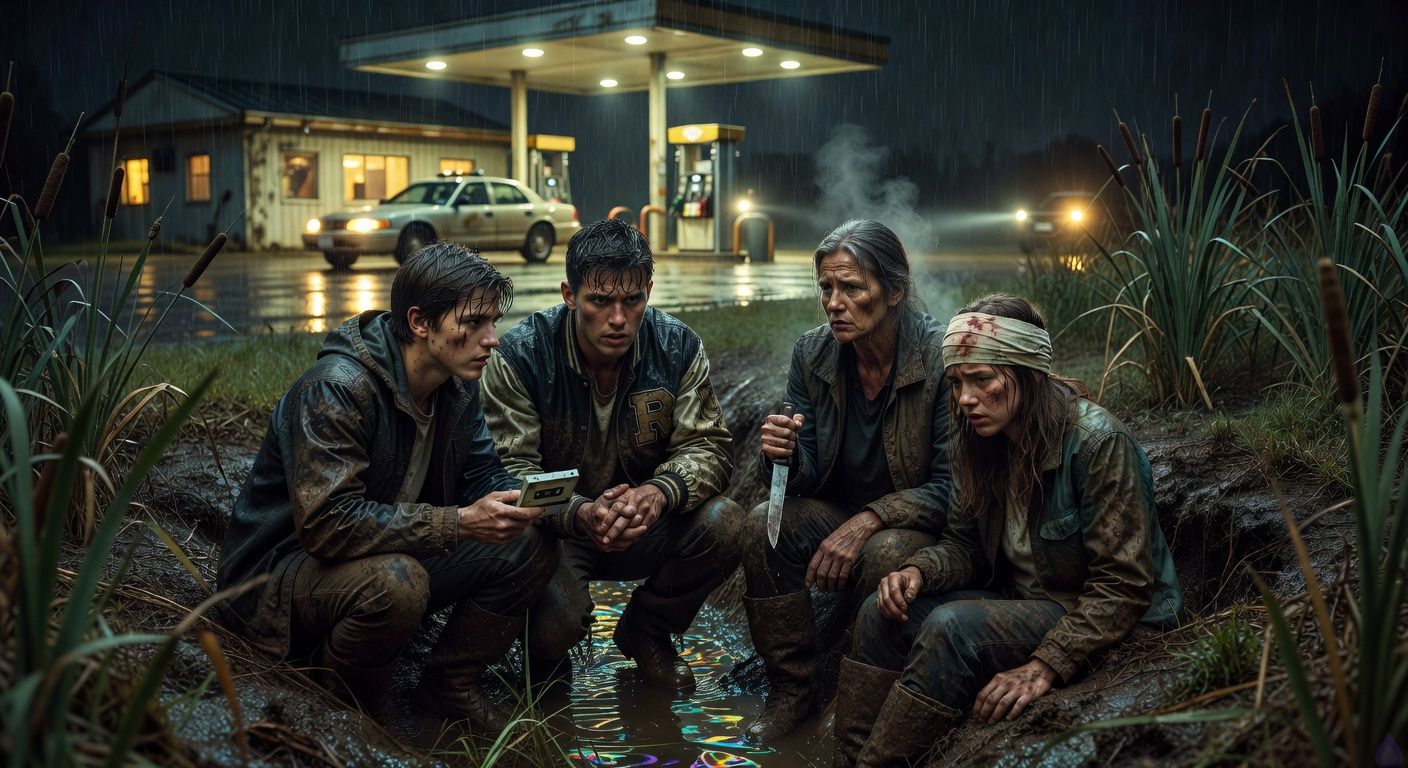
What readers chose (1 choices)
You move north before panic can root you in the ditch.
Cold runoff surges around your ankles as you shove through cattails, bottle caps, and rain-soft paper, one hand sliding back to find Shane’s sleeve, then Lila’s wrist, then Kara’s elbow. A silent chain of pressure. Keep moving. Stay low. Together. Your throat is too tight for words, and maybe words would only give the fear a mouth. So you use your hands. A squeeze for Shane when his breath snags. A steadying palm between Kara’s shoulder blades when she slips. A quick look to Lila, who answers with a grim nod and a knife held low against her thigh, rain ticking along its edge.
Route 9 runs beside you like a black river, slick with rain and oil, empty except for the dull red smear of the sheriff’s cruiser lights behind the gas station. Calder’s voice carries thinly through the storm, calling Shane’s name again, gentler now. Worse for it. Shane flinches every time, but he does not turn back. The lockbox knocks once beneath his jacket, metal tapping bone, and he clamps both arms around it as if he can smother whatever waits inside. You reach for his hand without looking. He takes it at once.
The ditch pinches narrow near the grain elevator, forcing you single-file beneath a rusted drainage pipe that spits brown water down your neck. It tastes of pennies and rotten leaves. The elevator towers over you, pale and skeletal, its corrugated walls booming softly in the wind. Painted on one support beam, half-hidden by weeds, is the same sickle-and-creek mark, old enough to flake but fresh enough to turn your stomach. Lila sees it too. Her mouth tightens, and for one heartbeat she looks not frightened, but betrayed by every harvest festival, every school fundraiser, every neighbor who ever smiled over a casserole while this sign waited under the town like a nail in wood.
Kara falters where the ditch drops sharply around a culvert outflow. Her sneaker skids in green slime. She goes down hard on one knee, choking back a cry that breaks anyway. Lila catches her under the arms. Shane, still holding your hand, reaches across and grabs Kara’s muddy sleeve with his other. For a second the four of you are tangled in the rain, all breath and shaking fingers, and you feel how thin the line is between escape and collapse.
Then Kara bares her teeth and drags herself upright.
Kara: "I’m good. Don’t stop for me. If I pass out, slap me and keep dragging."
Lila gives her a look sharp enough to cut wire.
Aunt Lila: "You pass out, I’ll haunt you before they get the chance."
A laugh tries to leave you. It comes out broken. Shane hears it and glances over, face streaked with rain and mud, eyes bright with terror and something stubbornly alive. For half a second, his thumb moves against your knuckles.
Tiny. Almost nothing.
It steadies you more than the ground does.
Ahead, the abandoned weigh station emerges through the rain: a low concrete scale house hunched beside the highway, its green metal roof blackened by weather, its windows boarded except for one cracked pane catching a weak shine. Beyond it, the road bends into a stand of pines where headlights could appear without warning. You count in your head without meaning to. Twelve minutes. Maybe ten. Maybe less. Vance said two flashes, then one, then two. Until then, the weigh station is only another empty building in a county that has learned to hide teeth behind doors.
Behind you, a whistle cuts through the storm.
Not a siren.
A man’s whistle, high and carrying, answered from somewhere across Route 9 by three slow knocks on metal. Calder’s men have spread out. They are not only behind you now.
Shane stops so abruptly you nearly hit him. He points toward the weigh station’s shadowed side lot.
A pickup sits there with its lights off, tucked behind the old scale platform. Rain crawls over the windshield, but through the blur you see a pale rectangle hanging from the rearview mirror.
A burlap hood.
Then, from the highway bend beyond the pines, headlights appear.
Twice.
Pause.
Once.
Pause.
Twice.
Vance.
Or someone who heard the plan.
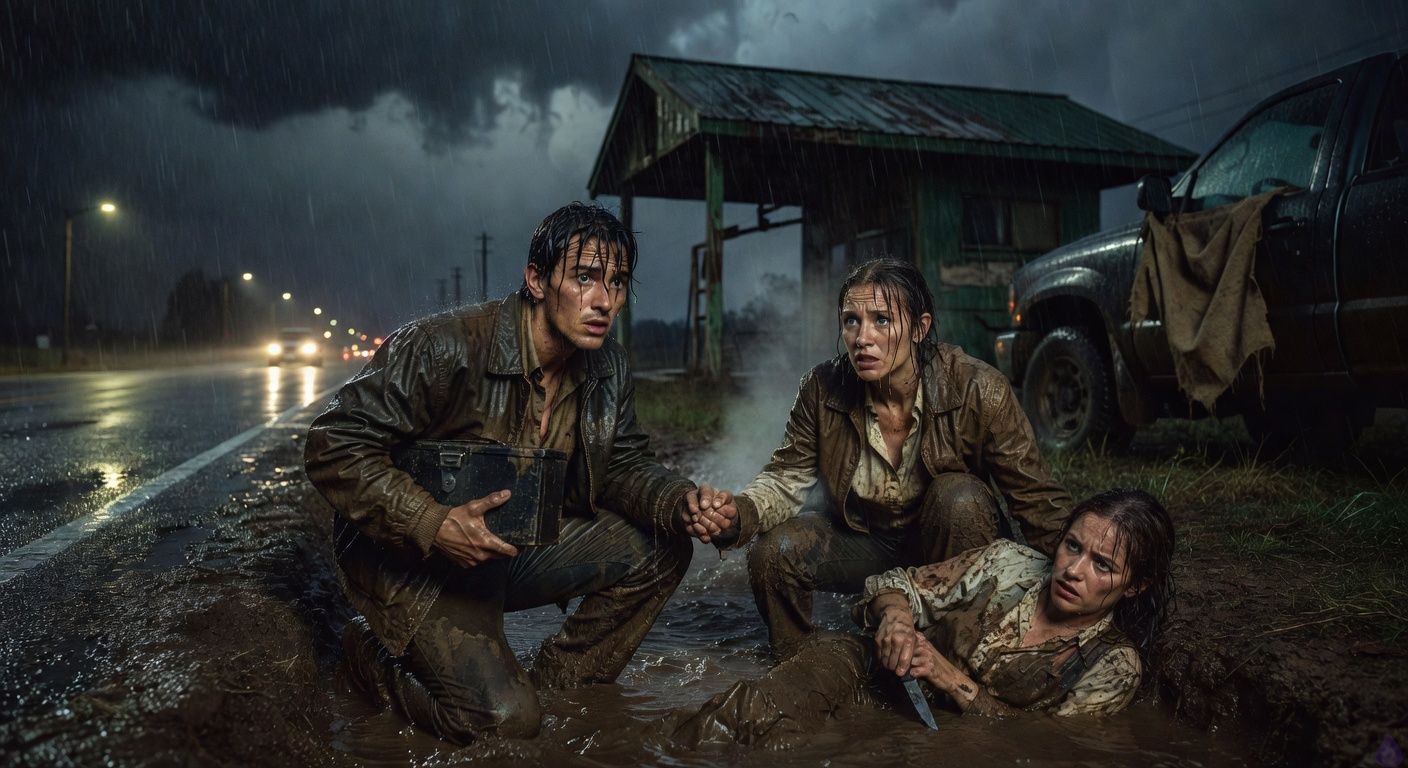
What readers chose (1 choices)
You do not run into the open.
The urge flares hot and stupid in your chest, but you crush it down and drag Shane beneath the lip of the drainage ditch, where weeds hang over you like drowned hair. Mud sucks at your knees. Your fingers clamp around his, slick with rain, then let go only long enough to press two fingers to your own eyes and point toward the headlights. Watch. Wait. He nods once, jaw locked, the lockbox hugged under his jacket like some trapped iron heart trying to hammer through his ribs.
Aunt Lila crouches beside Kara in the muck, one arm braced behind the girl’s shoulders to keep her upright. Kara’s eyes flutter. Snap open. Rage burns there, bright as fever, furious at the body failing her. Lila gives her cheek a brisk pat, almost a slap, almost a mercy, then lowers the knife until its dull kitchen blade lies flat against her thigh, hidden from the road. No one speaks. Even breath feels too loud.
The headlights at the bend hold still after the two-one-two pattern, white through rain and pine trunks. The vehicle does not come on.
Caution.
Or bait.
Across the highway, the dark pickup by the weigh station waits with the burlap hood dangling from its mirror, turning slowly in the wet air though every window is closed. You stare until your eyes ache and water runs salty into your mouth. Something about the truck is wrong. Too neat. Too visible. A scarecrow built from chrome, old oil, and shadow.
You slide your phone from your pocket, shield it against your chest, and use the cracked black screen without waking it. The glass catches a thin reflection from the highway. You angle it once. Twice. Then cover it with your palm.
Not a flashlight.
Not a wave.
Only a small, careful blink from the ditch. If Vance is out there, she might understand why you will not step into the open. If it is Calder, maybe he sees only rain.
For ten seconds, nothing answers.
Then the headlights dim, brighten once, and go black.
Shane’s breath catches. His shoulder presses against yours, cold rainwater soaked through both of you until the warmth under his skin feels almost shocking. He is not looking at the road now. He is looking at you, searching your face as if he can borrow whatever steadiness you are pretending to own. You want to tell him you are terrified. You want to say your chest is so tight the ditch has become the crawlspace again, earth pressed close, air gone thin, no room for grief or courage or anything except the next wrong move.
Instead, you squeeze his wrist once.
Together.
A figure steps out of the pine shadow near the bend, not from the road itself. Female. Hatless. Rain plasters dark hair to her cheeks. She wears a state police jacket, but she does not carry herself like someone who expects cloth and brass to save her. Her pistol is drawn and held low. Behind her, two more shapes move apart through the trees, spaced wide, weapons down but ready. The woman raises her left hand, slow and clear, then taps two fingers against the badge clipped at her belt.
Trooper Vance: "Drake Caine? Do not stand. Do not come to me yet. If you can hear me, show me your left hand only. Empty."
Her voice carries just far enough.
Controlled. Human.
No hymn underneath.
You lift your left hand above the ditch grass, palm open, rain sliding between your fingers. Shane shifts beside you, ready to yank you down if a shot comes. Lila’s gaze stays nailed to the pickup by the weigh station. Kara, pale and shaking, whispers through clenched teeth.
Kara: "Ask her what she wrote on my card. The part under the number."
Smart. Bleeding, half-conscious, and still sharper than fear.
You cup your hands around your mouth and aim your voice toward the pines, not the road.
Drake: "What did you write on Kara Bell’s card?"
Vance goes still.
Behind you, somewhere near the grain elevator, Calder’s voice lifts through the rain, flat and cold enough to make the wet weeds seem to shrink.
Sheriff Calder: "Trooper Vance, you are interfering with a county homicide investigation. Lower your weapon and identify your position."
Vance does not look toward him.
Trooper Vance: "If Calder calls, run."
Kara makes a broken sound, relief too sharp to be gentle. Lila shuts her eyes for half a heartbeat, then opens them harder. Shane exhales like something inside him has been held underwater all night.
Then the pickup by the weigh station wakes.
Its headlights slam across the ditch, white and blinding. The burlap hood whips from the mirror like a hanged thing in a storm. The engine roars, deep and animal, reeking of hot oil and burned rain. Not toward Vance.
Toward you.
Vance shouts. One of her troopers fires at a tire. The shot cracks through the rain and screams off metal. The truck surges over the old scale platform, tires spitting gravel, aimed straight for the shallow stretch of ditch where the four of you are hiding.
Shane throws himself against you and Kara at once, trying to shove both of you lower. Lila snatches the lockbox before it slips from under his jacket. Vance runs now, pistol raised, boots splashing black water, but the truck is closer.
The safe plan has lasted exactly long enough to prove there was never a safe plan at all.
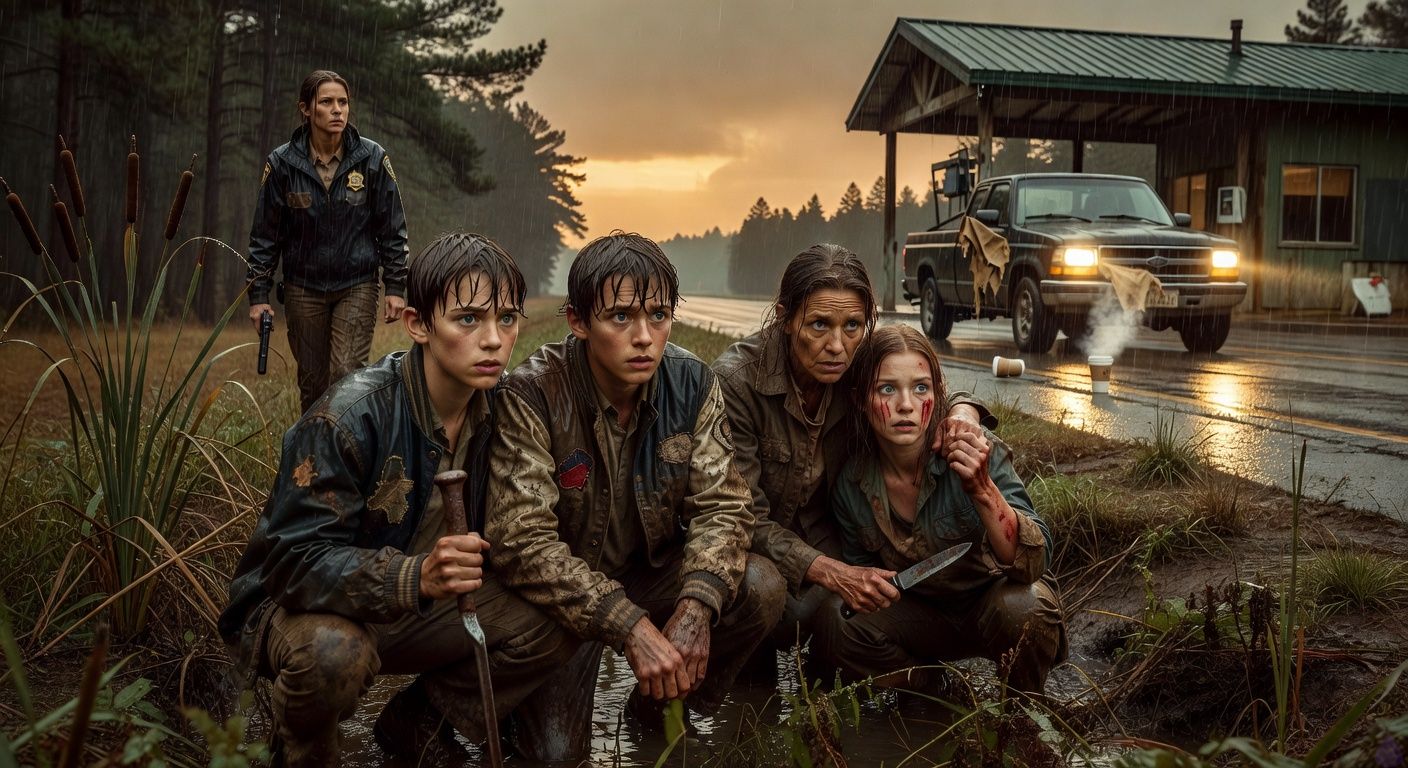
What readers chose (1 choices)
The truck tears through the ditch where you crouched a heartbeat ago, its front bumper chewing mud, cattails, and black water into one violent spray. Shane hits you from the side and drives you backward. Not away from Vance. Toward the pines, exactly where she screamed for you to run. Gravel stings your jacket. The truck’s headlight catches his face for one white flash—terrified, rain-slick, his mouth shaping your name with no sound behind it.
You grab him before momentum can rip you apart. Your hand closes on his soaked sleeve, slides, finds bone at his wrist, and you drag him with you into the trees. Aunt Lila comes after you with Kara tucked under one arm and the lockbox crushed against her ribs, moving with a staggering, furious strength that makes her look less like your aunt than something the fields should have learned to fear. Kara stumbles. Nearly folds. Then she forces herself upright when Vance’s nearest trooper reaches for her.
Trooper Vance: "Move through the trees, not the road. Keep the evidence covered. Caine, Riley, stay where I can see you. Lila, pass Bell to Trooper Dunn. Now."
Lila hesitates for half a second, because trust has become a luxury no one in Mercy Mill can afford. Then Kara’s knees buckle again, and the choice is made for her. Trooper Dunn catches Kara around the waist, rain running off the brim of his hat, gun still angled toward the truck. Vance steps between you and the highway with her pistol raised, her state police jacket black with water, her face bare and hard in the stuttering light. She does not look invincible.
She looks outnumbered.
Furious.
Real.
Behind you, the truck reverses with a tire-scream, then lunges forward again. One of Vance’s troopers fires twice into the front tire. The first shot sparks off the rim. The second lands. Rubber bursts with a flat, ugly crack. The vehicle slews sideways, slams into the old scale platform, and stops hard enough to throw the driver against the wheel. The horn blares, long and wounded, vibrating in your teeth. Through the rain-streaked windshield, burlap shifts.
Not a hanging hood this time.
Someone wearing one.
Sheriff Calder: "Vance! You have no jurisdiction to interfere with my suspect!"
Calder’s voice comes from behind the grain elevator, closer than it should be. Flashlights cut through the rain. Men move between rusted supports and waist-high weeds, their bodies breaking into pieces whenever the lightning shivers behind the clouds. County brown. Dark coats. Mud on boots. One of them raises a hand and knocks three times against the elevator’s steel ladder.
The sound rings over Route 9 like a church bell struck underwater.
Shane flinches hard, but he does not stop. He presses the cassette deeper against your jacket where you shoved it, then catches your hand again, tight enough to hurt. His eyes find yours beneath the dripping pine branches. He is shaking. So are you. The old panic claws up your ribs, begging you to fold, to hide, to make yourself small enough that the night forgets your name.
Instead, you squeeze back.
Shane: "Together. Still together."
The words are barely breath.
They carry you the next ten steps.
The pines take the road noise and bury it in layers. Wet needles slap your cheeks. Sap and rot thicken the air. Roots twist underfoot like knuckled fingers, slick with mud, waiting to trip you. Vance moves backward ahead of you, pistol steady, covering your retreat while Trooper Dunn hauls Kara toward a dark SUV hidden off the shoulder with its lights killed. Aunt Lila follows. The knife is gone now. Both hands clutch the lockbox, black metal pressed to her chest as if she can hold it shut by force alone.
She looks at you once through the rain.
The terror in her face changes when she sees Shane still beside you. Not gone. Not taken. Relief hits her so fiercely it almost breaks her mouth.
Then the lockbox knocks.
Once.
Twice.
Three times.
Vance hears it. Her eyes cut to Lila, then to you. For the first time since she stepped out of the pines, doubt moves across her face. The wrecked truck’s horn keeps wailing behind you. Calder’s shouts come closer, tangled with boot-cracks through brush and the metallic clink of rifles against buckles. Somewhere to your right, deep in the trees, someone begins humming the hymn.
Soft.
Off-key.
Already inside the woods.
Vance yanks open the rear door of the SUV.
Trooper Vance: "Evidence in the vehicle. Everyone in. We leave now."
But Kara, half-hanging from Dunn’s grip, twists toward the knocking box with wild, wet eyes.
Kara: "Don’t put it in the car until you open it. Please. That’s how they move things. That’s how they moved me."
Rain hammers the pine canopy overhead. Shane’s hand tightens around yours until your fingers ache. Lila stares down at the black metal box in her arms as something inside shifts with a soft, deliberate scrape, like a nail dragging along the lid from within. Vance’s engine waits in the dark—rescue, or another locked space,while Calder’s men push through the storm behind you.
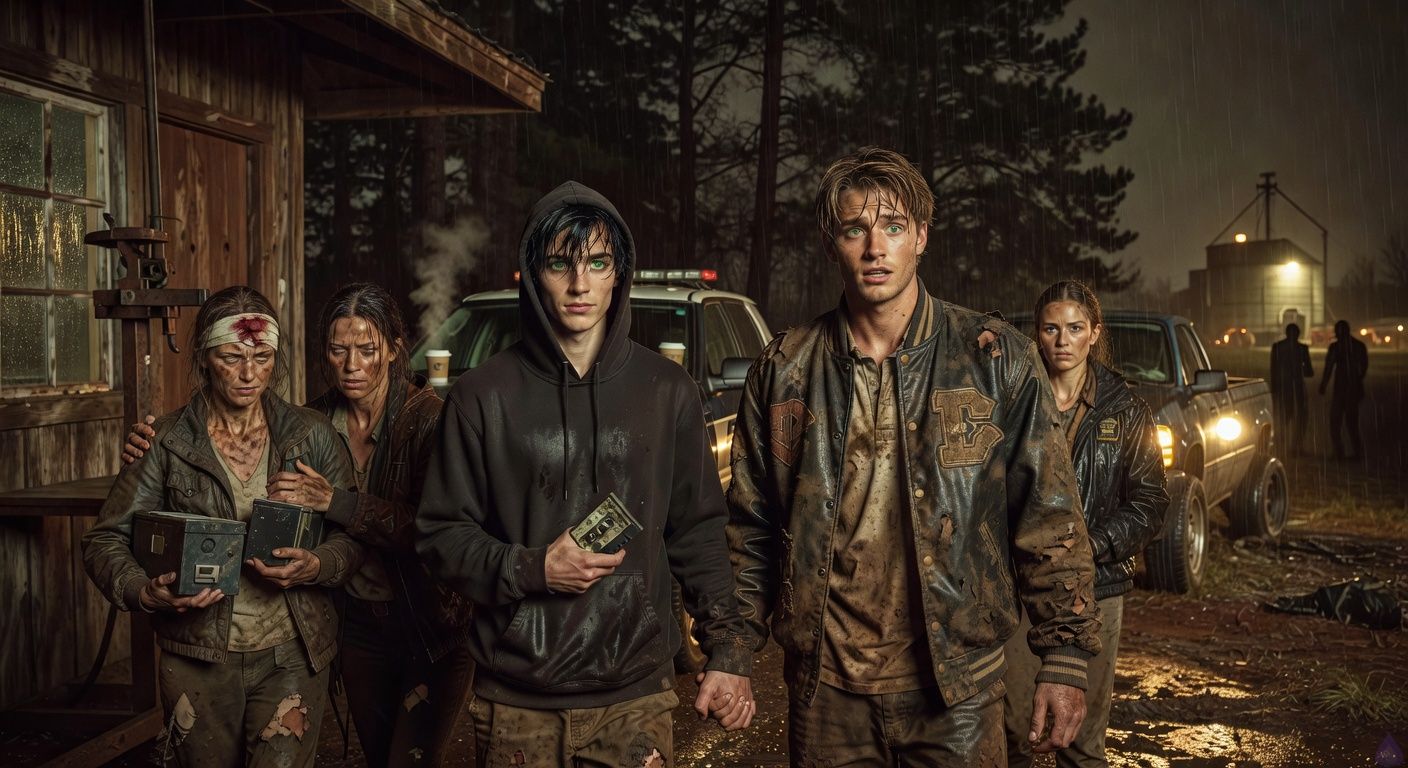
What readers chose (1 choices)
You take the lockbox from Lila before Vance can argue, before fear can turn the SUV into another sealed room with no air. The black metal slips in your hands, slick with rain and creek mud, heavier than iron has any right to be. It hums faintly. Not sound. Pressure. A vibration that crawls through your palms and settles in your teeth.
Shane stays close enough that his shoulder grinds against yours. One hand hovers over the lid. The other stays locked around your wrist, as if he can pin both of you to this one patch of soaked earth by force alone. Lila stands at your back, jaw clenched, her empty hands curled into fists. Kara watches from Trooper Dunn’s grip, fever-bright and shaking, whispering, “Not in the car. Not in the car,” like a prayer learned in captivity.
Vance snaps her pistol toward the dark between the pines, then back to you. Rain cuts down her face in hard silver lines. Behind her, the wrecked pickup’s horn finally dies with a strangled croak.
The quiet is worse.
Calder is shouting orders near the grain elevator. Branches crack under running feet. Somewhere deeper in the trees, a man hums the hymn in a voice with no need to hurry, soft as breath against a cellar door. Vance swears, low and vicious, then thrusts a small keyring at you. “Try these. Fast.”
The blue-tagged key from beneath the bridge is already in your pocket.
You know before your fingers touch it.
The metal is cold enough to hurt, cold enough to bite past skin, and when you slide it into the lockbox, the fit is perfect. No scrape. No resistance. The lock turns with a small, final click.
Shane’s breath catches beside you. “Drake.”
You lift the lid.
For one impossible second, the knocking keeps coming from inside, though nothing moves. Three hollow taps. Pause. Three again. Then Vance’s flashlight sweeps over the contents, and the spell breaks ugly and plain: a bundle of photographs sealed in yellowed plastic, index cards tied with red twine, a water-stained ledger swollen at the corners, and a tiny cassette recorder with its play button jammed down. The speaker crackles once. Three knocks tap from it, looping endlessly.
Not alive.
Not holy.
A lure.
A trick cruel enough to know the exact shape of your fear. Kara sobs once. Not weakness. Rage.
Lila reaches into the box and lifts the first photograph. Her hand shakes so hard the plastic whispers. The image shows the old service bridge in daylight, decades ago, its concrete pillars pale with river scum. Men stand beneath it in shirtsleeves and Sunday shoes, faces uncovered, smiling around a green tarp. Calder is younger but unmistakable, one arm slung around Earl Harker like they are brothers at a picnic. Shane’s father stands at the edge of the frame, half-turned away, a cigarette burning between his fingers.
On the back, in your father’s handwriting, are the words: Harvest Home, 1998. Ruthie Vale recovered. No report filed.
Shane sees his father.
The sound he makes is small. Awful. Like the ground has opened under him and taken the boy he used to be. His grip on you loosens, then tightens again with a desperation that hurts. You turn toward him, and for a heartbeat the storm shrinks to the circle of his face: mud-streaked, rain-lashed, broken open. Beautiful in the worst moment of his life because he is still choosing not to look away.
“He knew,” Shane whispers. “My dad knew.”
Vance snatches the ledger and flips it open under her flashlight. Names. Dates. Payments. Property transfers. Initials beside missing-person reports. The Harvest Men are no campfire story. They are ink. They are receipts. They are old families trading silence like seed corn, year after year, season after season, until the whole county grew crooked from it.
Vance’s mouth hardens with every page. “This is enough to bury half the county.” Her eyes lift toward the trees. “Which means they cannot let us leave with it.”
A shot cracks through the pines.
Bark explodes from the trunk beside Vance’s head. Trooper Dunn shoves Kara behind the SUV. Lila jams the photographs back into the box while you slam the lid shut on the ledger, the cards, the recorder, and the proof your father died trying to protect. Shane drags you down as another shot tears through the rain.
Calder’s voice comes closer, stripped now of law, of office, of every borrowed mask. “Caine! Last chance!”
Vance fires once toward the muzzle flash, then yanks open the SUV door. “Everyone in. Now. We go to the barracks I trust, not the one on paper.”
But Kara is already pointing past the SUV.
Toward the old scale house under the green roof.
A second vehicle waits hidden behind the building, headlights dark, driver unseen. On its windshield, someone has drawn three vertical lines in rainwater.
From the inside.
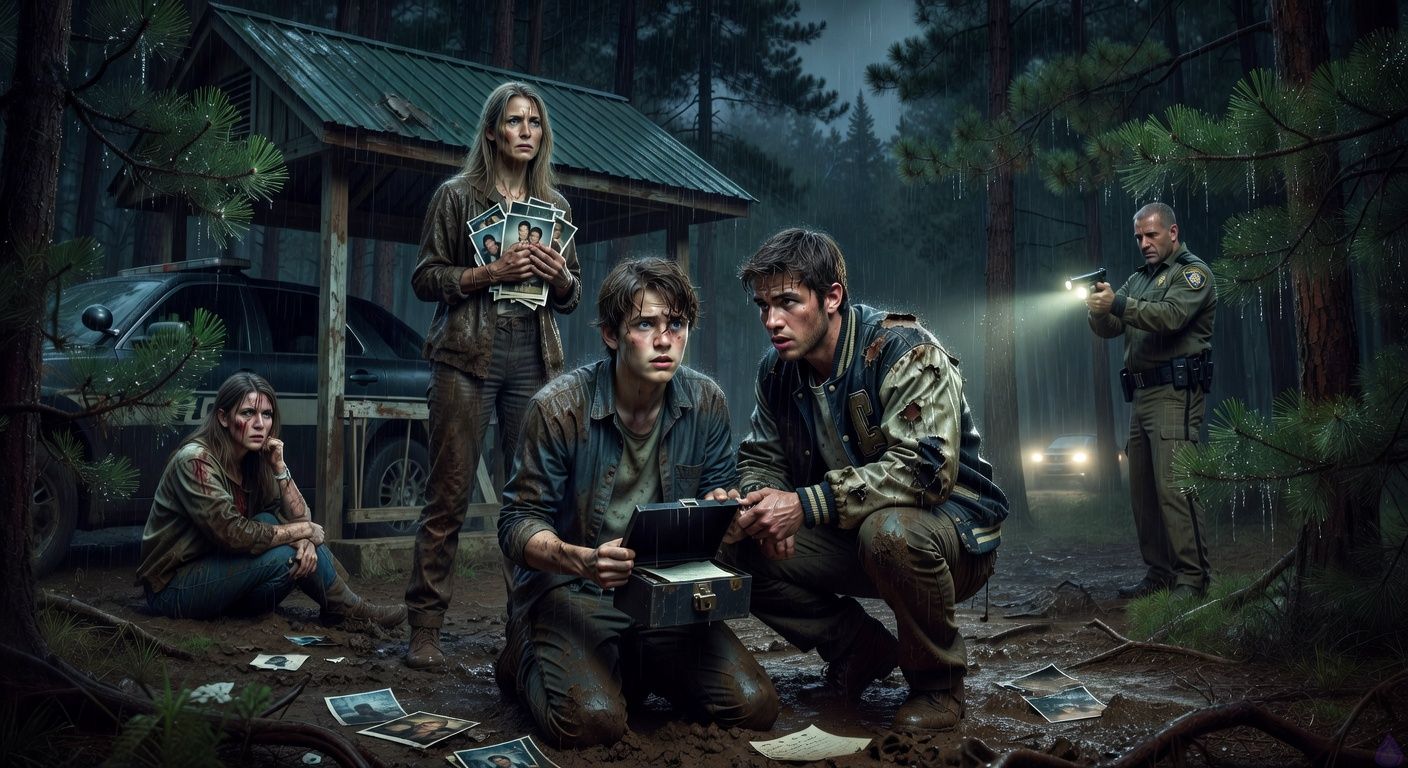
What readers chose (1 choices)
You choose the vehicle with the living woman shouting your name, not the black car marked from the inside.
Shane moves before you speak. He rams the lockbox against your chest long enough for you to catch it, iron corners biting through your soaked shirt, then turns and grabs Kara under one shoulder while Trooper Dunn takes the other. Aunt Lila dives into the rear seat first. Not fleeing. Planting herself. She hauls Kara in after her with a grunt, muddy hands hooked beneath the girl’s arms, while Shane folds himself in beside you so fast his knee cracks against the door frame.
Trooper Vance: "Down. Heads below the windows. Dunn, drive. I’ll cover until we roll."
Another shot snaps through the pines.
The rear window spiderwebs but holds, safety glass glittering white-blue in the flare of Vance’s pistol as she fires twice into the dark. Gun smoke curls in with the rain. Calder’s men shout from three directions now, their voices chopped apart by weather and tree trunks, trying to sound like law while they hunt you through mud. Behind the scale house, the dark vehicle stays still. Waiting. Its windshield mark gleams in the storm, three vertical lines sliding slowly downward as rain bends them into weeping scratches.
You clutch the lockbox against your ribs. The cassette is tucked inside your jacket. The blue key burns cold in your pocket, cold enough to ache through denim and skin.
Shane presses close on your right, half shielding you, though there is nowhere in the back seat to hide. His hand finds the back of your neck for one brief second as the SUV lurches backward. Steadying you. Holding on. It is an intimate touch made brutal by terror, fingers cold and shaking, his thumb brushing once below your ear before he jerks away like the contact has scalded him.
You catch his wrist.
His eyes meet yours in the dim cab. Rainwater runs from his hair down his jaw, carrying pine needles and grit. Mud has stripped the golden-boy shine from him. What remains is a scared eighteen-year-old with blood on his sleeve and his father’s guilt split open in his hands. He looks at your fingers around his wrist, then back at you.
Something in his face breaks.
Something holds.
Shane: "I’m here. I’m not leaving."
The SUV fishtails out of the pines. Trooper Dunn drives like the road has insulted his dead mother, one hand locked on the wheel, the other shoving the gearshift hard enough to make the engine snarl. Vance throws herself into the front passenger seat as the vehicle surges onto Route 9, tires screaming over wet asphalt. Behind you, headlights flare from the gas station, then the grain elevator, then the old scale house.
Too many.
Calder has more vehicles than Vance has troopers.
Aunt Lila curls over Kara in the rear cargo space, one arm wrapped around the girl’s shoulders, the other braced against the seat as every turn slams them sideways. Kara is conscious. Barely. Her eyes stay fixed on the lockbox in your lap, wide and fever-bright. She keeps whispering names under her breath. Mason. Emily. Ruthie. Carla. Each one leaves her mouth like a bead on a prayer string.
Maybe to keep them alive.
Maybe to remind herself why she is not allowed to die yet.
Aunt Lila: "Drake, keep that box shut until Vance says otherwise. If it starts singing, knocking, confessing, or asking for its mama, I do not care. You hold it shut."
A laugh tears out of Shane, wild and strangled, and for one second it catches in you too. The sound is ugly. Human.
Then red and blue lights bloom behind you, washing the wet road in police color.
Calder’s cruiser swings out from a side lane ahead, not behind, cutting across Route 9 with its headlights dead until the last second. Dunn curses and wrenches the wheel. The SUV clips the ditch. Bounces hard. The world becomes glass, rain, and the metallic scream of suspension.
Vance snatches the radio from the dash.
Trooper Vance: "This is Trooper Mara Vance, badge four-one-seven-two, requesting immediate federal and state backup on Route 9 north of Mercy Mill. Sheriff Robert Calder is armed, compromised, and attempting to suppress homicide evidence. Multiple civilians in protective custody. Repeat, protective custody."
Static answers first.
Then Calder’s voice slides through the speaker, calm again. Almost kind.
Sheriff Calder: "Mara. You should have stayed out of our fields."
The radio shrieks with feedback.
From the lockbox, the cassette recorder begins knocking again.
Three taps.
Pause.
Three taps.
The sound crawls through the metal into your bones. The blue key in your pocket turns colder, drinking warmth from your thigh until your muscles twitch. Shane clamps one hand over yours on the lid, and this time he does not pull away. Lila reaches forward from behind and adds her weight. Kara, weak and trembling, presses two fingers to the box as well.
Four hands holding the dead shut.
Ahead, beyond the rain, another set of lights appears on the highway. Not one car. A line of them. White headlights, high and steady, moving fast toward you from the north. Vance stares through the windshield, jaw clenched, waiting for the pattern.
Twice.
Once.
Twice.
Her shoulders drop by the smallest fraction.
Trooper Vance: "That’s ours. Dunn, drive straight through. Nobody stops."
Behind you, Calder’s cruiser accelerates, engine howling like the fields have finally learned to scream.
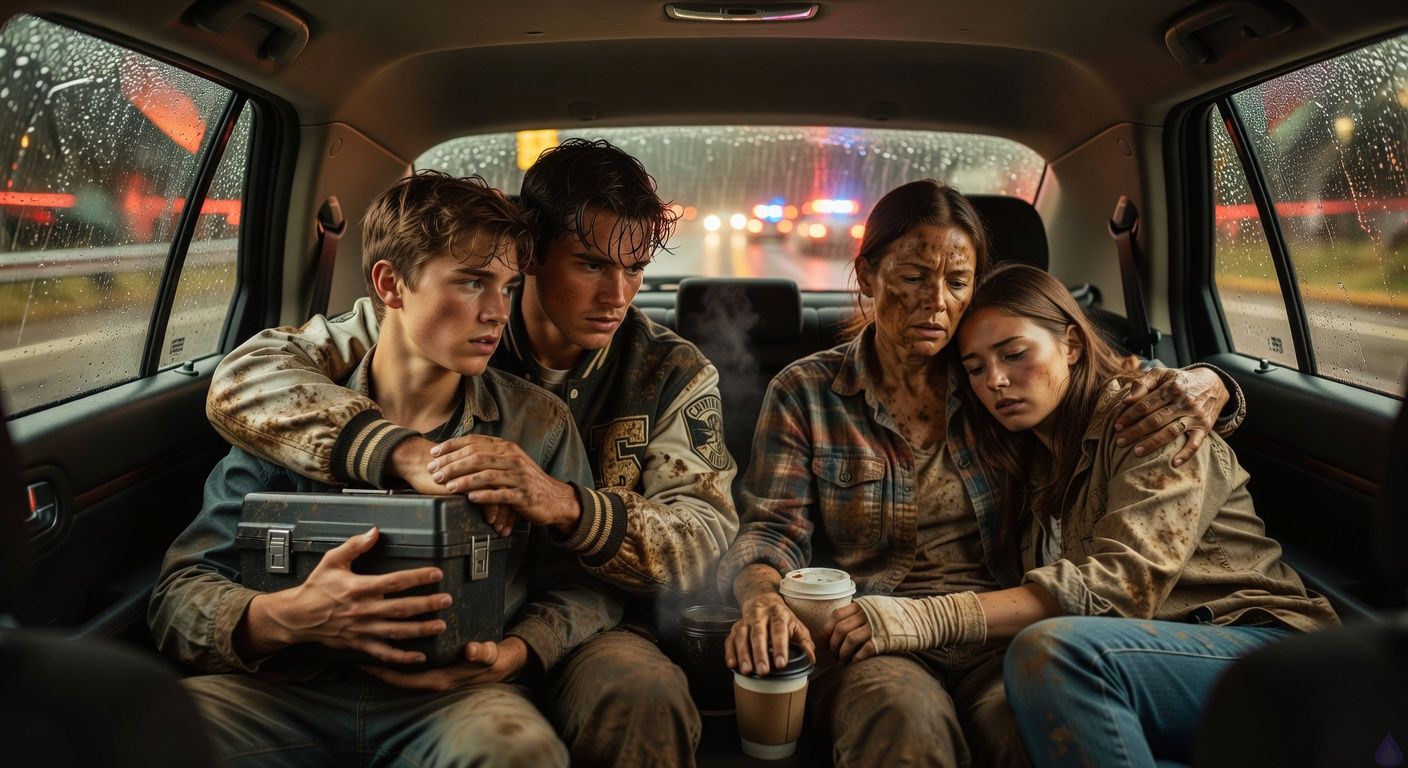
What readers chose (1 choices)
Drake: "Dunn, ram through before Calder reaches the convoy. Don’t let him box us in."
Trooper Dunn does not waste breath asking if you are sure. His knuckles whiten on the wheel, and the SUV lunges beneath him like a horse gone mad from lightning, engine growling through rain and fear and the stink of burned rubber. Ahead, Calder’s cruiser slews across the highway, blue lights smeared in the wet glass, trying to wedge itself between Vance’s vehicle and the oncoming line of state police headlights. Behind you, more beams wash over Route 9. Mercy Mill’s secrets arrive in steel and sirens, carried by men with shotguns and old oaths and no intention of letting the fields lose their harvest.
Vance braces one hand against the dashboard and twists back just long enough to meet your eyes. No softness. None. But trust is there, hard-earned and immediate, sharp as a blade passed hilt-first. Shane’s hand clamps over yours on the lockbox lid, his shoulder crushed against you in the cramped back seat, his breath hot and ragged at your cheek. Aunt Lila folds herself over Kara, one arm shielding the girl’s head as if bone, rage, and a mother’s grief might hold the whole town back. The knocking inside the box quickens until it becomes a trapped little heart made of brass and teeth.
Trooper Vance: "Hold on."
Dunn drives straight at the narrow gap between Calder’s cruiser and the rain-slick shoulder.
For one terrible second, the world shrinks. Headlights. Water. The white moon of Calder’s face behind his windshield. He looks less like a sheriff now than a man seeing judgment step out of the dark too early. His mouth opens. Maybe he shouts. Maybe he prays to whatever waits under the corn.
Then the SUV hits.
Metal shrieks through the night. The front quarter of Calder’s cruiser caves in with a sound like a giant biting down, and the force throws you sideways into Shane. His arm hooks around you before thought can catch up, locking you against him as glass bursts somewhere behind Lila in a bright, wicked spray. Kara cries out. Lila curses so fiercely the air seems to flinch, each word old and black and dragged up from the same soil that took your family. The lockbox bucks in your lap. Once. Twice. Four hands crush it shut.
The SUV fishtails. Tires claw for the road. For half a breath, there is no weight, only rain and roaring and Shane’s heartbeat hammering against your ribs.
Then the tires catch.
Dunn punches through the gap as Calder’s cruiser spins backward across Route 9, dead headlights flashing once toward the cornfields before the ditch swallows it with a wet, final crash. Mud erupts. Cornstalks shiver. Something out there hisses, thin and furious, as if a blade has gone into flesh.
The convoy reaches you like dawn on wheels. State police vehicles flood the highway with white glare and red-blue strobes. Sirens split the rain open. Troopers pour out with weapons raised, boots splashing through black puddles, voices snapping commands that are not meant for you. Vance kicks her door open before Dunn has fully stopped, badge high, her voice cutting clean through Calder’s radio static and the last faint thread of that hymn leaking from the fields. Behind you, Mercy Mill’s hunters brake too late, trapped between the wrecked cruiser, the convoy, and the truth they failed to bury.
You stumble out into the storm with the lockbox clutched to your chest. It is slick with rain and warm underneath, too warm, pulsing faintly against your sternum. Shane comes with you, one hand still locked around your wrist as if the road might crack open and steal you if he lets go. Aunt Lila helps Kara into Vance’s arms, and the girl stands on shaking legs while rain thins the blood on her face to pink ribbons.
Across the highway, troopers drag Calder from the ditch, mud up to his badge, his hat gone, his mouth working around orders no one follows anymore. He spits one word toward the corn, and the nearest stalks bend away from him. Not enough to save him. Earl Harker is taken near the scale house before dawn, hood torn away, wrists bound behind his back, his boots leaving dark furrows in the gravel. By sunrise, Vance has the ledger, the photographs, the cassette, and your father’s tape sealed in evidence bags bound for people Calder cannot threaten, charm, or call friends.
The first light over Mercy Mill is thin and gray.
It heals nothing.
It only shows the damage clearly: the churned mud, the torn metal, the corn flattened where men ran, the blood diluted in the roadside gravel until it looks like rust. Shane stands beside you at the edge of the highway, soaked letterman jacket hanging heavy from his shoulders, his face hollowed by grief and relief and the ruin of his father’s name. When he reaches for you this time, he does not hide it. His fingers thread through yours in front of Vance, Lila, Kara, the troopers, the wrecked cruiser, and the fields that remember blood.
You let him hold on.
Aunt Lila sees. She wipes rain from her face with a muddy sleeve. Maybe some of it is not rain. Kara sits on the ambulance bumper with a blanket around her shoulders, bare feet tucked above the wet pavement, watching the evidence boxes with the fierce attention of someone guarding graves. Vance speaks quietly into a secure radio, already building the case that will tear Mercy Mill open from roots to roof beams.
You look toward the fields.
The corn bends under the morning wind, whispering without power now. Dry. Frightened. Small. Your family is still gone. Justice has not brought them back, has not put your father’s hand on your shoulder or your mother’s voice in the kitchen or any of the dead back into their names. But the badge you once wanted means something different as dawn lifts over Hollow Creek.
Not authority.
Not permission.
A promise.
And this time, when the fields whisper, they do not sound hungry.
They sound afraid.