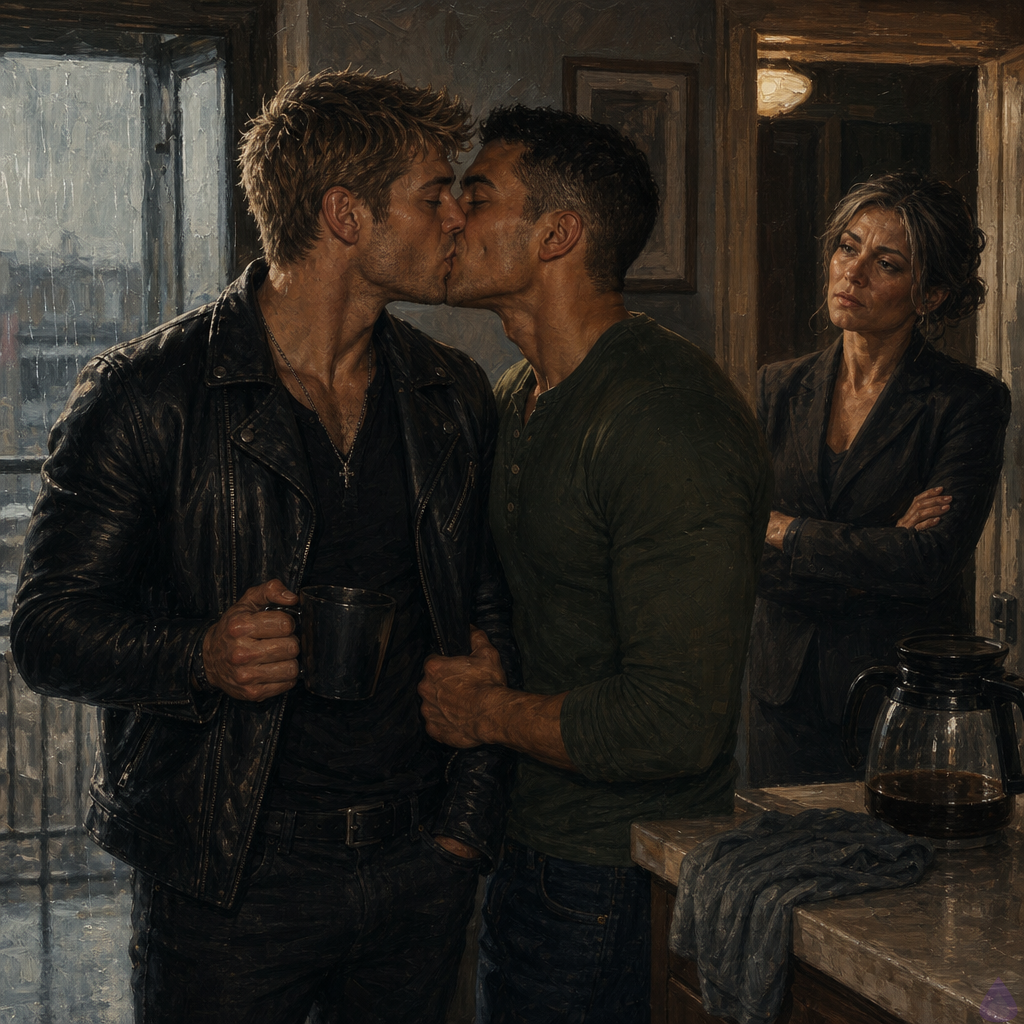
Published Story
Where the Streetlights End
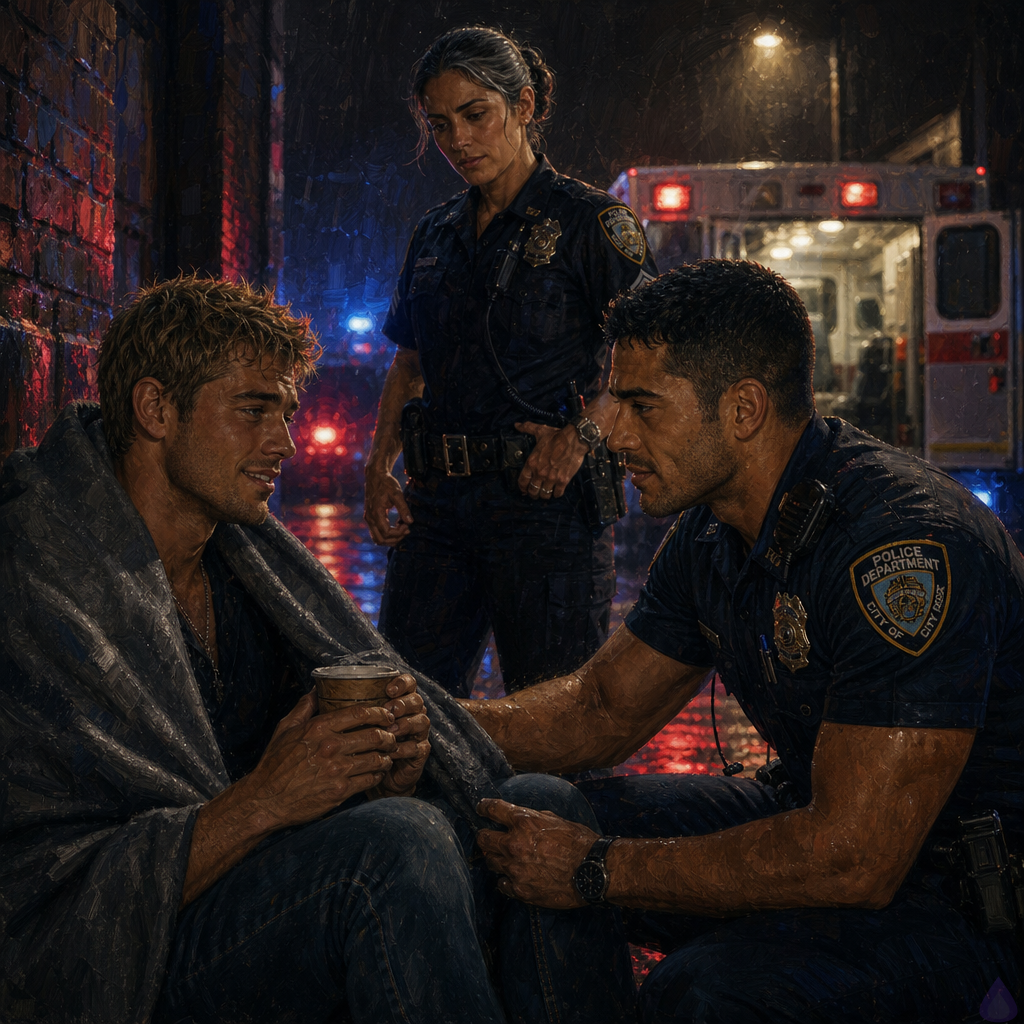
Rain turns the alley mouth into a smear of neon and gutter water, rinsing the city down to red brake lights, blue strobes, and the sour gleam of wet brick. You sit on the curb with a police blanket around your shoulders like a cheap magician’s cape, bare hands locked around a paper cup of coffee someone keeps promising is warm. It isn’t. It tastes like burnt mud and old pennies. You drink it anyway because your teeth won’t stop chattering, and because making a face at bad coffee is easier than admitting your legs still don’t believe in the ground.
You: “Y’all always serve this stuff to survivors, or is this how the department gets confessions?”
The officer crouched in front of you does not laugh too fast.
That is the first thing that gets you.
Mateo Reyes has warm sienna-brown skin damp with rain, dark eyes that don’t scrape over you, and a navy uniform pulled sharp across shoulders broad enough to make the alley feel narrower. His close-cropped black hair is wet at the edges. He smells faintly of rain, coffee, and something clean under it, like soap on warm skin, and when his mouth softens, a small dimple appears in his left cheek as if it slipped past his guard.
Mateo: “Mostly we use it to prove we’re underfunded. You don’t have to drink it.”
You: “Now you tell me. I already gave it a pet name.”
His gaze drops to the cup, then lifts back to your face. Calm. Careful. Not pitying. You cling to that difference with both hands. Behind him, Sergeant Mara Whitlock stands beneath the broken streetlight, compact and still as a locked door, her dark bun silvered at the temples, her badge clipped to her belt. She talks to two uniforms while a paramedic packs gauze into a kit and the open ambulance doors spill hard white light across the pavement.
Julian Vale’s house is only three blocks away, hidden behind ironwork and money, but you still feel it in your bones. The too-clean room. The black gloves. The soft click of a lock. The way his steel-gray eyes had moved over you like you weren’t a man at all, just a stain he meant to scrub out of his family’s floorboards. You had made jokes then too, because jokes were air pockets, and a drowning man grabbed whatever rose to the surface.
You rub your thumb along the blanket’s edge, careful not to let it shake. Dirty-blond hair falls into your eyes, messy from rain and worse, and you shove it back with a grin you don’t feel. Your leather jacket is gone, bagged as evidence. Without it, your lean muscle and old scars sit too close to the cold air, too available, like the whole damn city has learned exactly where to look.
Mara: “Cole.”
Her voice cuts through the drizzle. Not harsh. Not gentle either. She walks over with a folder tucked under one arm and the kind of expression that says she has seen enough damage to know better than to name it weakness.
Mara: “You are not under arrest. You are not evidence. You are a witness and a victim of a violent crime. I want that clear before anyone asks you another question.”
Something inside you goes still.
Then you bare your teeth.
You: “Well, hell, Sergeant, buy me dinner before you start respecting my dignity.”
Mara’s mouth twitches once. Mateo looks away just long enough to hide whatever almost escaped onto his face. It shouldn’t matter. It does. That almost-smile catches somewhere under your sternum and holds, steadier than the blanket, steadier than your ruined hands around the cup.
Across the street, a tall man in a tailored charcoal overcoat stands beside an unmarked car, pale face hollowed by fear. Adrian Vale looks like wealth pressed into human shape, all polished shoes, careful posture, and a silver watch flashing in the ambulance light. He is Julian’s mirror and opposite, the same bones softened by misty gray eyes that keep searching you for proof you’re alive. When your gaze hits his, his gloved hand tightens on the car door.
You hate that part of you relaxes.
You hate that another part wants to spit.
Adrian had always been careful. Always paid. Always asked if you were cold, as if kindness could rinse the transaction clean if he used enough of it. Maybe he called the police tonight. Maybe he saved your life. Maybe both can be true and still taste like blood.
Adrian: “Dwayne. I am so sorry. I did not know he would... I never thought Julian would go this far.”
The name lands wrong in his mouth tonight. Not because he says it badly, but because you remember the first time he asked for it instead of accepting whatever lie you’d tossed between you like a tip. You pull the blanket tighter and give him the flashiest grin in your arsenal.
All teeth. No mercy.
You: “Rich folks are always shocked when the family skeleton starts walkin’ around with a knife.”
Mateo shifts subtly. Not quite between you and Adrian. Close enough for you to feel the choice. His forearm brushes the rain-dark edge of the blanket as he stands, and the brief weight of his nearness sparks along your skin before you can kill it. There’s a faint scar across one knuckle. He keeps his hands visible.
Mateo: “Mr. Vale, Sergeant Whitlock will take your statement separately. Give him space.”
Adrian flinches as if space is a sentence, then nods. Mara watches the exchange with narrowed hazel-green eyes, measuring every thread between you, Adrian, and the brother currently being driven away in cuffs. Somewhere beyond the strobes, Julian shouts something muffled by a cruiser window. You can’t make out the words.
Thank God.
Mateo crouches again, lower this time, so you don’t have to crane your neck. Rain beads on his lashes. His voice drops until it belongs only to the small wet space between you.
Mateo: “The ambulance can take you to the hospital. I can ride with you if you want. Or Sergeant Whitlock can. Or nobody, if that feels better. You get a say now.”
You stare at him.
Three simple words lodge under your ribs.
You get a say.
They should be nothing. They feel dangerous. They feel like a door you’re afraid to open because you don’t know what waits on the other side if it isn’t another locked room. His eyes hold yours, steady and dark, and some reckless, starved part of you wants to believe he means it.
So you smile.
Because that is what you do when something matters too much.
You: “Careful, Officer. Keep talkin’ like that and I’ll start thinkin’ you’re the decent sort. Terrible reputation to have.”
This time, Mateo smiles.
Small. Real.
The dimple appears again, and for one unsteady breath, the rain doesn’t sound like warning. It sounds like the city exhaling around you, waiting to see which way you’ll turn.
What readers chose (1 choices)
Mara’s eyes flick to the evidence bag before she looks back at you, and for one sharp second, you can watch the argument build behind her face. Procedure has a shape. So does mercy. She stands in the rain between them, silver-streaked hair darkening at the edges, jaw set like she could bite through both if she had to.
Mara: “Your jacket is evidence, Cole. It has trace on it. Maybe prints. Maybe fibers. I can’t hand it back because you’re cold and stubborn.”
You: “That is a terrible customer service policy, Sergeant. One star. Would not get rescued here again.”
Mateo huffs once through his nose.
Almost a laugh.
Then he hides it by glancing toward the ambulance, but the sound has already gotten under your ribs, warm and dangerous. It is ridiculous, how badly you want to make him do it again. Your fingers tighten around the coffee cup, needing something familiar. Something sharp and ordinary. A cigarette would give your mouth a job and your hands an excuse. Smoke in, smoke out. Proof you are still running the machinery yourself.
Mara watches your hand.
Nothing gets past her. Not the shaking. Not the way your eyes keep snapping toward the cruiser where Julian sits behind rain-streaked glass, pale face turned just enough that you can still feel the shape of his attention on your skin. She lifts two fingers at one of the uniforms.
Mara: “Get the spare jacket from my trunk. Not his. Mine.”
You: “Well now, Sergeant, if you wanted me in your clothes, all you had to do was ask nice.”
Mara: “Keep flirting with me and I’ll make it an orange traffic vest.”
That one actually pulls a laugh out of you. It comes out cracked, too sharp at the end, but it is yours. Mateo’s gaze warms, quick as a match-strike, then moves away before it can become staring. He gives you room with the exact care of someone handling broken glass without ever calling it broken.
That gets to you.
You hate that it gets to you.
The uniform returns with a dark police windbreaker smelling faintly of rain, paper files, and hard citrus soap. Mara takes it, snaps off the damp, and steps close enough to settle it around your shoulders without crowding you. Then she pauses, eyebrows raised.
Mara: “May I?”
The question hits harder than it should.
You swallow around it and make your grin lazy, careless, practiced. The old mask. The one that still fits if nobody looks too close.
You: “Since you asked like I’m royalty. Go on, then.”
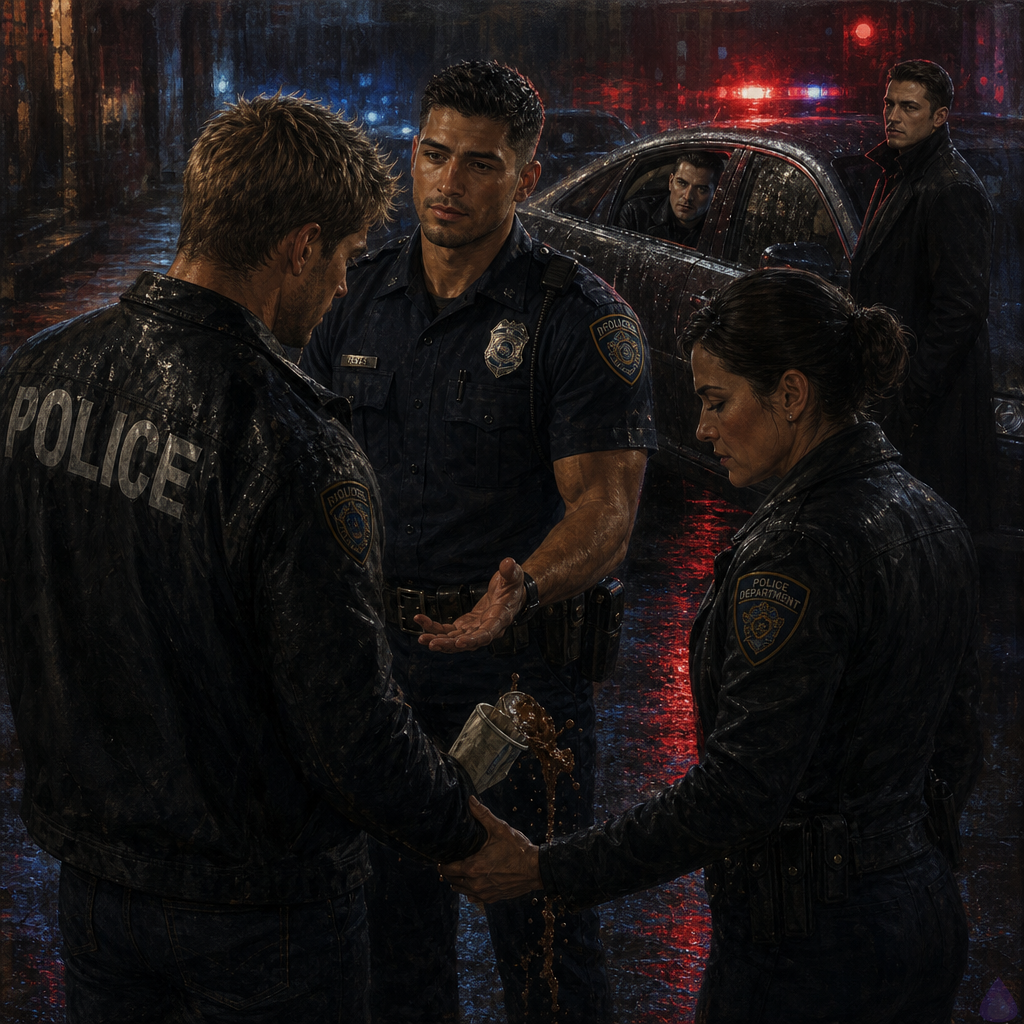
The jacket is too short in the sleeves and too broad through the shoulders, but it blocks the wind. The word POLICE stretches across your back in cracked white letters. You feel the irony of it almost physically, like a palm pressed between your shoulder blades. Ten years ago, you would have run from that word. Tonight, it sits over your scars and keeps the rain off.
You pat at invisible pockets, then look up at Mara with your best wounded expression.
You: “Now about the cigarette. Medical necessity. I’m allergic to bein’ sober and well-adjusted.”
Mateo’s expression changes.
Not disapproval. Not quite. More like concern drawn tight and kept polite because he knows better than to tug where you’re already fraying. Mara, less polite, snorts.
Mara: “You just came out of a crime scene and you’re going to the hospital. I’m not giving you a cigarette.”
You: “I didn’t ask you to give me one. I asked for one. There’s a difference if you squint and hate yourself.”
Mateo: “Dwayne.”
Your name in his voice quiets something before you can make it meaner.
Damn him for that.
He does not say it like a warning. He says it like a hand held near, not touching. Like he knows exactly how close is too close. You look at him despite yourself, and the rain has darkened his lashes, gathered at the strong line of his jaw. He smells faintly of wet wool and coffee and ambulance exhaust, and somehow you know that scent is going to find you later when you are trying very hard not to think about him.
Mateo: “I’m not going to lecture you. But if you light up right now, the paramedics will make you put it out in thirty seconds. Then you’ll be annoyed, they’ll be annoyed, and Sergeant Whitlock will absolutely win.”
Mara: “I do enjoy winning.”
You stare between them. The absurdity of it—standing under emergency lights debating tobacco like the world has not just tried to swallow you whole,makes another laugh scrape up your throat.
It turns into a cough.
Mateo takes one half-step forward, stops, and lets you decide whether to pretend you are fine.
You do pretend.
Obviously.
You: “Y’all are gangin’ up on an injured man. That’s ugly.”
Mateo: “You can hate us for it in the ambulance.”
Across the street, Adrian shifts by the unmarked car, his tailored overcoat shining with rain. He looks at the police windbreaker on your shoulders, then at your face, and whatever apology he had prepared dies before reaching his mouth.
Good.
Let it die there.
You are not ready to hold his guilt for him. You have barely got both hands around your own.
Then Julian’s cruiser door opens.
Only for a second. Only because one officer leans in to adjust something—maybe the restraints, maybe the seat belt. But Julian turns his head, and through the wet shine of distance, his steel-gray eyes find you. His lips move. No sound reaches you over the rain, but you know cruelty when it mouths your name.
The coffee cup crumples in your grip.
Hot liquid spills over your knuckles.
You barely feel it. Your whole body locks, muscles going hard under Mara’s jacket, breath cutting short in your chest. The alley narrows. Brick walls lean in. Rain becomes a hiss against metal. The ambulance light goes too white, too clean, too much like a room with no exit.
No.
Not there.
Not again.
Mateo moves then, not grabbing, not blocking your view by force. He steps into your line of sight with his palms open at waist height, dark eyes steady.
Mateo: “Look at me, Dwayne. Not him. Me.”
Your lungs refuse the first try.
The second comes rough.
Mateo stays there, rain sliding down his cheek, dimple gone, voice low enough that nobody else can make a spectacle of it.
Mateo: “He’s cuffed. He’s in a locked car. You’re outside. You’re wearing Mara’s terrible jacket. You insulted departmental coffee. That’s where you are.”
The details sound stupid.
They save you anyway.
You drag air in through your nose, then push it out through your mouth. Your hand hurts now, a delayed sting from the coffee, and somehow that is better than feeling nothing. Mara takes the crushed cup from you with clipped efficiency while pretending not to notice the way your knees nearly folded.
Mara: “Hospital. Now. Evidence can wait five minutes. Pride can ride in the back with you if it behaves.”
You look at the ambulance, its open doors glowing hard and sterile. Then at Adrian, standing useless and miserable in the rain. Then at Mateo.
His face gives nothing away except this: he will follow the choice you make.
That may be the most terrifying kindness of the night.
The cigarette remains unlit. The jacket stays on your shoulders. The city waits, wet and watching, while the next breath becomes yours again.
What readers chose (1 choices)
You let the paramedic steer you toward the ambulance, Mara’s borrowed windbreaker dragging heavy over your shoulders, and you make it two whole steps before the thought hits like a door slamming in a dark room.
Parents.
Your stomach drops so hard you nearly miss the curb. The ambulance lights smear red and white across the rain-slick pavement, and suddenly the alley is too bright. Too watched. Too full of people with radios who might have already done it. Might have checked a file. Found a number. Called home because that is what grown-ups do when a kid gets hurt, even when the kid would rather bleed out in the street than hear his father’s voice again.
“Wait.” Your voice cracks. You hate that. “Hey, no. Don’t call my family. I’m eighteen, all right? I’m legal. I can sign whatever y’all need me to sign, but don’t call them. Please don’t call them.”
The last word slips out naked.
Please.
Bare and ugly and too young. It tastes like blood and old fear. You try to throw a smirk over it, something sharp and careless, but your mouth won’t move right. Your eyes snap from the paramedic to Mara to Mateo, hunting for the exact second someone decides your panic is inconvenient and their judgment is mercy.
Mateo gets there first.
Not physically. He is already beside you, moving with the careful patience of a man guiding someone over cracked ice. But he reaches the answer before anyone else, his voice level, his body angled just enough to block the worst of the ambulance lights from your face.
“No one is calling your family without your permission,” he says. “You’re eighteen. You can make that call.”
You stare at him.
People say things all the time. Safe. Gentle. Trust me. Words are cheap until they cost someone something.
Mara turns toward the nearest uniform, her expression sharp enough to slice the rain in half.
“Confirm emergency contact hold,” she says. “No family notifications unless Cole authorizes it. Put it in the report and tell intake the same thing.”
“Yes, Sergeant.”
There.
Not soft words in a pretty voice. Orders. Paper. Procedure made into a shield.
Your throat tightens, stupid and painful, and you have to look away toward the wet street where Julian’s cruiser idles behind another patrol car. Its windows have fogged over. You can’t see him anymore.
Good.
The paramedic offers a hand to help you up into the ambulance. You ignore it for half a second on principle, then take it because your legs have apparently resigned from active service. The step is too tall. Or you are too tired. Both can be true. Inside, the air smells like antiseptic, rubber, rainwater, and cold metal. White cabinets line the walls. Straps hang from the cot. Every object has a place.
Which makes you feel very much like you don’t.
“Fancy,” you mutter, settling hard onto the bench. “Y’all got a minibar in here, or is that only for folks who get stabbed in nicer neighborhoods?”
The paramedic tears open a packet with her teeth. “We have saline, gauze, and a very judgmental blood pressure cuff.”
“Kinky.”
She pauses.
Then she laughs despite herself, short and startled, and Mateo’s mouth twitches as he climbs in after you, broad shoulders briefly filling the doorway. He brings the smell of rain in with him, damp wool and leather and something warmer underneath, coffee maybe, or soap worn down after a long shift. You hate that you notice. You hate more that it helps.
Mara stays outside, one hand braced on the open door, rain spotting her blazer and silvering the loose strands at her temples.
“Reyes rides with you,” she says. “I’ll meet you at the hospital after I finish here. Adrian Vale is being held for a statement. Julian Vale is in custody and will stay that way. You hear me, Cole?”
You nod too fast.
Mara doesn’t accept fast.
“Words.”
You swallow. The blanket scratches your neck. The police windbreaker clings cold to your arms. Somewhere beneath all that, your skin remembers hands it never invited.
“I hear you.”
Her face softens by a fraction, so small most people would miss it.
You don’t.
You learned to read weather in people’s faces before you learned long division.
“Good.” Mara taps the door once. “And for the record, the orange traffic vest is still on the table if you make my paramedic’s life difficult.”
“Yes, ma’am. Threat received.” You lift two fingers in a weak salute. “Deeply unfashionable.”
The doors shut.
Rain becomes a muffled hiss.
The ambulance lurches forward, and your body reacts before your brain can lie. Your hand shoots out and catches the bench edge. Hard. Your knuckles bleach white. The space is narrow. Closed in. The ceiling sits too low, and the straps on the cot look too much like restraints if you stare at them long enough.
Mateo notices.
Of course he does.
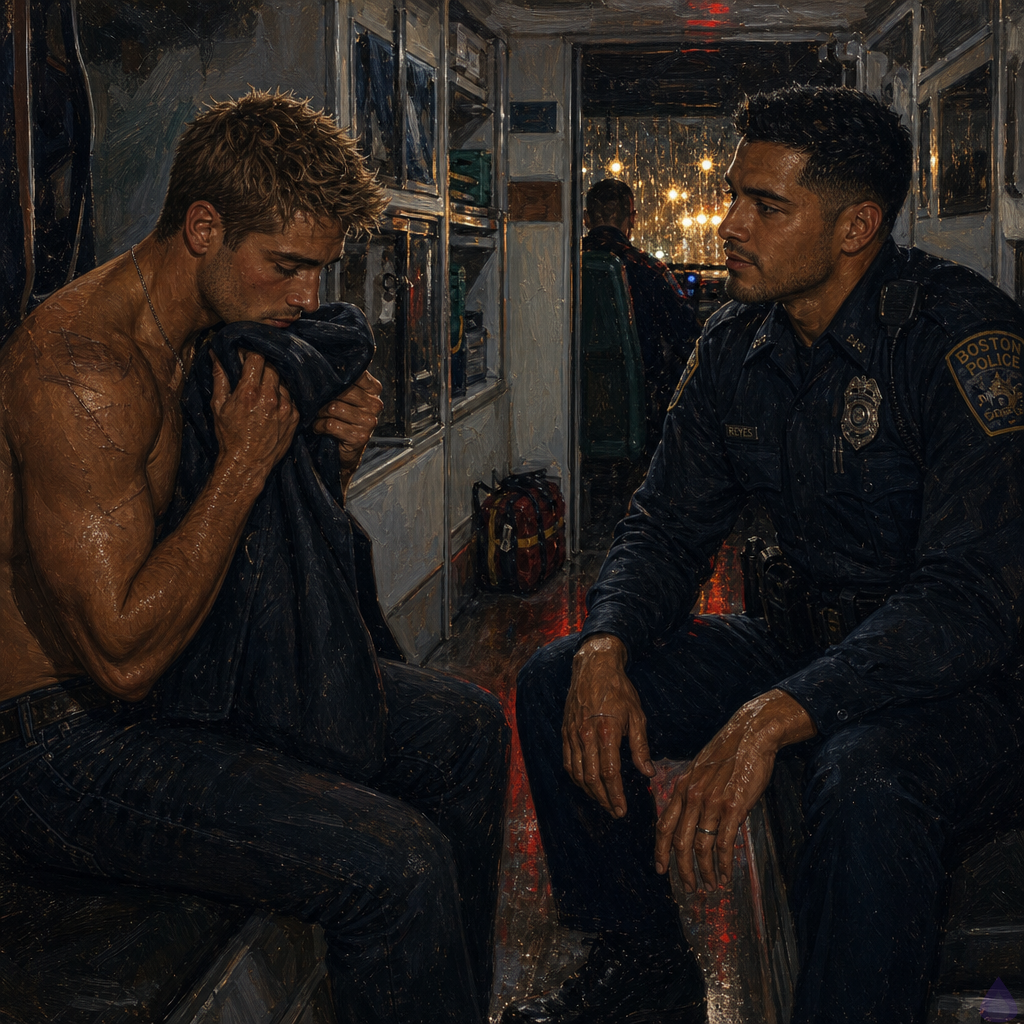
He sits across from you, not beside you, leaving a clean lane of air between your knees and his. His navy uniform is damp at the shoulders, badge dulled under the harsh lights, duty belt shifted so it doesn’t crowd the aisle. His hands rest open on his thighs. Empty. Visible. The faint scar across one knuckle catches the light when the ambulance turns.
“Window’s there,” he says quietly. “Doors are behind me. Paramedic’s up front. You are not locked in with anyone who can hurt you.”
Your chest pulls tight.
You force a grin. It arrives late, crooked and useless.
“You always narrate rooms, Officer, or am I gettin’ the deluxe rescue package?”
“Only for people who give bad coffee pet names.”
That almost gets you.
The laugh rises, breaks, and turns into a rough breath instead. You press your shoulder into the wall and stare through the small square window in the rear door. Streetlights smear past in trembling gold lines. The city looks different from inside an ambulance. Less like a hunting ground. More like something you might survive long enough to leave.
Then another thought crawls up, meaner than the first.
If they find your parents, they find Georgia. If they find Georgia, they find the name your father used like a curse. They find the church people who looked away, the mother who cried but still never opened the door, the boy who ran hungry and stupid and so desperate for kindness that the first warm car felt like rescue.
Until it wasn’t.
Your fingers dig into Mara’s jacket.
“If somebody asks for next of kin at the hospital,” you say, each word scraped raw, “you tell ’em I don’t have any.”
Mateo’s eyes stay on yours.
Dark. Steady. Too steady.
“I can tell them you declined to list one,” he says. “That’s the truth, and it protects you.”
There is that word again.
Protects.
You want to joke about him sounding like a courthouse pamphlet. You want to flirt because his voice is low and even, and because wanting him to keep talking is embarrassing enough to need camouflage. You want a cigarette so badly your hands ache. You want to lean forward until that clean lane of air between you disappears.
That one scares you most.
So you look down at your wet boots and say nothing.
For once, Mateo doesn’t ask you to fill the silence.
The ambulance turns, siren off now, tires whispering over soaked pavement. Behind you, the alley falls away. Ahead, the hospital waits with its fluorescent lights, intake forms, and questions that may cut cleaner than knives. But Mateo is still across from you, solid as a fixed point, and Mara’s order is already moving ahead through radios and reports.
No family notifications.
For tonight, that is almost enough to breathe around.
What readers chose (1 choices)
The ambulance rocks through a long turn, and the little square window catches your reflection in pieces. Dirty blond hair flattened by rain. Emerald eyes too bright in a face still trying to look careless. Mara’s windbreaker hangs off your shoulders with POLICE stamped across your back, stiff with cold water and smelling faintly of smoke, wool, and her mint gum. Underneath it, you feel eighteen again. Cornered. The walls at home pressing close, every floorboard ready to betray you.
You keep your gaze on your boots when you speak, because if you look at Mateo while saying it, you might not get the words out at all.
You: "My daddy used to call me Devil’s Spawn. Not when he was drunk or mad or havin’ a bad Tuesday. Just regular. Like it was my name. Like my mama named me Dwayne and he corrected her."
Mateo does not interrupt. He does not lean in. He does not perform shock for you. Across the narrow aisle, he stays seated with his hands open on his thighs, rain darkening the shoulders of his navy uniform, his calm gaze set near your face without pinning you in place. The ambulance hums around you. Tires hiss over wet streets. Cabinets rattle softly with every bump.
The words come easier once the first ones have bloodied the way out.
You: "He was real religious, you know. Not the casseroles and charity kind. The kind where every bruise is a sermon and every locked door is God teachin’ you obedience. Mama cried a lot. Prayed more. Stayed anyway. I ran when I was seventeen. Went to Atlanta, figured I was too pretty to die and too stubborn to go back."
Your mouth twitches at its own joke, but there is no breath behind it. Nothing warm. The paramedic up front keeps her eyes on the road, pretending not to hear while hearing enough to take the next turn smoother. Mateo’s jaw tightens once, a small muscle near his cheek jumping, but his voice, when it comes, is careful enough not to step on anything raw.
Mateo: "If they call them, you’re afraid he’ll come."
You laugh.
It sounds wrong in the sterile little box.
You: "No, Officer. I’m afraid he won’t have to. I’m afraid somebody at that hospital says his name out loud and I turn back into whatever he decided I was. I’m afraid my mama hears I’m hurt and still asks if I’ve repented before she asks if I’m alive. I’m afraid they look at me, look at what I had to do to keep from starving, and they think he was right."
There it is. The ugly heart of it, laid on the ambulance floor between your wet boots and his polished black ones. You feel stupid the second it leaves you. Dramatic. Weak. A grown man in a police jacket begging strangers not to call home.
Your shoulders tense.
You brace for comfort too soft to trust or silence too loud to survive.
Mateo gives you neither.
Mateo: "He was not right."
Simple. Flat. Bare.
It hits harder than sympathy would have.
You look up despite yourself. Mateo’s dark brown eyes hold yours, steady under the harsh ambulance lights. The small dimple in his left cheek is gone now, replaced by something quieter. Firmer. Not anger at you. Anger placed very carefully where it belongs.
Mateo: "You were a kid. You got out. You survived things no kid should’ve had to survive. None of that makes him right. None of it makes you what he called you."
Your throat works. Nothing comes out.
The ambulance seems smaller now, but not the same kind of small. The walls still sit close. The ceiling still presses low. Yet Mateo has named the exits and kept his hands visible, and the words he just gave you do not feel like a trap. They feel like a blanket that might actually be warm if you could stop flinching long enough to pull it closer.
So naturally, you try to ruin it.
You: "Careful, Reyes. Keep talkin’ sweet and I’ll start chargin’ by the hour for emotional labor. Premium rates for handsome men in uniform."
The joke lands limping but alive. Mateo’s mouth curves faintly, not because he missed the pain under it, but because he understands you need the joke to stand between you and the drop. The dimple threatens to return. Your traitorous gaze catches there and sticks.
Damn him.
Mateo: "I’ll submit it to payroll. They’ll deny it."
A real breath escapes you. Not quite a laugh. Close enough.
Then his expression sobers again, and he reaches slowly toward the side pocket of his vest. He pauses before removing anything, giving you time to track the movement, then pulls out a small notepad and pen. Ink clicks softly in the ambulance’s antiseptic air.
Mateo: "When we get to intake, I’ll tell them you declined next of kin. Sergeant Whitlock already ordered the hold, and I’ll repeat it in front of you. If anyone pushes, you say my name or Mara’s. We handle it. You don’t have to explain your childhood to a clerk at three in the morning."
The ambulance passes under a row of streetlights, gold flashing across his face, turning his warm sienna skin bronze, then shadowed, then bronze again. Rain clings to his lashes. His uniform smells like wet cotton, coffee, and the clean bite of winter air whenever the vehicle shifts and sends the scent your way.
You stare at him too long.
You know you do.
It is not desire exactly, or not only that. It is worse. It is the sudden, disorienting pull of wanting to believe someone will do what they said.
You glance away first.
You: "You always this decent, or did I catch you on your best night?"
Mateo: "I have bad nights. This just isn’t where I plan to put them."
That answer shuts you up.
The ambulance slows, tires crunching over the hospital drive. Fluorescent light floods the rear window, cold and official. Your pulse kicks again. Forms. Questions. Gloves snapping tight. Rooms with curtains instead of doors. People touching because medicine says they can.
Your hands curl around the edge of Mara’s jacket, knuckles aching. For one sharp second, you miss the cigarette you never got so badly your teeth hurt.
Mateo catches it.
Of course he does.
Mateo: "One step at a time. First, we get you inside. Second, we make sure no one calls your family. Third, you insult the hospital coffee and maintain your reputation."
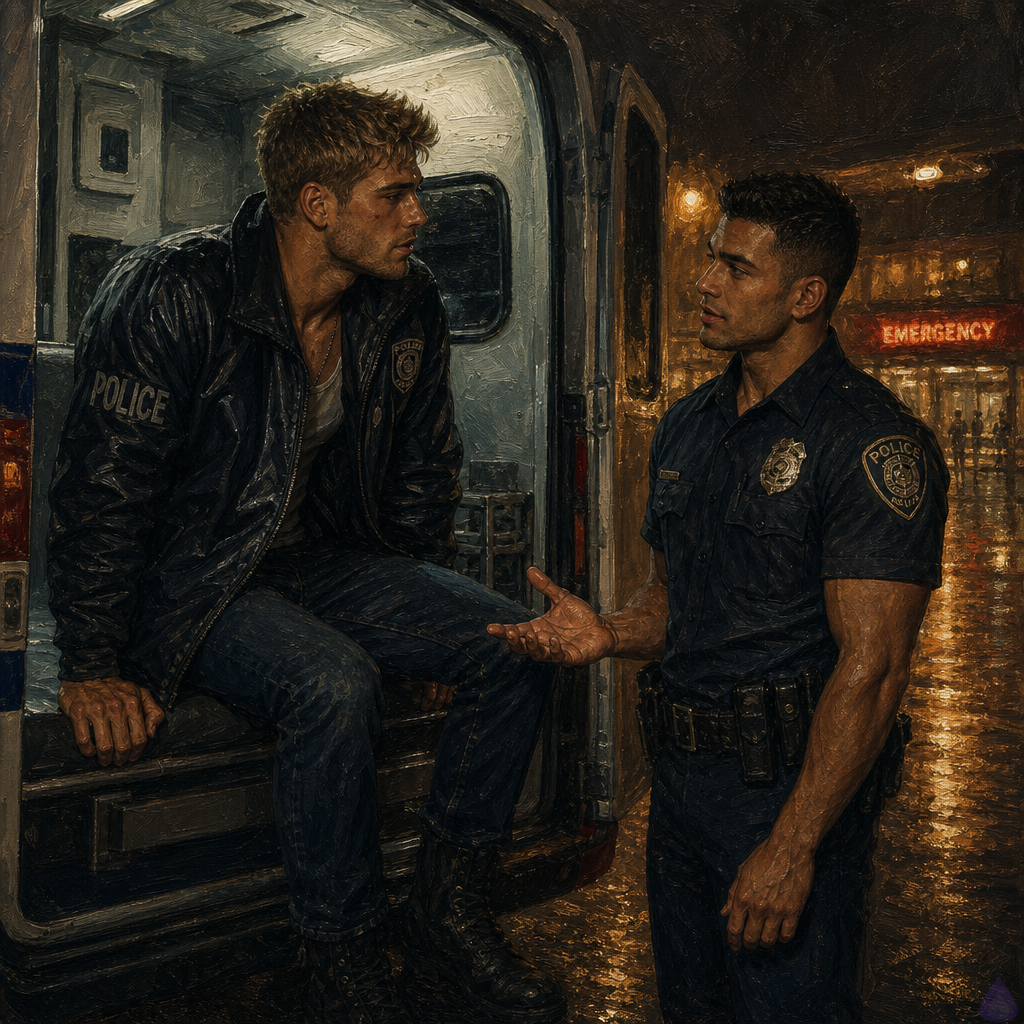
The doors open before you can answer. Wet night air rushes in, carrying sirens from somewhere far away and the sharp medicinal smell of the emergency entrance. Mateo steps down first, boots hitting pavement with a solid, grounding thud.
Then he turns back.
He does not offer his hand right away. His eyes ask first.
Your choice.
Always your choice.
You are still shaking. Your fingers still want to curl into fists or claws or anything that might keep the past from reaching through those hospital doors and taking you by the throat.
But Mateo waits.
So you breathe in rain, diesel, antiseptic, and him.
Then you take his hand.
What readers chose (1 choices)
You take Mateo’s hand because your legs have quit pretending they belong to you.
His grip closes around yours, firm and warm, no squeeze of ownership, no pull until you shift forward first. The ambulance step drops away beneath your boot like the edge of a cliff. For one sick second, the hospital entrance tilts bright and white around you—glass doors yawning open, rain hissing behind you, the world narrowed to his palm, his knuckles, the pale scar cutting across one of them. You lean harder than you mean to.
Mateo takes the weight.
No comment. No flinch.
You: “Don’t get excited, Officer. I make all handsome men carry me eventually. Usually there’s dinner first. Sometimes better lighting.”
His mouth almost moves. Almost.
Mateo: “We can complain about the lighting once you’re inside.”
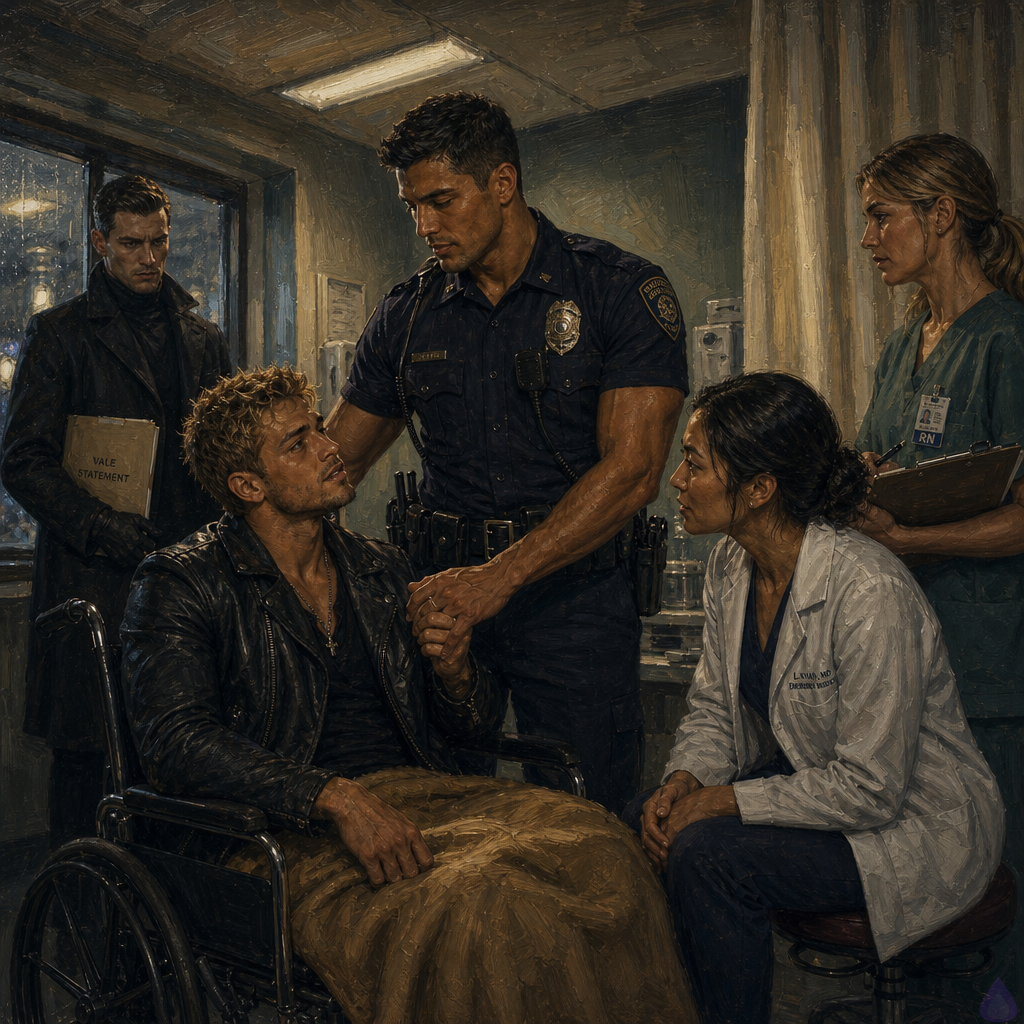
A nurse meets you with a wheelchair, and pride makes a brave little attempt to crawl out of its grave. It dies fast when your knees buckle again. Mateo’s other hand hovers near your elbow, close enough that you feel the heat of him through damp air, but he doesn’t touch until you nod. Then he helps you lower into the chair as if this is ordinary. As if needing help does not turn you into glass.
The emergency department swallows you whole—fluorescent glare, rubber soles squeaking on polished floor, intercom murmurs, the sharp antiseptic bite of a place built to fix bodies whether souls come along quietly or have to be dragged.
The exam room has a curtain instead of a door.
You hate it on sight.
A young doctor with tired eyes introduces herself as Dr. Kwan. The nurse, Elise, speaks in a voice pitched soft but not sweet enough to rot your teeth. Mateo stands near the wall where you can see him, arms loose at his sides, while another officer waits outside the curtain. Mara’s voice comes over Mateo’s radio, low and clipped, confirming that Julian Vale has been transferred to booking and Adrian Vale remains at the scene giving a statement under supervision.
The names hit the room like wet coats dropped on clean tile.
Dr. Kwan asks what happened.
Your mouth opens before the rest of you can stop it.
You: “Well, Doc, rich evil twin invited me to the world’s worst private party. Zero snacks, bad conversation, very hands-on customer service. Would not recommend.”
Elise pauses with her pen above the intake form. Mateo looks at the floor, jaw locked tight enough to hurt. Dr. Kwan does not smile.
She does not scold you either.
Dr. Kwan: “I’m sorry that happened to you. I’m going to ask specific questions so we know how to care for you and document your injuries. You can answer yes, no, or not right now. You can stop at any time.”
The permission should help.
It does, a little.
It also makes your ribs ache in a place no one can X-ray.
You start listing things because listing is easier than remembering. He grabbed you. He trapped you. He hit you. He threatened to kill you. He talked about corruption and sin in that calm, careful voice, the kind that crawled under your skin worse than shouting ever could. He used pain like punctuation, and you keep sanding the edges off every sentence with jokes until the room fills with them, thin and frantic as cigarette smoke.
You: “He had gloves. Real theatrical. I kept waitin’ for him to reveal a secret volcano lair.”
Elise writes. Her pen scratches softly.
You: “He asked if I’d ruined his brother. I told him Adrian came pre-ruined, but, uh, I do not think he appreciated my peer review.”
Mateo’s fingers curl once at his side. Then still.
You: “At one point I thought, wow, Dwayne, this is why you don’t date rich. Then I remembered I wasn’t dating anybody and got offended on principle.”
By the third joke, your voice has gone too bright. By the fourth, your hands are shaking so hard Elise has to set the blood pressure cuff aside and wait. Dr. Kwan’s expression stays steady, professional and kind in that terrible way that makes kindness feel dangerous.
Mateo lifts his eyes to yours from across the room.
Dark. Anchored.
Not pity. Not horror. Just there.
Mateo: “You don’t have to make it easier for us to hear.”
Everything stops.
Or maybe only you do.
You blink at him, caught with your grin still on and nothing underneath it ready for daylight. The curtain rustles as someone passes outside. Somewhere down the hall, a man laughs because a vending machine ate his money. Life keeps being ordinary in all the places you are not.
You: “Ain’t for y’all,” you say, but the drawl wobbles and betrays you. “It’s for me. If I stop bein’ funny, I might start bein’ honest, and nobody wants that kind of paperwork.”
There.
Too much.
Your throat burns.
Dr. Kwan lowers herself onto a rolling stool until her eyes are level with yours. Elise quietly lays a warm blanket over your lap, the weight of it startling in its gentleness. Mateo does not move closer, but his attention does—careful as a hand held near a candle flame, wanting to warm, afraid to scorch.
Dr. Kwan: “Honest is allowed here. Funny is allowed too. Silent is allowed. We just need to keep you safe while we examine you. Officer Reyes confirmed no family contact. Sergeant Whitlock called ahead personally. That boundary is in your chart.”
For a second, you cannot speak at all.
No family contact.
In your chart.
Not a favor whispered in a hallway. Not a promise that evaporates the second someone important frowns. A line written down where the hospital has to see it. Where they have to follow it.
Your chest loosens.
Then tightens again, because relief has teeth when you have been starving long enough.
The curtain parts just enough for Mara to step inside, rain still clinging to her dark blazer, hazel-green eyes taking in the room with one clean sweep. She has Adrian’s statement folder tucked beneath her arm and the look of a woman who has already fought two administrators and made one of them apologize. Mateo straightens slightly.
You catch it.
Mara catches you catching it.
Of course she does.
Mara: “Vale says Julian used Adrian’s phone to send the message that lured you there. Adrian claims he suspected something was wrong and called it in when you didn’t answer. I don’t need you to process that right now. I need you alive, medically cleared, and deciding who gets access to you.”
Adrian’s guilt presses at the edge of the room without him being there. Julian’s cruelty sits heavier, locked somewhere behind badges and steel, but still breathing in the back of your mind. You look from Mara to Dr. Kwan to Mateo, then down at your own hands, pale-knuckled against the blanket.
The jokes are still there, lined up and ready.
So is the truth.
Ugly. Exhausted.
Waiting behind your teeth.
What readers chose (1 choices)
You tell them about the knife without looking at the knife tray.
You tell them about the cuts in careful little pieces, like you’re reporting damage to somebody else’s car. Shallow here. Deeper there. The place on your shoulder where Julian took his time because he liked making a lesson out of skin. You tell Dr. Kwan about the belt, or whip, or whatever rich men call things when they want cruelty to sound old and expensive. You tell Elise where it landed, where it burned, where it knocked the breath out of you before you could decide whether screaming would make him happier.
Then you grin so wide your face aches.
You: "Honestly, Doc, felt almost like home. Minus the charming Southern hospitality and the part where my daddy quoted scripture after. Julian’s got no showmanship. Two stars. Maybe two and a half for wardrobe."
Silence drops hard.
Not empty silence. Full silence. The kind where every person in the room decides not to rush you, not to throw noise over your words just because they’re unbearable. Elise’s pen stops moving for half a breath, then scratches on. Dr. Kwan’s eyes stay on your face, but something in them changes, soft around the edges without going wet. Mara goes still by the curtain, one hand gripping the folder so tight the paper bows. Mateo, across the room, looks like every muscle in his body has been ordered to stay calm and is obeying under protest.
Dr. Kwan: "Dwayne, I am very sorry. We are going to treat every injury with care. I also need to ask whether there was any sexual assault tonight. You can answer however you need to."
The room tilts.
There are fluorescent lights above you, too clean and too bright, buzzing faintly like trapped insects. A monitor beeps somewhere beyond the curtain. Your borrowed police windbreaker hangs open now, and the warm blanket over your lap suddenly weighs too much, too much like being pinned down. You hear the question, and your brain does a fast, ugly little dance around it. Sexual assault sounds like a thing that happens to other people. People with cleaner histories. People who didn’t learn to turn hunger into a price and a smile.
Your mouth moves before the rest of you can vote.
You: "Nah. I mean, not like that. Don’t worry about it. I’ve done worse for rent."
Mateo’s head lifts.
Not sharply. Not like accusation. Just enough that you feel his attention settle on you with terrible precision, warm and heavy as a hand between your shoulder blades.
Dr. Kwan does not write that down right away.
Dr. Kwan: "Being paid in the past does not mean anyone has the right to touch you now. Or ever. Your consent matters every time."
Your laugh comes out fast, bright, and dead on arrival.
You: "Well, that is a real inspirational poster, and I appreciate the font choice, but we got plenty of injuries already. No need to go diggin’ for bonus content."
Mara’s voice cuts in, low and hard, but not at you.
Mara: "No one is digging. We are asking because your care changes depending on what happened, and because Julian Vale does not get protected by what you think you’re allowed to call it."
There it is again. That impossible rearranging of blame. You hate it. You want it. You want to spit it out and swallow it whole at the same time.
Your hands curl into the blanket. The motion drags at sore places, and your breath catches before you can hide it. Mateo takes one step forward, then stops himself near the foot of the bed. Close enough for you to catch the faint line of the scar across his knuckle again. Close enough that his voice reaches you without filling the room.
Mateo: "You do not have to tell us everything right now. But you also do not have to protect him from the truth. Not Julian. Not Adrian. Not anyone who paid and called it kindness because that made it easier to sleep."
Adrian’s name hits different.
You look up, and for a second the exam room isn’t the exam room. It’s the back seat of a car that smelled like expensive leather and winter cologne. It’s Adrian Vale watching you with misty gray eyes, asking if you were cold, paying more than agreed, touching like gentleness could become absolution if he performed it carefully enough. You had hated him for being kind in the shape of something that still bought you. Hated yourself more for the relief of him. For thinking, at least it’s him.
You: "Adrian didn’t do this."
Your voice comes out sharper than you mean.
Mateo takes the correction with a small nod, but his face stays grave.
Mateo: "I know. Julian did. And Adrian’s choices are still part of the investigation. Both can be true."
Mara’s gaze flicks between you and Mateo, measuring the thread there, then she steps closer to the bed. The sparrow tattoo behind her right ear shows when a loose silver-streaked strand slips from her bun.
Mara: "Cole, listen to me. You decide what medical exam you consent to. You decide what statement you give tonight. But do not make those decisions because some man taught you your body was public property. That lesson was a lie."
Something in your chest cracks so quietly nobody else should be able to hear it.
You hear it anyway.
Dr. Kwan folds her hands over her clipboard.
Dr. Kwan: "We can do this in stages. We can treat visible injuries first. We can bring in a forensic nurse and explain every step before anything happens. You can decline any part. Officer Reyes can stay if you want him to, or Sergeant Whitlock, or neither."
The choices stack up in front of you, too many and too intimate. Stay. Leave. Tell. Don’t tell. Let them document. Let them touch. Keep the joke alive. Let it finally die.
Outside the curtain, the hospital keeps breathing in muffled layers. A cart rattles by. Someone coughs. A radio crackles with Mara’s name, and Julian Vale’s follows a moment later, cold syllables wrapped in procedure. Booked. Photographed. Processed. Alive and contained, for now.
You stare at Mateo because it is easier than staring at yourself.
His dark eyes do not tell you what to do.
That may be the worst kindness yet.
You: "If I say it," you whisper, the drawl almost gone, "then it happened."
Mateo answers soft, steady, immediate.
Mateo: "It happened whether you say it or not. Saying it only means you stop carrying it alone."
Your grin tries to come back.
It fails halfway.
For once, nobody makes you finish the joke.

What readers chose (1 choices)
Mara does not move right away when you say you want to make it official.
She studies your face instead, those hazel-green eyes steady beneath the loose, silver-streaked strands at her temples, as if she can sort the words by weight—fear on one side, that stubborn little ember still burning under all the wreckage on the other. Her gaze doesn’t flinch. Neither do you.
Barely.
Then she nods once, clipped and final, and turns toward the curtain.
Mara: "We do it on your terms. Dr. Kwan treats what needs treating first. Then I take your statement in here, with medical staff nearby, not in an interview room. Reyes stays only if you want him. No one rushes you. No one edits you. No one calls your family."
The last sentence lands harder than the warm blanket.
No one calls your family.
You try to grin, because apparently your mouth still thinks it works for a living, but the thing that comes out is lopsided and tired. Half-built. No roof. Dr. Kwan cleans and dresses the visible injuries with Elise assisting, explaining each step before she touches you, waiting for your nod every time. Gauze whispers. Antiseptic stings sharp and cold. Gloved fingers pause at the edge of every bruise like permission is something sacred.
It should feel ridiculous.
It doesn’t.
It feels like being handed tiny pieces of control in a room where you expected to have none.
Mateo stands where you can see him, dark eyes lowered whenever the exam requires privacy, his broad shoulders held brutally still beneath his damp navy uniform. Rainwater still clings to the fabric. He smells faintly of storm air, coffee, and the clean bite of hospital soap, and you hate how badly that steadies you. He is there without taking up all the oxygen.
So, of course, you track his breathing when yours gets lost.
When the worst of the immediate care is done, Mara pulls a chair close, but not too close, and sets a recorder on the rolling tray between you. The little red light blinks. Patient. Unblinking. She states the date, time, location, her name, your name, and the fact that you are giving the statement voluntarily after receiving medical care.
It sounds so neat when she says it.
So official.
Like horror can be folded into file tabs if the right woman has a badge, a pen, and hands steady enough not to shake.
Mara: "Start wherever you can, Cole. If you need to stop, say stop. If you need water, say water. If you need me to repeat a question, I will."
You look at the recorder.
Then at Mateo.
His jaw is tight enough to hurt, but when your eyes catch his, his expression softens into something simple and solid. He gives you a small nod. Not permission. Faith.
That is worse.
That is better.
You drag in a breath that scrapes all the way down and begin with Adrian, because that is where the story started before Julian took it apart and made it bleed.
You tell Mara how Adrian Vale first found you, how he kept coming back in that tailored charcoal overcoat with his misty gray eyes and his careful voice. How he paid too much and asked too little. How you hated the gentleness almost more than you hated the money, because gentleness made it harder to file everything cleanly under survival and shut the drawer.
You tell her he never hurt you the way Julian did.
Then you make yourself say the rest.
His loneliness still bought access to your fear.
Your voice wavers there, thin as wet paper. Mateo looks down at his hands. Mara’s pen keeps moving, steady scratch after steady scratch.
Then you tell her about the message from Adrian’s phone. The address. The way the house felt wrong the second you stepped inside, all polished wood and stale air and silence too thick to breathe through. Julian Vale waiting in black gloves and a dark coat, identical to Adrian in bone and blood and utterly different in the eyes.
You do not make it pretty.
You do not make it brave.
You tell her he trapped you, hurt you, threatened to kill you, and called it punishment. The words scrape your throat raw. You tell her about the sexual assault too, not with details that would hollow you out in front of them, but with the clear words Dr. Kwan told you were enough.
The recorder catches them.
The room catches them.
You do not disappear.
For a while afterward, nobody speaks. The hospital hums around the silence—carts rolling past the curtain, distant voices rising and falling, rain tapping faintly against the window like nervous fingers. Your hands tremble in your lap, and your whole body feels emptied, like you have poured poison out of a bottle and only now noticed the bottle was part of you.
Mara stops the recorder and labels the file with decisive fingers. Then she sets the device down and looks at you.
Not like evidence.
Not like a case.
Not like something broken open for her report.
Mara: "That was enough. More than enough. Julian Vale is not walking away from this because you were too ashamed to name what he did. You just took that weapon out of his hand."
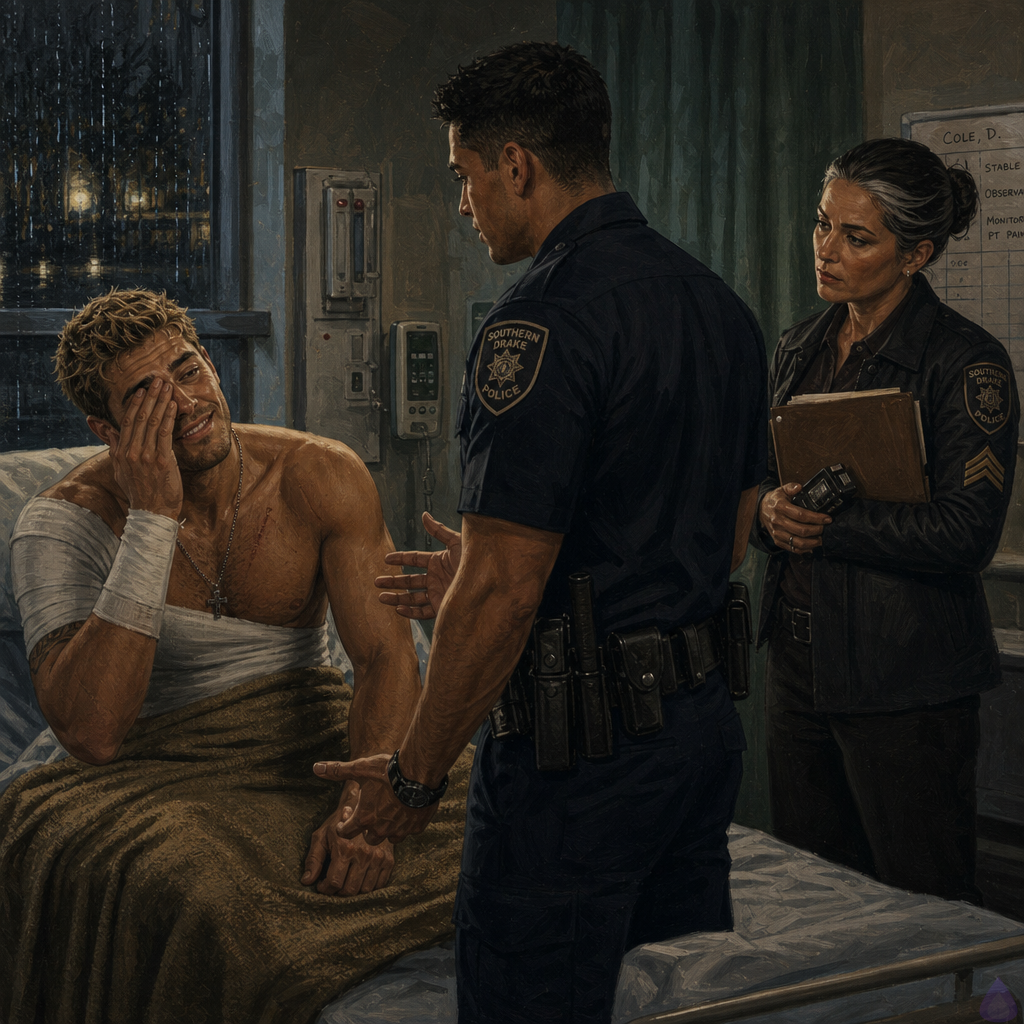
A laugh slips out of you, thin and wet. Ugly. Yours. You press the heel of your palm to one eye before it can become anything worse.
You: "Well, hell. Somebody get me a cape. Apparently I’m heroic when concussed and undercaffeinated."
Mateo’s smile appears slowly, aching at the edges, the little dimple in his left cheek barely showing. It hits you somewhere tender. Somewhere bruised in a way Dr. Kwan can’t dress. He steps closer only after you glance his way and don’t look away.
Mara notices.
Of course she notices.
All she does is gather her folder and angle herself toward the curtain.
Mara: "Reyes, stay with him. I’m going to update the warrant team and lean on booking before Julian’s lawyer starts earning his watch. Adrian remains contained for questioning. Cole, you are safe in this room until I personally say otherwise."
When she leaves, the space changes.
Not smaller.
Quieter.
Mateo stands at the foot of the bed with his hands visible, rain drying in his close-cropped black hair, his calm, assessing gaze holding all the things he is disciplined enough not to say. You are suddenly aware of the blanket, the bandages, the hospital gown, the police windbreaker folded over the chair, and the fact that you have never felt less charming in your life.
Never less armor-plated.
Never more seen.
Mateo: "You did not have to be funny for any of that. But you were still you. I hope you know that."
Your throat closes.
The joke comes late, softer than usual, with less bite to hide behind.
You: "Reyes, if you keep sayin’ things like that, I’m gonna have to accuse you of bein’ emotionally competent. In public."
His smile warms, just enough to make the fluorescent room feel less cruel. Not gentle, exactly. The room is still the room. Your body still hurts. The red marks under the bandages still burn.
But outside, Julian is in booking, Adrian is answering for what he knows, and Mara is turning your words into pressure against locked doors.
Inside, Mateo stays.
And for the first time tonight, staying does not feel like being trapped.
What readers chose (1 choices)
Sleep takes you in ugly pieces.
One minute Mateo is a warm, steady shape near the foot of the hospital bed, navy uniform wrinkled from rain and too many hours, dark eyes lowered to the paper cup cooling untouched in his hands. The next, the fluorescent ceiling bleeds into gray morning, and you wake with your tongue stuck to the roof of your mouth, your body held together by gauze, tape, and pain you can measure one breath at a time.
For half a second, you do not know where you are.
Then the curtain whispers back.
Sergeant Mara Whitlock steps in with her blazer creased, her silver-streaked bun coming loose at the nape, and a face that says the night has found one last place to put the knife.
Mara: "Cole. Julian Vale is dead."
The words do not land.
They hang above you, cold and clean, like breath fogged on glass. Mateo stands behind her, off duty now but still looking like he forgot how to be anything but on guard—dark jeans, forest-green henley, brown leather jacket damp at the shoulders. His broad hands curl once at his sides, then go still.
Too still.
Through the gap in the curtain, Adrian Vale is a pale ruin in his charcoal overcoat, one hand pressed hard to his mouth as if grief might spill out if he lets go. Julian, with his black gloves and steel-gray eyes and careful, polished cruelty, is suddenly gone. Nowhere a warrant can find him. Nowhere your anger can reach.
Mara: "He was found in booking before arraignment. Medical staff responded. He left a statement blaming you and Adrian both. It won’t erase what he did. Your statement stands. The evidence stands." Her mouth tightens. "But there will be no trial."
You laugh.
God, it’s awful.
Thin. Cracked. Almost bright. The sound of something breaking and pretending it meant to. Your ribs flare white-hot in protest, and your eyes sting so badly you fix on the small sparrow tattoo tucked behind Mara’s ear, because if you look at Mateo—if you catch even one ounce of pity in those dark eyes,you might come apart right here in this narrow bed, under this scratchy blanket, with your blood still drying beneath hospital tape.
You: "Well. That’s just rude. Man tortures me, ruins my night, then skips the customer satisfaction survey." Your throat scrapes around the words. "Rich folks really do hate accountability."
Beyond the curtain, Adrian makes a sound like he’s been struck.
You do not look at him.
You can’t. His grief is too big, too complicated, too expensive, and your own rage has nowhere to go but back into your body. It burns there. Quietly. Like a cigarette held to skin.
Mara brings discharge papers two days later with victim services numbers, a temporary shelter referral, and practical instructions printed in neat black ink—the kind that assume there is a world waiting to help, if only you call the right office between nine and five and can survive on hold without falling apart. She speaks gently. Mateo says nothing from the doorway, but you feel him there the way you feel weather in an old scar.
You sign where they tell you.
Then you leave with no money, no jacket that belongs to you, no key in your pocket, and no place in the whole bruised city where you can lock a door and believe it will stay locked.
Every shelter bed sounds like another crowded room.
Every crowded room sounds like sleep putting a hand over your mouth.
So you walk.
The hospital releases you into a wet afternoon, pavement shining under weak sun, the air smelling like exhaust, rainwater, and the sour-metal tang of the city after a storm. Your borrowed clothes hang wrong on your body. Too loose in the waist. Too tight over the bandages. Every step tugs at stitches you pretend not to feel.
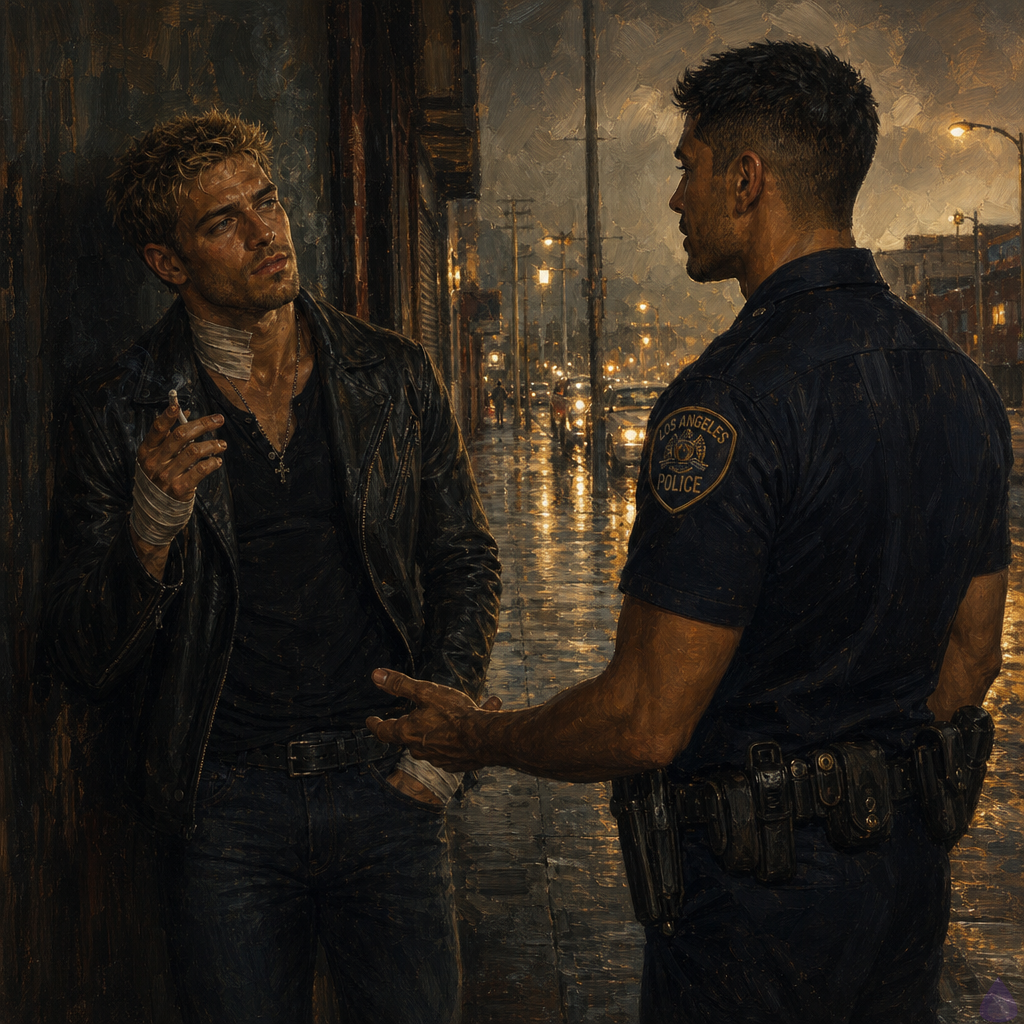
A cigarette burns between your fingers.
First one since the alley.
It tastes so good you hate yourself a little.
You tell yourself you are just going to ask around. Just going to see whether the old street remembers your name. Just going to find the man who once turned hunger into a contract and a roof into a leash, because maybe a leash is better than sleeping under an overpass with fresh wounds and no one to hear you if you stop saying no.
Three blocks from the corner where the streetlights start to thin, a car rolls slow beside the curb.
Your spine locks.
Mateo gets out before you can decide whether to run.
No uniform now. Just the forest-green henley, dark jeans, brown leather jacket, close-cropped black hair roughed up by the wind. He looks tired enough to be human. Dangerous enough to be a problem. His eyes drop to the cigarette, your bandaged side, the direction of your feet.
He does not touch you.
He does not block the sidewalk.
He just stands between you and the old route like a man willing to be hated if hatred is the toll for keeping you breathing.
Mateo: "Dwayne. Don’t go back to him."
Your smile comes quick. Sharp. Mean.
Soft things cost too much today.
You: "Ain’t your shift, Officer. You stalkin’ all your favorite paperwork now?"
A muscle jumps in his jaw. Not anger. You know anger. This is worse. This is him taking the hit because he thinks you need somewhere to put your teeth.
Mateo: "Mara called when you didn’t show at the shelter intake. Adrian offered to pay for a hotel, and she told him to stay useful from a distance." His voice drops, roughened by cold air and something he won’t name. "I came because I know what this corner means."
That steals the breath right out of you.
Behind him, traffic hisses through dirty puddles. Ahead, the streetlights give up one by one, thinning into familiar shadow. Somewhere down there is a door. A mattress. Rules you know. Men you know how to read before they decide what your body is worth.
Survival.
Not safety.
Never safety.
Mateo’s face is open and worried, but not pleading. He lets you see the fear there without handing it to you like a debt. The wind lifts the edge of his jacket, carrying the scent of rain, coffee, and clean soap, and something in you aches so hard you almost hate him for smelling like a room where nothing bad has happened yet.
Mateo: "You get a say. Still." He swallows. "Tell me you want me gone, and I’ll step back. But I’m asking you to come with me first. One meal. One safe room arranged through Whitlock, not Adrian. No debt. No favors you have to pay with your body. Just tonight."
The cigarette trembles between your fingers.
Stupid hand.
You want to laugh. You want to cry. You want to tell him he is too late and exactly on time. You want to press your forehead to his chest and listen for proof that somebody in this city can stand close without taking.
You don’t move.
Neither does he.
The street waits on one side.
Mateo waits on the other.
What readers chose (1 choices)
You: "Okay. And what then? I'll still have no job and no roof over my head."
The words cut sharper than the cigarette smoke.
You stand on the wet sidewalk with Mara’s shelter address folded in your back pocket like a joke somebody forgot to finish, bandages tugging beneath borrowed clothes, the old corner breathing at your back. Damp brick. Old grease from the diner vent. Rainwater shining black in the gutter.
Mateo’s face shifts, just a little.
Not wounded. Not offended.
Worse.
He looks like a man who expected the question and still hates that the honest answer won’t fit into one clean sentence.
Mateo: "Then tonight we solve tonight. Tomorrow, Sergeant Whitlock gets you into victim services again. They can help with emergency housing, replacement documents, medical follow-up, witness compensation, job placement programs. It won’t be fast enough. It won’t be fair enough. But it is real."
You laugh under your breath and flick ash toward the gutter. The cigarette trembles between your fingers despite your best attempt to make it look careless. Across the street, a bus exhales at the curb, windows fogged with strangers who all seem to know where they’re going.
You used to hate people like that.
People with keys. People with paychecks. People bored enough to complain about rent as if rent wasn’t a miracle with four walls and a lock.
You: "Programs. Lord help us, he brought out programs. Next you’re gonna hand me a pamphlet and tell me the power of positive thinkin’ can pay first and last month’s deposit."
Mateo steps closer.
Then stops.
Right at the line where closeness becomes pressure.
His brown leather jacket is dark at the shoulders from the rain. The forest-green henley beneath it clings to the solid heat of him, ordinary and warm and impossible, and you hate that your body registers him before your pride can tell it not to. Coffee on his breath. Rain in his hair. Soap, clean and faint, under the city’s rot.
His dark eyes hold yours, steady enough to make you want to look away and stubborn enough that you don’t.
Mateo: "No. I’m going to tell you I called Mara before I came after you, and she’s already yelling at someone from a city-funded safe housing program. She is very good at yelling."
That almost gets you.
A stupid little breath of a laugh slips out before you can kill it. You picture Sergeant Mara Whitlock in her dark blazer, silver-streaked bun half coming down, hazel-green eyes pinning some poor administrator to a wall through a phone line.
The image is satisfying enough to hurt.
You drag on the cigarette again, needing the burn, needing the ugly familiar taste of something you chose even if it’s killing you slow.
Mateo: "Adrian offered a hotel again. Mara said no unless the funds go through a victims’ assistance account with no contact, no strings, and no room number he can know. He agreed. He’s still answering questions. Julian’s death doesn’t close the investigation into how you were lured there."
Adrian’s name lands like cold rain down your collar.
Julian is dead, and somehow still in the middle of everything. Adrian is alive, grieving, guilty, maybe useful, maybe dangerous in the way soft things can be dangerous when they come wrapped around money.
You look down the street, toward the dim stretch where the old life waits with its rules simple as a fist.
You know that kind of danger.
It asks less imagination of you.
You: "So I go to some safe room paid for by a man who used to buy me, arranged by a cop, watched over by another cop, and I’m supposed to call that free?"
Mateo’s mouth tightens.
For a second, the city noise crowds into the space between you. Tires whisper through puddles. A siren cries somewhere far off. Bass thumps from a passing car, then fades into wet pavement and exhaust.
Then he nods once, slow.
Mateo: "No. You’re supposed to call it not going back tonight. Free comes later. Maybe in pieces. Maybe with a lot of paperwork and a job you hate at first and a room that feels too quiet. Maybe with you furious at everyone trying to help because help still feels like a bill you can’t pay."
Your throat closes before you can make fun of him.
Damn him.
He says it too well.
Not pretty. Not like a rescue fantasy where love shows up with clean sheets and the past politely dies outside the door. He says it like he knows survival isn’t the same as being saved, and that makes the cigarette taste worse.
You look at his hands, broad and empty at his sides.
He could grab you.
He doesn’t.
He could order you.
He doesn’t.
He only stands there, off duty and tired, between you and the place where the streetlights end, letting the rain bead on his lashes like he has nowhere else in the world to be.
Mateo: "I can drive you to the safe house. Mara will meet us there. If you don’t like it, we leave and find another option. If you need to curse at me the whole way, I can take it. If you want silence, I can do that too. But I will not pretend that man back there is shelter just because he knows how to price a desperate person."
The cigarette burns down close to the filter.
You stare at the ember until your eyes sting.
A job. A roof. A name in a system that might drop you. A dead attacker who escaped trial. A wealthy client whose money might keep you from sleeping outside. A principled cop with a dimple you should not notice and a voice that keeps making impossible things sound like steps instead of cliffs.
It would be easier if he wanted something.
A kiss. A debt. Gratitude prettied up as obedience.
But he just waits.
And that feels more dangerous than any hand on your wrist.
You drop the cigarette into a puddle and watch it die with a small hiss.
You: "Fine. But if this safe house has inspirational posters, I’m stealing one and holding it hostage."
Mateo’s smile comes slowly, tired and real, the dimple appearing like a little betrayal against the grim day.
Your heart gives one foolish kick.
Traitor.
Mateo: "I’ll warn Mara. She negotiates hard."
He opens the passenger door of his car and steps back, leaving the choice physically clear. You can still walk past him. You can still turn toward the old corner. You can still ruin your own rescue just to prove nobody gets to keep you.
The rain slides cold beneath your collar.
The car waits, engine murmuring, warm air fogging the edges of the glass.
Instead, you get in.
The seat is warm. The car smells like leather, rain, and coffee gone cold. Mateo closes the door gently, not trapping you, just shutting out the wind.
Through the windshield, the streetlights blur into gold.
For once, the road away from them is the one you take.

What readers chose (1 choices)
Mara gets you the interview by bullying three people, charming one, and pretending not to see it when you show up in a borrowed button-down, sleeves rolled high to hide the shaking in your hands. The security company works a contract at a downtown office tower—all glass doors, slick marble floors, cameras tucked into every corner, and a night-shift supervisor who clocks your lean muscle, your military posture, the scarred steadiness you keep tucked under your jokes, and decides you might be worth the risk.
You: "So what I’m hearin’ is I get paid to stand around lookin’ handsome and suspicious. Ma’am, I was born for this."
You get hired two weeks after discharge.
Not rescued.
Hired.
There is a difference, and you cling to it hard enough to leave fingerprints. The uniform is plain black instead of navy, stiff across your shoulders, with a plastic badge clipped over your heart and boots you polish until the leather throws back the light, because it feels good to make something shine on purpose. Adrian’s money stays behind a wall of victim assistance paperwork, untouchable by him, faceless enough that you can sleep in the safe apartment without feeling his hand on the rent. Julian remains dead, a closed cell in a report and an open wound everywhere else. Mara keeps checking in like a storm cloud with a calendar.
Mateo checks in too.
At first, it is rides to appointments. Then coffee after your shift, always somewhere public, always with him sitting across from you instead of beside you unless you choose otherwise. Off duty, he wears that forest-green henley, dark jeans, and brown leather jacket that make him look softer than he has any right to, warm sienna skin turned gold by diner lamps, dark eyes catching every flinch you try to bury under charm. He smells like rain on leather and coffee gone sweet with too much sugar. His laugh is quiet. Low. It lands under your ribs and stays there.
You tell yourself you like him because he is safe.
Then you tell yourself you like him because he is handsome.
Then one night, after your first full paycheck hits your account, you stop lying about either.
You take him to a little bar with cracked vinyl booths and a jukebox that favors old country heartbreak. You mean to have one drink. Maybe two. Celebration drinks, not need drinks. But the whiskey goes down warm, and your nerves have been screaming for weeks, and Mateo’s laugh does something stupid to your chest when you call the bartender a saint for overpouring. He watches your glass a little too carefully after the third, concern tucked behind that calm gaze, but he does not scold you.
That almost makes you want another just to prove you can.
Mateo: "You want food with that?"
You: "Officer Reyes, are you implyin’ I can’t hold my liquor? Because I’ll have you know I come from a proud Southern tradition of bad decisions and worse coping mechanisms."
His smile fades at the edges.
Not all the way.
Enough.
You should stop there.
Instead, outside under the bar’s flickering sign, with rain threatening but not falling, you turn toward him too fast. The sidewalk tips. Just a little. His hand rises toward your elbow, then pauses in the damp air, asking without words.
That tiny hesitation cracks you open.
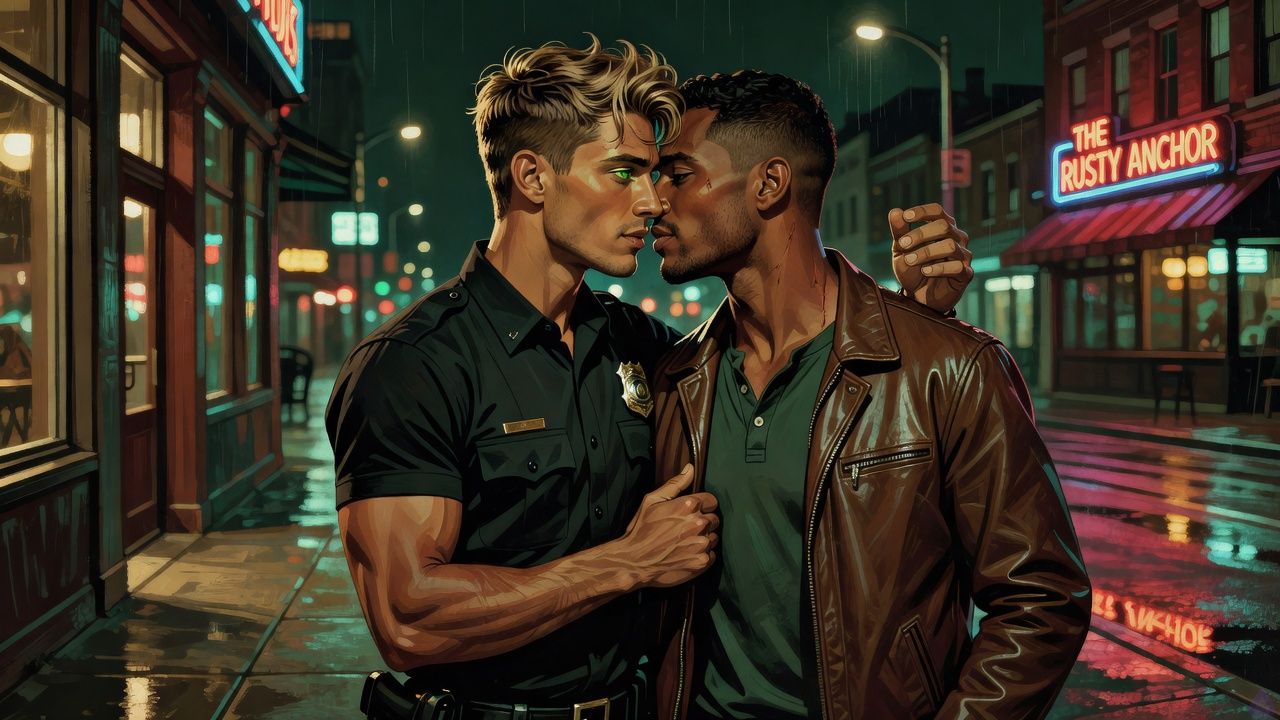
You are so tired of asking the whole world whether you are allowed to want something. Tired of measuring every breath, every reach, every hunger against somebody else’s comfort. Tired of being grateful for scraps of gentleness like they are meals. So you step in, catch the front of his leather jacket in both hands, feel the worn creases under your fingers, and kiss him.
For one breath, Mateo kisses you back.
It is not much. His mouth is warm, startled, careful. He tastes like coffee and the single beer he nursed all night. One hand comes up near your shoulder, not gripping, just there, and the almost-touch sends heat through you so sharp it nearly hurts. The neon buzzes overhead. Traffic hisses over wet pavement. Your whole body reaches for him with a hunger that has nothing to do with survival and everything to do with being seen. Chosen. Wanted without a price.
Then he pulls away.
Fast.
Too fast.
Mateo steps back like he has touched fire, breath uneven, eyes wide with something you cannot read because panic turns every language into disgust. His hand drops to his side. The space between you becomes a verdict.
Mateo: "Dwayne, I can’t. Not like this. I’m sorry."
The words split open every old place at once.
Not like this becomes not you.
I can’t becomes I don’t want you.
Sorry becomes shame.
You laugh because if you do not laugh, you might make a sound neither of you can survive hearing.
You: "Well, hell. That bad, huh? Don’t worry, darlin’, I’ve had worse reviews. Usually they still tip."
His face changes, pained and urgent, but you are already stepping away. Your black security uniform suddenly feels like a costume, your badge a cheap toy, your first paycheck a joke the city let you believe for a few days. You lift both hands as if surrendering to a cop, because apparently you are still cruel enough to know exactly where to cut.
Mateo: "That is not what I meant. You’ve been drinking, and I was part of your case. I care about you too much to blur that line when you might feel cornered later."
You hear the explanation.
You do.
Some reasonable, sober little corner of you even understands it.
But the rest of you is eighteen again under bad lights, being taught that your wanting is dirty and your body is only useful until someone better remembers what you are.
You: "Sure. Boundaries. Very professional. Congratulations on bein’ the gentleman in this tragic little misunderstanding."
You turn before he can answer, walking too straight, too fast, through the damp glow of the streetlights. Your boots strike the pavement hard enough to rattle up your shins. Behind you, Mateo says your name once, rough enough to almost stop you.
Almost.
You keep going anyway, because running first is the only kind of dignity your body remembers.
What readers chose (1 choices)
You do have another drink.
Then another half of one, because the bartender tops you off before you can decide whether pride counts as a good reason to stop. The whiskey burns clean going down, turns the bar lights soft at the edges, and gives your smile enough electricity to stay hooked to your mouth all the way home.
You tell yourself you’re celebrating the job.
You tell yourself Mateo’s mouth had not gone warm under yours for one impossible breath before he stepped back.
You tell yourself a lot of things while your key scrapes at the lock of the safe apartment Mara fought to get you.
By three in the morning, the apartment is dark.
Too quiet.
You wake sitting halfway up, heart trying to kick its way through your ribs, whiskey sour at the back of your throat. There’s a sound at the door. A soft scrape. A pause. Another scrape. The deadbolt swims in your vision, silver and useless.
The walls fold inward.
Your bedroom is not your bedroom anymore. It is polished wood and stale air. A lock clicking. Black gloves smoothing down over long fingers.
You: "No. No, no, no. He’s dead. He’s dead, damn it."
The scrape comes again.
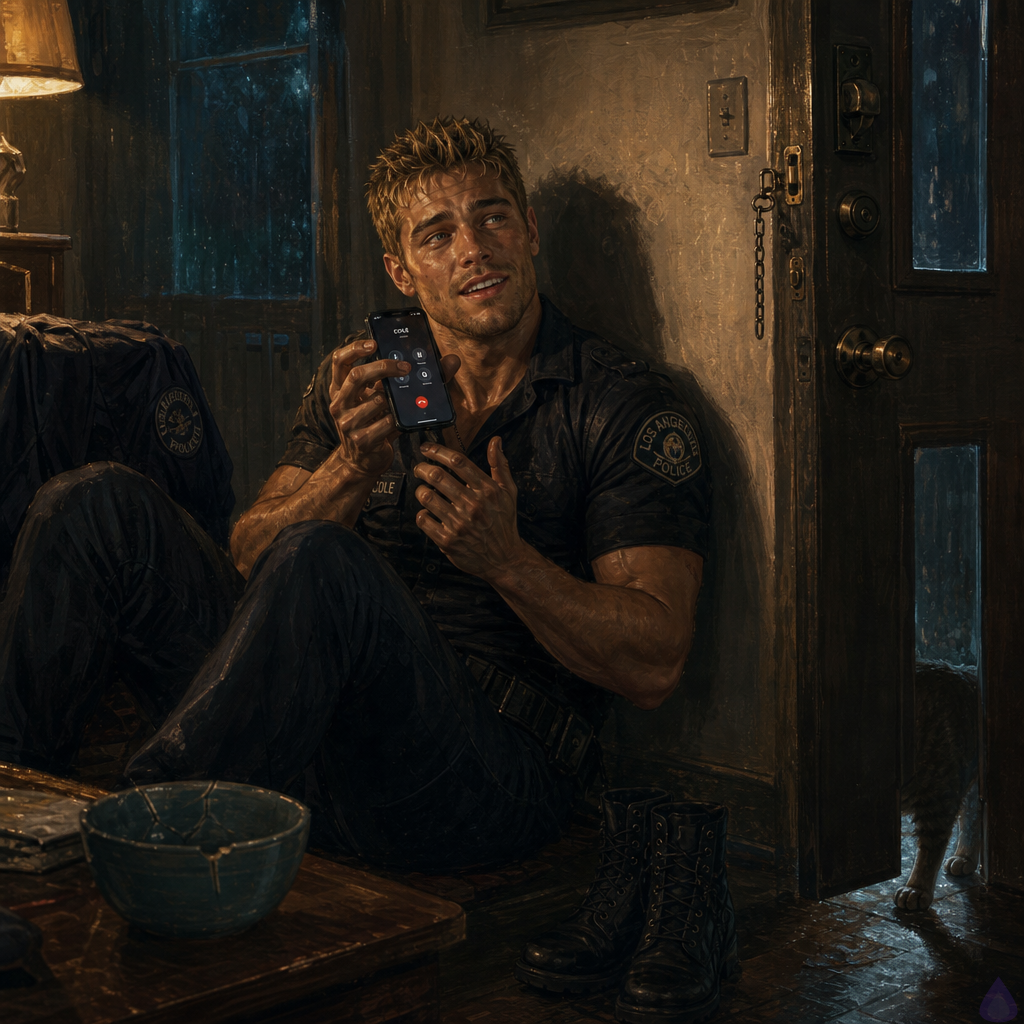
You grab your phone so hard it nearly slips from your hand. Mateo’s name glows on the screen before you remember choosing it. Before you remember deciding you were done with him, done with his decent eyes and careful hands and the way he could reject you gently enough to make it hurt worse.
The call rings once.
Twice.
Mateo: "Dwayne?"
His voice is rough with sleep, low and immediate. Not annoyed. Not distant. Warm in the dark, and God help you, your breath catches so hard it turns into a broken laugh.
You: "Hey, Officer. Sorry to interrupt your beauty sleep, but I’m pretty sure a dead man’s tryin’ to break into my apartment, and I would like to file a complaint with the afterlife. Very poor boundaries."
There’s a shift on his end. Fabric rustling. A lamp clicking on. When he speaks again, the sleep is gone.
Mateo: "Are you inside with the door locked?"
You: "Unless I sleepwalked into a damn metaphor, yes."
Mateo: "Good. Put your back against a wall where you can see the door. Not a closet. Not the bathroom. Somewhere open. Keep me on speaker. Can you do that?"
You move because his voice gives the room a shape.
Bed. Floor. Wall. Window. Door.
Not Julian’s room. Not your father’s house. Not the back seat of Adrian Vale’s car. Your apartment. Your cheap couch with one leg slightly crooked. Your security uniform hanging over a chair, smelling faintly of starch and city rain. Your boots by the door. Your first paycheck folded in an envelope under a cracked ceramic bowl because banks still feel like places built to laugh at you.
You slide down against the living room wall, phone trembling in your palm. The scrape happens again, followed by a tiny metallic clatter.
You almost stop breathing.
Mateo: "Talk to me. What did you hear?"
You: "Scratchin’. At the door. Like a horror movie, but with worse rent control."
A pause.
Not doubt. Listening.
Mateo: "Do you have a peephole?"
Your laugh comes out too loud.
You: "You want me to walk toward the door? Bold strategy."
Mateo: "No. Stay where you are. I’m getting dressed. I’m ten minutes out. I’m also calling it in for a welfare check. If there’s someone there, they won’t be dealing with you alone."
Someone there.
Your stomach flips. You press the heel of your hand against one eye until sparks burst behind it.
You do not want cops at your door. You do not want neighbors peeking out. You do not want to be the man in the hall again, barefoot and shaking, proving to the whole building that safe housing is wasted on someone who cannot even sleep inside it.
You: "Don’t send uniforms. Please. I just, I don’t know. Maybe I heard a mouse. Maybe I heard my own damn liver beggin’ for mercy."
Mateo is quiet for one breath too long.
Mateo: "How much did you drink after I left?"
There it is.
The shame finds you fast, hot and mean. It crawls up your neck, tightens your face, sharpens your tongue before you can stop it.
You: "Oh, we doin’ that now? You gonna put on your serious voice and tell the poor traumatized idiot he drinks too much? I know, Reyes. I was there. Participated heavily."
Mateo: "I’m not calling you an idiot. I’m saying alcohol is making the fear louder, and it’s hurting you. I care that it’s hurting you."
You hate him.
For not yelling. For not leaving. For saying care like it’s allowed between you after he stepped back under the bar sign and made you feel like poison in a pretty glass.
Your throat burns worse than the whiskey ever did.
You: "You don’t get to care when it’s convenient and run when it ain’t."
Silence lands.
Soft this time.
Wounded.
On the other side of the apartment door, something thumps.
Your whole body jerks. The phone nearly hits the floor. Mateo says your name, once, sharp enough to catch you before you bolt.
Mateo: "Dwayne. Look at the uniform on the chair. Tell me what color it is."
You: "Black."
Mateo: "Your boots. Where are they?"
You: "By the door. Right where the ghost psycho can critique my polish job."
Mateo: "Good. The bowl with your paycheck?"
Your eyes sting.
You: "Coffee table. Blue crack down the side. Ugly as sin. Mara said it was charming, which is how I know she lies for work."
Mateo: "That’s where you are. Your apartment. Your things. Your door locked. I’m almost there."
A new voice crackles faintly through his phone, distant but clear enough to recognize Mara’s clipped authority. She must be on another line with him, or he’s called her already.
Of course he has.
Sergeant Mara Whitlock, patron saint of yelling at systems and men who think boundaries are suggestions.
Mara: "Cole, if you can hear me, do not open that door. Reyes is close. Patrol is staged at the block, not at your threshold unless needed. You are not in trouble."
You let your head fall back against the wall. A laugh slips out, small and wrecked.
You: "Everybody keeps sayin’ that like I’m not a full-time trouble factory."
Mara: "You are a part-time trouble factory with benefits pending. There is a difference."
The scrape comes one last time.
Then a soft, offended meow rises from the hallway.
You freeze.
Mateo goes silent.
Mara says, very dryly, through the phone,
Mara: "Is that Julian Vale’s ghost, or a cat?"
For one second, nothing in the world makes sense.
Then the absurdity hits so hard your breath breaks open. You laugh, but it shudders too close to crying, and you clamp your free hand over your mouth as if you can hold the sound in.
A cat.
A damn hallway cat trying to murder your dignity at three in the morning.
The laugh collapses halfway through.
You: "I thought he was back."
No joke follows.
No armor, either.
Mateo’s voice softens until it nearly undoes you.
Mateo: "I know. I’m still coming up. You can tell me to wait outside when I get there. You can tell me to leave. But I’m not letting you sit with this alone."
You close your eyes.
The apartment smells like stale whiskey, rain through the cracked window seal, and the cheap detergent from the donated sheets. Your body hurts. Your head hurts. Your pride is somewhere dead in a puddle beside the cigarette you put out earlier.
But the door is locked.
Julian is dead.
Adrian is still kept at a distance by paperwork and Mara’s teeth.
Mateo is on his way.
And for the first time since waking, the room has corners again.
What readers chose (1 choices)
You open the door with the chain still hooked, because bravery has limits, and yours is wearing yesterday’s shirt and breathing whiskey fumes.
Mateo stands in the hallway under the sick yellow ceiling light, one hand visible at his side, the other holding his phone with Mara still on speaker. His brown leather jacket is thrown over a forest-green henley like he dressed in a hurry, dark jeans tucked into rain-spattered boots. His close-cropped black hair is mussed from sleep. His dark eyes sweep your face once. Careful. Quick. Taking inventory without making you feel like evidence.
The hallway cat sits between his boots, tail curled primly around its paws, looking deeply unimpressed by the entire justice system.
You: "Turns out the murderer was four pounds of judgment and fleas. Real twist ending. M. Night Shyamalan wishes."
Your voice cracks on the last word.
The joke hangs there, too bright and too thin, and then your mouth gives up on holding its shape. You keep one hand on the doorframe because the apartment floor has started to lean again—not enough to drop you, just enough to remind you the drinks are still in your blood and the hangover is waiting with a knife behind its back.
Mateo does not smile at the joke.
He does not frown either.
Mateo: "Can you unhook the chain, or do you want me to stay out here?"
That question nearly breaks you worse than if he had shoved his way in.
Your fingers fumble with the chain. Metal scrapes metal, loud as thunder in the narrow hall. When the door opens wider, warm apartment air spills out, stale with whiskey, sweat, cheap detergent, and the sharp burnt-match stink of panic. You step back too fast, sway, and Mateo’s hand lifts an inch before stopping midair.
Asking.
Always asking.
You nod once, too small to be proud of, and he comes in only far enough to shut the door behind him. He smells like rain and cedar and the coffee he must have swallowed too fast on the way over. Safe things. Dangerous things, because you want to lean into them.
He locks the door, then turns the deadbolt slowly so you can hear the click.
Not trapped.
Secured.
The cat meows from the hallway, deeply offended not to be invited, and somehow that tiny normal sound makes your eyes sting.
Mara: "Reyes?"
Mateo: "I’m inside. Door secured. No intruder. Hallway cat confirmed as primary suspect."
There is a pause over the phone.
Mara: "Tell Cole the cat has no priors, but I remain suspicious. I’m keeping patrol on the block for fifteen minutes, then clearing them unless you request otherwise. Cole, you are still not in trouble. Drink water. Do not argue with me through Reyes."
You: "Wouldn’t dream of it, Sergeant. I only argue directly. It’s classier."
Mara: "Good. Then directly hear this. Julian Vale is dead. Adrian Vale is nowhere near your building. Your emergency contact hold remains active. Your apartment placement is still secure. You had a trauma response, not a failure. Reyes will update me in the morning."
The call ends before you can thank her, which is probably mercy.
Silence settles after Mara’s voice disappears, leaving only the refrigerator hum, the faint drip in the sink, and your own uneven breathing. Mateo sets his phone face down on the small kitchen counter, then looks around without snooping. Security uniform on the chair. Boots by the door. Blue cracked bowl on the coffee table with your paycheck envelope tucked beneath it. A glass on its side near the sink. Half a bottle of whiskey on the counter.
His gaze stops there.
So does yours.
Shame moves fast. It fills the room before either of you can speak.
You: "I’m sorry."
Rough. Plain. No armor on it at all.
You swallow and try again, because apparently you are determined to make the night worse by being honest.
You: "I’m drunk. Or hungover. Or sittin’ right on the ugly little fence between the two. And I’m scared. I’m so damn scared I can’t tell a cat from a dead man, and I kissed you, and you ran, and I acted like an ass because that was easier than admitting I thought you were disgusted by me."
Mateo’s face changes in a way you cannot bear to read. Pain, yes. Concern. Something warmer beneath both, held back by discipline and decency and that hard clean line he keeps drawing because somebody has to.
Because you sure as hell won’t.
He takes off his jacket and drapes it over the back of a chair, slow and deliberate. His sleeves have shoved up his forearms, and there is a faint scar across one knuckle, pale under the dim kitchen light. You hate that you notice. You hate more that your body remembers the shape of his mouth from earlier, the heat of that almost, the split second when wanting him had felt like falling and flying and picking the lock on your own cage.
Then he fills a glass with water from the tap and places it on the coffee table.
Not in your hand.
No forced care. No cornering you with kindness.
Mateo: "I didn’t run because I was disgusted. I stepped back because you’d been drinking, because I was involved in your case, and because I want anything between us to be something you choose sober and safe." His jaw tightens. "Not because you’re hurting. Not because you think you owe me closeness to keep me here."
Your laugh is small and ugly.
You: "That sounds real noble. Hate it."
Mateo: "I know."
That almost makes you laugh for real.
Your eyes burn first.
You sit hard on the couch before your knees can betray you, elbows on thighs, fingers laced tight enough to hurt. Mateo stays standing by the chair, broad shoulders loose, weight balanced like he knows exactly how not to crowd a frightened person. It should make him feel farther away.
It doesn’t.
It makes you want him closer.
You: "I don’t know how to do this. Any of it. Job. Apartment. Not goin’ back. Not drinkin’ every time my skin remembers somethin’. Likin’ somebody who doesn’t want to take a damn thing from me." Your throat closes, but the words shove through anyway. "I keep waitin’ for the bill."
Mateo’s voice lowers, soft enough that you have to listen with your whole body.
Mateo: "There is no bill from me. But there may be consequences from the drinking. Not punishment. Consequences." He pauses, and the room seems to hold its breath with him. "Fear gets louder. Sleep gets worse. You miss shelter appointments, or shifts, or you end up walking toward people who know how to use you. I’m saying that because I care, not because I’m judging you."
You stare at the water glass.
Then at the whiskey.
Then at him.
Julian is gone. Adrian is distant, wrapped in paperwork and guilt. Mara is awake somewhere, still guarding the edges of your life like she can threaten the whole city into behaving. Mateo is in your apartment at three in the morning, close enough to want and too honorable to touch what hurt and alcohol have made blurry.
Your chest aches with it.
With him.
With the terrible, unfamiliar shape of being allowed to choose.
You pick up the water.
Your hand shakes.
But you drink.
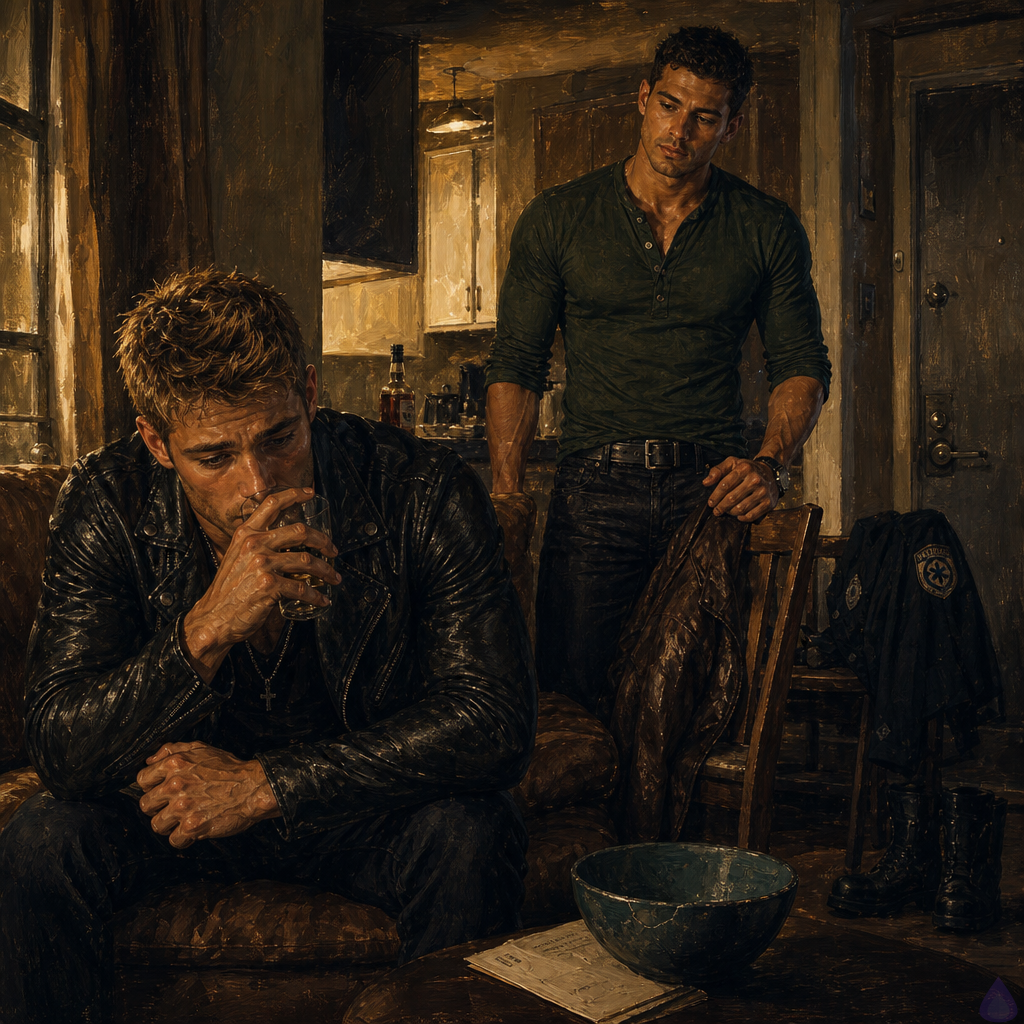
What readers chose (1 choices)
You fall asleep on Mateo before you mean to.
It happens with the water glass empty on the coffee table and the whiskey bottle shoved, very deliberately, into the sink, as if proximity to water might drown the damn thing. One minute you’re sitting stiffly on the couch, swearing you’re only resting your eyes because the room keeps swaying in a rude and personal manner. The next, your shoulder tips into Mateo’s arm, your temple finds the solid heat of his chest, and his whole body goes carefully, painfully still beneath you.
He doesn’t wrap you up. Doesn’t take. Doesn’t turn it into anything you’ll have to regret in the morning.
He only shifts enough to keep you from sliding sideways, one hand open on the back of the couch, the other curled loose in his lap. He smells like rain on leather, coffee gone cold, and the clean soap he buys in bulk because he’s that kind of responsible bastard. The last thing you remember is the slow drum of his heartbeat under your ear, steady as a locked door, and his voice, barely louder than the refrigerator hum.
Mateo: "Sleep, Dwayne. I’ve got the door."
A year passes. Not cleanly. Not like a movie with bright music, a better haircut, and one inspiring montage where you learn to jog at sunrise. It comes in stubborn little pieces.
You keep the security job. You get promoted to lead night guard after catching two idiots trying to steal copper wire from a maintenance room. You move from the safe apartment into a small place with a narrow balcony and a lock you chose yourself, heavy brass, clean click, yours. Mara still calls every other week, claiming it’s professional follow-up while bringing groceries when you pretend you forgot to eat. Adrian Vale’s money keeps filtering through restricted victim funds, never with a note, never with a visit, and you hate him less on some days than others.
Julian remains dead.
Not gone.
He lives in sounds at the door, in black gloves reflected in shop windows, in that split second before waking when your body still believes the room has no exit.
Mateo becomes both easier and harder.
He’s there for coffee after brutal shifts, his sleeves pushed to his elbows, his laugh rough with exhaustion when you complain about coworkers who think flashlights are optional. He’s there for courthouse paperwork when Julian’s estate lawyers try to bury ugly facts under expensive language. He’s there the afternoon Adrian sends a formal apology through Mara and you leave it unopened on the table for three days, the envelope sitting there like a dare.
Mateo never kisses you drunk.
Never presses.
Never lets his eyes drop to your mouth when you’re swaying, too loud, too brittle, trying to turn want into a joke before it turns into need.
But on sober evenings, when your shoulder brushes his on the balcony and neither of you moves away, the almost between you grows teeth. The city breathes below, damp concrete and exhaust and somebody’s garlic dinner drifting up from another floor. Mateo’s knee bumps yours. His hand rests on the railing close enough that you could hook one finger around his if you were a braver man.
Sometimes he looks at you like he’s choosing patience with both hands clenched around it.
Sometimes you make jokes sharp enough to make him step back.
Just to prove he still can.
The drinking stays too.
At first it’s celebration. Then sleep medicine. Then punishment with ice. Then habit wearing a nicer jacket. You tell yourself you’re functioning because your uniform is pressed, your rent is paid, and nobody at work knows how often you rinse vomit out of the sink before dawn, water running cold over your shaking hands. You tell yourself plenty of men drink too much. You tell yourself worse things have had their hands on you, and whiskey is at least honest about burning.
Then the bad night comes.
It’s raining, because apparently the city has no imagination.
You’re walking home from a late shift after drinking at a bar you promised Mateo you’d stop visiting, the kind with sticky floors and a bartender who never asks questions as long as you tip. Your coat is soaked through. Your ribs feel loose. The streetlights smear gold across the pavement.
A kid, maybe sixteen, thin as a matchstick, is being shoved against the wall outside the alley by a man with a hand twisted in his hoodie.
The old ruthless part of you wakes instantly.
Clean. Cold. Ready.
You step in. You swing first. You win, technically, if winning means the kid runs and the man ends up cursing in the gutter with blood on his knuckles and rain in his mouth.
But you’re drunk enough that your boot slips on wet pavement.
There’s no grace in it.
Your ribs hit the curb. Air punches out of you. Your shoulder tears open along old scar tissue, bright pain ripping white through your vision. By the time patrol lights paint the brick blue and red, you’re laughing with blood on your lip, telling the responding officers you’re fine, charming, heroic, and available for weddings.
Mara arrives in a fury so cold it sobers you more than the rain ever could. Her dark hair is pinned back in a practical bun, silver streaks bright beneath the streetlight, hazel-green eyes fixed on you like she might personally staple common sense to your forehead.
Mara: "You could have called it in. You could have backed off. You could have not been drunk. Pick any one of those miracles, Cole."
You: "In my defense, Sergeant, I did save the kid and provide free entertainment for your officers. Civic engagement."
Her face doesn’t move.
That’s when Mateo steps out of his car.
Off duty. Brown leather jacket thrown over a dark shirt, hair mussed like he dragged his hands through it the whole drive, jaw locked so tight you can see the muscle jumping. One look at him and the joke dies in your mouth.
Not because he’s angry, though he is.
Not because he’s disappointed, though God help you, that’s there too.
It dies because he looks scared.
And you realize, with sudden sick clarity, that you’ve made him stand on a wet street at two in the morning wondering whether this is the night your luck finally runs out.
The hospital is a blur of X-rays, bandages, antiseptic sting, and Mara’s clipped voice turning the incident into statements instead of charges. Adrian’s name appears only because the victim assistance fund still covers treatment, and you snap that you don’t want his guilt paying for your bad decisions.
Mara tells you to shut up and accept medical care.
Mateo says nothing.
Not in the exam room. Not while the nurse cleans blood from your shoulder. Not while you try to make one more joke and taste copper instead.
He waits until dawn, when he drives you home and parks under the weak gray light outside your building.
You sit in his passenger seat with your head against the window, hungover, bruised, and hollowed out by the fact that nothing truly terrible happened only because other people kept arriving in time. Rain ticks softly on the roof. Mateo’s hands rest on the wheel, broad and still. Too still.
Your throat hurts.
You: "I need help."
Mateo turns toward you slowly.
You keep staring through the windshield because if you look at him, pride might crawl back into your throat and choke the words dead.
You: "With the drinkin’. I don’t want a speech. I don’t want you to fix me with those big tragic eyes." Your laugh comes out broken. Barely a sound. "I just… I can’t keep doin’ this. I’m gonna get somebody hurt. Maybe me. Maybe some kid in an alley who needed a sober man and got me instead."
For a moment, Mateo only breathes.
Then his hand settles on the center console between you.
Palm up.
Not touching.
Waiting.
Mateo: "Okay. We get help. Real help. Mara knows programs that are not just pamphlets. I can sit with you while you call. I can drive you. I can hold boundaries when you hate me for them." His voice roughens there, just enough to hurt. "But I cannot be your only lifeline, and I cannot be your reason to quit. You have to be your reason."
Your eyes burn. Your ribs ache. Julian’s shadow, Adrian’s guilt, Mara’s anger, Mateo’s careful love—all of it crowds the small car until you can barely breathe.
Still, you place your shaking hand in his.
His fingers close around yours, warm and solid, not a rescue.
An anchor.
You: "Then help me find a reason that ain’t dead yet."

What readers chose (1 choices)
Mateo’s hand is still wrapped around yours when the question slips out, rougher than you meant it to.
You: "The kid. The one in the alley. Did he get home safe?"
For a second, Mateo only looks at you. Gray dawn leaks through the windshield and catches the bruised tiredness under his eyes. His thumb doesn’t stroke over your knuckles. He’s careful even with comfort, like one wrong touch might make you bolt.
But his fingers tighten once.
Small. Solid.
Mateo: "Mara found him. His name is Leon. Sixteen. He refused the hospital, but she got EMS to check him out and drove him to his aunt’s apartment herself. She’s arranging a follow-up with youth services that he may or may not dodge." His mouth flattens. "He asked if the drunk blond guy was dead."
A laugh scrapes out of you before you can stop it. It hurts your ribs, sharp and bright, so it breaks into a wince halfway through. Rain ticks on the car roof like impatient fingernails. The security badge in your pocket digs into your thigh, hard plastic and cheap metal, proof that somewhere, somehow, you still belong to an ordinary life.
Even when you keep trying to stagger out of it.
You: "Drunk blond guy has excellent hair and a minor curb-related disagreement. Tell him I am wounded by the lack of faith."
Mateo’s mouth twitches.
Not a smile. Not quite.
He looks at you the way he did in the hospital a year ago, when you kept turning pain into punchlines and he refused to let the jokes carry the whole damn room. There’s affection there now, deeper and more dangerous because it has had time to root itself in places you didn’t give permission for. There’s worry too.
You hate the worry.
You lean into it anyway.
Mateo: "You saved him. And you scared him. Both are true."
The words settle between you, less like judgment and more like a bill finally set on the table.
You stare through the rain-blurred windshield at your apartment building. Stained brick. Narrow balconies. Your chosen lock. Your chosen door. The life you keep almost choosing.
Somewhere inside, there’s a sink with no whiskey in it because you finished the bottle before it could drown. Pressed black security uniforms hang in your closet, waiting for a version of you who shows up clean and on time. An unopened envelope from Adrian Vale sits in a drawer, his formal apology folded into expensive paper and expensive guilt. Julian Vale’s absence waits in every dark corner, taking up more space than any dead man has a right to.
You: "I didn’t mean to scare him."
Your voice comes out small.
Too honest.
No drawl thick enough to cover it.
Mateo releases your hand only long enough to pull his phone from his jacket pocket. He holds it where you can see the screen, not dialing yet.
Another choice made visible.
His knuckles are nicked from some old workday scrape. The faint scar across one catches the dim dawn. You want, stupidly, to press your mouth there. To apologize against his skin. To be forgiven without having to become someone worth forgiving first.
You don’t move.
Neither does he.
Mateo: "Then we start there. We call Mara. We ask about the recovery program she mentioned. Not tomorrow. Not after sleep. Not after you decide this was embarrassing and try to charm your way out of it." His voice softens, which somehow makes it worse. "Now."
Your stomach twists.
Program.
The word tastes like stale coffee and fluorescent lights. Chairs in a circle. Strangers nodding while you decide which version of yourself is least humiliating to admit out loud. The thought of saying, I drink too much, makes your skin crawl worse than any confession about blood or bruises.
Bruises were things done to you.
This feels like something you did with both hands.
You: "What if I call and then don’t go?"
Mateo: "Then we call again. Or we try a different kind of help. Detox consult. Trauma therapist. Recovery group. Outpatient program." He keeps his eyes on you, steady as a hand at your back. "You don’t fail because the first door doesn’t fit."
You look at him then.
Really look.
Warm sienna skin dulled by exhaustion. Dark brown eyes that have every right to be furious and are, instead, painfully present. Brown leather jacket creased at the elbows. Forest-green shirt rumpled from being dragged out of bed because you decided whiskey was easier than sleep and fists were easier than fear. He smells faintly like rain, coffee, and the cedar soap he uses, a clean, familiar ache in the tight space of the car.
He should be angry enough to leave.
He should be tired enough to stop answering.
Instead, he waits with the phone in his hand.
Your throat burns.
You think of Mara’s fury under the streetlight, her silver-streaked bun coming loose while she made sure Leon got home. You think of Adrian’s money moving behind walls so it can’t touch you directly, useful and resented and complicated. You think of Julian, dead before trial, leaving you with a truth nobody got to hear in court and a body that still flinches at locked doors.
You think of the kid asking if the drunk blond guy was dead.
Not dead.
Not yet.
You take Mateo’s phone because yours is probably dead in your jacket, along with half your dignity. Your hand shakes so badly you have to brace it against your knee.
Mateo’s fingers brush yours when he lets go.
Barely anything.
Your pulse trips over it anyway.
You: "If Mara answers mean, I’m hangin’ up. I am a delicate Southern flower and require gentle handling."
Mateo’s smile finally appears, small and aching, with that dimple cutting into his left cheek like mercy had a face and terrible timing.
God help you.
Mateo: "I’ll warn her. She’ll ignore me."
You press call before you can run from your own courage.
Mara answers on the second ring, voice clipped, awake, and already suspicious.
Mara: "Reyes?"
You close your eyes. Breathe through the nausea. The shame. The warm weight of Mateo beside you, close enough to hear you break and not flinch from it.
Then you make yourself speak before the joke can take the wheel again.
You: "Sergeant. It’s me. I need that help you keep threatening me with."
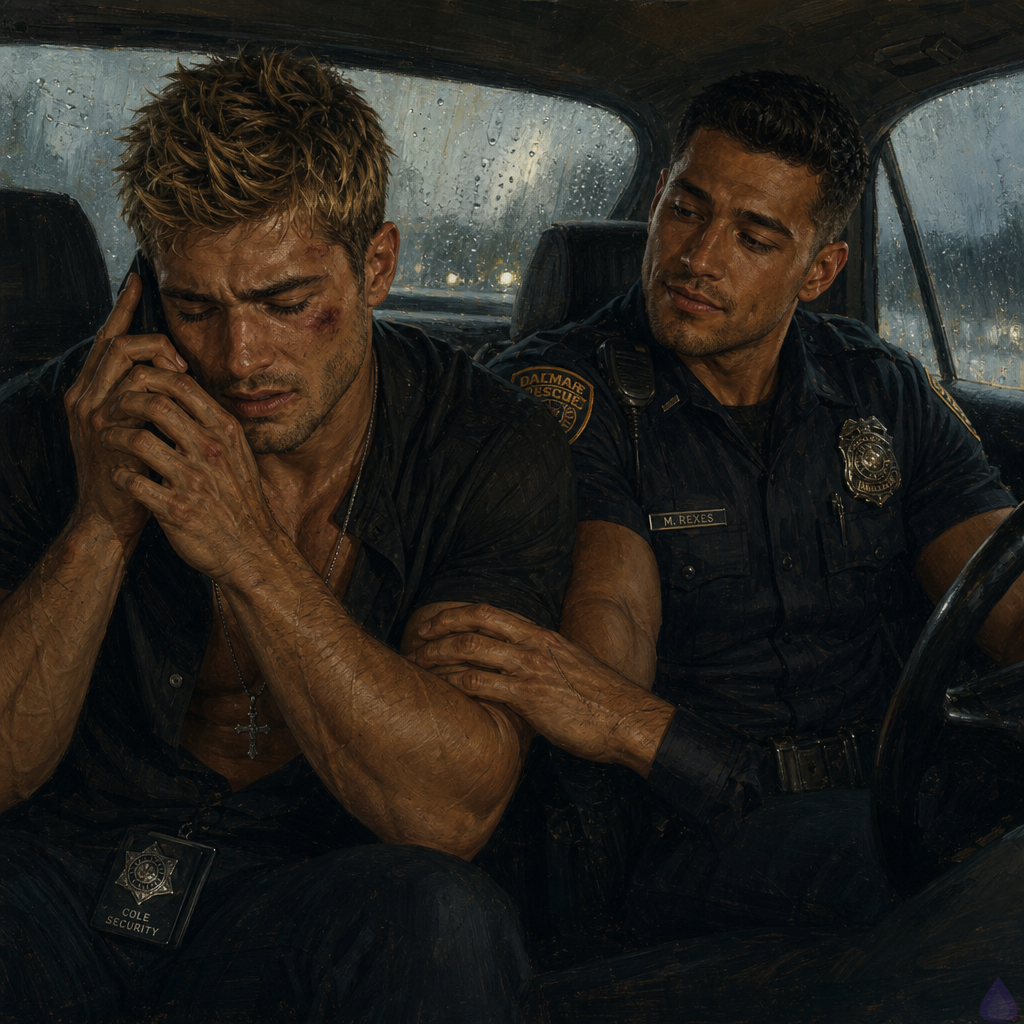
What readers chose (1 choices)
You get help, and it is ugly.
It is not one brave phone call and a clean road out, bright with forgiveness. No. It is Mara driving you to outpatient intake with a travel mug of bitter coffee shoved into your hand and the expression of a woman ready to put bureaucracy through a wall. It is Mateo sitting beside you in waiting rooms that smell like old carpet and antiseptic, his knee close enough to touch, his presence both comfort and weight, until you start hating the quiet shine of his hope because every relapse feels like cheating on it. On him. It is group meetings where you joke too loudly, therapy appointments where you lock every real answer behind your teeth, and mornings with your hands braced on the sink while you curse your own reflection because survival should have come with instructions. Better ones.
At twenty-one, after one relapse too many and one fight that comes too close to ending with handcuffs, you join the Army like a man throwing himself through a window because the door looks too hard to open. Structure saves you. Then breaks you. Then saves you again, but smaller this time, in pieces you can actually hold. You learn to wake before dawn, polish boots until they throw back your exhausted face, run until your lungs burn cleaner than whiskey ever did. You learn that orders can be easier than choices. You learn that being useful is not the same as being healed, but sometimes useful keeps you alive long enough to become something else.
Mateo leaves before that.
Not cruelly. God, cruelty would have been kinder. Cleaner. He comes to your apartment after finding you drunk on the balcony with blood on your knuckles from punching brick instead of calling him, and his face is calm in the awful way people look when they have already cried somewhere private. Rain ticks against the railing. Your hand throbs. He tells you he cares about you. He tells you he cannot keep being the person you run to only after you set yourself on fire. He tells you his staying is starting to feel like permission for you to keep falling, because you trust him to catch you more than you trust yourself to stand.
Mateo: "I love you too much to become part of what hurts you."
You make a joke.
Of course you do.
Something about him always choosing the most dramatic lines, something about cops and their flair for tragic exits. It limps out, brittle and stupid, and dies before it reaches him. His mouth tightens like the laugh hurts too much to let out. Then he kisses your forehead once, careful and devastating, his lips warm against skin gone cold with shame, and walks out with his brown leather jacket dark from rain and his shoulders held like the whole city has climbed onto them.
Mara stays. In her way. She curses you through enlistment paperwork, sends care packages full of socks and terrible protein bars, and writes letters that begin with, “Do not make me come down there.” Adrian Vale fades into the background of legal trusts and victim funds, his apology finally read once in a barracks laundry room at two in the morning while dryers thump like distant artillery. Julian remains a dead name in sealed documents and bad dreams, less a monster with gloves now and more a shadow your mind can sometimes step around.
By twenty-seven, you are stable enough that people use the word without flinching. You have rank on your collar, muscle earned the hard way, a lean face weathered by sun and discipline, dirty blond hair still refusing to behave, and emerald eyes that do not snap toward every door anymore. Not always. You drink sometimes. One beer at a barbecue. One glass raised with your unit after a hard month. But you do not get wasted. You count. You stop. You leave when leaving is the win, even if your hands shake in the parking lot afterward.
The night you run into Mateo again, you are off base on leave, wearing tight jeans, a black T-shirt, and the leather jacket you bought yourself with your own money because you wanted something that looked like your old armor but did not smell like fear. The bar is respectable, which still feels suspicious. Warm lights. Low music. No sticky floor. You are nursing one beer and losing badly at pool to Sergeant Whitlock, who has aged into sharper angles and somehow more terrifying patience.
Mara: "You aim like a man thinking about something else."
You: "I aim like a misunderstood artist. The cue ball and I are in a complicated emotional relationship."
Mara’s hazel-green eyes slide past your shoulder.
Her expression changes by half an inch.
That is all the warning you get.
You turn with a smile already loaded, bright and useless, and there he is.
Mateo Reyes stands near the entrance in a dark button-down under that same brown leather jacket, older by years and still so instantly himself that your body recognizes him before your pride can catch up. His close-cropped black hair is shorter than you remember. His warm sienna skin catches the amber light. He still carries the faint scent of rain and leather and clean soap, or maybe your memory supplies it because it has always been cruel that way. His dark brown eyes find you and stop.
The dimple does not appear.
Not yet.
His gaze drops once to the beer in your hand, then returns to your face, and you feel the old story rise between you like smoke from a match you thought had gone cold.
You set the bottle down on the nearest table.
Not because he asked.
Because you want him to see you can.
For a long second, neither of you speaks. The room keeps moving around you—laughter, clinking glasses, the soft knock of pool balls, Mara chalking her cue with the ruthless discretion of a woman pretending not to watch the most important thing in the room. Your heart beats with a young man’s panic in a grown man’s chest.
Then Mateo steps closer.
Mateo: "Dwayne."
Your name in his voice still knows where to land.
You almost make a joke. You feel it spark behind your teeth, bright and protective, begging to be useful. Instead, you breathe once, steady and slow, the way recovery taught you, the way the Army drilled into your bones, the way you learned when nobody was coming to save you from yourself except you.
You: "Hey, Reyes. Been a while."
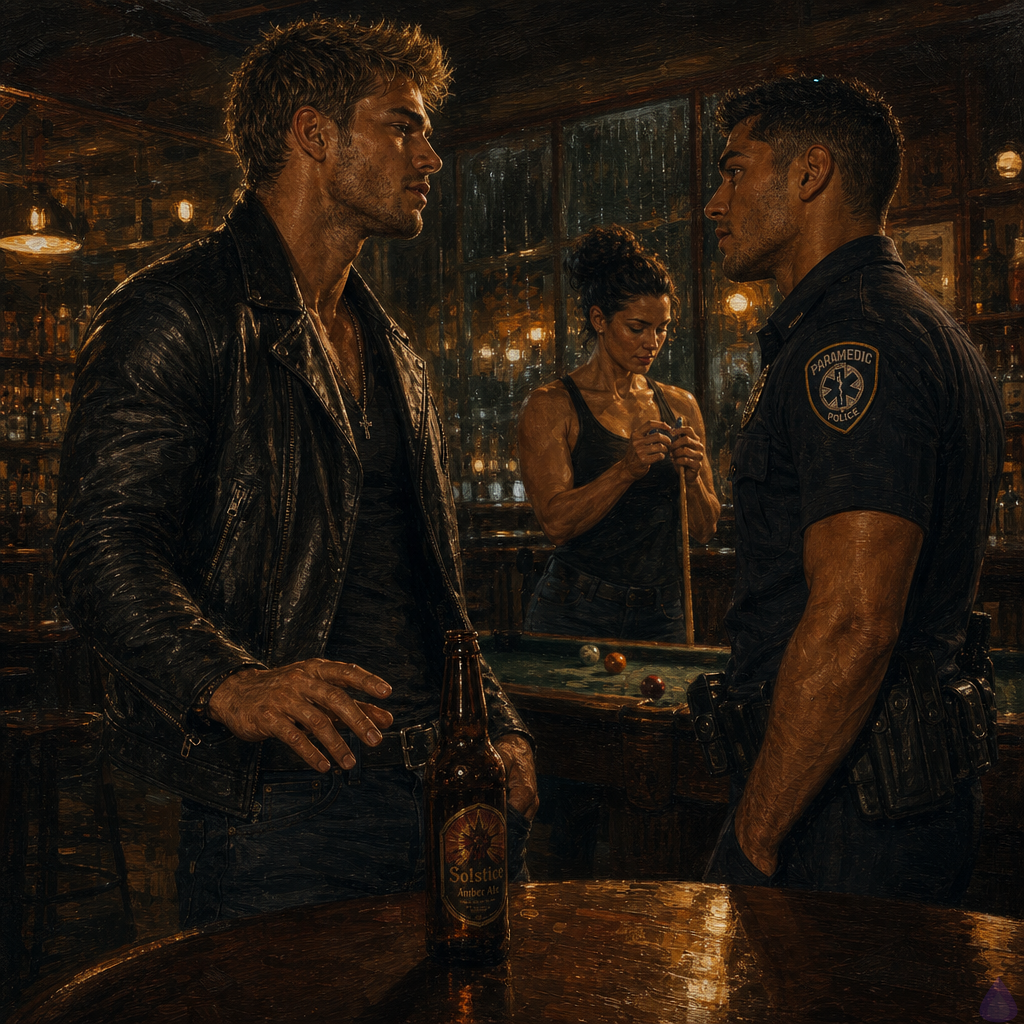
What readers chose (1 choices)
You: “I was just gonna step out for a smoke. You wanna join me?”
The words slip out easier than you deserve. Too easy. So you ruin it—because apparently courage has a short fuse and yours is already burning down.
You: “And I’m sorry, Mateo. For before. For all of it.”
The bar noise thins around you. Not quiet. Never quiet. Glass clinks, someone laughs too loud near the jukebox, the bass line bumps through the floorboards. But your attention narrows to the man under the warm amber light, to the set of his shoulders, to all those years sitting heavy in his eyes.
Mateo doesn’t answer.
His gaze cuts to Mara by the pool table, where she has developed an intense and deeply fake interest in chalking the same cue tip for the third time, then comes back to you. He clocks the untouched beer you set down after his eyes found it. He clocks your hand, steady enough near your jacket pocket, and the cigarette pack you tap once against your palm like a nervous card trick.
Mateo: “Yeah. I’ll join you.”
Outside, the air is cool and damp, edged with rain and old brick. The street shines black beneath the last wet skin of an earlier storm. The bar door shuts behind you, sealing the music and laughter into a low pulse through the wall. Neon shivers in a puddle by the curb.
You shake a cigarette from the pack, catch it between your lips, and cup your hand around the lighter. The flame jumps gold against your olive skin. For one sharp second it paints shadows over the scar at your shoulder where your jacket collar has slipped, then dies when you inhale.
Smoke drags into your lungs with that old familiar bite.
Not good for you.
Yours anyway.
Mateo leans against the wall a few feet away, giving you space like he still remembers every rule your body never had to explain twice. He’s broader than he used to be. Or maybe just more settled inside his own skin. Brown leather jacket creased at the elbows. Rain-dark hair cut close at the sides. A faint scar flashing across one knuckle when he folds his arms.
His dark eyes don’t accuse you.
Somehow, that makes the apology harder.
You: “I got sober wrong about six different ways before I got it halfway right. Relapsed. Lied. Made you watch me turn myself into a damn emergency, then acted offended when you got tired of bleeding on the carpet with me.” You blow smoke toward the street instead of his face. Small mercy. Late mercy. “I was mad when you left. Told myself you gave up on me. But you didn’t. You just stopped lettin’ me use your love like a crash pad.”
Mateo’s jaw tightens at the word love.
It had been his word first, years ago on your balcony, spoken like a wound and a boundary in the same breath. Hearing it now between you makes the city feel too bright, every streetlight sharpening on wet pavement, every passing car hissing through rainwater like it has somewhere cleaner to be.
He looks down. Then away, toward traffic, where headlights slide over his face and leave him half-lit, half-guarded.
Mateo: “I wondered if leaving would be the thing that made you worse.”
No self-pity.
That cuts deeper.
Just the plain confession of a man who carried his own corner of the wreckage and never once made you pay rent for it.
You: “It did, for a while.” You try for a smile. It arrives small, scraped up, honest. “Then it didn’t. Army helped. Mara helped, mostly by threatenin’ to haunt me while she was still alive. Adrian’s money helped too, though I reserve the right to be extremely bitter about that until I’m dead and possibly after. Julian…”
His name still changes the weather.
Your cigarette stops halfway to your mouth. The street seems to tighten around you, brick and glass and shadow leaning in with old attention. You are twenty-seven now. A Lieutenant. Respected. Steady, most days. Strong enough to stop after one beer and mean it.
Still.
Some dead men know exactly where the unlit corners are.
Mateo unfolds his arms slowly.
Mateo: “Still there?”
You laugh once. Soft. No humor in it.
You: “Less. Not gone. He didn’t earn gone.” The ember burns close to your fingers, orange and stubborn. “But less. Sometimes I hear a sound at the door and think cat before corpse. That’s progress, right?”
This time, the dimple appears.
Small. Reluctant.
It hits you with such stupid force that you have to look down at the cigarette and pretend your chest did not just forget every scrap of military discipline it ever learned.
Mateo: “That cat was very suspicious. Mara still asks about it.”
You: “Tell her I outrank that cat now. Barely.”
His smile fades, but the warmth stays. Dangerous thing, warmth. It gets under the ribs. Mateo steps one pace closer and stops well outside touching distance.
The old carefulness is still there.
So is something else.
Want, maybe. Caution with both hands wrapped around its throat. You can read the question in him—not whether you are fixed, not whether the past has politely packed its bags and left, but whether the man standing in front of him is asking from solid ground.
You tap ash into the gutter and make yourself meet his eyes.
You: “I’m not asking you to pick up where we left off. Hell, I don’t even know where that was. Somewhere between disaster and almost.” Your drawl roughens. Damn it. “I just wanted you to know I’m sorry. And I’m glad you’re here. Even if all we do is stand outside and let me ruin my lungs in formal wear.”
Mateo’s gaze drops to your mouth for the first time tonight.
Not by accident.
Your breath catches around smoke and rain and the clean, warm scent of him—leather, soap, the bitter ghost of his beer. Close enough to ache. Not close enough to touch.
Then his eyes lift again, disciplined and dark, and the space between you fills with years, restraint, regret, and the dangerous possibility that not everything broken stayed broken.
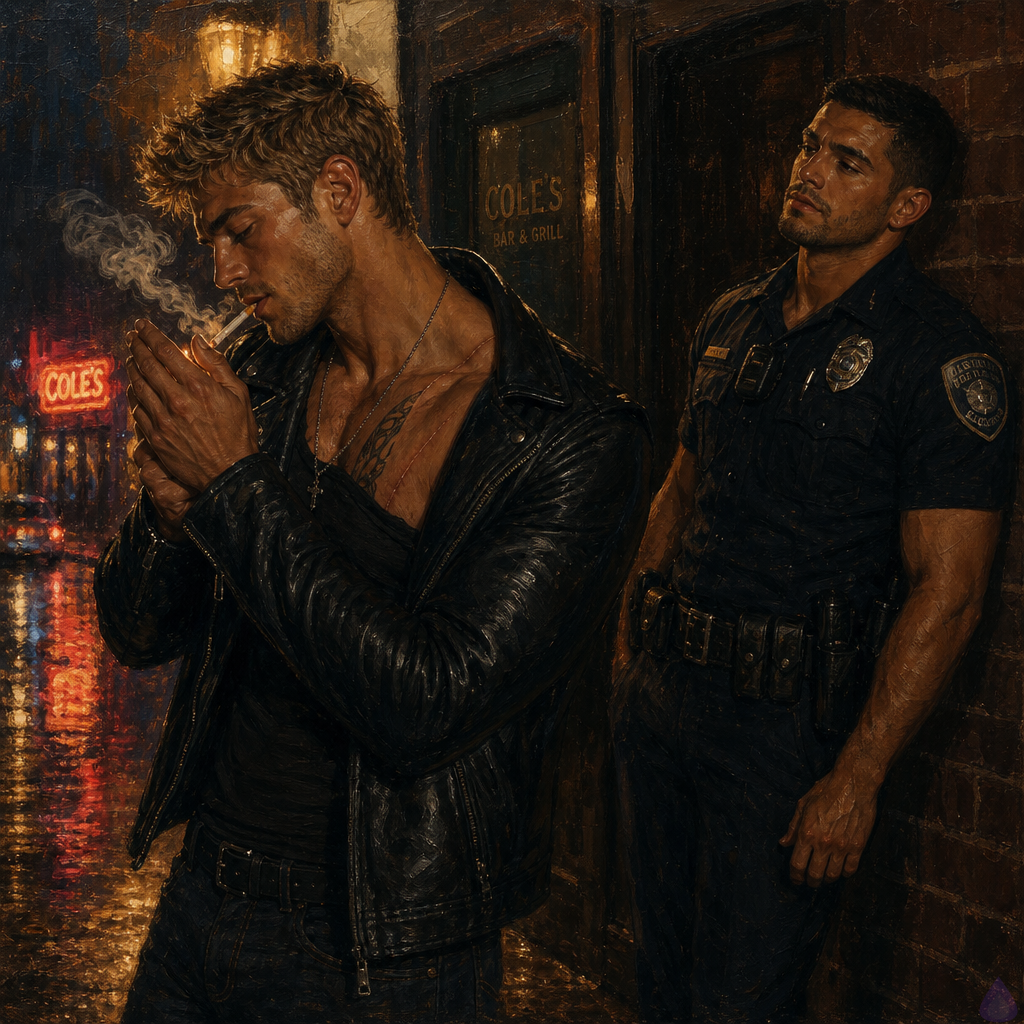
What readers chose (1 choices)
You: "I never stopped loving you."
The cigarette burns forgotten between your fingers, ember shivering in the damp air. The words leave you low. Almost broken. Stripped of charm and smoke and every pretty little trap you’ve ever set before anyone could get close enough to touch the real bruise. For one heartbeat, Mateo only stares, dark brown eyes searching your face like he’s testing whether the ground beneath both of you has finally stopped lying.
Then he steps closer.
Not rushing. Never rushing you. One pace, then another, his brown leather jacket creasing as his hand lifts, stopping just shy of your cheek until you close the last inch yourself. Your fingers curl into the front of his jacket. Familiar leather. Rain-slick and warm from his body. And when you kiss him this time, there is no whiskey dragging the room sideways, no panic hiding its teeth behind want, no old bill waiting in the dark to come due.
Mateo kisses you back.
His mouth is warm and careful for the first breath, then less careful when you make a small, wrecked sound against him and he lets himself answer. One hand settles at your jaw, his thumb light near the corner of your mouth, the other hovering at your waist until you pull him in by the jacket and make the choice plain. Rain dampens your hair. Neon bleeds red and gold through the puddles. The bar hums behind you, muffled and alive, while every aching year between you folds inward until there is only the taste of him—coffee, beer, rain, and restraint finally given permission to break.
You are the one who laughs first, breathless against his mouth.
You: "Well, hell. That was overdue."
Mateo’s forehead rests close to yours for half a second. Not quite touching. The dimple appears in his left cheek, small and stunned and so beautiful it makes you furious with your own heart for still being this easy to wound.
Mateo: "Dwayne."
Your name sounds different now. Like a door unlocked from the inside.
Then a voice from the end of the sidewalk curdles the air.
Edward Cole: "Ain’t that sweet. Devil’s Spawn finally found another man to shame himself with."
The whole street stops breathing.
You turn slowly, Mateo’s hand falling from your jaw but not going far. A man stands beneath the broken edge of the bar’s awning, hunched inside a rain-dark coat that has survived better decades. Edward Cole is older than the monster in your memory, but not smaller. Never smaller. His face is red-veined and sagging, gray stubble rough along his jaw, and his eyes are wet with liquor and righteous hatred, the same old fire guttering in a ruined lamp.
The smell finds you a second later.
Whiskey. Sweat. Road dust. Church-basement coffee gone sour in a paper cup.
Your stomach drops so hard the sidewalk seems to tilt. Georgia rises through the wet city pavement. A locked closet. Cigarette burns. Scripture shouted through wood. Your mother crying somewhere beyond the door, not opening it. Never opening it.
Mateo shifts beside you, not in front of you. Not yet. His body changes first—shoulders squaring, calm gaze sharpening into an officer’s measured assessment even without the uniform. Inside the bar, through the rain-streaked window, Mara’s head turns. She catches your face and sets her pool cue down at once.
Edward sways one step closer and points at you with a hand trembling from drink or rage or age.
Maybe all three.
Edward Cole: "Your mama’s dead. Annie’s dead, and I hope you hear me clear when I tell you it was you that killed her. Broke her heart with your filth. Ran off and left her with the shame of you. She prayed for you till it rotted her from the inside."
Something inside you goes silent.
Not calm. Not peace. A blown fuse.
The cigarette slips from your fingers and dies in a puddle with a soft hiss. Your mouth opens, but no joke comes. No drawl. No shield. Your scars seem to wake all at once under your leather jacket, shoulder and back and the soul-deep places no one can see. Annie Cole, your mother, with tired eyes and trembling hands. Annie, who loved you badly. Annie, who stayed. Annie, who did not save you.
Annie, dead.
And Edward standing there with the oldest knife he owns, trying to press the handle into your hand.
Mateo: "Sir, stop where you are."
His voice is steady. Firm. Official without the uniform. Edward’s eyes cut to him, lip curling.
Edward Cole: "You the one keepin’ him like this? You proud of what you got your hands on?"
Mateo’s jaw tightens, a muscle jumping hard beneath rain-damp skin, but he doesn’t take the bait. His hand lowers slowly to his phone.
Mateo: "Dwayne, look at me."
You can’t.
You are staring at Edward’s mouth because it keeps moving, and every word is a fist from ten years ago.
Edward Cole: "She died askin’ God where she failed. I told her. I said, Annie, you birthed evil and called it a son. And now look at him. Look at him."
The bar door slams open behind you.
Mara steps out with murder in her posture and law in her voice, silver-streaked hair catching the neon, hazel-green eyes fixed on Edward like she has finally found the source of every report she ever wanted to rewrite with her fists.
Mara: "That is enough. Back away from him now."
Edward laughs, wet and mean.
Edward Cole: "Another one. Whole city full of sinners patting my boy on the head like he ain’t poison."
Your hands curl at your sides. You feel the old ruthless part wake up, the part that sees an abuser and wants to become bigger, crueler, impossible to hurt. For one flashing second, you imagine crossing the sidewalk and putting Edward on the ground. Not because it would bring Annie back. Not because it would undo a single locked door or burned shoulder or prayer sharpened into a weapon.
Because he still thinks he can make you small.
Mateo says your name again, softer now.
Mateo: "Dwayne. Stay with me. He doesn’t get to decide what her death means. He doesn’t get to hand you that blame."
Annie is dead.
The words finally land.
Your breath breaks.
Not a sob. Not yet. Something uglier. Something that bends you forward before you can stop it. Mateo moves then, close enough to catch you if your knees give, but still not grabbing. Still letting you choose. Mara steps fully between you and Edward, compact and immovable, badge already in her hand.
Behind Mara, through the bar window, your abandoned beer sits untouched on the table beside the pool cue. Adrian’s unopened apology flashes through your mind for no reason, expensive paper in a drawer, another ghost asking what forgiveness is worth. Julian’s dead face follows, then Edward’s living one, and for one terrible second every man who ever made your body a battleground seems to be standing under the same streetlight.
But Mateo is there too.
Mara is there.
And you are twenty-seven.
Not seventeen.
Your voice comes out hoarse enough to hurt.
You: "Don’t let me hit him."
Mateo’s eyes soften with grief and fierce relief.
Mateo: "I won’t."
Edward spits near the curb. Mara moves like a closing door.
Mara: "Edward Cole, you are intoxicated, harassing a protected party, and about three seconds from making my evening very simple. Turn around and put your hands where I can see them."
Your father’s face twists.
The street waits, wet and bright and cruel, while the kiss still burns on your mouth and your mother’s death opens under your feet.

What readers chose (1 choices)
For one second, the only sound you hear is rain ticking against the awning and your own breath scraping in and out, fighting your ribs for room. Mara stands between you and Edward with her badge out, compact and fierce, but your father’s eyes aren’t on her.
They’re on you.
Wet with liquor. Bright with old certainty. Waiting for you to become the boy he named wrong.
You step around Mateo before either of them can stop you, but you don’t cross the whole distance. No. You stop where the streetlight slices across the pavement, hands shaking at your sides, leather jacket heavy on your shoulders, dirty-blond hair damp in your eyes. Mateo moves with you, one careful step behind and to the side.
Not blocking.
Not leaving.
Mara’s jaw tightens, but she holds Edward with her stare.
You: “You want to talk about what killed Mama? Fine. Let’s talk. You beat your kid and called it holy. You locked me in closets till I forgot what air felt like. You burned me with cigarettes and told me pain was the Lord correctin’ His mistakes. You ripped at my skin because you hated that I tried to make my body mine. You called me Devil’s Spawn so many times I started answerin’ to it before I answered to my own damn name.”
Edward’s face twitches. For the first time since he stepped out of the rain, something uncertain shifts beneath the drink and rage.
Not guilt.
You aren’t generous enough tonight to call it guilt. More like surprise that the door he nailed shut has opened from the inside.
Edward Cole: “You watch your mouth, boy.”
Boy.
The word snaps something hot and red through you, fast as a struck match, but Mateo’s voice lands low behind your shoulder.
Mateo: “Breathe. He does not get to pull you back.”
You do breathe.
Once.
Twice.
Smoke from your dead cigarette still ghosts over your tongue, bitter and stale, and beyond the bar window you catch the amber gleam of the untouched beer you left behind. One beer. Stopped. Chosen. Yours. You cling to that as hard as any prayer your father ever sharpened into a weapon.
You: “No. I’m done watchin’ my mouth so you can keep your story pretty. I ran because stayin’ meant dyin’. I left Mama because she never opened the door. I loved her, and I hated her, and I am gonna grieve her without lettin’ you turn her death into one more belt across my back.”
Mara’s eyes flick toward you then, sharp and soft at once. Rain beads on the loose silver-streaked strands at her temples. Her hand stays steady near her cuffs. She has heard official statements, hospital confessions, the clean legal version of pain.
This isn’t clean.
This is the language before paperwork. This is the wound speaking for itself.
Edward sways, mouth twisting, the sour reek of whiskey cutting through wet asphalt and cigarette ash.
Edward Cole: “She prayed every night you’d come home right. She prayed God would fix what was wrong in you.”
Your laugh comes out broken.
But not hollow. Not this time.
You: “There was nothin’ wrong in me that you didn’t put there. And even that didn’t stay yours. I got out. I survived the streets. I survived Julian Vale. I survived every man who looked at me and saw somethin’ he could use or punish. I joined the Army. I got rank on my collar. I got a job, a home, people who know what you are and still know who I am.”
Mateo’s breath catches behind you.
Maybe at home.
Maybe at the way your voice steadies around it, like your mouth finally believes the shape of the word. The kiss you shared still burns there, a living thing, complicated now by grief but not erased. Nothing Edward says can unmake the warmth of Mateo’s mouth, the tremor in his hands when he held back, the truth you gave him because it cost too much to keep. For one clear moment, you loved out loud.
And were loved back.
Edward looks past Mara toward Mateo, hate searching for fresh ground.
Edward Cole: “He’s made you weak.”
Mara steps closer to Edward, voice like a cell door locking shut.
Mara: “No, Mr. Cole. He asked someone to stop him from assaulting you while you harassed him in public. That is restraint. You should try it sometime.”
A laugh bursts out of you before you can stop it. It hurts. God, it hurts. It rips straight through the place where Annie’s death is still opening, raw and black and endless, but it’s real.
Mateo’s hand hovers near your back.
Waiting.
Always waiting now, damn him, like your choice matters more than his need to hold you. You lean the smallest fraction toward him. His palm settles between your shoulder blades, warm through the leather, steady but light enough that you could still step away.
You don’t.
You: “Mama’s death is not mine. Your cruelty is not mine. Your God is not mine. And I am not your Devil’s Spawn. I’m Dwayne Cole. That’s the name you don’t get to poison anymore.”
For once, Edward has no scripture ready. No curse quick enough. He stares at you with rain running down his ruined face, and in the blue-red flicker of a patrol car pulling to the curb, he looks suddenly, terribly human.
Smaller than memory.
Meaner than grief.
Just an old drunk man with bloodshot eyes and empty hands.
Mara moves in then, decisive and controlled.
Mara: “Edward Cole, turn around. Hands behind your back.”
Edward snarls, but the arriving officers flank him before he can turn that sound into action. Mateo stays with you while Mara cuffs your father, while Edward spits one last slurred curse into the rain, while the street that once felt like a battlefield becomes, inch by inch, only a street. Wet pavement. Neon bleeding red in the gutters. The low murmur of bystanders pretending not to stare.
Your knees nearly go when the cruiser door shuts.
Mateo catches you because this time, you reach for him first. His arms come around you carefully, solid and warm, and you press your face to his shoulder with a sound you don’t bother turning into a joke. He smells like rain, wool, and the coffee he drank hours ago. His fingers spread over your back, not claiming.
Holding.
Behind your closed eyes, Annie is still dead. Julian is still dead. Adrian’s apology still waits unread or half-read in some drawer of your life.
But Edward’s voice is behind glass now.
And yours is still in your throat.
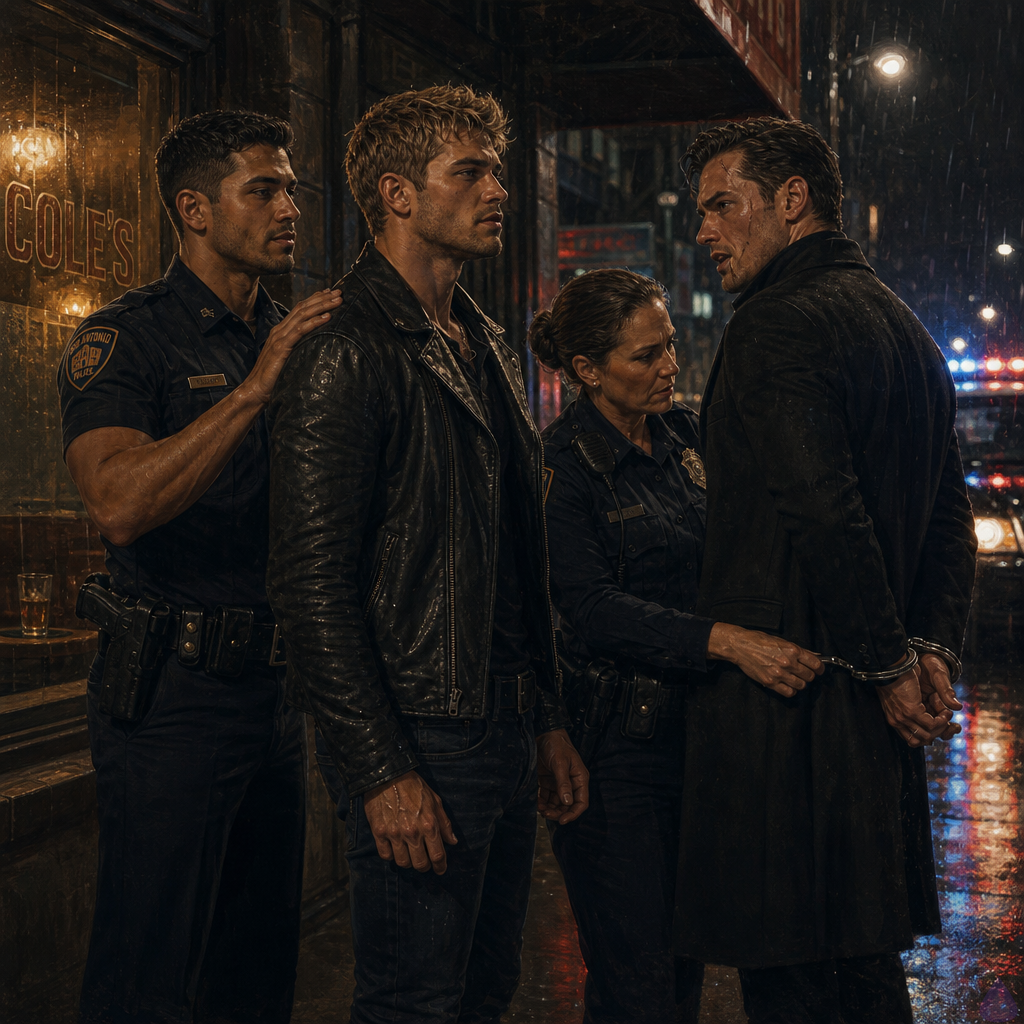
What readers chose (1 choices)
Annie steps out of the shadows beyond the bar’s awning as if the rain has been keeping her there all along.
For one impossible second, nobody moves. Not Mara, one hand still near her cuffs. Not Mateo, his palm warm and solid between your shoulder blades. Not the patrol officers guiding Edward toward the cruiser. Even Edward goes slack-faced, like his own lie has wandered out of the dark wearing a church coat and tired eyes.
Your mother is older than memory and thinner than grief should allow. Annie Cole stands beneath the sputtering streetlight in a damp gray cardigan, her hair pinned back in a plain clip, her face drawn pale, her eyes red-rimmed but dry.
Alive.
Not dead.
Alive after Edward buried her with his mouth just to watch you bleed.
The first thing you feel is relief so violent it nearly drops you. The second is rage.
Annie: "Dwayne."
Your name in her voice finds the child in you before the man can stop it. Your chest caves around the sound. The sidewalk tilts beneath your boots, slick with rain and old fear. Mateo’s hand presses firmer against your back, and this time you do not move away, because if he lets go, you might become seventeen right there on the wet pavement.
You: "Mama?"
The word comes out ruined.
Annie’s mouth trembles. For one breath, she looks like she might cross the distance and touch your face. You hate how badly some starving part of you wants it. Her hand. Her palm on your cheek. The smell of starch and lavender soap from Sunday mornings before everything went sharp.
Then Edward laughs beside the cruiser, low and wet and mean, and whatever softness might have survived in her folds itself away beneath old doctrine.
Annie: "Your father should not have said it that way. But this was a test. God’s test. Ours too. We needed to see whether the world had humbled you. Whether suffering had brought you back to repentance."
Her eyes flick to Mateo, then to Mara, then back to you, grief honed into accusation.
Annie: "And here you are. Still proud. Still living in sin. Still choosing strangers over blood. You failed it."
The kiss dies on your mouth.
Not the love. Not Mateo. But the warmth of him freezes beneath the old ice of home. The streetlight buzzes overhead. Rain ticks from the awning in steady little strikes. Somewhere behind you, the bar door opens and closes, spilling laughter and beer-warm air into a world that has no damn right to keep functioning. Julian’s voice is dead. Adrian’s guilt feels miles away. Edward is cuffed and seething by the cruiser.
But Annie’s voice, soft and righteous, cuts deeper than all of them because once—God help you,you wanted it to save you.
Mara: "Mrs. Cole, stop speaking. Now."
Annie flinches at the command, then lifts her chin.
Annie: "I am his mother."
Mara: "Then act like it or step back. He is a protected party, and you are participating in harassment. I will not warn you twice."
The old reflex rises in you, fast and poisonous.
Defend her. Explain her. Make her smaller so what she did hurts less.
She cried, you want to say. She was scared too. She prayed because she did not know what else to do. She stayed because leaving Edward would have meant tearing her whole world in half.
Then another truth rises beside it.
She let him tear you instead.
Your hands shake so hard you shove them into your leather jacket pockets. Your fingers close around your cigarette pack.
Empty.
Of course it is empty.
You almost laugh. You want a drink so badly it becomes a living thing, a hook behind the ribs, dragging you toward the bar door and the amber bottles lined up like answers. Whiskey would burn this clean for ten minutes. Maybe fifteen. Long enough to stop seeing your mother alive and unreachable. Long enough to stop hearing failed in the voice that once sang hymns over your fever.
Mateo feels it happen.
Of course he does.
He does not grab the pack from your hand. He does not say no like you are a child. He only shifts until his body angles with yours, not blocking the bar, but making himself part of the view. Warm sienna skin under the neon. Dark eyes steady. Brown leather jacket damp with rain. The faint scar across his knuckle catches the blue wash of the cruiser lights when he opens his hand at his side.
He smells like rain, coffee, and the clean bite of soap. Real. Here.
Mateo: "Dwayne. Stay with me. Wanting a drink is not the same as taking one."
Your laugh breaks out raw.
You: "That your official wisdom, Reyes? Because right now I want a whole damn bottle and maybe a second one to hit myself with after."
His face tightens.
But he stays.
Mateo: "Then say it. Say the ugly thing. Don’t swallow it alone."
Annie watches you like confession is owed to her. Edward mutters something by the cruiser, but Mara shuts him down with a look that could sterilize metal. One of the officers opens the back door. Blue light washes over your father’s rain-dark coat and gray stubble, making him look less like wrath and more like evidence.
You turn back to Annie.
You: "You let him tell me you were dead."
She closes her eyes.
That is answer enough.
Your throat burns. Your whole body burns. The drink calls from twenty feet away, golden and simple and mercifully stupid. Instead, you take your hand out of your pocket and reach behind you without looking.
Mateo’s fingers close around yours.
Not rescue.
Witness.
His grip is warm. Careful. Like he knows you could break and refuses to make that another thing you have to survive.
You: "You don’t get to test me anymore, Mama. Neither of you do. If God needed me broken to prove somethin’, then He can find another boy. I’m done."
Annie’s face crumples, but the tears do not move you the way they used to.
That frightens you.
It frees you too.
Mara steps in, voice low and final, directing the officers to take statements from both Coles separately and keep them away from you. Edward curses. Annie whispers a prayer. The cruiser door shuts on your father first, and the sound is almost clean.
When Annie is led toward the second patrol car, she looks back once.
You do not wave.
The urge for a drink remains. It does not vanish because you chose well for thirty seconds. It claws. It bargains. It tells you one beer is not wasted, one whiskey is not a relapse, one night does not count when your dead mother resurrects herself to condemn you under a bar sign.
You squeeze Mateo’s hand until your knuckles ache.
You: "I need to leave before I walk back in there."
Mara turns from the curb at once, hearing the part you did not dress up.
Mara: "Good. We leave. Now. My car or Reyes’s. No speeches. No bar tabs. No martyr nonsense."
Mateo’s thumb rests against the side of your hand, still as a promise.
Mateo: "You choose. But we go somewhere with coffee, food, and no bottles within reach."
The bar glows behind you. Warm. Familiar. Dangerous.
The street ahead is wet, cold, and uncertain.
For once, uncertain might be safer.
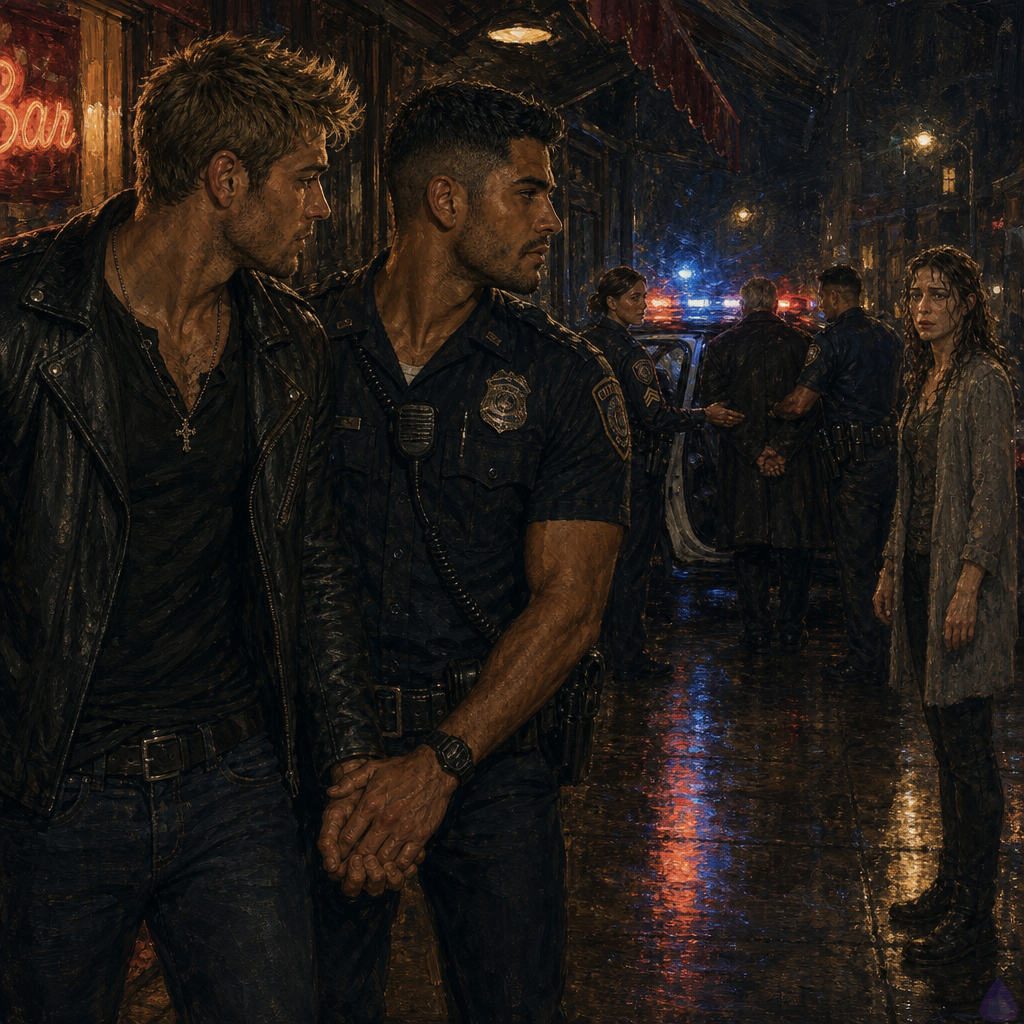
What readers chose (1 choices)
Mateo’s car smells like rain, warm leather, and the coffee he must live on when sleep turns optional. You sit in the passenger seat with both hands locked around your knees, as if holding yourself together is a practical task and not a prayer. Outside the windshield, Mara’s cruiser follows at a respectful distance until the bar disappears behind wet corners and smeared gold streetlight. Edward and Annie are gone in opposite patrol cars, but their voices ride with you anyway. One loud with blame. One soft with judgment. Both trying to crawl back into the places you spent years clearing out.
Mateo: "Window down or heat up?"
The question is so ordinary it nearly wrecks you.
You stare at him. At his close-cropped black hair, damp at the edges. At his dark eyes flicking from road to mirror to you, careful without making a show of it. His brown leather jacket creaks when he turns the wheel, and the faint scar across his knuckle catches the dashboard light. He has just kissed you under neon and watched your mother step out of the dead, and still he asks about air because he knows air matters.
God help you. He pays attention.
You: "Heat. I’m dramatic, not frostproof."
His mouth tugs at one corner. Not a full smile. Enough to make your ribs ache.
The all-night diner squats at the edge of a grocery plaza, bright as a stage set against the rainy dark. Its windows are fogged from the inside, its sign missing one blue letter, so it reads OP N 24 H URS, like even the building is too tired to finish a sentence. Mateo parks near the door but not right beside it.
Easy exit. Clear sightlines.
You catch it, and your chest hurts with the unfair tenderness of being known that specifically.
Inside, the air hits thick and greasy-warm, fryer oil and burnt coffee braided with maple syrup and the lemon cleaner someone abuses after midnight. A waitress with a pencil behind her ear seats you in a booth near the back. Mateo takes the side facing the entrance without comment. Mara arrives two minutes later, dark blazer speckled with rain, silver-streaked bun half-loosened, hazel-green eyes sweeping the room before she slides into the booth beside you like a compact wall of law and bad attitude.
Mara: "Your father is being held until he sobers up. Your mother is giving a statement and trying very hard to make religious cruelty sound like concern. She is failing. Adrian Vale’s attorney called because apparently everyone in this city can smell paperwork. I told him Mr. Vale can be useful tomorrow and silent tonight. Julian’s records remain sealed unless needed for ongoing proceedings. That is the official update. The unofficial update is that you are ordering food."
You: "Yes, ma’am. Nothing says emotional stability like hash browns under police supervision."
The waitress brings coffee before anyone asks. Mateo quietly pushes a glass of water toward you too, not replacing the coffee, not turning it into a lesson. Just adding the thing your body actually needs.
That almost does it.
The want for a drink hasn’t left. It sits beside you in the booth like a fourth companion, elbow on the table, whispering that whiskey would make Annie’s face blur, Edward’s words dull, Mateo’s kiss easier to remember without shaking. You wrap both hands around the water glass until cold seeps into your palms.
Mateo: "How loud is it?"
You know what he means.
Damn him for knowing. Damn him more for asking like the answer won’t scare him away.
You: "Loud enough I can hear the bottles from here, and this place only serves pie. Loud enough I’m mad at coffee for not being bourbon. Loud enough I want to make a joke about it and then go do somethin’ stupid while y’all are proud of me for bein’ honest."
Mara’s expression doesn’t soften.
That is why it helps.
Mara: "Then we don’t do proud yet. Proud is for tomorrow. Tonight is logistics. You eat. Reyes stays with you if you want. I call your sponsor, or your counselor, or whoever is on your relapse plan. If you don’t have an updated plan, congratulations, you’re making one over eggs."
You laugh, but it cracks around the edges.
Mateo’s foot brushes yours under the table by accident, or maybe not. Heat slips up your shin, ridiculous and immediate. He starts to pull back. You hook your ankle lightly beside his before he can vanish completely, a tiny contact hidden beneath Formica, coffee steam, and Mara’s ruthless competence.
His eyes lift to yours.
Startled. Warm.
The kiss comes back in a rush. His mouth under the neon. His hand at your jaw, steady even when you weren’t. The way he did not pull away this time. The way you wanted to believe that meant something and hated yourself a little for wanting anything tonight.
You look down first because grief is already too much without adding hope to the pile.
You: "I told him. Edward. Annie too, I guess. I said it out loud, and they still looked at me like I was the sin instead of the crime scene."
Mateo’s voice is quiet, but it holds.
Mateo: "They can look wrong. That doesn’t make them right."
A simple thing. A clean blade.
You breathe around it.
Mara reaches for a menu and opens it with the grave severity of a judge reviewing evidence.
Mara: "Also, for the record, your father is a drunk bully, your mother is a coward in church shoes, Adrian is a complicated donor with a guilt problem, Julian was a violent predator, and Reyes is currently trying not to stare at you like you invented oxygen. None of those facts require you to drink."
Mateo chokes on his coffee.
For one blessed second, you laugh for real. It comes out rough, aching, alive. The craving does not vanish. Annie is still alive and terrible. Edward is still your father. Julian is still dead without ever facing you in court. Adrian is still a name tied to money you resent needing.
But Mateo is coughing into a napkin. Mara looks smug as sin. The waitress is approaching with a pot of coffee like she might refill the whole ruined world.
Your hands are still shaking when you pick up the menu.
You: "Fine. I’ll take eggs, toast, and enough hash browns to disappoint my ancestors. And if anybody says inspirational journey, I’m stabbin’ the pancakes."
Mateo smiles across the booth, dimple showing, eyes tired and bright. Something in you leans toward it before you can stop yourself.
Dangerous.
Soft.
Mateo: "No inspirational journey. Just breakfast."
Just breakfast.
For tonight, it is enough to keep your hands on the table and your feet pointed away from the bar.
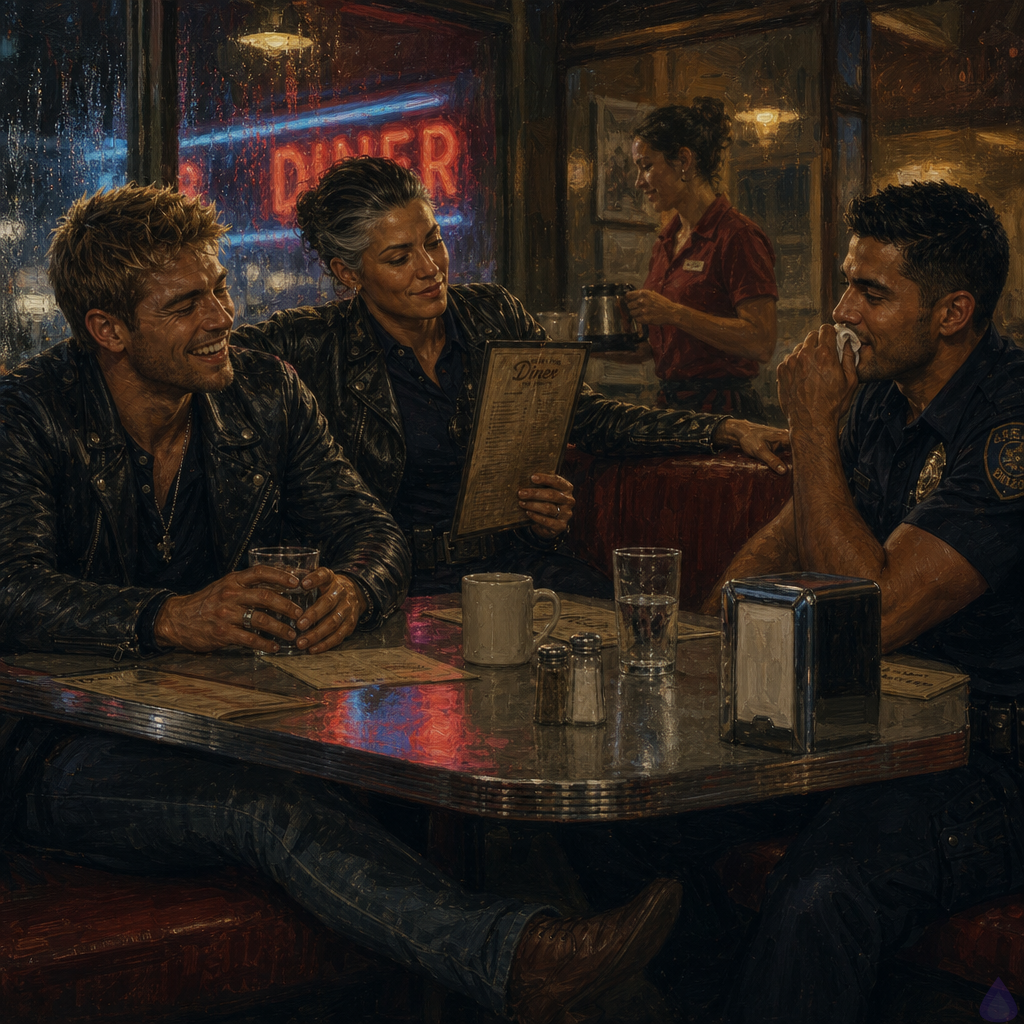
What readers chose (1 choices)
You: "I'm gonna be fine."
The words come out too fast. Too bright. Already wearing sequins to a party nobody invited them to. You set the menu down like you’ve made a reasonable administrative decision, not like shame has crawled up your spine and clamped both hands over your mouth.
You: "Seriously. Y’all can stand down. Crisis averted. Gold star for breakfast-based intervention. I’ll eat my sad little eggs, go home, sleep it off, and wake up a model citizen with suspiciously good hair."
Mara looks at you over the top of her menu.
She does not blink.
Mateo’s smile fades. Not all at once, but enough that the dimple disappears and the diner light catches the worry underneath. His foot stays lightly against yours beneath the table because you haven’t moved away, and that small, warm pressure suddenly feels unbearable. Too intimate. Too kind. Too much like evidence that if you leaned, someone might actually hold.
So you pull your foot back.
Mateo lets you.
That makes it worse.
The waitress arrives with the coffee pot, her pink lipstick worn thin at the center of her mouth, a pencil still tucked behind one ear. She refills Mara first, then Mateo, then pauses over your cup. You nod. Coffee splashes dark and bitter into the chipped white mug, steam curling up between you and the two people who have seen too many versions of you tonight.
Waitress: "Kitchen’s still doing breakfast. You folks ready?"
Mara: "He’ll have eggs, toast, and hash browns. Extra hash browns. I’ll have the same. Reyes?"
Mateo: "Pancakes. Side of bacon."
You point at him, grateful for the opening, desperate for any exit that looks like humor.
You: "See, this is why he’s dangerous. Man orders pancakes at three in the morning like he’s got a clean conscience."
The waitress snorts and walks away.
The joke lands. Barely. It skids across the Formica and dies somewhere near the sugar packets.
Mara folds her hands on the table. Her badge is hidden under her blazer now, but you can still feel it, a weight in the booth. Not threatening. Anchoring. The same way Mateo’s presence anchors and terrifies you, because your body has never known what to do with steady things except test whether they will break.
Mara: "Cole. Embarrassment is not a relapse plan."
Your jaw tightens.
You: "Didn’t say it was. I said I’m fine. I have handled worse than wanting a drink after my mother faked bein’ dead for Jesus. Which, by the way, I feel deserves its own holiday."
Mateo’s eyes lower for a second, as if he has to take a breath before he trusts himself to answer.
Mateo: "You can handle a lot. That was never the question."
You hate that.
You hate the gentleness. You hate the way he refuses to argue with the strongest version of you, because he has met the version underneath and remembers its name.
The diner window beside you reflects all three of you in pale layers over the rainy parking lot. Mara, compact and watchful, silver-streaked hair coming loose around her tired face. Mateo, broad-shouldered in his brown leather jacket, dark eyes fixed on the space near your hands. You, twenty-seven and still somehow seventeen when the right voice says the wrong word, dirty blond hair damp from rain, emerald eyes too sharp, leather jacket zipped over scars no uniform ever outranked.
Your mother is alive.
The thought hits again, quieter this time.
Worse.
Alive, and willing to stand in the shadows while Edward told you she was dead. Alive, and calling cruelty a test. Alive, and still choosing the story where you are the failure because that story lets her stay holy.
Your hand goes for the coffee.
It shakes before you reach the mug.
You stop halfway and make a fist instead.
You: "I don’t want to be watched all night like I’m a grenade with pretty eyes."
Mara’s expression shifts. Just a fraction.
Mara: "Then do not make us guess where the pin is."
The words should sting.
They do.
But they aren’t cruel. Mara has a way of putting truth on the table like a weapon she expects you to pick up safely. You stare at the sugar packets, at the little blue and pink and white paper rectangles stacked in a metal tray, and feel the sudden, absurd urge to count them until your breathing behaves.
Mateo catches it.
Of course he does.
Mateo: "You do not have to perform being okay for me. Not tonight. Not because we kissed. Not because you said what you said outside."
Your eyes snap to his.
There it is.
The kiss. The confession. The thing you have been trying not to look at since Annie stepped into the rain and turned your heart into a crime scene.
You: "Maybe I don’t want you thinkin’ you signed up for this."
His face goes very still.
Mateo: "I didn’t sign up for a crisis. I came to breakfast with the man I love. The crisis came too."
The air leaves you.
Mara abruptly becomes fascinated with opening creamer cups, which is the closest she will ever come to giving privacy in a booth.
You look down because looking at Mateo is impossible. The craving is still there, sour and insistent at the back of your throat, but now it’s tangled with grief, humiliation, want, and a tenderness so sharp it feels unsafe to touch directly. He smells like rain-soaked leather and coffee. Like the night outside. Like the kind of trouble that stays.
The food arrives, plates heavy with eggs, toast, hash browns, pancakes, bacon. Ordinary abundance. Butter shines in little yellow pools. Grease and salt fill the booth, grounding and nauseating at once.
You pick up your fork.
Set it down.
You: "If I say I need help stayin’ out of a bottle tonight, I’m gonna feel pathetic."
Mateo’s voice is low.
Mateo: "You can feel pathetic and still be brave."
Mara lifts her coffee in a dry little toast.
Mara: "Multitasking. Very adult."
A laugh breaks out of you, small and wet around the edges. You press your fingers to your eyes for one second, then drop your hand before it becomes hiding.
The diner hums around you. Rain taps the glass. Somewhere far away, Edward is in holding, Annie is giving statements, Adrian is being kept behind legal distance, and Julian is still dead in the sealed dark where he belongs.
Here, there are hash browns.
Here, Mateo waits.
Here, Mara will not let shame run the meeting.
You breathe in. Slow. Uneven.
Then you decide what kind of help you can stand to ask for.
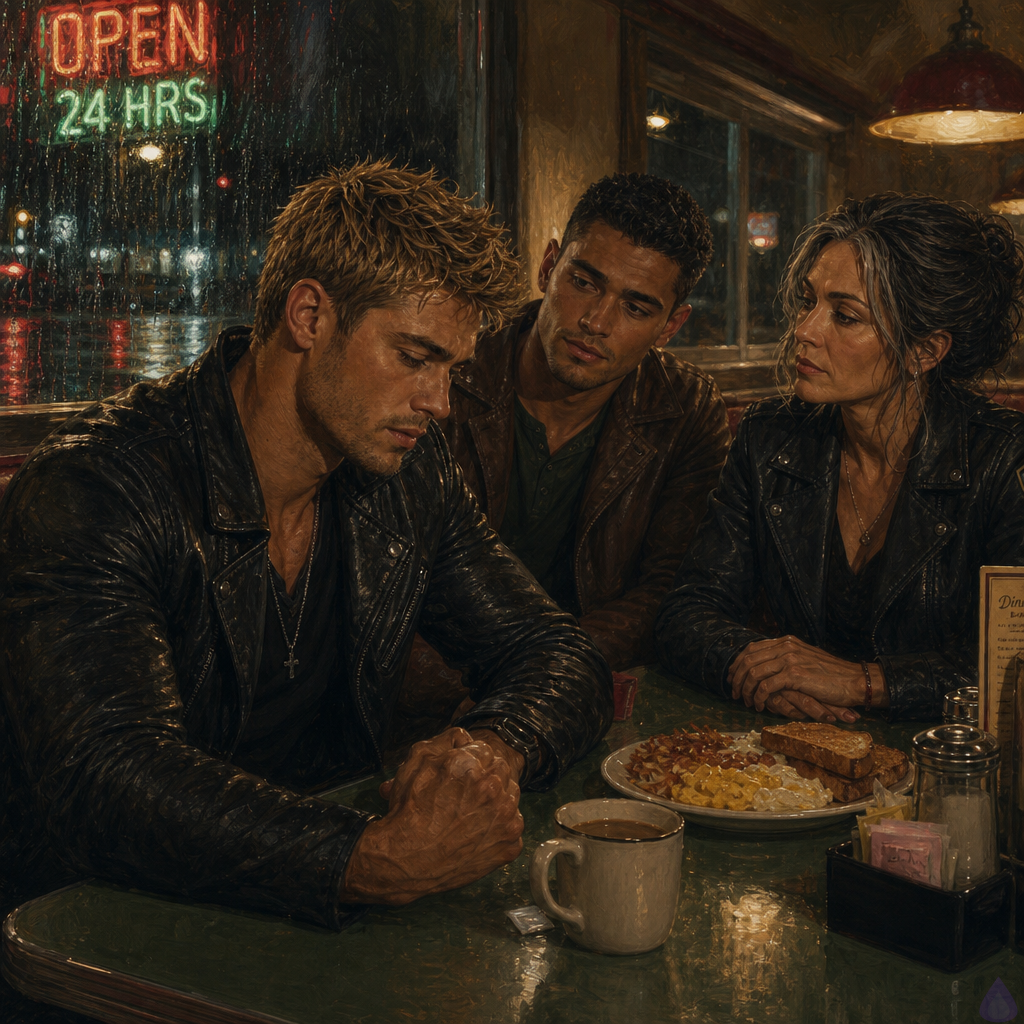
What readers chose (1 choices)
The fork lies untouched beside your eggs while the question claws its way out of your ribs.
You: “You can stay over tonight. If you want. Couch, chair, balcony—wherever your noble self feels least scandalized.”
Mateo looks up from his pancakes, and the whole diner smears soft around the edges. Grease on the air. Burnt coffee. Rain ticking against the glass like impatient fingers. Mara’s cup kisses its saucer.
You hear that.
You hear your pulse, too, loud as boots in an empty hallway. You force yourself not to turn the rest into a joke, though the joke is right there, sleeves rolled up, begging for work.
You: “And, uh. If you meant that. What you said. About lovin’ me.”
Mateo doesn’t answer too fast.
Once, that would have gutted you. Tonight it still scares the hell out of you, but you can recognize the shape of care inside the pause. He sets his fork down. Wipes his hands on a napkin though they’re clean. Then he looks at you like he’s stepping onto holy ground he has no right to own and no intention of bruising.
Mateo: “I meant it. I loved you when I left, and I hated leaving. I love you now.” His voice is low, roughened by the hour and the rain and whatever it costs him not to reach for you. “But staying over means exactly what you say it means. If it means I sleep on the couch and keep the door locked, that is what happens. If it means I make coffee at dawn and pretend not to judge your pantry, that is what happens. It does not have to become more because we kissed.”
Your throat tightens so hard you almost laugh just to break the pressure.
Across the booth, Mara leans back, silver-streaked bun coming loose, hazel-green eyes moving between you and Mateo with the stern discretion of a woman who has absolutely no intention of giving either of you space to be stupid unsupervised.
Mara: “For the record, Reyes is correct. Also for the record, if either of you turns this into some tragic self-sacrificing nonsense before sunrise, I will arrest the vibe.”
That gets you.
A laugh breaks out, rough and wet, and something clenched behind your breastbone cracks open without spilling everything inside. Mateo smiles too, small and helpless, that dimple appearing like it has no survival instinct at all. You stare at it longer than dignity permits.
You have never been dignified a day in your life.
So. Consistency.
The craving is still there. It doesn’t politely leave because love has slid into the booth and put its warm hands on the table. It sits behind your teeth with its boots up, muttering that this is all too much, that one drink would sand down the edges, that whiskey would turn Annie’s voice into static and Edward’s hatred into a story somebody else told.
You pick up your water instead.
Your hand shakes.
Mateo watches the glass, not like a guard watching contraband, but like a man watching you choose the harder road and understanding exactly how heavy it is. That almost undoes you more than judgment would have.
You: “I don’t want to drink tonight. I mean, I do. Bad.” The word scrapes on the way out. “But I don’t want to want it, and I don’t want to wake up tomorrow wonderin’ what I said or did or ruined.”
Mara nods once, satisfied in that ruthless way she gets when honesty finally shows up late, soaked, and underdressed.
Mara: “Good. Then the plan is this. You finish enough food to keep your body from staging a coup. I call your counselor’s after-hours line and document contact. Reyes drives you home. He stays in the living room unless you explicitly change that while sober tomorrow. You hand him any alcohol in the apartment, if there is any. You text me when you are both inside. I call in the morning. You answer.”
You: “That all, Sergeant? Want me to file a weather report and confess my sins alphabetically?”
Mara: “Only if you want extra credit.”
Mateo’s gaze stays on you, warm and serious beneath the diner’s tired fluorescent glow. His sleeve is damp at the cuff. His hair curls darker from the rain. He smells faintly like coffee, cold air, and the soap you remember from years ago, which is an unfair thing for a man to still smell like when you’re trying to keep your heart from making decisions without a warrant.
The bar is miles away now and still too close. Annie is at the station, giving statements wrapped in scripture. Edward is in holding, drunk and furious behind a door he doesn’t control. Adrian remains at a distance, his money useful only because Mara keeps it leashed. Julian is dead and sealed in records, but his shadow still knows your weak hours.
None of them are in this booth.
Mateo is.
You eat three bites of eggs, half the hash browns, and one strip of Mateo’s bacon because emotional recovery apparently requires theft. He lets you take it without protest, which is suspicious and possibly romantic. Mara talks to your counselor in clipped, efficient phrases, then slides the phone across so you can say enough to make it real.
Your voice shakes.
You hate that.
You say you want a drink and you are not going to take one tonight. You say Mateo is staying. You say Mara is insufferable but effective.
Mara looks proud and offended at the same time.
When the check comes, you reach for it first. Mateo’s hand lands near yours on the table, not touching. Just close. The space between your fingers hums, quiet and dangerous in a way that doesn’t feel like falling off a roof.
More like standing at a door.
More like knowing you don’t have to open it tonight.
Mateo: “You do not have to earn tonight by paying for it.”
You look at him, then at Mara, then back at the check with its little curl of receipt paper and coffee stain bleeding at one corner.
You: “I got a job, a rank, and a deeply unreasonable amount of pride. Let me buy breakfast, Reyes. I’m not buyin’ love.” Your fingers close over the slip. “I’m buyin’ pancakes.”
His smile comes slow.
Real.
Mateo: “Then thank you for the pancakes.”
Outside, the rain has softened to mist. The diner windows glow behind you as the three of you step into the wet parking lot, Mara already issuing instructions like a field commander, Mateo walking beside you with his hands visible, and you carrying the ache, the craving, the grief, and the impossible warmth of being loved without a bill attached.
It is not peace.
But it is a plan.

What readers chose (1 choices)
The drive home is quiet in the way a held breath is quiet.
Mateo keeps both hands on the wheel, his brown leather jacket creaking softly whenever he turns through the wet streets. Mara follows for the first ten blocks, her headlights steady in the rearview mirror like a warning aimed at everyone else on the road, then peels away after one sharp flash of her brights.
Your phone buzzes at once.
Mara: "Text when inside. Water. Food. No heroics. No vanishing. If Reyes annoys you, remember he is cheaper than bail."
You snort despite yourself, and the sound fogs the window near your mouth. The craving hasn’t left. Of course it hasn’t. It rides low in your gut, mean and patient, whispering about bottles behind bars, whiskey heat, the clean blackout mercy of not having to think about Annie’s face when she said you failed.
Your thumb presses into the edge of your phone until the plastic bites.
You: "She always this romantic, or am I special?"
Mateo: "You are extremely special. She threatens very few people before breakfast."
That gets a real laugh out of you.
Small. Ragged. Real.
Mateo glances over, and for one second the dashboard light catches his dimple before he smooths his face back into careful calm. He isn’t pretending tonight is easy. He isn’t trying to polish you into something less sharp.
You love him for that.
You hate him for being lovable in a way that makes sobriety feel like standing naked in a well-lit room, every scar visible, every bad instinct breathing against the glass.
At your apartment, he parks beneath the balcony, the engine idling while you stare up at your own dark windows. The brass lock you chose waits upstairs. Your bed. Your couch. Your closet with uniforms lined in severe black and Army gear packed tighter than memory. Maybe one old emergency bottle hidden behind the cleaning supplies, unless you threw it out months ago.
Maybe not.
Your stomach twists because you genuinely don’t know.
Mateo: "We can sit here for a minute. Or we can go up. Your pace."
You: "My pace is usually reckless with a side of self-sabotage. But sure, let’s pretend I’m a graceful woodland creature."
His mouth softens. Then he steps out first, not to lead you, not to drag you, but to stand in the rain while you make yourself open the door.
The cold hits when you step out. Rain freckles your face and slides under your collar. Mateo smells like cedar, coffee gone bitter, and the damp night air, and your stupid body registers all of that before it remembers you are one bad choice away from ruining everything again.
Upstairs, the hallway smells like wet carpet and someone’s overcooked onions. No cat tonight. No scratching at the baseboard. You still pause before the door, listening hard enough for ghosts to get creative.
Mateo waits beside you, close but not crowding. His gaze moves once down the hall, once to the stairwell, then back to you.
Clear exits. Clear air.
God, he knows you.
You unlock the door with only one failed attempt, which feels like a victory nobody should clap for.
Inside, your apartment is exactly as you left it. Narrow living room. Cheap couch. Blue cracked bowl on the coffee table, holding keys, coins, and a folded receipt. One security uniform draped over the chair because apparently rank and stability still can’t teach you laundry discipline. The place smells faintly of detergent, old coffee, leather, and you.
Mateo steps in after your nod and locks the door slowly enough that you hear every click.
Mateo: "First step?"
You pull the relapse plan from the side of the fridge, where Mara taped it under a magnet shaped like a peach because she is a menace with regional humor. The paper is creased, coffee-stained, and written in your own blocky handwriting from a much saner afternoon.
You: "Remove alcohol from apartment. Drink water. Eat something with protein. Contact support. Shower if not dizzy. No big emotional decisions after midnight." You glance at him. "Rude. Targeted. Possibly unconstitutional."
Mateo: "Sounds thorough."
You search the kitchen first.
Nothing under the sink but cleaners and a tragic pile of plastic bags. Nothing in the freezer except peas you bought during a brief fitness delusion. Then, in the back of the pantry, behind rice and a box of stale crackers, your fingers close around a small bottle of bourbon.
The room goes very still.
Your mouth waters.
Shame follows so fast it nearly knocks you sideways.
You: "Well. Look at that. Past me was a sneaky little bastard. Handsome, though. Can’t deny that."
Mateo says nothing. He only brings over a trash bag and sets it open on the counter.
He doesn’t reach for the bottle.
He doesn’t make your wanting into another test you can fail.
You unscrew the cap yourself. The smell rises, sweet and brown and brutal, and for one second Annie’s voice blurs at the edges. Edward’s spit. Julian’s gloves. Adrian’s apology in the drawer. The alley. The hospital. The balcony where Mateo left because loving you had started hurting him.
Your hand shakes so violently bourbon kisses the rim.
Then you pour it down the sink.
The sound is small.
Pathetic, almost.
Liquid hitting metal, running into pipes, vanishing where it can’t climb back into your bloodstream. You keep pouring until the bottle empties. In the dark kitchen window, Mateo’s reflection stands behind yours, solid and silent, his face drawn tight with something too deep to cheapen by naming it.
You drop the empty bottle into the trash bag and grip the counter with both hands.
You: "I really, really wanted that."
Mateo: "I know."
You: "No, I mean I wanted it like I wanted air. Like I wanted to stop being somebody’s failed son for ten damn minutes."
This time, Mateo moves closer.
Slowly.
He stops at your side, shoulder nearly brushing yours, close enough that his warmth reaches through your sleeve before his skin does.
Mateo: "You are not her failed son. You are the man who poured it out while wanting it." His voice roughens. "That counts."
Your laugh breaks wet and quiet. You hate how close it is to crying, so you let your forehead dip toward the cabinet instead of turning into him. Mateo does not touch you until you reach sideways and catch his sleeve between two fingers.
Barely anything.
Everything.
His arm comes around your shoulders, careful and warm, and you lean into him like your bones have been waiting years to admit they are tired. No heat beyond the human kind. No demand. Just his body beside yours in the dim kitchen, rain whispering at the balcony door, the sink still smelling faintly of bourbon and victory.
You text Mara with one hand.
You: "Inside. Bourbon murdered. Eating soon. Reyes annoyingly useful."
Her reply comes before you can set the phone down.
Mara: "Good. Proud tomorrow. Logistics tonight. Eat."
Mateo reads it over your shoulder and huffs a laugh, the sound brushing your temple. You elbow him weakly, then let him guide you toward the couch, where the relapse plan waits for its next impossible little step.
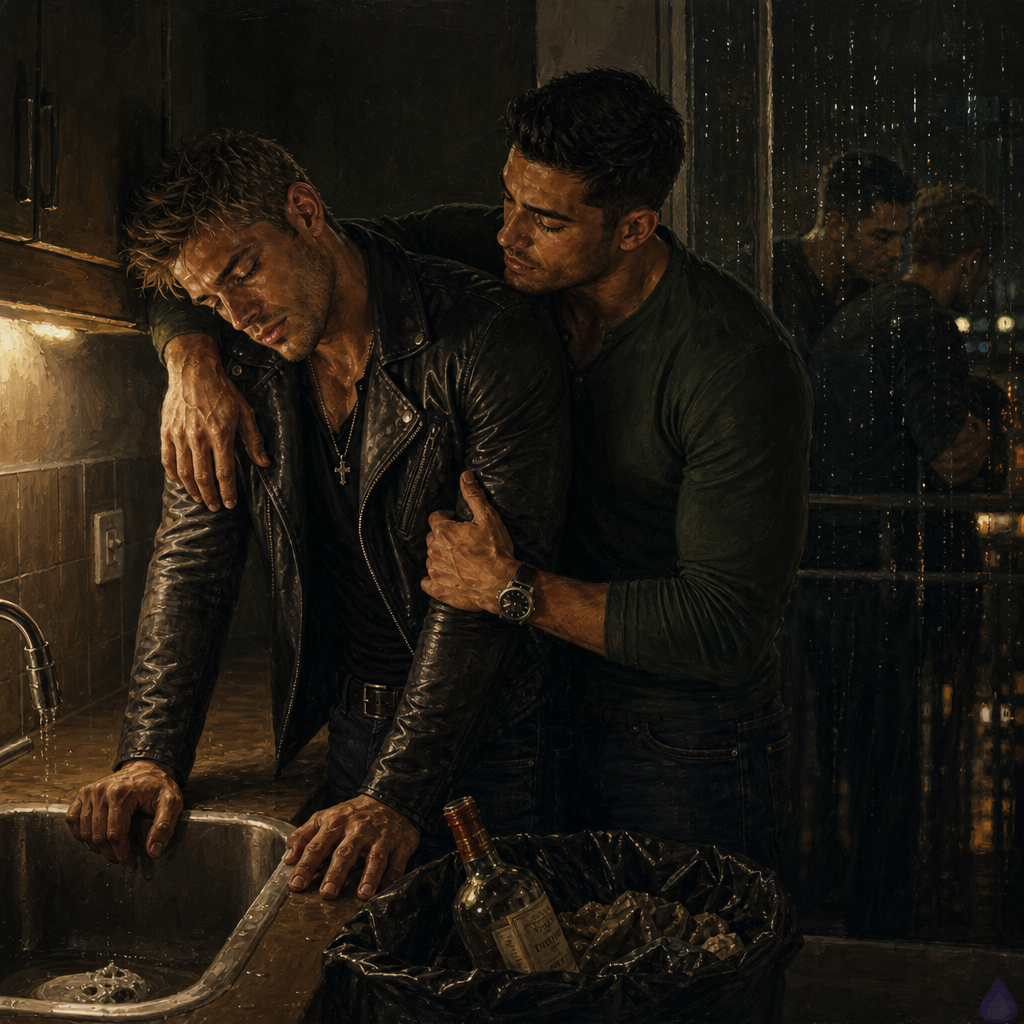
Mateo makes eggs because your relapse plan says protein, and because apparently the man can face down armed suspects but still approaches your warped frying pan like it might press charges. You sit on the couch with a blanket around your shoulders, boots unlaced, watching him move through your tiny kitchen in the soft yellow light over the stove. Rain taps the balcony door with patient fingers. The sink still smells faintly of bourbon, sweet and accusing, but the bottle is empty in the trash bag and your hands are no longer wrapped around it.
You: "If you poison me after that romantic speech at the sink, Reyes, I’m hauntin’ you specifically. No generic ghost work. Personalized service."
Mateo: "Noted. Do you haunt quietly?"
You: "Absolutely not. I’m Southern. We linger with commentary."
His laugh is quiet, tired, and real. It loosens something in the room.
Not the grief. Annie’s voice is still there, saying failed like she stamped it on your birth certificate. Edward’s face still floats behind your eyes, slack with liquor and old hate. Julian stays locked in the sealed dark of your memory, and Adrian’s unopened apology waits somewhere in the drawer like a bill you can’t afford to read. None of it vanishes because Mateo scrambles eggs in your kitchen.
But butter hisses. Pepper blooms sharp in the air. The warm, salty smell starts to push back against the ghost of bourbon.
For tonight, pushing back counts.
He brings you a plate and sets it on the coffee table beside a glass of water. Then he sits at the far end of the couch, not close enough to crowd, not far enough to feel like punishment. The space between you is one cushion wide and packed with everything you both did not say for years. His brown leather jacket hangs over the chair. In just the forest-green henley, sleeves shoved to his forearms, he looks less like the memory you kept polishing and more like a man who drove through rain at midnight because love sometimes means making eggs badly and not asking to be praised for it.
You eat because Mara will somehow know if you don’t. The first bite sits heavy in your mouth. The second goes down easier. By the fourth, hunger wakes up under the nausea, embarrassed and feral. Mateo looks away while you clean the plate too fast.
Another mercy.
You clock it against your will.
Your phone buzzes on the table. Mara again.
Mara: "Counselor confirmed morning appointment. I will drive if needed. Edward held overnight. Annie released with warning and no contact order pending. Adrian’s attorney notified funds remain no-contact. Sleep if possible. Do not start philosophical debates after 0300."
You read it twice, then hand the phone to Mateo. His mouth tightens at Annie’s release, that little muscle in his jaw ticking once, but he nods when he reaches the part about the no contact order. His thumb hovers near the screen.
He doesn’t reply for you.
Never for you.
You: "She’s alive."
It comes out smaller than you mean. Thin. Barely yours. The apartment seems to lean toward the words, even the rain going softer against the glass. Mateo sets the phone down carefully and turns his body a little more toward you.
Mateo: "Yes."
You: "I spent ten whole minutes thinkin’ she was dead, and then she walked out like the world’s cruelest magic trick. And some part of me was still happy." Your mouth twists before it can tremble. "How pathetic is that?"
Mateo: "It isn’t pathetic to love someone who failed you. It’s painful." His voice drops, rough at the edges. "There’s a difference."
You stare at him until your eyes burn.
There he goes again, saying things like he has a key to doors you boarded up yourself. You want to kiss him. You want to crawl out of your skin. You want a drink. Less than before, maybe, but still enough that the want bares its teeth when the room gets quiet.
So you do the thing the plan says.
You say it out loud.
You: "I still want one. Not as bad. But it’s there." Your fingers curl in the blanket, twisting fleece until it bites into your palm. "And I hate that you’re seein’ me like this after I finally got to look impressive for, what, half a pool game?"
Mateo’s gaze softens. The dimple almost appears, then doesn’t.
Mateo: "I saw you pour it out. I saw you ask for help. I saw you tell your father the truth and not hit him." He holds your eyes like he won’t let you look away from yourself. "If you think that isn’t impressive, your standards are bad."
You: "My standards dated me for years, so yeah, evidence supports that."
This time, the dimple shows. Small. Warm. Devastating.
You let yourself look at it.
Just for a second.
Then you reach across the cushion between you, palm up, because brave is apparently something you can be while terrified and full of eggs.
Mateo looks at your hand first. Then at your face. A question lives there, careful and aching, and he waits until you don’t take it back.
When his fingers lace through yours, the contact is gentle, sober, and chosen. No neon. No bar. No whiskey. No panic shoving you together. Just the couch, the rain, the empty bourbon bottle in the trash, and his thumb resting still along the side of your hand like he is willing to wait all night for your nervous system to believe him.
Heat gathers behind your ribs. Quiet. Dangerous.
You lean your head back against the couch and close your eyes. The craving doesn’t leave. The grief doesn’t either. But Mateo’s hand is warm in yours, Mara is awake somewhere making threats on your behalf, Adrian is held back by paperwork, Julian is dead, and Edward and Annie are farther away than they were an hour ago.
For tonight, that is the shape of safety.
Then your phone buzzes again.
Not Mara this time.
Unknown number.
A voicemail notification appears without ringing, and beneath it, the transcript begins with two words that turn your stomach cold.
Voicemail Transcript: "Dwayne, sweetheart..."
Annie.

What readers chose (1 choices)
Mateo’s hand tightens around yours once, not enough to trap you, just enough to remind you he is there. The phone lies on the coffee table between the empty plate and the water glass, its screen too bright in the dim living room. Unknown number. Annie’s voice waiting behind a little triangle of glass and light.
You stare at it until the letters blur.
You: "Well. That’s ominous. Nothin’ says maternal affection like bypassin’ a pending no-contact order with burner-phone energy."
Mateo does not laugh, but his thumb rests against the side of your hand, warm and steady. He sits one cushion away on your couch in his forest-green henley, dark eyes on your face rather than the phone. The kitchen still smells faintly of eggs, pepper, and bourbon poured down the sink. Rain whispers against the balcony door. The apartment is locked. The relapse plan is still taped to the fridge under Mara’s ridiculous peach magnet.
Mateo: "You do not have to play it tonight. You can delete it. You can send it to Mara. You can listen with me here. All of those are choices."
Choices. The word should feel empowering. Mostly it feels like standing barefoot in broken glass and being told you may select which piece cuts first. Your thumb hovers over the screen. Annie had stepped out of the shadows alive and called your survival a failed test. Edward had tried to make you responsible for a death that never happened. Julian had died before trial, leaving you with testimony sealed into paper instead of spoken in court. Adrian remained distant, useful in ways you still resented. Everyone who had ever touched your life had left fingerprints, and now your mother’s voice waited in your hand like another bruise asking permission.
You press play.
Static breathes first. Then Annie.
Annie: "Dwayne, sweetheart, I know you are angry. I know that woman with the badge will tell you not to listen to your mama, but I am still your mama. Your father did wrong in how he spoke, but grief makes sinners of us all. We only wanted to know if the city had hardened your heart past saving. When I saw you with that man, I knew. I knew the devil still had hold of my boy."
Your fingers go numb inside Mateo’s hand.
The phone keeps talking.
Annie: "I forgive you for leaving me. I forgive you for the shame, for the things you did in the streets, for choosing that life and those people. But forgiveness requires repentance. Come home. Come alone. Your father and I can help you find your way back before it is too late. Do not let them turn you against your blood. Blood is sacred. A mother’s love is sacred."
A small sound leaves you. Not a laugh. Not a sob. Something worse, something that has no manners and no shape.
Mateo’s hand stays around yours. His jaw is locked tight, but he says nothing over her voice. He lets you hear it. Lets you know exactly what you are choosing against.
Annie: "If you refuse us now, Dwayne, then whatever becomes of you is on your own head. We tried. God saw us try. I pray you remember the boy you were before sin made you proud."
The voicemail ends with a click.
Silence floods the apartment.
For a second, you can hear everything. The refrigerator hum. Rain on glass. Mateo’s breathing. Your own pulse, too fast and too young. The craving surges so hard you taste bourbon that is no longer in the apartment. It roars up with Annie’s words, come home, come alone, your fault if you refuse. Old hooks. Old scripture. Old chains polished until they looked like love.
You pull in one breath through your nose. Then another. The air smells like eggs, damp leather, and the ghost of whiskey in the sink drain. You want to throw the phone across the room. You want to call her back and beg her to say one sentence that does not cut. You want a drink so badly your body shakes with it.
Instead, you pick up the phone and forward the voicemail to Mara.
Your thumb almost misses the button twice.
You: "There. Evidence. Look at me, bein’ a responsible adult. Disgusting behavior."
Mateo lets out a breath he must have been holding. His hand shifts, and this time his fingers lace more fully with yours. You let them. You need them.
The response from Mara arrives almost immediately, because of course it does.
Mara: "Received. Do not respond. Blocking number now is acceptable. No contact violation added to report. I am not surprised, but I am furious. Stay with plan. Reyes, confirm eyes on him."
Mateo reads it when you tilt the screen toward him.
Mateo: "Eyes on him," he says softly, not into a phone, but to you.
The words land low in your chest. You look at him then, really look. Warm sienna skin in lamplight. Dark brown eyes tired and fierce. A man who once left because loving you had started hurting you both, now sitting in your apartment at midnight, holding your hand while your mother’s voice tries to make ruin sound holy.
You: "She still thinks I chose wrong."
Mateo: "She is wrong."
You: "You say that like it’s easy."
Mateo: "No." His voice roughens. "I say it like it is true. Easy has nothing to do with it."
Your laugh breaks quietly, and this time it does turn wet. You wipe at your face with the heel of your free hand, furious with the tears and too tired to bully them back where they came from. Mateo does not reach for them. He only stays, hand warm around yours, while you grieve a mother who is alive and a childhood that never got rescued in time.
The craving remains. But so does the plan.
You block the number. Drink the water. Set the phone face down.
Then, because your voice is still yours even when it shakes, you whisper,
You: "Couch better be comfortable, Reyes. You’re on door duty."
Mateo’s dimple appears, small and aching.
Mateo: "Yes, Lieutenant."
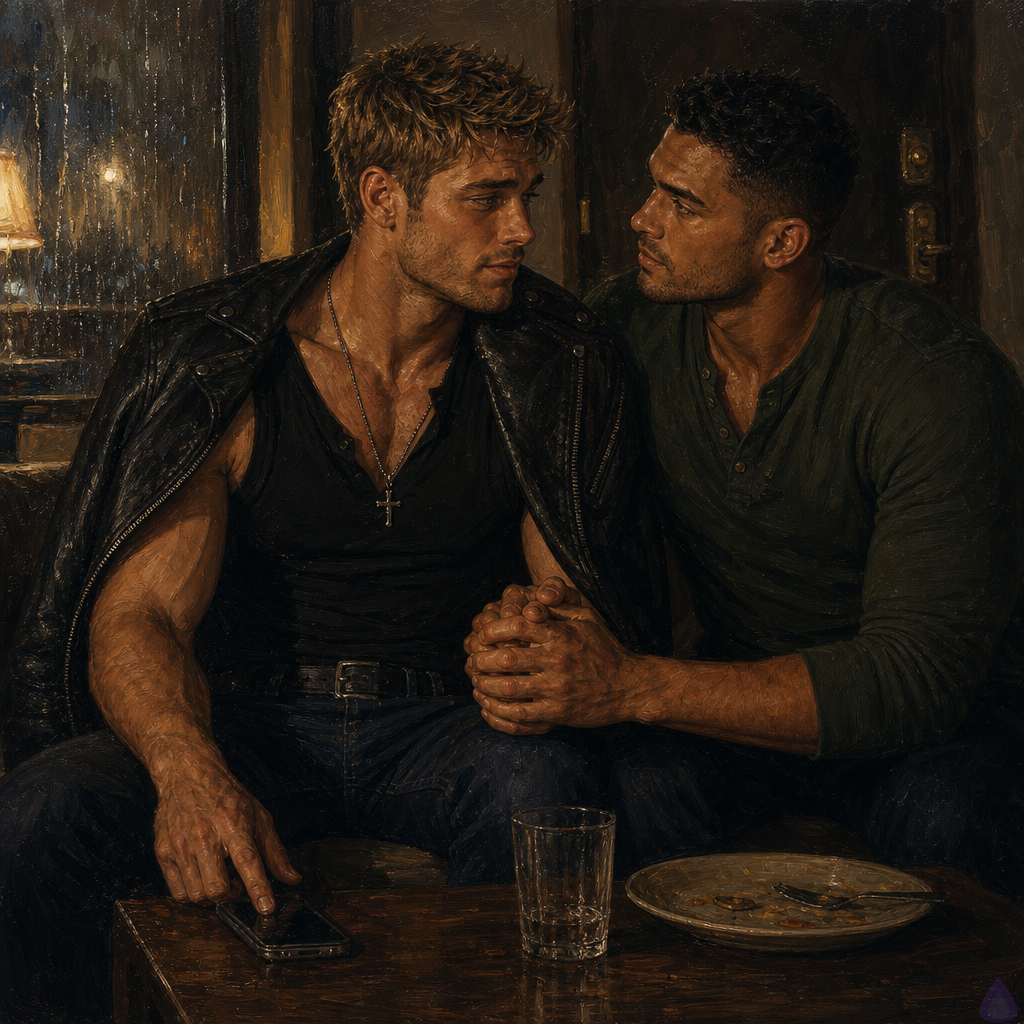
What readers chose (1 choices)
You unblock the number for exactly long enough to do something reckless with boundaries and, for once, not self-destructive.
Mateo catches the shift in your face before you move. Of course he does. His hand stays around yours on the couch, warm and steady, while the phone lies facedown on the coffee table like a sleeping snake. Outside, rain tracks crooked lines down the balcony glass. Inside, the apartment smells of peppered eggs, damp leather, and the faint sour ghost of bourbon in the sink—evidence of the thing you wanted and did not take.
Mateo: "Dwayne. Before you do anything, ask yourself if this helps you or feeds the fire."
You look at him. At the close-cropped black hair mussed from a night that should have ended hours ago. At the dark eyes that have learned every one of your exits and still never block the door. Years ago, he might have been your only lifeline. Tonight, he is beside you. Not holding you up. Just holding your hand while you stand.
That difference aches.
You: "It helps me. I ain’t callin’ her. I ain’t beggin’. I ain’t lettin’ her preach back. I just need my voice somewhere outside my own head before hers grows roots in there."
Mateo nods slowly. He lets go only because you reach for the phone, then rests his palm open on his knee, there if you need it again. The small distance lands hard in your chest. It says he trusts you with the sharp thing in your hand.
You open the voice memo app first.
Not the phone call. Not voicemail. A recording you can send to Mara, to your counselor, to nobody, if courage goes bad before morning. Mara would approve of evidence. Mara would also threaten to staple the no-contact order to Annie’s front door, which is probably why you can feel her even from across the city—silver-streaked bun, hazel-green eyes, practical fury honed bright and dangerous.
You hit record.
For half a second, nothing comes out.
Your thumb hovers. Your throat locks. Annie’s voice rises again. Sweetheart. Blood is sacred. Come alone. Your father and I can help. Under it, Edward’s drunken accusation snarls. Under that, older voices. Julian Vale’s cold certainty that your body could be punished into meaning something. Adrian Vale’s soft apologies wrapped in money and distance, never clean, never entirely useless. All of them crowd the edge of your mouth like they own the right to name you.
Mateo’s knee touches yours.
Barely.
You breathe.
You: "Mama. This is Dwayne. I listened to your message. I am not comin’ home. I am not comin’ alone. I am not meetin’ you, Daddy, or anybody from that church without Sergeant Whitlock present, legal counsel present, and a no-contact order respected."
Your voice shakes on Daddy.
You hate that.
You keep going anyway.
You: "What you and Edward did tonight was cruel. Lettin’ him tell me you were dead was cruel. Callin’ it God’s test does not make it holy. It makes it worse. You do not get to use faith to scare me back into bein’ quiet. You do not get to forgive me for survivin’. You do not get to call what happened to me shame and then pretend that is love."
Mateo’s eyes shine in the low lamplight, but he does not interrupt. His jaw is locked. His broad shoulders hold still. His fingers curl against his thigh like he is pinning himself there, choosing not to reach too fast, choosing you over the reflex to rescue.
The sight of him steadies you more than you want to admit.
Maybe more than you are ready to owe.
You swallow.
You: "I loved you. Part of me still does, and I hate how much that hurts. But loving you does not mean I have to let you hurt me. If you contact me again outside legal channels, I will send it to Sergeant Whitlock. If Edward contacts me, same thing. If either of you shows up at my home, my work, my base, or anywhere near Mateo, I will report it."
There.
Mateo’s name.
Solid in the room. Chosen.
His breath changes, so quiet you almost miss it. Not a gasp. Not quite. Just air catching in a chest too disciplined to break open. You feel it anyway, because you have become embarrassingly fluent in him—the scrape of his thumb against denim, the soft click in his throat when he swallows pain, the way his stillness is never emptiness.
Your hand trembles so hard the phone wobbles.
Your voice does not break.
You: "I am not Devil’s Spawn. I am not your failed test. I am not the sin in this family. I am Dwayne Cole. I am twenty-seven years old. I am a lieutenant. I have a home. I have people. I have a relapse plan taped to my fridge under a stupid peach magnet, and tonight I poured bourbon down the sink instead of drinkin’ it because I am tryin’ to live."
A laugh almost gets loose there, wet and sharp.
You let it pass.
You: "Do not call me sweetheart again until you can say it without a hook in it."
You stop the recording.
The silence afterward is enormous.
Not empty. Enormous. Like a church after everyone has left. Like a courtroom before the verdict. Like the second after liquor hits the drain and the world does not end after all. The phone screen shows the little file sitting there, thirty-seven seconds of your voice turned into proof.
Your chest feels cracked open.
Not bleeding, exactly.
Ventilated.
You: "Well. That was either personal growth or a felony. Hard to tell at this hour."
Mateo exhales a laugh that sounds dangerously close to grief. Then he reaches for you slowly, giving you every chance to refuse. You don’t. His hand closes around yours again, and this time you turn into him before pride can file an objection.
The embrace is careful at first.
Then it becomes real.
His arms come around your shoulders, warm through your leather jacket and the blanket, one palm settling between your shoulder blades where he has learned to hold without trapping. You press your face into the side of his neck and breathe him in—rain, cedar soap, coffee, clean cotton, the salt-warm skin just beneath his jaw. No whiskey. No bar smoke. No panic dressed up as want.
Just Mateo on your couch.
Just his pulse against your cheek.
Just your recorded voice waiting on the coffee table like a door you finally locked from your side.
Your phone buzzes.
Mara.
Mara: "Send me the recording before you send it to her. Do not improvise legal strategy at midnight. Also, good work. That is tonight’s pride. Logistics resume now."
You laugh against Mateo’s shoulder, and this time the sound holds.
You: "She’s psychic. Or there are cameras in the peach magnet."
Mateo: "Both seem possible."
His voice is rougher than usual. You feel it where your cheek rests against his throat, feel the words before you fully hear them, and something low in your stomach twists—not fear, not craving, not the old need to disappear into somebody else’s hands until morning.
Want, maybe.
The safe kind. The terrifying kind.
You pull back just enough to look at him. His hand slides from your shoulder blade to the back of your neck, then stops, loose and warm, asking without words. The rain keeps ticking against the glass. His gaze drops to your mouth for one dangerous second.
Your whole body answers.
Then your phone buzzes again in your palm, Mara’s impatience dragging you both back from the edge.
Mateo’s hand falls away first. He does it gently. Like it costs him.
You forward the recording to Mara, then set the phone down without sending it to Annie.
Not yet. Maybe tomorrow, with counsel. Maybe never.
The point, you realize, was not making your mother hear you.
The point was hearing yourself.
Across the city, Adrian Vale remains behind the clean wall of legal distance, his guilt turned into funds and statements instead of access. Julian Vale remains dead, unable to take the stand or take anything else. Edward and Annie are names in Mara’s report now, not gods in your doorway.
And Mateo is still here.
Your hand finds his again while the rain keeps falling, and the craving, though not gone, lowers its voice enough for you to hear your own.
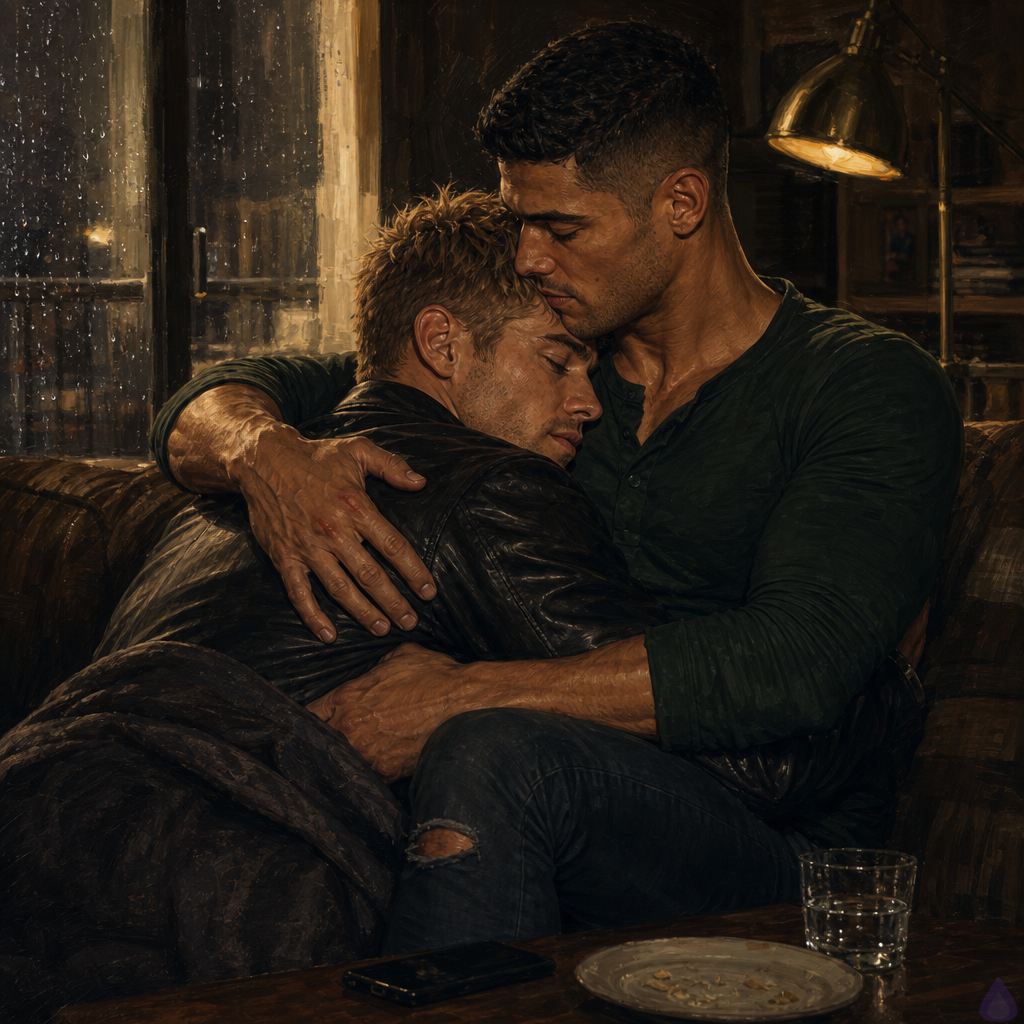
What readers chose (1 choices)
You send it before courage can become committee work.
The little arrow flashes blue, then disappears into delivered, and the apartment seems to inhale around you. Rain ticks against the balcony glass. The sink still smells faintly of bourbon, sharp and sweet and rotten at the edges. Mateo sits close enough that the heat from his thigh seeps into yours, but not close enough to take the phone from your hand, even though his eyes go keen the second he catches what you did.
Mateo: "Dwayne."
Your name is not a scold.
That makes it worse.
You lift one shoulder, aiming for careless and landing somewhere around cornered.
You: "What? I didn’t call her. Didn’t drive to Georgia. Didn’t start a revival in my livin’ room. Progress comes in many questionable flavors."
Mateo’s jaw tightens, but he breathes through whatever rises first. He has gotten good at that. Too good, maybe. The forest-green henley is rumpled from the long night, his brown leather jacket draped over your chair, and his dark eyes stay tired and steady on your face. He looks like a man standing beside a live wire because he promised he would, not because he forgot it could burn.
Your phone buzzes.
Not Mara.
Annie.
The message preview appears like a bruise blooming under glass.
Annie: "You sound so hard. That man and that woman have made you cruel. I will pray until my son comes back to me."
The craving comes back so fast you taste copper.
Not bourbon this time.
Rage. Shame.
The old hook under your ribs yanks hard enough to make you want to smash the phone, open the door, walk until the streetlights thin out and some bar with no questions lets you be nobody for a while. Your thumb hovers over the screen, ready to answer, ready to bleed straight into the argument, because some starving part of you still believes if you arrange the words perfectly, if you make them clean enough, sharp enough, holy enough, your mother will finally choose you over the story that lets her sleep.
Mateo’s hand lands on the couch cushion between you.
Palm up.
Not on your wrist. Not over the phone. Just there, broad and warm, knuckles rough from work, a scar silvering one finger beneath the lamplight.
Mateo: "Do not answer while she has the hook in."
You laugh once, sharp and ugly.
You: "She’s my mama, Reyes. I came pre-hooked."
Mateo: "Then let someone else hold the line for a minute."
Your phone buzzes again, this time with Mara’s name lighting up the room like incoming artillery. You almost don’t answer. Pride, that rat bastard, lifts its head. Then Annie’s message sits there glowing, and the empty bourbon bottle waits in the trash, and Mateo keeps his palm open like he already knows you are angry enough to bite and tired enough to need a hand anyway.
You answer on speaker.
Mara: "Tell me you did not send it."
Silence.
Mateo closes his eyes for half a second.
You: "Would you accept a spirited interpretation of no?"
Mara exhales through her nose. You can picture her perfectly, silver-streaked bun loosened, hazel-green eyes narrowed at some kitchen counter or station desk, surrounded by paperwork that has learned to fear her.
Mara: "Cole. I am going to speak calmly because Reyes is there and because I assume the bourbon stayed murdered. Do not respond further. Send me screenshots now. Her reply helps the no-contact petition, but if you engage, their attorney can paint this as mutual conflict instead of harassment. Do you understand?"
The word attorney makes Adrian flicker through your mind, expensive suits and distant guilt turned into controlled funds and legal insulation. Julian follows like a shadow in a black coat, dead before trial, still stealing clean endings. Edward’s drunk voice snarls beneath both, blaming you for a death that never happened.
Annie’s text glows brighter than all of them.
You swallow. It hurts.
You: "I understand."
Mara does not accept easy answers any more than she accepts cheap coffee.
Mara: "Words with specifics."
You grit your teeth.
You: "I won’t answer her again tonight. I’ll screenshot it and send it to you. I will not improvise legal strategy while emotionally concussed."
Mara: "Good. Also, you are not cruel for having a boundary. You are impulsive for ignoring my warning. Those are separate findings."
Despite everything, a laugh breaks loose.
Small. Wet at the edges.
Mateo’s mouth softens, the dimple almost appearing before worry covers it again, and damn him for being so careful with you. Damn him for making careful feel less like a cage and more like someone standing in the doorway with a blanket.
You: "Yes, ma’am. Thank you for the emotionally supportive verdict."
Mara: "Anytime. Reyes, confirm the relapse plan is still active."
Mateo looks at you first.
Asking.
Always asking.
You press the phone against your knee and stare at his open hand. The craving still snarls, humiliated and hungry. Annie’s words still sting. But your recorded message exists. You said the truth. You poured out the bourbon. You did not go back into the bar. You are here, on your couch, with rain at the windows and the door locked from your side.
You place your hand in Mateo’s.
His fingers close around yours, warm and steady, and the weight of them does something dangerous inside your chest. Not fix. Not save. Just hold.
Mateo: "Active. He ate. He poured out the alcohol. He contacted support. We’re documenting the message. I’m staying on the couch."
Mara’s voice softens by a fraction.
Mara: "Then keep going. One step at a time. Pride tomorrow. Logistics tonight."
The call ends, leaving the apartment quieter but not empty.
You send Mara the screenshots. Then you block Annie again. This time, your thumb does not shake as badly.
For a while, you and Mateo sit hand in hand while the rain softens against the glass. The kiss from earlier still waits between you, warm and unfinished, a held breath neither of you is brave enough to spend. The craving remains too, lower now, sulking in the corner with all the other ghosts. You look at Mateo’s profile in the lamplight, the calm line of his mouth, the exhaustion under his eyes, the stubborn choice of him still being here.
You: "I messed that up."
Mateo: "A little."
You bark a laugh because the honesty is rude and perfect.
Mateo: "And then you stopped. That matters more."
You lean back against the couch, still holding his hand, and let the truth settle in without dressing it up.
You sent the message. Annie answered with a hook. You did not bite down hard enough to bleed.
For tonight, that is not nothing.
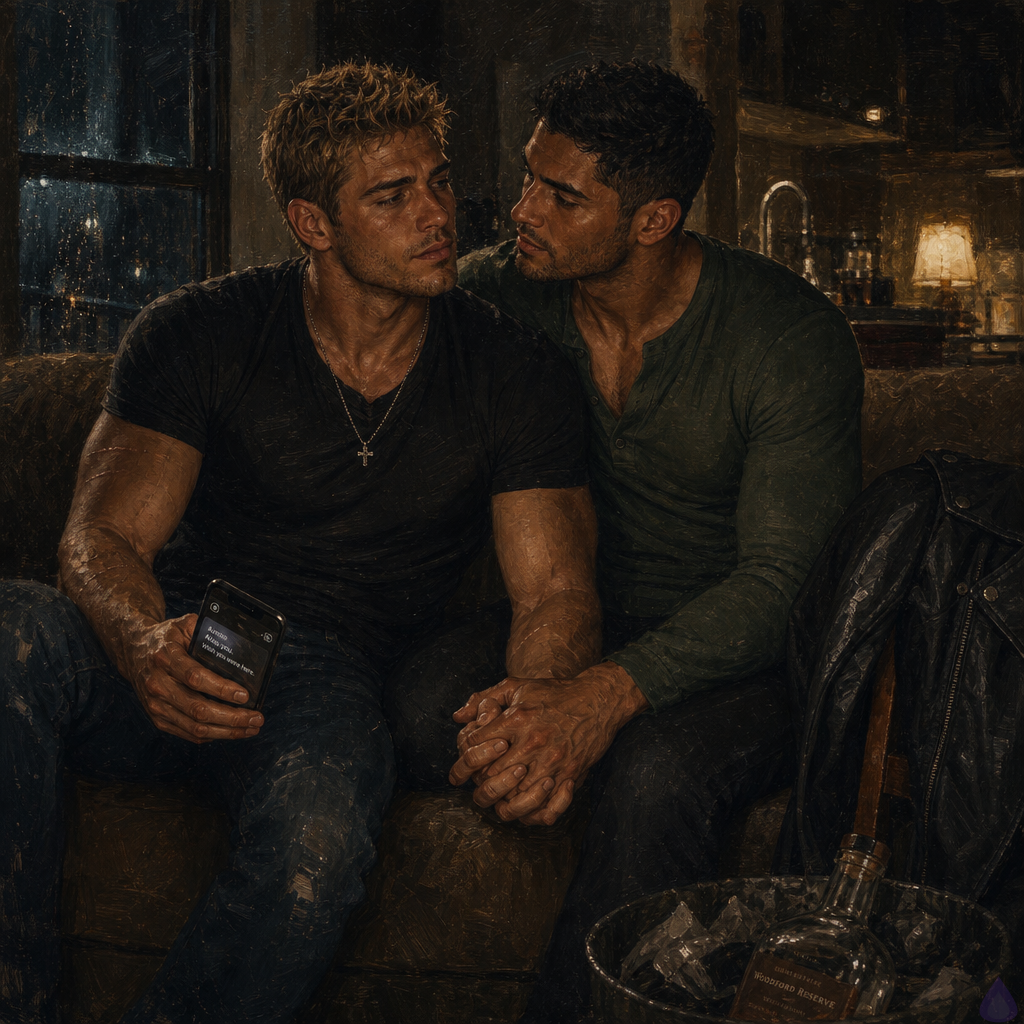
What readers chose (1 choices)
You: “Can you sleep with me in my bed?”
The question drops into the dim apartment with nothing dressed around it. No joke. No glitter. No smoke. No crooked grin to give either of you a way out. You sit on the couch with Mateo’s hand still in yours, rain whispering against the balcony glass, the empty bourbon bottle buried in the trash like a small defeated demon. Your phone lies face down on the coffee table after blocking Annie again, and Mara’s last message—Logistics tonight,still seems to stand in the corner wearing sensible shoes and refusing to blink.
Mateo goes very still.
Not pulling-away still. Careful still.
His dark eyes move over your face, then your joined hands, then the hallway leading to your bedroom, and you can feel every line he is drawing inside himself. The kiss outside the bar. The bourbon down the sink. Annie’s voicemail, sugar-sweet and barbed. The craving you dragged into the open by its throat. The years he spent loving you from too far away because staying had started to look too much like bleeding.
Mateo: “I can sleep in the bed beside you if that is what you want. Sleep only. Clothes on. Door open or closed, your choice. If you change your mind, I move to the couch, no questions. If I fall asleep and you need space, wake me. You don’t have to protect my feelings.”
Your laugh comes out thin. Scraped raw at the edges.
But not broken.
Not completely.
You: “Damn, Reyes. You make sharing a mattress sound like a military treaty.” Your mouth twitches even though your chest aches. “I respect the paperwork. Hate it, but I respect it.”
His mouth softens, and the dimple almost appears.
Almost is cruel.
Almost is enough to make your ribs hurt.
You stand too fast, sway once, and he rises with you without grabbing. Without claiming. The room tilts on its axis, rain and lamplight and him, then settles back into place. You are sober enough to choose. Shaken enough to need steadiness. Tired enough that the thought of lying alone in the dark feels like locking yourself outside your own damn body.
In the bedroom, you turn on the small lamp instead of the overhead light. Amber spills across the unmade bed, the stack of Army manuals on the nightstand, the folded security uniform over the chair, the boots lined beneath it with stubborn precision. Your whole life reduced to damage control and right angles.
Your leather jacket lands over the back of the chair.
Mateo pauses in the doorway until you nod him in. Only then does he step across the threshold. He takes off his shoes and sets them neatly beside the wall, quiet as a prayer, as if respecting the room means respecting you.
God help you, it does.
You keep your T-shirt and jeans on. He keeps his henley and dark jeans on. The blanket rustles too loudly when you pull it back, and suddenly your skin knows everything. The size of the bed. The slow movement of his hands. The rain tapping the glass. The heat of him across three feet of mattress. The fact that your heart has no damn discipline despite your rank, your record, your hard-earned talent for standing under fire and not flinching.
Mateo lies down on the far side first. On top of the sheet.
You gesture sharply at the blanket.
You: “Get under there, Officer. You’re not a decorative throw pillow.”
Mateo: “Lieutenant.”
You: “Do not bring rank into my bedroom unless you’re prepared for me to make it weird.”
There.
The dimple.
Brief. Real. Dangerous.
Then he slides under the blanket, careful not to crowd you, one arm resting above the covers where you can see it. The faint scar across his knuckle catches the lamplight. You remember that hand steadying a rifle. Opening a door. Holding yours like it was something breakable and worth saving.
You lie on your side facing him, close enough to feel the warmth coming off his body, not close enough to touch unless you choose it.
For a while, you don’t.
You just breathe.
The bed smells like your detergent, cold rain clinging to his clothes, and the clean cedar soap that has haunted you for years. Annie’s voice tries to rise again—sweetheart, with a hook buried under the sugar,but it stumbles against the ordinary fact of Mateo blinking sleepily at you from your pillow. Not invading. Not taking. There because you asked, and because he loved you enough to make the asking safe.
Your throat tightens.
Damn him.
You: “I’m scared if I close my eyes, I’ll hear her. Or him. Or Julian.” You swallow, staring at the hollow of his throat instead of his eyes because eyes are worse. Eyes know things. “Hell, maybe Adrian’s apology will grow legs and start tap-dancin’ in the hallway. Been a crowded night.”
Mateo’s expression turns gentle.
This time, you let it.
You don’t make it fight you. You don’t slap a joke over it fast enough to keep it from getting in.
Mateo: “If you wake up, wake me. If you hear them, tell me what year it is. If you want the light on, it stays on.” His voice lowers, rough with restraint. “If you want my hand, it’s here.”
He places his hand palm-up on the mattress between you.
Open.
Waiting.
You stare at it like it is more dangerous than any bottle.
Maybe it is. A bottle only takes what you hand it. Mateo offers something worse. Witness. Memory. Morning.
You put your hand in his.
His fingers close slowly, warm and solid, and something in you starts dropping its weapons one at a time. Not all of them. You are not a miracle, not a redemption arc with cheekbones and a soundtrack. But enough. Enough to feel the weight of his thumb brush once over your knuckle. Enough to let your shoulders unclench. Enough to breathe all the way in.
You: “You really meant it.”
His gaze holds yours in the amber dark.
No escape routes. No old ghosts between his teeth.
Mateo: “I love you. I mean it now.” His fingers tighten, just barely. “I’ll mean it in the morning.”
The craving is still somewhere in the apartment. Quieter now, sulking behind the sink and the blocked number and the unsent legal consequences waiting for Mara. Edward is in holding. Annie is one report update away from a court order. Julian is dead. Adrian remains at a distance, his guilt fenced off by paperwork and too many years.
None of that is gone.
But Mateo’s hand is in yours.
The bedroom lamp glows warm. Rain keeps time against the glass. His breathing slows beside you, steady and human and close.
And for once, when sleep comes near, it does not feel like surrendering to the dark.
It feels like letting someone keep watch while you rest.
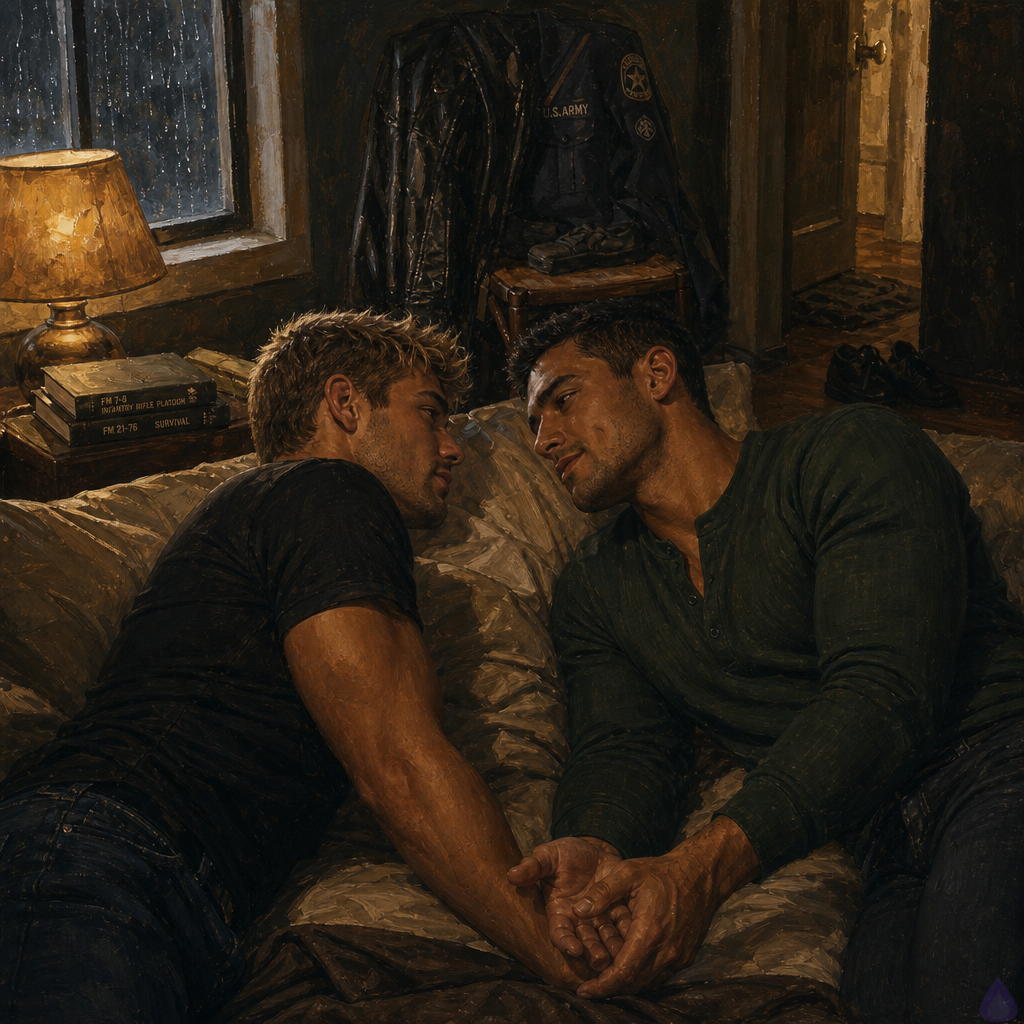
What readers chose (1 choices)
You wake tangled in Mateo’s warmth, your hand still locked around his, your knee hooked against his thigh beneath the blanket. For one blurred second, the room is amber lamplight, rain on glass, and the steady human weight of him beside you. Cedar. Soap. The faint bitter edge of coffee still clinging to his skin.
Then wanting hits so hard it feels like fear with a different face.
You kiss him before you can talk yourself out of it.
Mateo wakes on a soft, startled breath against your mouth. His fingers tighten around yours, instinctive. Then loosen at once. Careful, even half-asleep, because of course he is. Of course that is the knife and the mercy. You fist the front of his forest-green henley and drag him closer, and he comes over you on one elbow, broad shoulders blocking the lamp’s glow, his body warm and solid above yours without letting his full weight pin you down.
For one breath, he kisses you back.
God help you.
It is not the neon kiss outside the bar, sharp with years and rain. This is darker. Closer. Sleep-rough tenderness, the scrape of stubble near your jaw, the heat of his mouth opening under yours like he forgot, just for a second, how to be good. The sound he makes is low enough to ruin you. Your fingers knot in his shirt. Your body remembers every empty year, every almost, every time he stood close enough to want and far enough to be honorable.
You hate honorable right now.
You want him closer.
You: "Mateo. Please."
His whole body goes still above you.
Not cold. Not gone.
Still.
The word you chose hangs in the room, dangerous as a match held too near a gas stove. Rain ticks against the balcony glass. The lamp lays gold along Mateo’s cheek, his warm sienna skin shadowed and soft, dark eyes open now and fixed on yours with restraint so tight it almost looks like pain. One hand is braced beside your shoulder. The other cups your jaw so lightly you could turn away with no effort at all.
He makes sure you know that.
Mateo: "Dwayne. Look at me."
You do, though every instinct in you wants to drag him down again and let wanting get louder than Annie. Louder than Edward. Louder than Julian’s dead shadow and Adrian’s distant guilt and the bourbon you poured into the sink with your hand shaking like it belonged to someone else.
Mateo’s breathing is uneven.
That helps, in a terrible way.
He wants you. You can feel it in the tremor he is trying to bury, catch it in the way his gaze drops to your mouth and climbs back up like it costs him. No room left for the old lie that he is disgusted. His thumb trembles once against your cheek before he stills it.
Mateo: "We said sleep only tonight. You said it while sober, and I agreed. I am not going to change that because you woke up scared and wanting comfort, even if I want you too." His throat works. "Especially because I want you too."
The words land like cold water down your spine.
Your face burns. Shame rushes in so fast it nearly shoves him off you before your hands do. You release his shirt like it has burned you and turn your head hard toward the wall.
You: "Right. Treaty violation. My mistake. Congratulations on bein’ morally superior in bed too. Very impressive résumé."
Mateo moves then, but not away to punish you. He shifts off your body and lies on his side facing you, still close, one hand visible on the mattress between you. Open. Empty. Waiting.
The absence of his weight feels like rejection even though your brain knows better.
Even though some stronger part of you heard exactly what he said.
Your body hears abandonment first.
It always does.
Mateo: "I am not rejecting you. I am keeping the promise I made to you earlier."
You laugh, but it comes out thin. Mean.
You: "Well, promises are real sexy when they’re stranglin’ a man."
He flinches.
You see it.
You hate yourself immediately.
The old reflex lifts its ugly head, all teeth and rotten breath. Cut first. Make him leave before he decides to. Prove the bed is dangerous before it proves you wanted too much. Somewhere beyond this room, Annie’s voicemail waits in a blocked number and Mara’s no-contact order crawls through paperwork. Edward is in holding. Julian is dead. Adrian is a legal distance away. None of them are here, not really, but all of them have trained your nervous system to treat care like a trap with fresh bait.
Mateo’s voice stays low.
Mateo: "Do you want me to go to the couch?"
There it is again.
Choice.
The worst kindness.
Your throat closes. You stare at his open hand on the mattress, at the faint scar across his knuckle, at the steadiness he keeps offering even while you are doing your damnedest to turn it into something he has to defend himself from.
You: "No."
Barely louder than the rain.
Mateo waits.
Damn him, he waits for the rest.
You swallow hard. Your eyes sting.
You: "No, don’t go. I’m embarrassed. And mad. And I want you so bad I feel like I’m gonna crawl out of my skin, which is inconvenient because this skin is already heavily damaged and under warranty." Your breath catches, then breaks loose. "But I don’t want tomorrow to taste like panic. Or like I tricked you. Or like you had to save me from myself again."
Mateo’s expression breaks softly at the edges.
Not pity.
Relief, maybe. Grief. Love, wearing both.
Mateo: "Then we stay with the plan. I can hold you if you want. Over the blanket. Lights on. Nothing more tonight." His thumb brushes the sheet, not you, and somehow that restraint aches worse. "Tomorrow, if you still want to talk about us, we talk in daylight. With coffee. Possibly with Mara threatening us from a distance."
A laugh catches you off guard. Wet. Small. Humiliatingly real.
You: "She’d bring a clipboard. Romance is dead. Sergeant Whitlock killed it with procedure."
Mateo: "Procedure saved us from several bad ideas tonight."
You: "Don’t defend procedure in my bed, Reyes. That is where I draw the line."
The dimple appears.
You almost kiss it.
You do not.
That might be the bravest thing you do all night.
Instead, you roll onto your side with your back to him, then hesitate, because asking for tenderness after being stopped feels like walking into gunfire without armor. Mateo does not make you ask twice. He shifts closer only after you nod, and his arm settles over the blanket at your waist, light and warm, a shield against the room without becoming a cage.
His chest rests near your back.
Not pressed too tight.
Just there.
His breath warms the nape of your neck, slow and controlled, though you can feel the strain in him too. Want has not left either of you. It sits in the corner with its hands clenched, breathing hard, told to behave until morning.
Your body slowly learns the difference.
Desire does not have to become a transaction.
Need does not have to become a debt.
Being told no does not have to mean being unwanted.
You close your hand over Mateo’s forearm where it rests above the blanket, feeling muscle, warmth, the steady pulse under his skin. Outside, rain softens against the glass. Somewhere across the city, Mara is probably asleep with her phone close enough to weaponize. Annie’s message is documented. Edward cannot reach you tonight. Adrian remains behind the wall built for him. Julian remains dead and unable to open any door.
Mateo’s voice is a whisper near your ear.
Mateo: "I love you. Still in the morning. Remember?"
Your eyes burn again.
This time, you let them.
You: "Yeah. You better. I’m awful before coffee."
His quiet laugh brushes the back of your neck, warm enough to hurt.
You do not sleep right away. Neither does he. But you stay there, held over the blanket, desire banked but not shamed, the lamp still glowing, the door locked, the night survived one boundary at a time.
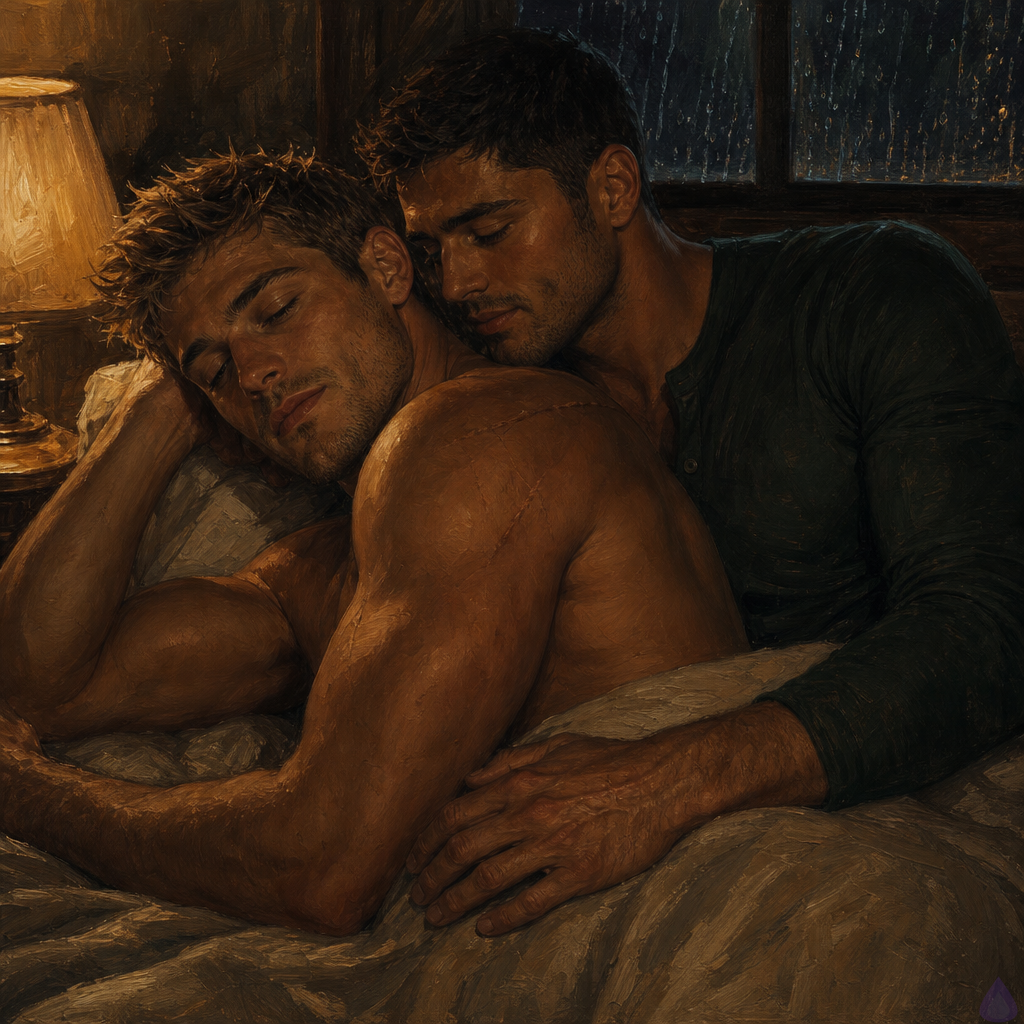
Morning arrives without permission, gray and thin behind the curtains, turning the bedroom lamp pale and useless. You wake before Mateo does. Or maybe he’s been awake for a while and is kind enough to let you pretend you get the first move. His arm is still over the blanket at your waist, exactly where he promised it would stay.
Not lower.
Not tighter.
Not gone.
For a long minute, you do nothing but breathe. The room smells like sleep-warm cotton, rain-damp leather from the chair, and old coffee grounds waiting in the kitchen. Your body remembers last night in broken flashes. Annie’s voice. Bourbon glugging down the sink. Mateo above you, wanting you so badly his hands shook, and stopping anyway.
The shame tries to rise.
It has less muscle in daylight.
You: "Reyes. You awake, or am I about to confess emotional growth to an unconscious man?"
His laugh drags rough with sleep, soft against the back of your neck. His arm loosens at once, giving you space before you ask for it, and God help you, that hurts more tenderly than any touch. You turn onto your back and find him watching you with dark, tired eyes and that infuriating calm that used to make you want to start a fight just to prove he could be shaken.
Mateo: "Awake. Still love you. Before coffee, against medical advice."
Your chest does something stupid. It opens, maybe. Or cracks. Hard to tell the difference with old wounds. You reach for his hand under the blanket and lace your fingers through his, sober and clear enough to feel the full terror of choosing him without a bottle, a crisis, or a punchline yanking the wheel.
No sirens.
No anesthesia.
Just him.
You: "I still want you. Just so we’re all sufferin’ with accurate information." Your mouth twitches. "But I also don’t feel like I’m gonna die if we wait. Which is new. Hate that. Sounds mature."
Mateo’s smile comes slow, dimple and all, and this time you let yourself look straight at it. No flinching. No joke fast enough to hide behind. Morning stubble shadows his jaw, and when he brings your joined hands to his mouth, his lips are warm against your knuckles. One kiss. Gentle enough to undo you. Clean enough not to ask for more.
Mateo: "Then we wait until wanting is the only loud thing in the room. Not fear. Not grief. Not proving anything. Just us."
You stare at him, because no one should be allowed to say things like that while rumpled in your bed, smelling like cedar, rain, and your laundry soap, with sleep still graveling his voice. It is indecent. Possibly criminal. You are considering filing a complaint when your phone buzzes from the nightstand.
Mara, obviously.
Mara: "Status. Did anyone drink, flee, commit emotional arson, or make catastrophic romantic decisions?"
You show Mateo the screen. He closes his eyes like a man asking every saint ever canonized for patience. You type back with one thumb.
You: "No drinking. No fleeing. Moderate emotional arson contained. No catastrophic romantic decisions unless hand-holding counts."
Her reply comes fast.
Mara: "Hand-holding is admissible. Counselor at 10. I am picking you up at 9:30. Reyes can make coffee or leave by the window like a Victorian scandal."
You laugh so hard it catches in your ribs, but it does not break you. That still feels worth reporting. Mateo steals the phone long enough to type, "Coffee," then hands it back with the solemn gravity of a man accepting a sacred duty.
In the kitchen, twenty minutes later, he ruins the first pot by forgetting the filter and stands there looking personally betrayed by gravity. You lean against the counter in yesterday’s T-shirt, bare toes curled against cold tile, arms folded tight so you don’t reach for him just because he is there. Because he stayed. Because the craving is still scratching somewhere in the walls and his nearness is a different kind of ache.
You: "Lieutenant Cole’s official assessment, Officer Reyes has many fine qualities. Domestic competence remains under investigation."
Mateo: "I can disarm a man with a knife."
You: "Can he make breakfast without creating a crime scene? Jury’s out."
The second pot works.
Mostly.
You drink it anyway, black and bitter and hot enough to remind your body it survived the night. The craving is still there, but farther away now, a voice down the hall behind a locked door. Annie’s message remains documented. Edward’s harassment is in Mara’s report. Adrian’s money stays behind legal walls, useful without touching you. Julian Vale is dead and cannot stand trial, but he no longer owns the whole dark.
That should not feel like freedom.
It does.
At 9:30, Mara knocks exactly once and lets herself be heard without letting herself in. When you open the door, she takes in Mateo at the stove, you with coffee in hand, the trash bag tied by the door with the empty bourbon bottle inside, and the relapse plan still on the fridge beneath the peach magnet.
Her face does not soften much.
It does not need to.
Mara: "Good. Shoes on. Appointment first, existential romance later."
You glance back at Mateo. He stands in your kitchen with warm sienna skin lit by gray morning, close-cropped hair mussed, dark eyes steady on you, and his brown leather jacket folded over one arm. He is not leaving like an ending. He is standing there like a beginning that knows better than to demand trust all at once.
Your throat tightens.
Damn him.
You step close and kiss him. Not desperate. Not hidden under neon or panic. A brief, sober kiss with weak sunlight threading through the curtains and Mara sighing loudly in the hallway like procedure itself has been inconvenienced.
Mateo kisses you back, soft and certain. His hand lifts, almost touches your waist, then stops in the air between you before settling at your elbow. Careful. Asking. Always asking now.
When you pull away, his dimple is there.
You: "Still in the morning, huh?"
Mateo: "Still."
You nod like that does not nearly take your knees out, grab your jacket, and walk out with Mara toward the counselor, leaving Mateo to lock up behind you. The road ahead is not clean. Your parents are still alive and poisonous. Grief still has teeth. Sobriety is still a daily argument, and love will not fix what treatment, time, and your own stubborn work have to carry.
But the streetlights are on.
This time, you are walking toward them.