Shared Story
First Cape Day
20 segments
The bus leaves you at the annex gates under a hard white afternoon sun, the kind that makes every chain-link diamond glitter like a warning. Mercy Falls Federal Training Annex squats beyond the fence in low concrete blocks and mirrored windows, half school, half bunker. Your Bureau-issue duffel bites into your shoulder. The badge around your neck feels too new, too official, and the BX number printed beneath your name looks like it belongs to someone else.
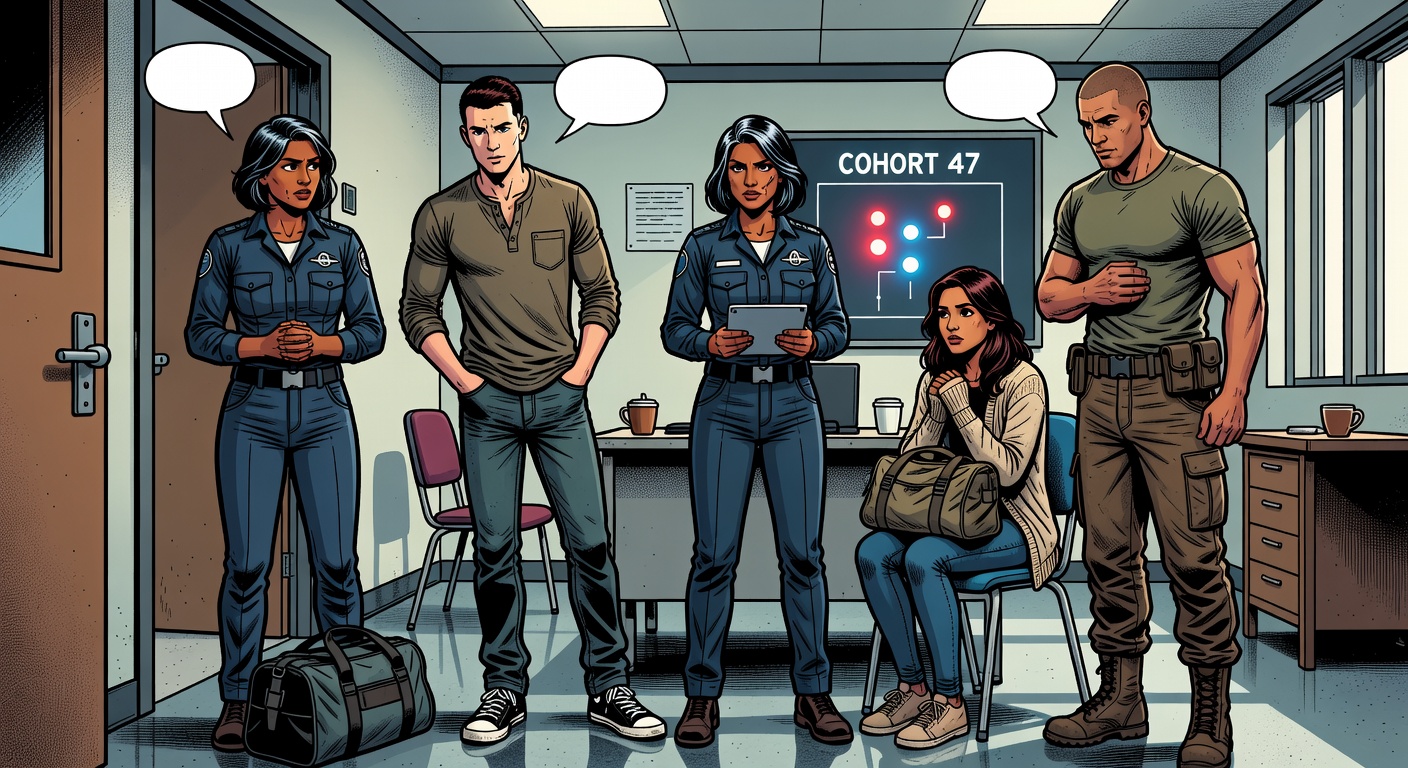
Inside, the intake room smells of floor wax, burnt coffee, and old adrenaline. Four plastic chairs face a metal desk. Three are already taken. Marc Whitley looks up first, tall and thin in a faded olive henley, one ankle hooked over the other like he has been waiting for a punchline. Jasmine Cordero sits beside him with a canvas bookbag hugged against her knees, her cream cardigan sleeves pulled over her hands. Beau Kallenberg stands rather than sits, broad shoulders square, ex-medic pouch at his belt, his blue eyes moving once over the door, the windows, the corners. Then over you. Not hostile. Assessing.
Marc: "Cohort forty-seven, I presume. Unless you are here to fix the vending machine, in which case I have a formal complaint and three dollars in losses."
Jasmine gives him a look that is probably meant to be stern, but mostly comes out nervous. Beau's mouth twitches, almost a smile. Before anyone can say more, Lieutenant Vega Rashidi enters from the side office with a tablet under one arm and the clean, balanced stride of someone whose body has never once betrayed her. Her navy field uniform fits like a verdict. Silver A-Rank insignia flashes at her collar, and a small scar at the corner of her mouth pulls slightly when she speaks.
Lt. Rashidi: "Cohort forty-seven. Sit if you are sitting. Stand if you are standing. Panic quietly if you must panic. We begin either way."
She reads names, ages, field ranks, legal waivers, and emergency contacts. When she reaches yours, her eyes slow. She reads the screen. Reads it again. Your hands remember drywall dust, tile grit, the kitchen wall buckling inward like wet cardboard. You fold your fingers into your palms before anyone can see them shake. Rashidi notices anyway.
Lt. Rashidi: "Striker. Provisional C-Rank. Field appraisal was conducted nine days post-trigger under unstable conditions. We will do the appraisal again after intake. Sometimes the field rating is wrong. Sometimes it is very wrong."
The room changes around that sentence. Marc's joking expression thins into interest. Jasmine's concern sharpens, soft but immediate. Beau lowers his chin a fraction, as if filing away the word unstable and not judging you for it. You feel all three of them looking, and for one bright, awful second, you cannot tell whether you are a recruit, a risk, or a weapon that has been left on a table.
Rashidi taps her tablet, and the wall behind her wakes into a projected schematic of the annex: dorms, mess, gym, med wing, evaluation chambers, sealed range. Four glowing dots appear in a cluster marked COHORT 47. Your dot pulses red once before turning Bureau blue.
Lt. Rashidi: "Your first forty-eight hours are observation, baseline testing, and power safety. You will not use abilities unsupervised. You will not spar without clearance. You will not lie to medical. You will not leave annex grounds. You will learn each other's civilian names, cape classifications, tells, limits, and panic responses, because in eight weeks some fool in a mask may decide you look trained enough to shoot at. I would prefer that fool be disappointed."
Marc leans slightly toward you without taking his eyes off Rashidi, his voice lowered just enough to be private and not enough to be safe.
Marc: "For what it is worth, red-dot-to-blue-dot is usually either a database hiccup or a deeply ominous metaphor. Welcome to federal service."
You almost laugh. Almost. Rashidi's gaze cuts to him, then to you, and the room holds its breath, waiting to see who you will be on your first official day as a cape.
The laugh does not come out whole, but enough of it gets loose to change the air around you. Low. Dry. More breath than sound. Your shoulders drop half an inch.
You: "If it’s a metaphor, I’d like to file a complaint with whoever handles subtlety."
Marc’s mouth curves, quick and pleased, like someone just handed him a live circuit after he’d already smelled smoke. Jasmine exhales through her nose, almost laughing too, and her fingers ease around the strap of her bookbag. Even Beau changes. Not softer. Less sealed. Rashidi watches all of it with the calm patience of a woman counting not only words, but the damage they do on arrival.
Marc: "Good news. The Bureau has a department for that. Bad news, it’s three people named Karen and a printer from 1998."
Lt. Rashidi: "Whitley."
Marc: "Respectfully retracting the joke, Lieutenant."
Lt. Rashidi: "Too late. It’s in evidence."
That gets Jasmine for real. She ducks her head, dark waves spilling over her cream cardigan, trying and failing to hide the smile. The moment is tiny. Stupidly tiny. A bad joke in a fluorescent intake room that smells like floor disinfectant, old coffee, and the hot dust inside the projector vent. But your hands stop feeling like separate dangerous animals attached to your wrists, and for the first time since the bus station, you remember that other people can occupy a room without becoming threats.
Rashidi lets the humor live for exactly three seconds. Then she kills it with one tap of her tablet.
The annex schematic vanishes. A list replaces it: names, classifications, small Bureau tags meant to make human disasters easier to sort. Whitley, B-Rank Blaster. Cordero, C-Rank Mind. Kallenberg, B-Rank Shaper. Your name, C-Rank Striker, flagged for reassessment. Beside each entry sits a narrow column marked VOLATILITY, blank except for yours, where a grey placeholder reads PENDING.
Lt. Rashidi: "Since we’re all charming and functional now, preliminary disclosures. Not confessions. Not trauma tourism. Operational basics. What can you do, what should we avoid standing near, and what does it look like when you’re losing control? Short version. Save the monologues for week four."
She points at Marc first. He straightens. The irony slides off him, leaving something cleaner underneath. His restless hands go still on his knees.
Marc: "Directed thermal discharge from hands and forearms. Range varies with pulse rate, which is embarrassing but useful, apparently. I can burn through a steel door if nobody needs it pretty afterward. Don’t startle me from behind. If I stop talking completely, assume I’m either concentrating or very angry. The difference is, I’m told, subtle."
Rashidi makes a note. The tablet gives a soft little chirp, like approval from a machine that has never had to stand too close to fire. Jasmine looks at Marc with fresh caution, but not fear. Beau’s gaze flicks to Marc’s hands, then the corners of the room, then the distance to the door. Measuring. Always measuring.
Rashidi nods to Jasmine.
Jasmine: "I can sense emotional states if people are close enough. Sometimes I can nudge them calmer, but only a little, and only if they’re not fighting me. I don’t read thoughts. I don’t want to read thoughts." She swallows. "If I get overwhelmed, I go quiet and... I might start answering questions nobody asked. Please don’t crowd me when that happens."
A silence follows. Not awkward. Careful. The kind people make around glass on the floor.
Beau speaks without waiting to be called on, his voice low and even.
Beau: "Matter shaping by touch. Mostly inorganic. Sand, concrete, metal if it isn’t too pure. I can brace structures, make cover, close wounds badly if there’s nothing else and someone’s bleeding out." His jaw tightens once. "Don’t ask me to do that for practice. If I square up and stop blinking, get behind me or get away from me. Depends what’s in front of us."
Rashidi’s attention returns to you.
Marc’s does too, though he tries to make it look casual and fails because his eyes are too alert. The projected list throws pale Bureau-blue across the room, washing every face in the same false color. Your palms prickle. Somewhere inside memory, a kitchen wall bows inward under your hand, studs cracking like bones in a place where bones should never be.
Lt. Rashidi: "Your turn. Short version. What do we need to know to keep you and everyone else intact?"

Rashidi does not blink at the request. If anything, the small scar at the corner of her mouth pulls a millimeter higher, as if she approves of the part where you did not bother pretending to be brave.
Lt. Rashidi: "Good. That is an answer. Cohort forty-seven, bags up. Range Three. Nobody touches anyone without asking. Nobody powers up unless I say clearance granted."
The annex takes the intake room away one sealed door at a time.
Fluorescents buzz overhead. The walls thicken. Cameras go matte black and patient in the corners. Warning stripes run along the floor in clean yellow bands, fresh enough to look wet, and your badge chirps at two checkpoints with a sound too cheerful for a place built to contain accidents. Rashidi’s badge chirps first, always half a step ahead. Marc falls in beside you, duffel strap neat across one narrow shoulder, but he leaves a careful strip of air between your hand and his sleeve.
Marc: "For the record, supervised test was the right call. The Bureau adores people who fear forms more than death."
Jasmine: "Marc."
Marc: "What? That was support. Government-issued, emotionally limited support."
Beau says nothing. When a maintenance tech comes around the corner too fast with a rolling cart, Beau shifts between the cart and the rest of you before anyone can decide whether there is danger. Not dramatic. Not claiming anything. Just a body doing the math faster than language can. The tech mutters sorry and disappears through a side door, leaving hot metal, machine oil, and burnt dust in the corridor.
Range Three is a hollowed-out chamber lined with pale composite panels and floor plates scarred by old impacts. The far wall holds swappable test surfaces: concrete, steel mesh, brick, tempered polymer, ceramic tile, and one blank white slab labeled UNKNOWN MATERIAL, DO NOT TOUCH WITHOUT INSTRUCTOR CLEARANCE. Above it, behind reinforced glass, the observation booth waits with three empty chairs and a green-lit console. The air is colder here. Cleaner. Filtered until it tastes almost medical.
Rashidi sends Marc, Jasmine, and Beau into the booth. Marc goes last, glancing back once. Through the glass, his face becomes a ghost over the warning lights, dark eyes reaching for a joke and, for once, letting it die. Jasmine presses one hand to the window in a small, steady gesture, then seems to remember where she is and lowers it. Beau stands behind them both, arms folded, broad and silent, his gaze dropping to your feet first, then your hands.
Rashidi stops three meters from the concrete wall. She taps her wrist cuff. A red dot appears on the floor where you are meant to stand. It pulses once, the same patient beat as your intake marker on the schematic. Under the floor plates, something begins to hum.
Lt. Rashidi: "Baseline Striker appraisal. No heroics. Put your dominant hand on the marked surface for one second, then take it off. If anything feels wrong, say stop. If I say stop, you stop. If you cannot stop, I move you. Do not make me move you unless there is no other option."
Your mouth goes dry.
The target wall is only concrete, clean and numbered and paid for by a federal budget, but your body refuses the paperwork. It remembers another wall. The give. The sound. The instant after, when the room stopped being a room and became evidence. Your fingers curl, then open. The red dot glows under your shoes.
Lt. Rashidi: "In for four. Hold two. Out for six. Again. You are not in that kitchen. You are on Range Three, Mercy Falls Federal Training Annex. You are wearing a Bureau badge. I am standing to your left. Your cohort is behind glass. Nothing happens until you choose."
Behind the observation window, Marc leans forward despite himself. Jasmine’s hands lock tight at her waist. Beau has gone completely still, the kind of stillness that says glass is only glass if everyone agrees to treat it that way.
The concrete waits.
So does the red dot.

You choose to believe her before you feel ready, because ready has become a luxury word.
The kitchen comes with you anyway.
White tile. Cracked plaster. Scorched onions in old grease. The wall folding inward, impossible and obedient, solid your whole life until your hand told it not to be. Your throat tightens. Your fingers hover over Range Three’s numbered concrete, and for one second the two rooms sit on top of each other so precisely you cannot tell which one is real enough to break.
Lt. Rashidi: “Name the room.”
You: “Range Three. Mercy Falls Federal Training Annex.”
Lt. Rashidi: “Name the wall.”
You: “Concrete test surface. Panel C-three. Bureau property.”
Lt. Rashidi: “Name yourself.”
Your name comes out scraped raw, but it comes out.
Behind the glass, Jasmine’s shoulders drop as if she has been holding your breath for you. Marc grips the console edge, knuckles pale under the booth’s sick green light, the same color every federal room seems to choose when it wants people to confess. Beau watches Rashidi more than he watches you, weighing her promise against the doors, the guards, the little black shock ports in the floor.
You put your palm against the concrete.
Nothing happens.
Then the world answers your skin.
It is not strength. Strength would feel like muscle, pressure, leverage. This feels like being allowed to overhear the private argument inside matter. The wall is a thousand locked decisions—grit and lime, aggregate, old water, the memory of poured slurry hardening under fluorescent lights,all of it convinced it is stable. Your touch disagrees. A circular bruise spreads from your palm, not black but a deep, dry gray, eating the clean surface in a perfect widening ring.
Lt. Rashidi: “One second. Off.”
You pull away.
The ring keeps spreading.
A warning tone chirps from the wall panel, polite and useless. Rashidi changes shape almost faster than sight can catch: weight forward, knees loose, one hand raised but not touching you. The concrete shivers. Hairline cracks shoot outward in a spiderweb, stop, then crawl backward toward the place your palm left behind, as if the wall has regretted opening itself. A fist-sized plug of concrete sinks into itself without falling. It compresses. Tightens. Becomes a dense, smooth stone knot with a faint red heat burning at its center.
Behind the reinforced glass, Marc says something you can’t hear. His mouth makes the shape of a curse. Jasmine steps closer to the window, alarm and awe fighting across her face. Beau’s hand comes down on Marc’s shoulder—not holding him back, not exactly. Just reminding him the glass is thick for a reason.
Rashidi lifts her wrist cuff.
Lt. Rashidi: “Range Three, log anomaly. Striker contact produced continuing structural reaction after disengagement. Thermal signature present. No secondary discharge. Recruit remains conscious and compliant.”
Compliant.
The word lands colder than the room. People like Rashidi say compliant the way doctors say stable, as if stillness is the same thing as consent.
The red glow in the stone knot dims. The warning tone cuts off. Silence takes its place, heavy and institutional, full of vents and old dust and the faint chemical bite of panic-sweat under disinfectant.
Your hand is still raised in front of you. Your palm does not hurt. That is somehow worse. It feels crowded, full of remembered texture: concrete dust, kitchen plaster, the wet give of something that should not have given. Rashidi steps nearer, slowly enough to let you refuse, and studies the untouched skin without taking your wrist.
She does not look afraid.
That scares you more.
Lt. Rashidi: “That was not C-Rank behavior.”
From the booth speaker, Marc’s voice crackles through, with most of the joke stripped out by cheap audio and real fear.
Marc: “Lieutenant, was the red dot supposed to do that too?”
You look down.
The floor marker beneath your shoes has changed. The projected red dot is no longer round. It has thinned into a rotating ring, precise and hungry, turning under your boots like something searching for a lock it has not yet found.
Rashidi’s face goes still.
Not blank. Still. There is a difference. Blank is ignorance. Still is recognition with orders stacked on top of it.
Lt. Rashidi: “Nobody move.”

Fear waits for you to feed it.
You don’t.
Not this time.
The ring turns beneath your shoes in clean red light, too exact to be blood, too patient to be an attack. The kitchen tries to come back anyway: plaster dust, hot copper, the sick memory of a wall listening under your palm. You shove it down. The effort has weight. Range Three. Bureau property. Concrete panel C-three. Projected marker. Optical system. Sensors under the floor. Information, not threat.
You: "Lieutenant. I don’t think it’s trying to hurt me. I think it’s reading something. Or showing something it already read."
Rashidi’s eyes flick from your face to the floor, then to her wrist cuff. She doesn’t praise you. She does something better. She treats the sentence like data.
Lt. Rashidi: "Whitley, console. Cordero, emotional baseline. Kallenberg, do not break my glass unless I am visibly on fire."
In the booth, Marc moves so fast he nearly trips over the chair. His long fingers skate across the green-lit console, and layered diagnostics smear themselves pale against the reinforced window. Jasmine shuts her eyes for half a breath, one hand pressed to her sternum, the other locked around her bookbag strap like it is the only honest thing in the room. Beau stays behind them, but his folded arms loosen. Ready to become a door. A shield. A battering ram.
Whatever the room needs him to be.
Marc: "Okay. Hate that. The projector isn’t making the ring. Repeat, the floor projector is not making the ring. Marker system still thinks it’s a dot. Pressure plates normal. Thermal normal. Electromagnetic noise is—wow. No. That’s ugly."
Jasmine: "They’re scared, but not sliding." Her voice shakes, then finds its feet. "Focused scared. And curious. I think the curiosity is helping."
Rashidi steps to the ring’s edge and stops just short of the red. The silver insignia at her collar catches the glow, turning blood-bright for one second. Her face stays controlled. The small scar near her mouth tightens anyway.
Lt. Rashidi: "Describe what you perceive. Not what you think helps me. What is actually happening from your side of the room?"
The ring’s motion feels less like rotation now and more like a question asked over and over until someone admits they heard it. You look down without dropping your guard. The light isn’t only under you. It climbs in hair-thin threads around your shoes, stops at the rubber soles, withdraws, then tries again.
Not skin.
Not yet.
Mapping the edge of you. Asking where you begin.
You: "It wants contact. Not with the floor. With me. It stops at my shoes. I don’t think it knows what I am unless I touch something."
Marc’s voice comes through lower.
Marc: "That is either a breakthrough or the first line of an incident report I’m not cleared to read. Possibly both."
For once, Rashidi doesn’t correct him. She lifts her wrist cuff and changes the range lights from white to amber. Behind the walls, locks engage with a heavy metal certainty you feel in your teeth. The observation booth door seals. Beau’s head turns toward the sound, blue eyes narrowing. Jasmine flinches, then breathes past it. Marc goes still at the console, his quick half-smile gone.
Soft containment.
A polite phrase. A locked door.
Lt. Rashidi: "Cohort forty-seven, this room is now under soft containment. Not punishment. It means nobody outside this room gets to make a panicked decision before I know what we’re looking at."
She looks back to you.
Lt. Rashidi: "You made a useful call. Now we choose the next risk carefully. We can end the test, isolate the anomaly, and send you to medical with a clean incident log. We can continue under my clearance and learn why the floor is trying to identify you. Or we bring the cohort into it, because whatever this is, they may need to recognize it before week eight recognizes them first."
Behind the glass, all three of them watch you.
Marc with bright, worried calculation. Jasmine with fear and faith fighting across her face. Beau with the grim steadiness of someone who has seen bad rooms turn worse and still stepped inside because somebody had to.
The red ring turns once beneath your feet.
Waiting.

Rashidi answers at once, and it is not permission.
Lt. Rashidi: "No. Not yet. You do not put skin on an unknown anomaly because it feels polite. You tell me what you intend, I build the least stupid version of it, and then I decide whether I can survive the paperwork. Kneel slowly. Both hands where I can see them."
The correction steadies you more than comfort would have. She is not stopping you because she thinks you might break. She is stopping you because this room has rules, and for once the rules mean someone else is responsible for the cliff edge.
You lower yourself onto one knee inside the red ring.
Slowly.
The light climbs the scuffed rubber of your sneakers again. Probing. Retreating. Coming back like it recognizes you and hates that it does. Your hands hover over your thighs, fingers spread, your palm still tingling with the memory of concrete giving way as if the floor had been only an opinion.
Behind the glass, Marc bends over the console until his cropped dark hair almost brushes the display. Diagnostic columns crawl across his fair face in pale green strips. Jasmine stands just behind him, warm golden-brown face drawn tight, long dark waves spilling over her cardigan while she watches you instead of the numbers. Beau has moved to the booth door. One broad hand rests flat beside the sealed frame.
He is not breaking anything.
Yet.
Just reminding the door that all doors are temporary.
Marc: "Lieutenant, I can spoof a dead-floor state for four seconds if you want the grid to stop staring. Five, maybe, if the annex uses the same bargain-bin vendor I think it does. Which, because God has jokes, it does."
Lt. Rashidi: "On my mark. Cordero?"
Jasmine: "They’re scared, but they’re choosing. Not spiraling. If that changes, I’ll say so."
Beau: "And if the floor opens?"
Rashidi does not look away from you.
Lt. Rashidi: "Then you make a bridge, and I move them before gravity finishes the sentence."
The amber containment lights pulse overhead. The room smells of hot dust, disinfectant, and the sour metal bite of old emergency batteries. Rashidi steps close enough for you to see the silver chain at her collar shift with each breath, but she still does not touch you. Her dark eyes hold yours. Composed. Unkind in the way competence has to be.
Lt. Rashidi: "Two fingers only. Non-dominant hand. Half a second of contact. Say stop if you need stop. Whitley, mark."
Marc: "Spoofing dead-floor in three, two, one—now."
You touch the floor.
The ring rises.
Not physically. The floor stays hard beneath your fingertips, cold through your skin. But the red light lifts through your hand like a diagram deciding it wants to hurt. Lines unfurl behind your eyes. Geometry without color. Corridors under Range Three, power conduits, drainage channels, old stress fractures in the foundation, sealed rooms identified only by absence.
For half a second, Mercy Falls is not a place around you.
It is a body under your palm.
Then something looks back.
A second ring ignites inside the first, smaller and darker, red shading toward black at the edges. It locks around your fingertips with a sound too low to hear and too deep not to feel. Your arm goes cold to the elbow. Behind Rashidi, the concrete test wall answers with a sharp crack, and the compressed stone knot from your earlier touch glows red again.
Brighter this time.
Hungry, maybe.
Jasmine: "Stop. They’re changing. Something is pushing back."
Lt. Rashidi: "Off. Now."
You try.
Your fingers do not move.
Marc swears over the speaker, raw and frightened, no joke attached. Beau strikes the booth door once with the heel of his hand. Not enough to break it. Enough to make the frame boom like thunder and wake every lock in the annex. Rashidi is gone from where she stood and at your side in the same breath, one boot braced outside the ring, one hand hovering above your wrist.
Lt. Rashidi: "I’m going to move you. Do not fight me."
The moment her gloved hand closes around your sleeve, the black-red ring snaps open like an eye.
A symbol burns across the floor.
Not language. Not any Bureau warning mark you know. A circle interrupted by nine small gaps.
Nine days.
Nine cracks.
Nine locked doors.
From the booth, Marc’s voice drops until the speaker barely catches it.
Marc: "Lieutenant. That pattern isn’t in the range system. It’s in the restricted architecture files. Sublevel Nine."
Rashidi goes very still, her hand still gripping your sleeve, the impossible light staining her face red.
Lt. Rashidi: "Whitley. Explain why you know that."
The ring tightens around your trapped fingertips, waiting for one of you to lie.

Rashidi’s order cuts through the room, sharp enough to make everyone flinch.
You do not let go.
For one awful second, her strength gathers through the grip on your sleeve. She could move you. She said she could, and now you know it in the same practical way you know concrete is hard, right up until it isn’t. Her body shifts with that impossible balance the instructors pretend is training and not something stranger, all compact muscle and decision, ready to turn you into cargo.
Then your trapped fingers pulse cold against the floor.
The red-black symbol opens another fraction.
You: “Wait. It’s giving me something. Not words. A layout. I can hold it.”
Lt. Rashidi: “Holding is not controlling. Cordero, status. Whitley, hands off anything that can open a door. Kallenberg, if I tell you to breach, you breach inward and low.”
The booth answers in pieces.
Jasmine’s voice is thin with concentration, her gentle face washed sickly green by the consoles. Marc has both hands raised away from the controls now, tall frame locked in place by guilt, discipline, or the particular tone Rashidi uses when people are about to become case studies. Beau stands at the sealed observation door with his shoulders angled forward.
Waiting.
He looks like a man listening for the universe to make one more mistake.
Jasmine: “They’re not panicking. They’re… listening. It feels like when someone hears their name across a crowded room.”
The pattern climbs through your fingertips.
Not heat. Not electricity. Something colder and more intimate, like the floor has found the small bones in your hand and is counting them.
Sublevel Nine is not on the public annex schematic. It is not even a floor, not the way the building wants people to understand floors: stacked, numbered, licensed, inspected. You feel it as a hollow below the training ranges, a ring of rooms built around an empty central shaft. Walls too dense for ordinary concrete. Service corridors that loop wrong, doubling back to places they should have passed and should not be able to reach again. Nine sealed nodes around the circle.
One dark.
One active.
One active since nine days ago.
Kitchen wall.
Your breath catches. The ring bites colder.
The memory comes without asking permission.
Not the whole trigger. Just an edge of it. Your palm against painted drywall. Grease in the air. Old onion smell under cheap cleaning spray. A sound behind the wall that was not plumbing, not rats, not your own blood rushing in your ears. A red circle under layers of plaster and builder-grade tile, shining where no light should have fit.
The kitchen wall did not break because you hit it.
It opened because something underneath recognized you.
Marc: “I can explain part of it.” His voice comes through the speaker rougher than before. “Not enough. Obviously not enough. I saw a contractor map on a restricted terminal before intake. Sublevel Nine was blacked out, but the symbol was there. Nine interrupted points. Same as the floor. I thought it was old infrastructure. Or a containment archive. Or, you know, a federal murder-basement, because I was trying not to catastrophize.”
Lt. Rashidi: “You accessed restricted architecture before signing your final operational oath.”
Marc: “Yes. In my defense, the password policy was criminally negligent.”
No one laughs.
Someone in the booth breathes too fast for two seconds and forces it down. The room smells of scorched dust, disinfectant, and the coppery tang the ranges always get after hard training, as if fear itself leaves residue in the vents. Above you, a speaker clicks once and does not speak. The building is full of systems that were designed to report danger. Right now they are all being polite.
Rashidi’s hand tightens on your sleeve.
Not yanking. Not yet.
Her eyes have gone flat and bright, all veteran arithmetic, but anger lives under it. Not at you. Maybe not even at Marc. At the annex. At the people who built a secret deep enough to sleep under recruits and stupid enough to reach up through Range Three under your skin.
The active node below you pulses once.
In the observation booth, the lights flicker.
Jasmine gasps and catches herself against the window. Her palm leaves a damp print on the reinforced glass. Beau’s hand spreads against the door frame, and the metal around his fingers dimples inward like warm clay. He looks down at it, almost offended.
Marc’s gaze snaps from the console to you.
For a moment the worried rapport between you changes shape. It becomes a wire pulled tight over a long drop. He knew something. Not enough, he said. Never enough. That is how institutions keep people useful: give them a corner of the monster and call it clearance.
The ring pushes deeper.
You see the nine nodes as pressure instead of image. One beneath the old kitchens. One under medical storage. One behind the east stairwell everyone says smells like wet pennies. One below Records, where paper files are still kept because paper can burn and digital ghosts can’t. One dark. One waiting. One awake.
And beneath all of it, the shaft.
Empty.
No. Not empty.
Available.
Lt. Rashidi: “Enough. You got your read. I am extracting you on three. If the floor resists, let me fight it, not you.”
Her voice drops half a degree.
Human, briefly.
“Do you understand me?”
You want to say yes. You want to ask what happens if the floor knows her better than it knows you. You want Marc to stop looking at you like he has just realized a joke was actually a warning. You want Jasmine to say the listening has stopped.
The symbol opens a hair wider.
Lt. Rashidi: “One.”
The ring shows you one final thing before she reaches two.
A corridor under the annex. Amber emergency light buzzing in stale air. Condensation on pipes that should not run that deep. A door marked in fresh black stencil.
BX-47.
Not Cohort 47.
Your Bureau number prefix.
Waiting below.

Your voice comes out rough, but the booth speaker catches enough.
You: "Jasmine. If you can do it without getting dragged in, anchor me. Not calmer. Here. Keep me here."
Jasmine’s face changes behind the glass. The fear stays. Purpose steps in front of it, both hands up. She presses her palm flat to the observation window, eyes locked on you, her bookbag slumped at her feet with a history textbook spilling open like any normal day might still be available. Marc turns sharply, already reaching to stop her, then freezes, because grabbing a Mind cape mid-reach is exactly the kind of thing that adds three new pages to the safety binder. Beau shifts beside the sealed booth door, broad body angled between Jasmine and the rest of the room. Not blocking her. Guarding her while she chooses.
Lt. Rashidi: "Cordero, consent check. Yours and theirs. No compulsion. No deep dive. Surface regulation only. If you feel architecture, machines, voices, anything that isn’t them, you break contact and say breach."
Jasmine: "Understood." Her throat works once. "I consent to surface anchor only. Do you consent?"
You: "Yes. Surface only. If I say kitchen, pull me back."
When Jasmine reaches, it is not like a hand taking yours. It is like hearing one steady note through the wall during a storm. The ring under your trapped fingers still gnaws cold through skin and bone, still feeds you Sublevel Nine in pulses, but Jasmine gives the rest of you a shoreline. Range Three. Amber lights. The scorched smell of old insulation. Rashidi’s grip on your sleeve. Marc’s thin shape over the console. Beau’s hand denting the frame. Your knees on hard floor. Your breath, ugly and wet and yours.
Below, the BX-47 door brightens in your mind.
Not a vision now. A route. The central shaft drops through maintenance levels nobody put on the public schematic, past cable bundles wrapped in old Bureau tags and concrete poured in two eras: one signed for, one buried. The corridor to BX-47 has opened recently. You know it the way you know heat from a stove. Fresh stress in the hinges. New current in an old lock. A reader panel waiting for a federal ID number with a BX prefix, and beneath it, older than the panel, a recess shaped for a human palm.
Marc: "Lieutenant, the console just generated an access request I did not start. It’s trying to handshake with their badge. No—scratch that. Through their badge."
Lt. Rashidi: "Deny it."
Marc: "I am denying it in several emotionally significant ways. It keeps asking more politely."
Jasmine inhales hard. Her palm slides half an inch down the glass, leaving a streak in the condensation.
Jasmine: "There’s a pull. Not on me. On them. It wants recognition." She grimaces. "It feels lonely, which is impossible and I hate that I said it."
Rashidi reaches two.
The ring tightens once, hard enough to kill all feeling in your fingertips, and then Jasmine’s anchor holds. Not by beating it. By giving you a choice with edges. You are not the kitchen. You are not the wall. You are not the door beneath the annex, even if your prefix waits burned into its lock.
You: "It wants my hand. BX-47 has a palm recess. The badge is secondary. The door was built for someone like me. Maybe because of someone like me."
Rashidi’s face does not crack, but something in her eyes confirms the shape of your dread. She has not seen this exact thing before. She has seen enough cousins.
Lt. Rashidi: "Extraction now. Cordero, hold anchor for three seconds after separation. Whitley, if that request jumps systems, kill the booth uplink. Kallenberg, brace the door and east wall."
Beau’s hand spreads wider. The booth frame groans as he persuades the metal to thicken around the sealed door, veins of reshaped alloy crawling outward under his palm. Marc’s fingers move across the console in a blur, jaw tight, fast mouth finally shut. Jasmine keeps her eyes on you with such fierce gentleness it hurts worse than the cold.
Rashidi moves.
For a fraction of a second, gravity loses the vote. Her gloved hand locks around your sleeve and shoulder, and the world snaps sideways in controlled violence. Your fingers tear free of the red-black ring. The floor screams without sound. The concrete knot in the wall flashes crimson.
Then dark.
You land five meters away against Rashidi’s braced arm, not fallen, not exactly standing on your own. The ring collapses back into a dot.
On the observation booth console, every screen goes black except one line of white text.
BX-47 INTAKE ACKNOWLEDGED.
Marc stares at the words. Jasmine’s anchor trembles but does not break. Beau looks through the glass at the floor as if he is deciding whether to fold the whole range shut and make the Bureau dig for its secrets with spoons.
Rashidi releases you only when your feet remember their job.
Lt. Rashidi: "Nobody says a word outside this room until I know who else just heard that door answer."

You: "Okay. Just call me Ash, please. Also, what the fuck is BX-47?"
Your voice does not echo, but it feels like it should. It drops into the locked range, skims the amber containment lights, and dies against the observation glass where Marc, Jasmine, and Beau stare at the black console screen. The single white line stays there, bored by profanity, fear, and names people choose for themselves.
BX-47 INTAKE ACKNOWLEDGED.
Rashidi looks at you for one measured second. Not at your hand. Not at the floor. Your face. Something shifts when she accepts the name. Small, real. Like a record corrected in ink.
Lt. Rashidi: "Ash. Understood. Honest answer? I don’t know what BX-47 means in full. I know the prefix. Experimental intake track. Restricted routing. Usually for capes whose powers interfere with infrastructure, containment, or Bureau systems in ways field teams can’t label cleanly. I was not informed Cohort Forty-Seven had one."
Marc gives a short, humorless laugh through the speaker. His tall, narrow frame is still bent toward the dead console. The green glow has left his face, leaving him washed pale under the booth’s emergency strips.
Marc: "That is a very elegant way of saying someone lied on the paperwork. Which is impressive, because federal paperwork is basically a religion with staples."
Lt. Rashidi: "Whitley."
Marc: "Yes, ma’am. Shutting up after this sentence. BX showed up in the restricted map headers too. Not as a student tag. As a door class. BX access nodes. BX service spine. BX sealed intake. I thought it meant Bunker Experimental, or Bureau Expansion, or Bad Extremely. I did not think it was a person."
Jasmine lowers her hand from the glass slowly, like moving too fast might snap whatever thin line still connects you. Her warm brown eyes stay on you. Worried. Steady. Even through the barrier, you can feel the last thread of her presence, not in your head and not pushing, just there. A porch light left on.
Jasmine: "Ash. Are you still here with us? Range Three, not the kitchen?"
The question hits harder than the acronym. Your name in her mouth makes the room less sterile. Ash is not the BX number, not the red ring, not the door under the annex with a palm recess waiting in the dark. Ash is someone who rode a bus here with a duffel bag, bad sleep, and hands held too carefully away from walls.
You: "Here. Mostly. I hate that mostly is the best answer."
Beau’s voice comes from near the booth door, low and practical. The metal around his hand is still warped thick, braced in ugly veins where he reshaped it during the extraction. It smells faintly hot, like coins left on a dashboard.
Beau: "Mostly counts after contact. Lieutenant, if this place has a door keyed to them, and that door just acknowledged intake, then containment may not be containing what we think it is. It may be finishing a process."
Rashidi’s gaze snaps to the floor dot. Red again. Round again. Innocent in a way that fools no one. She lifts her wrist cuff, then shuts the display off instead of logging more data.
That is the first truly frightening thing she has done.
Lt. Rashidi: "Then we stop feeding it. Range Three stays sealed under my authority. Whitley, no more console interaction unless I order it. Cordero, visual check only. Kallenberg, keep that door braced, but do not reshape anything else. Ash, sit down before your knees make an argument you cannot win."
A chair rises from the floor near the east wall, smooth composite unfolding on a quiet hinge. Bureau design loves hiding furniture like an apology. You sit because your body accepts Rashidi’s assessment before your pride can object. Your fingertips throb as feeling returns. Pins and needles. No marks.
Rashidi crouches near the collapsed red dot, one gloved hand hovering above it without touching. The air carries disinfectant, warm circuitry, and the flat mineral smell of sealed concrete. The silver chain at her collar slips forward, its small medallion catching amber light before she tucks it back with an irritated motion.
Lt. Rashidi: "Here’s what happens next. I make two calls. One to Annex Command, because I’m required to. One to someone outside the annex, because I’m not stupid. Before either call, I need to know whether BX-47 showed you anything else that puts this cohort in immediate danger. Names, rooms, routes, timers, faces. Anything."
Marc’s eyes lift to yours through the glass. The worry there is no longer private. Jasmine stands beside him, one hand curled against her chest. Beau stays at the door like a living barricade. Rashidi waits in front of you, controlled and furious on your behalf in a way she has not said aloud.
Under your chair, too faint for the others to see yet, the red dot pulses once.

You give Rashidi routes, not conclusions, because conclusions feel too much like offering yourself up to be swallowed.
You: “Central shaft under Range Three. Maintenance levels below the public map. Cable bundles with old Bureau tags, the paper kind, before they stopped pretending decay was temporary. A corridor ring around the shaft with nine nodes. One under medical storage. One under Records. One behind the east stairwell that smells like wet pennies. One under the old kitchens, or what used to be kitchens. One dark. One active since nine days ago. One waiting. The BX-47 door sits off the ring, past amber emergency lights and pipe sweat. Badge reader first. Palm recess second. It wants both, but the hand matters more.”
Rashidi listens without writing anything down.
That tells you she is memorizing every word, or refusing to make a record she cannot protect.
Maybe both.
Her dark eyes stay on your face while you speak, but her body tilts slightly toward the floor dot, keeping herself between you and the thing that answered once already. Behind the glass, Marc has gone still at the dead console, one hand hovering where the keys used to matter. Jasmine mouths east stairwell, shaping the words like she has tasted them before. Beau’s hand stays spread against the booth door, his reformed metal brace thick and ugly around the frame, holding back a room that was never supposed to have teeth.
Marc: “The east stairwell is on the restricted map.” His voice comes through the speaker too clean. Marc panics messily; this is worse. “Not labeled restricted. More like the file walks around it. There’s a blank stripe where the stairwell should keep going. I thought it was a scan error. Because optimism is my toxic trait, apparently.”
Jasmine: “I felt something there during the tour.” She looks embarrassed, then angry about being embarrassed. “Not a thought. Not a person. Just pressure. I told myself old buildings feel weird.”
Beau: “Old buildings don’t aim.” He looks at Rashidi. “If there’s a route under medical storage, people are standing over it right now. Staff. Patients. Recruits, if they bring in another batch.”
Another batch.
That is what the Bureau calls you when the doors are open and the parents are still outside filling out consent waivers on warm tablets that smell faintly of disinfectant. Cohort when they want you proud. Batch when they want you movable.
The red dot under your chair pulses again, so faint it could pass for an afterimage, except Rashidi sees your gaze drop and steps closer, cutting it off.
Small movement.
Protective, not gentle.
You understand then that she is managing what you can see the way she would manage a live wire. Not because you are fragile. Because whatever sits below may be using attention as permission, and everyone in this building has been trained since childhood to look when a system asks.
Lt. Rashidi: “Ash, stop looking at it. Cordero, keep eyes on Ash. Whitley, I want every system that went dark when the message appeared. From memory. Don’t touch the console. Kallenberg, when I open the booth, you exit first and brace the corridor. Nobody walks alone. Nobody steps on red light. Nobody scans a badge unless I tell them to.”
Marc gives one tight nod and starts whispering system names under his breath, acronyms strung together like a prayer for people who no longer trust gods but still trust lists. “Med-lock, east cam stack, intake archive, lift two, thermal—no, thermal stuttered before,”
Jasmine meets your eyes through the glass and holds them.
Warm. Steady.
She makes the room human by force of will, as if eye contact can put a body back inside itself. Beau peels his palm away from the warped frame. The metal creaks, a long tired sound, and the air smells of hot dust and old pennies and the plastic tang of overworked insulation.
Rashidi lifts her wrist cuff.
She hesitates.
Only for half a second, but you see it. So does the floor, maybe. So does the thing under Range Three that has been waiting longer than any of you have been alive.
Then she keys a command with two fingers.
The booth door unlocks with a heavy, reluctant clunk.
At the same moment, every amber light in Range Three flickers twice.
On the blank console screen, white text appears.
BX-47 COHORT CONFIRMED.
A second line writes itself beneath it.
FOUR KEYS PRESENT.

Rashidi does not raise her voice. She doesn’t need to. The room has already learned the shape of her authority.
Lt. Rashidi: “Cohort Forty-Seven, controlled evacuation. Ash moves second. Kallenberg first, because if the corridor changes, he argues with the architecture. Cordero third, eyes on Ash. Whitley last, eyes on systems, and absolutely no hero nonsense. If anyone sees red light, hears a voice, feels a pull, or develops sudden confidence, you stop and say so. Confidence is not our friend today.”
Beau leaves the booth first when the door finally grinds open. He fills the threshold without trying, shoulders nearly brushing both sides, one hand raised near the wall but not touching. The metal brace he made peels away behind him with a tired groan. His clear blue eyes sweep the corridor beyond Range Three, then drop to the floor seams, the vents, the ceiling cameras, the fine black line where wall panel meets concrete.
Beau: “Corridor looks clear. Smells hot. Not smoke. Wiring, maybe. Locks getting cranky.”
You rise when Rashidi points. Not before.
Your knees object. They obey anyway. The red dot under the chair stays dim, a sullen ember pretending it isn’t watching. Rashidi places herself half a step to your left, close enough to stop you, far enough not to crowd your hands. The difference matters. Your fingers curl once. Open.
Jasmine comes behind you as ordered, her soft Birkenstock steps almost lost under the containment hum. Her cardigan sleeve is stretched over one hand again, but her gaze stays fixed on the back of your head like a promise she is afraid to say out loud. Marc follows last, tall and thin and too quiet, his neat duffel abandoned in the booth. He keeps glancing over his shoulder at the black console where the words still sit.
BX-47 COHORT CONFIRMED.
FOUR KEYS PRESENT.
The corridor outside Range Three is the same corridor you walked down earlier. That is the problem. Trust has drained out of it. Yellow floor stripes shine under amber emergency light. The matte black cameras sit too still. Somewhere inside the walls, relays click in little patterns that might have sounded normal before the building started asking for your hand.
Rashidi leads you past the first checkpoint without scanning her badge. Instead she opens a recessed manual panel and uses an actual key, brass and absurdly small, pulled from the silver chain at her collar. The medallion you noticed before is not a medallion. It is a key cover, worn smooth by someone’s thumb.
Marc sees it too.
Marc: “That is either extremely reassuring or the beginning of a much worse conversation.”
Lt. Rashidi: “Both. Keep walking.”
The checkpoint door unlocks mechanically. No chirp. No cheerful federal beep. Just metal agreeing with metal.
You step through after Beau, careful to put your shoes exactly where Rashidi indicates. Jasmine murmurs your name once. Not a question. A pin driven into the world.
Ash. Here. Corridor. Not kitchen. Not below.
At the east stairwell junction, Beau stops so fast you almost hit his back. He lifts one fist.
Everyone freezes.
The air smells like wet pennies.
There is no red light on the floor. No symbol. No text. Just the stairwell door at the end of the hall, painted Bureau gray, with a narrow safety window too dark to see through. From the other side comes a sound like a distant elevator moving in a shaft that should not exist.
Rashidi’s face hardens.
Lt. Rashidi: “We do not take the east stairwell. Medical corridor, then exterior muster. Slow turn. Nobody looks through that window.”
You start to turn.
The stairwell door knocks once.
Not from your side.
From below.
Jasmine inhales sharply. Marc’s hand twitches toward a pocket he is smart enough not to reach. Beau takes one step back, putting his body between the door and all of you, while Rashidi angles toward the medical corridor and snaps two fingers in the evacuation signal.
Move.
You do. Exactly as ordered.
Behind you, through the safety window you did not look into, amber light blooms for one second.
Then it goes dark.

You keep moving because Rashidi told you to, but the words get out before the medical corridor can swallow the sound of that knock.
You: "Lieutenant. It wasn’t behind the door. Not exactly. It came from below the stairwell, then climbed through the frame. Like the door was just the speaker."
Rashidi’s left hand rises. Two fingers closed.
Halt.
Beau stops first, his broad back set between you and the east stairwell junction. Jasmine nearly clips your shoulder, catches herself, and breathes an apology that never quite becomes a word. Marc freezes at the rear, too still for someone who normally spends every second bargaining with his own nervous system.
For a moment the corridor is amber emergency light, sealed concrete, iodine, hot dust from the wall vents, and five people trying not to breathe like prey.
Rashidi turns only her head. The gray streak at her right temple catches the warning glow, making her look older for half a second. Or just more tired than rank allows. Her eyes move from you to the stairwell door behind Beau, then down to the floor seams where yellow safety paint crosses gray composite tile.
Lt. Rashidi: "Direction matters. Distance?"
You close your eyes because looking makes the hallway too convincing. The knock is still inside your bones, a remembered vibration traveling upward through structure. Not sound first. Contact first. Matter carrying intention. You track it the way you tracked Sublevel Nine’s route, only thinner now, through stairwell anchors, support bolts, old poured concrete around a shaft the public map pretends was never built.
You: "Deep. Lower than first maintenance. Maybe the ring corridor. Maybe near the east node. It wasn’t random. It knocked where we’d hear it."
Jasmine’s voice shakes, but her gaze stays on you.
Jasmine: "It wanted attention again. When Ash said direction, the pressure changed. Like it noticed we’d noticed."
Marc makes a short, sharp sound. Almost a laugh. Not funny.
Marc: "Great. Fantastic. Chatty architecture. My favorite kind. Lieutenant, just so nobody dies politely, the east cam stack was one of the systems that blacked out when the BX message appeared. If that door has a feed now, I wouldn’t trust it to show us anything from the current decade."
Beau: "Then we don’t look. We keep moving."
His voice is calm. His right hand is not. It hovers near the wall, fingers loose, restraint showing in every tendon. Beau could thicken the corridor, seal the stairwell, pull the doorframe into a dead knot of metal and concrete. You have seen him make a room smaller around a threat. You have also seen what it costs him afterward, the blood under his nails, the hours of silence, the way people stop touching him unless they need something blocked.
He does not reach.
Rashidi told him not to feed the building touch unless necessary. In the annex, touch is never just touch. It is permission, or payment, and the building has always been good at collecting.
Rashidi studies all of you with brutal speed. Ash, newly named and still shaking. Jasmine, anchoring but pulled too thin. Marc, with too many secrets locked behind his teeth. Beau, ready to become a barricade at the first wrong light. Her cohort. Four keys present.
Then the east stairwell knocks again.
Once.
Twice.
A pause.
Twice more.
Four impacts hit your soles and climb your legs. Four recruits. Four keys. The kind of counting that is not counting at all, but selection.
Marc whispers something that sounds like no. Jasmine’s eyes fill with a recognition she clearly wishes belonged to someone else. Beau’s shoulders rise as if he means to take the whole hallway’s weight onto his spine and hold it there until the rest of you are gone.
Rashidi steps back, putting herself at the center of you all, and draws the brass manual key from her collar again. Old metal. Warm from her skin. In this place, the only tools that still feel honest are the ones too simple to lie.
Lt. Rashidi: "New plan. We leave the annex now, or we find out whether the thing below can follow us through locked doors. Either way, no one answers that knock alone."
Behind Beau, the narrow safety window in the east stairwell door flickers amber from the wrong side.
A shadow crosses it from below.
Moving up.

Rashidi answers at once, quiet, with steel under it.
Lt. Rashidi: “You can ask. That doesn’t mean I say yes.”
The east stairwell door waits at Beau’s back, its gray paint turning amber in slow pulses from the wrong side of the safety glass. The shadow behind it has stopped moving. Or it has learned how to move where eyes don’t work.
The knock still lives in your bones.
Four impacts. Four keys. The corridor seems built around that number now, every light strip and floor stripe suddenly in on it.
You don’t reach for the wall.
That matters.
Rashidi sees. Beau sees too, because his hand drops a fraction from its ready position. Not relaxed. Never that. But no longer half a breath from turning the corridor into scrap and dust. Jasmine stands close enough that her sleeve stirs the air near your elbow, careful not to touch you without permission. Marc has gone pale at the rear, his dark eyes jumping between the stairwell window and the brass key in Rashidi’s palm.
You: “Not full contact. Controlled. Like Range Three was supposed to be. I can trace direction through matter. Maybe distance. Maybe whether it’s moving toward us. If we leave blind, it may follow anyway.”
Marc swallows hard.
Marc: “I hate how reasonable that sounded. For the record, I remain against touching haunted infrastructure. I am also against being hunted by haunted infrastructure in a parking lot. My position is layered and scared.”
Jasmine: “If Ash does it, I can anchor again. Surface only. I felt the pressure shift when they named the direction. If it pulls, I’ll know faster this time.”
Beau doesn’t look back from the stairwell.
Beau: “Give me a wall section and three seconds. I’ll brace around the contact point without touching the red if it shows. If the structure grabs them, I can shear the panel out.”
A beat.
Beau: “Maybe.”
Maybe is not comfort. It is still more than the annex usually gives.
Rashidi studies the corridor as if it has terrain, weather, kill zones. Her brass key rests in her gloved palm, plain and physical and absurdly small against whatever the building has hidden under concrete and payroll codes. The place smells faintly of scorched dust, old disinfectant, and the metallic bite that comes before a breaker fails. Somewhere above the ceiling, a fan keeps turning because no one told it to be afraid.
The scar at the corner of Rashidi’s mouth tightens. Then she points to the wall opposite the stairwell, two meters from the junction, where a maintenance seam runs straight down through the composite panel.
Lt. Rashidi: “One fingertip. Non-dominant hand. Half a second, unless I say off sooner. Cordero anchors. Kallenberg braces only after contact, not before. Whitley watches for system response without touching a device.”
Marc opens his mouth.
Rashidi cuts him a look.
He closes it.
Lt. Rashidi: “Ash. If you smell the kitchen, say kitchen. If you see the BX door, say door. If you feel anything trying to move through you, say breach. Do not be brave at the expense of being useful.”
You nod, because your mouth has gone dry again.
The five of you shift into position with the terrible intimacy of people preparing to survive the same bad idea. Beau plants himself between the stairwell and everyone else, shoulders angled, boots square on the yellow line worn down by years of obedient feet. Jasmine faces you, eyes warm and frightened and steady. Marc stands behind her with his hands curled into fists at his sides, no tablet, no console, no little rectangle to make fear look like work. Rashidi takes your left, close enough to move you if she has to, far enough to let the choice remain yours.
For half a second, nobody breathes.
Then you touch the wall.
Cold runs through your fingertip in a needle-thin line.
Not the hungry flood of Range Three. Not the awful sense of a whole building noticing your blood. This is sharper. Cleaner. Worse, because it feels almost practiced.
The corridor opens under your skin.
Conduit. Bolt. Reinforcement mesh. Hollow stairwell shaft. Old cable runs sealed behind newer panels. The annex is not a structure so much as a stack of decisions no one wanted recorded. The knock’s path brightens in your mind as vibration, a hard little trail rising from below the east node, climbing support ribs, striking the doorframe from inside the building’s bones.
Four impacts.
Four keys.
Not a request. A count.
Then the trail splits.
One path drops toward the BX-47 door.
The other comes up behind you.
Your eyes snap open.
At the far end of the medical corridor, the way you were evacuating moments ago, the overhead lights blink red once. Just once. A badge reader chirps though no badge is near it. The sound is polite, almost bored.
Then the wall speaker clicks.
Static breathes through the grille.
The voice that follows is soft, filtered thin by old wiring, and shaped almost like your own.
Wall Speaker: “Intake incomplete. Four keys present. Return to Sublevel Nine.”
Rashidi rips your hand away before the wall can ask twice.

You: “We have to follow it. Do you trust me?”
The words hit badly. Exactly where they have to.
Jasmine’s face tightens, not rejection, just the strain of carrying two truths without dropping either one: you are scared, and you may be right. Marc looks at you like he wants to argue with every noun in the sentence and can’t find one false enough to start with. Beau keeps himself between the cohort and the east stairwell, shoulders squared, but his eyes cut to Rashidi.
Waiting.
Only one order counts here.
Rashidi does not answer right away. Behind you, the wall speaker hisses with static and something too close to breathing. At the far end of the medical corridor, the red blink fades back to amber, innocent again. Like it never happened. The stairwell door knocks once more.
Soft, this time.
Almost polite.
Lt. Rashidi: “Trust isn’t a switch. I trust your read. I trust your fear. I don’t trust the thing using both. So we follow only if we control the route, the pace, and the terms. Nobody goes where I can’t pull them out. Nobody touches a lock. Nobody gives the building a hand, a badge, or a confession. Clear?”
Marc: “Define confession, because I have several pending emotional admissions, and at least two are Bureau-related.”
Lt. Rashidi: “Whitley.”
Marc: “Clear. Very clear. Horribly clear.”
Jasmine steps closer. She doesn’t touch you. Not quite. But when the ventilation coughs awake overhead, her cream cardigan brushes your sleeve, a small civilian softness in a corridor built to rinse blood off the floor. Her voice comes low and steady by effort, not temperament.
Jasmine: “I trust Ash. I don’t trust the pull. If we follow it, I anchor from behind. If I say they’re slipping, we stop. Not discuss. Stop.”
Beau turns his head enough to look at you. Under the amber lights he looks carved out of weather and bad decisions, sun-browned face unreadable except for the crease between his brows. His right hand flexes once.
Empty.
Careful.
Beau: “I trust that you told us before it used you. That counts. But if it asks for your palm again, I’m putting a wall between you and it, even if you hate me after.”
Marc’s gaze snaps to Beau, then back to you. Something in him drops the jokes for half a second. It’s there plainly, bright and worried and inconvenient, like a wire showing through insulation.
Marc: “I trust you more than I trust this annex. That’s an insult to the annex, not praise for your current decision-making. But yes. If you go, I’m going too. Last in line. Watching systems. Not touching systems. Suffering quietly, except obviously not quietly.”
Rashidi takes in each answer like impact telemetry. Then she draws the brass key from its cover and points, not toward the east stairwell, but toward the medical corridor where the false badge chirp sounded.
That stops everyone.
For a second, even the hallway seems to listen.
Lt. Rashidi: “It wants us back through the obvious throat. We don’t reward that. We take medical storage, confirm the node Ash saw, and find a descent point we can control. Kallenberg front. Ash second. Cordero third. Whitley fourth. I bring up rear until contact, then I move where needed. If the annex tries to split us, your only job is to keep the person ahead of you in sight.”
You start forward.
The first three steps are ordinary. Rubber soles on composite tile. Breath held too high in your chest. Jasmine at your back like a lamp cupped against wind. Marc muttering system names under his breath again, half memory palace, half warding charm. Beau ahead, checking corners without letting his skin touch the walls. Rashidi behind you, manual key ready, ignoring the badge readers that glow with polite little invitations as you pass.
The annex has manners. That may be the worst part.
It offers doors. It offers access. It offers the old bureaucratic comfort of a green light and a compliant chirp, the kind of sound that taught whole generations to walk where they were told and call it permission. No one looks at the panels for long. No one wants to know whether the panels are looking back.
Then you reach the medical storage door.
It should be white, with a blue cross and a keycard plate dulled by years of gloves and impatient thumbs. It is still those things. Mostly.
There is a second mark now, burned faintly into the paint at shoulder height: a circle broken by nine small gaps. Not painted. Not projected. Scorched in with patient heat.
The handle has gone pale with cold. Frost feathers along the metal in delicate veins, spreading and retreating with each pulse of the lights. The air smells sharp, antiseptic over mold, with the mineral bite of old freezer burn. Something inside the room shifts its weight.
Then it knocks four times.
Not random.
Not urgent.
Jasmine whispers your name.
Marc stops breathing long enough for you to hear the silence he leaves behind. Beau raises one fist without looking back, and everyone freezes so cleanly it feels rehearsed.
Rashidi steps beside you, brass key in hand. Her voice drops into the register people use for frightened children, armed suspects, and wounded friends. A command meant for humans. Not buildings.
Lt. Rashidi: “Ash. Read only. Do not answer.”

You keep your hands at your sides.
That choice has weight. The medical storage door seems to resent it, though doors should not resent anything. Frost creeps over the handle in thin branching veins, pulls back, then creeps again. At shoulder height, the scorched nine-gap circle darkens around its rim, as if heat is still trapped under the paint, waiting for someone to give it a name.
Lt. Rashidi: "Good. Eyes only. Breathe slow. Tell me what comes. Don’t reach."
You study the door the way you studied the floor ring, but you do not open yourself the same way. No fingertip. No palm. No offered nerve.
Distance helps.
Cold metal. Hollow hinges. A seal replaced twice, badly the first time and in a hurry the second. One lock modern and electronic, one older and manual, one tucked into the frame where no inspector, honest or paid, would ever think to look. Behind the door: shelves, medical kits, sterile gauze, emergency blood substitute in sealed cartridges. A freezer unit humming too hard, its compressor grinding with the tired anger of cheap institutional machinery.
Under all of it, the node.
Not inside the room.
Below it.
You: "The storage room is normal on top. Mostly. The node is under the floor. Something’s routed through the freezer power. It’s using the cold like a signal line. Or a sink. The door isn’t the door it wants."
You swallow. Your mouth tastes like copper and old panic.
You: "It wants us looking here."
Marc exhales behind you, a narrow sound that almost becomes a laugh and wisely changes its mind. His hands are clenched around nothing, knuckles pale, fingers twitching with the muscle memory of a terminal that is not there. He keeps his eyes moving: badge reader, hinges, ceiling camera with its dead black eye. Anywhere useful. Anywhere but the circle.
Jasmine stays close enough for you to feel her attention. Not touching. Not steering. Just there, warm at your back in a building that keeps trying to teach people they are alone.
Beau stands ahead and to the side, big body angled toward the door, careful hands held away from the wall as if the whole corridor has become skin.
Marc: "So the haunted murder-basement has misdirection. Great. Love an enemy with interface design."
Jasmine: "Ash is clearer than before. Scared, but not pulled. The pressure’s outside them right now."
A beat.
Jasmine: "Waiting for a way in."
Rashidi nods once. The brass key is hidden inside her fist. The amber emergency light paints the gray streak at her temple gold, then red, then gold again. She looks down the corridor toward the false chirp you heard earlier, then back to the medical door, measuring routes with the kind of calm that only exists after panic has been broken in and made useful.
The medical door knocks four times.
Up close, the sound is wrong. Not wood. Not metal struck by knuckles. It is vibration traveling up through the frame from underneath, shaped into a knock because that is what people answer. Four impacts. Four keys. The frost on the handle flowers white.
The badge reader wakes.
Green light. Polite as a clerk.
Lt. Rashidi: "Nobody scans. Nobody touches. Kallenberg, can you lift a floor tile two meters back without contacting the marked door or wall?"
Beau looks down. His jaw shifts once.
Beau: "Yeah. If the slab’s standard. If it isn’t, I’ll know before I commit."
Lt. Rashidi: "Do not commit until I order it. Whitley, from memory, what’s under medical storage on the restricted map?"
Marc’s face tightens. For once, the answer costs him before he gives it.
Marc: "Blank space. Not redacted. Blank. Like the map was built around pretending there shouldn’t be anything there." He rubs both hands against his thighs, fast and useless. "Old file header had a route tag, though. BX-MED-NODE. I thought it meant backup medical node."
He glances at the blinking reader.
Marc: "I am beginning to suspect optimism has betrayed me again."
The badge reader blinks faster.
Then the speaker above the medical door clicks on. Static slips through old wiring, dry and insectile. Under it comes that almost-your-voice again, soft and patient and close enough to live in your teeth.
Wall Speaker: "Medical node available. Four keys present. Instructor key present. Intake may proceed under supervision."
Rashidi goes completely still.
Instructor key.
Her fist closes tighter around the brass key at her collar. The tendons stand out in her wrist. For the first time since Range Three, you see personal fear cross her face.
Not fear of dying.
Fear of being recognized.

The question lands harder than the knocking did.
Rashidi does not answer immediately. Her gloved fist stays closed around the brass key at her collar, and for one second the annex corridor seems to narrow around that tiny piece of old metal. Frost breathes across the medical storage handle. The badge reader blinks green, patient and civil. Somewhere under the floor, the node waits like a held breath.
You: "Lieutenant. What does the instructor key really mean?"
Marc goes quiet behind you, which is worse than any joke. Jasmine’s attention tightens at your back, careful and warm, but you feel the tremor in it now, not pushing into you, just resonating with the fear Rashidi is trying not to show. Beau looks from the key to Rashidi’s face, his broad shoulders lowering a fraction, not less ready, just more human.
Lt. Rashidi: "It means I can override student containment, open manual exits, and assume command when the annex network fails. That is the official answer. It is also the answer I was given when they put it around my neck."
The speaker above the medical door crackles once, as if something in the wall appreciates the distinction.
Rashidi’s jaw sets. She turns the key in her fingers and lets you all see it properly. It is not just brass. Under the worn surface, fine dark lines run through the metal in a circular pattern broken by nine tiny interruptions, so subtle you would have missed them before Range Three. Not decoration. Circuitry, maybe. Or a shape older than circuitry that someone later taught to speak electricity.
Lt. Rashidi: "Unofficially, it has opened doors I did not badge for. It has locked systems out of rooms I was standing in. Twice, in eight years, it warned me before a containment breach. A heat pulse through the chain. I reported it the first time. The report vanished. The second time, I kept my mouth shut and got three recruits out before the lights went red."
Jasmine whispers, "Three?" like she cannot stop herself.
Rashidi looks at her, then at Marc, then Beau, then you. She does not soften the truth. That may be her only mercy.
Lt. Rashidi: "Three survived. One did not. That was not Cohort Forty-Seven. It was not here. And before any of you ask, no, I do not know if the key chose the survivors, the route, or me. I know only this. When the annex says instructor key present, it is not asking whether I have clearance. It is saying I am part of the mechanism."
The green badge reader turns amber.
Marc makes a faint sound through his nose, horrified and fascinated despite himself.
Marc: "So the four of us are keys, you are the authorized adult-shaped key, and the basement is politely requesting the full set. That is, and I cannot stress this enough, a design philosophy I oppose."
Beau’s hand lowers toward the floor, stopping just short of contact.
Beau: "If she’s part of it, then supervision might be the only reason it hasn’t forced the intake harder. We leave her out, it may improvise. We bring her in, it may complete whatever this is. Bad either way."
The medical door knocks four times again.
Then once more.
A fifth knock.
Not for the four keys.
For Rashidi.
The brass key warms visibly in her palm, not glowing, not yet, but steaming faintly where frost has touched the air. Jasmine flinches. Marc takes one involuntary step forward, then stops when Rashidi’s eyes cut to him. Beau shifts his stance, ready to put himself between her and the door if she gives even the smallest sign.
Rashidi closes her fingers around the key until the steam disappears.
Lt. Rashidi: "Now you know. The question is whether we use that knowledge, or deny the building the pattern it wants."

The words get out before strategy can file them smooth.
You: "You’re more than the mechanism. It can name your key. It doesn’t get to name you."
Rashidi looks at you like you’ve stepped into fire she never cleared you to cross. The brass key steams inside her fist. Frost nerves its way up the medical storage handle, white and frantic, and the wall speaker clicks once. Soft static. A tongue behind teeth.
For one second, the annex corridor feels crowded.
Not with people. Systems. Nodes. Old routines sleeping under concrete and newer lies, turning attention into permission.
Jasmine makes a sound behind you. Small. Almost swallowed. Hurt and grateful at the same time. Her presence steadies at your back, not an anchor now but a witness, which is worse and better. Marc’s face shifts too, the panic math around his eyes breaking into something bare. Beau keeps watching the door, but his voice comes in low and certain.
Beau: "Ash is right. I’ve seen machines use medics as spare parts. Didn’t make them parts. Just meant somebody built ugly."
The key cools by a fraction.
Rashidi notices.
So does the door.
The fifth knock does not come. Amber light crawls through the badge reader and stops there, no longer green, no longer a welcome pretending to be a choice. Rashidi opens her hand. The brass key rests against black glove leather, still scored by nine fine breaks, but the steam is gone. Her face stays composed. Of course it does. Rashidi probably looked composed in dental surgery.
Still, something in her has moved.
Less locked. More chosen.
Lt. Rashidi: "Do not romanticize command, Ash. That is how people forgive cages because the person holding the bars had a gentle voice."
You: "I’m not forgiving it. I’m saying it doesn’t own you."
The speaker hisses hard enough to make Marc twitch.
Wall Speaker: "Instructor key present. Supervision required. Intake may proceed."
Marc: "It really hates emotional complexity. Relatable, but bad."
Rashidi’s mouth almost becomes a smile.
Almost.
Then she lifts the key, not toward the medical door, but toward the plain maintenance seam two meters back, where Beau said he could raise the floor. She holds it where everyone can see. No hidden hand. No private bargain with the building. Refusing secrecy the way someone else might refuse a needle.
Lt. Rashidi: "New terms. We do not open the marked door. We do not use the badge reader. We create access through the floor, under manual supervision, with no palm contact and no network handshake. Kallenberg, lift the slab. Whitley, watch for system response and say it out loud, embarrassing wording included. Cordero, stay on Ash and on me. If either of us starts sounding like a door, you say breach. Ash, you read the route only after Beau opens it. No touching until I say."
Jasmine: "Understood. Surface watch on both of you."
Marc: "I resent how accurately my assignment predicts my worst habits, but yes. Systems aloud. No touching. Maximum humiliating transparency."
Beau crouches at the seam. His big hands hover over the floor, careful as a surgeon’s, then settle with controlled pressure. The composite tile dimples around his fingertips.
Not melting.
Listening.
Obeying him in a way different from how concrete obeyed you, less like force and more like an old animal recognizing a handler it still hates. The slab rises in one clean rectangle, its edges bending upward as if metal has decided, briefly, to remember softness.
Cold air exhales from below.
It smells of antiseptic, wet pennies, and the deep mineral damp of rooms that were never meant to be found. Amber emergency light glows up from a narrow service crawlspace missing from every honest map. A bundle of cables sags along one side, tied with old paper tags browned by age and moisture. One label turns in the draft just far enough for you to read the faded print.
BX-MED-NODE.
Then, from somewhere under the open floor, a voice repeats in your own shape, gentler now.
Wall Speaker: "Alternate route acknowledged."

Cold air breathes up from the open floor, and for once nobody moves just because a path has appeared.
You make yourself look at each of them before you look down.
Beau crouches by the lifted slab, big hands still braced on warped composite, blue eyes narrowed against the amber glow below. Jasmine stands close enough to anchor without touching, one sleeve pulled over her knuckles, her attention split between your face and Rashidi’s key hand. Marc waits at the rear, tall and thin and bloodless under the emergency lights, jaw clenched around every joke he is refusing to use as armor. Rashidi holds the brass key in her palm.
Visible now. Not hidden. Not surrendered.
You: “Before anyone goes down, we set rules. Out loud. If this thing wants four keys and an instructor key, it doesn’t get any of us separately. We move as people, not parts. Beau leads only if he can keep one hand free. I go second and read only. No contact unless Rashidi clears it. Jasmine calls breach if my emotions shift wrong or if the pull hits Rashidi. Marc says every system change the second he notices it, even if it sounds stupid. Rashidi makes the stop call, and if she sounds compromised, Jasmine overrides her and Beau pulls us out.”
The words leave you shaking.
They land anyway.
Rashidi’s expression sharpens. Not offended. Not indulgent. Evaluating. The kind of look she gave the range wall before it proved every file wrong and started bleeding heat through the seams. For one tight second you think she will remind you command is hers.
Instead she turns her wrist, presenting the brass key flat across her glove like evidence.
Lt. Rashidi: “Accepted, with amendment. If I sound compromised, Cordero calls breach, Whitley confirms whether the system is echoing me, and Kallenberg extracts Ash first. Not me. Ash is the active interface. If I’m part of the mechanism, removing me may not stop the intake. Removing Ash might.”
Marc’s control cracks.
Marc: “I’d like to object to Ash being called an interface, even tactically. Also, I hate that the amendment is probably right. Also, if anyone starts saying acceptable losses, I’m setting something expensive on fire.”
Beau: “Noted. Aim away from oxygen lines.”
It should not help.
It does. A little.
Jasmine steps closer, her dark eyes bright with fear she is choosing not to obey. She lifts one hand, palm open, not touching you. Asking. When you nod, her fingertips settle lightly against your sleeve near the elbow.
Not skin. A point of return.
Jasmine: “Anchor protocol. If I say kitchen, Ash stops reading and names the present. If I say door, Ash closes eyes and steps back. If I say breach, nobody asks me to explain until we’re already moving away. If I stop talking, assume I need help.”
Lt. Rashidi: “Good. Whitley.”
Marc looks toward the dead medical badge reader, then the ceiling speaker, then the hole in the floor. His restless hands hover uselessly, as if waiting for a keyboard the annex has decided he no longer deserves. Finally he curls them into fists at his sides.
Marc: “Systems protocol. No badge scans. No console input. I track lights, speakers, locks, cameras, temperature, and anything that chirps with fake cheer. If the building uses someone’s voice, I say whose. If it uses mine, nobody believes me unless I say printer from 1998 first.”
Rashidi nods once.
Accepting even that.
Beau peers into the crawlspace. The amber light below slides over deployment scars on his forearms and the old field-aid pouch at his belt. He reaches one hand down, stops short of the metal ladder rungs, and tests the air instead. It smells cold and mineral, with the sour-plastic bite of insulation that has spent years pretending not to burn.
Beau: “Descent protocol. I go down first if ordered. I touch structure only when needed. If walls move, I brace. If floor opens, I bridge. If something grabs Ash, I cut the path around them before I pull their body against resistance. No yanking unless Rashidi says immediate extraction.”
The crawlspace answers with a low metallic click.
Not a knock this time.
A lock releasing.
Amber light deepens below the floor, showing the first three ladder rungs and old paper tags shivering on cable bundles marked BX-MED-NODE. Paper. In a building that updates door permissions faster than fear can travel through a room. Farther down, just beyond clean sight, a second light wakes.
Red.
Small.
Waiting.
Rashidi closes her fist around the key, then opens it again.
Lt. Rashidi: “Cohort Forty-Seven, final check. We either descend under our terms, seal this opening and evacuate, or force the annex to show its hand from here. Choose with the understanding that the building has already counted you.”

Rashidi gives the order with the brass key lying bright in her open hand.
Lt. Rashidi: “Controlled descent. Protocol stands. Kallenberg first. Ash second. Cordero third. Whitley fourth. I follow from above until the last safe moment. Nobody gets creative unless the alternative is dying.”
Beau lowers himself through the floor with slow care, his size made deliberate, almost gentle. His boots find one rung, then the next. Amber light climbs over his buzzed pale hair and the heavy line of his shoulders until the corridor takes him by degrees: waist, chest, head. Gone. Only his hands remain for a second, then his voice, low and practical, rising from under your feet.
Beau: “Ladder holds. Walls are tight. Cable bundles on the right. Don’t brush them. Floor’s five meters down, service landing, metal grate. Red light farther in. Not on the ladder.”
You move when Rashidi points.
The ladder bites cold through your palms, and every rung seems to ask what you are today. Hand. Key. Person. Something the building has been waiting to sort.
Jasmine’s anchor stays between your shoulder blades until distance breaks touch. Then it becomes her voice.
Jasmine: “Ash. Name the present.”
You answer between careful steps.
You: “Medical storage node. Ladder. Beau below. Jasmine above. Marc behind her. Rashidi supervising.”
The crawlspace smells of freezer burn, wet copper, dust kept away from weather, and the sour rot of old insulation. Somewhere beyond the ladder, the red light waits with the patience of footage no one admits they kept.
Marc starts down after Jasmine, talking because silence has teeth.
Marc: “Systems update. Medical badge reader still amber. Speaker silent. Corridor lights steady. No camera swivel. No cheerful chirps, which I now miss in a deeply humiliating hostage-bonding way.”
Above him, Rashidi braces one boot by the opening and keeps one gloved hand on the ladder rail. The brass key is hooked between her fingers, visible. Not offered. Not hidden. She watches each of you descend like she is memorizing evidence that, at this point, you were still yourselves.
The service landing takes Beau first with a grated metal groan. He steps off, one hand hovering near the wall without touching it, then signals clear.
You reach the bottom next.
Amber strips run along a maintenance corridor too narrow to be honest and too long to belong beneath the annex. Sweating pipes. Sagging cable runs. Paper tags, old enough to have browned at the edges, twitch in the ventilation draft. BX-MED-NODE appears on three labels in faded black print. Beneath one, fresh white tape reads COHORT ROUTING in block letters that have no business being down here.
Jasmine steps onto the landing behind you and goes pale.
Not frightened. Offended.
Jasmine: “There’s pressure in the corridor. It’s not a person.” She swallows. “It’s arranged like one.”
Marc lands last among the cohort, folding his thin frame off the ladder with less grace than urgency. He looks up.
Marc: “Lieutenant. Medical door just relocked behind us. No scan. No command.”
Rashidi descends the final rungs without answering. Once. Twice. Her boots strike the grate. The brass key in her hand warms until the air above it bends faintly, as if the corridor has started breathing through metal.
At the far end, the red light widens into a ring around a sealed hatch set low in the wall.
Not the BX-47 door from the vision.
Smaller.
A waypoint. A test.
Four shallow recesses mark the hatch frame at hand height, each shaped differently: palm, knuckle, fingertip, wrist. Above them, a fifth slot matches the length of Rashidi’s brass key.
The wall speaker clicks from nowhere visible.
Wall Speaker: “Cohort confirmed. Instructor present. Safety protocol acknowledged. Proceed to appraisal descent.”

Nobody moves toward the recesses.
That is the first victory. Small. Absurd. Necessary.
The hatch waits with its five empty shapes cut into the frame, each one an invitation pretending to be design. Palm. Knuckle. Fingertip. Wrist. Instructor key. The red ring around it burns steady in the maintenance dark, washing Beau’s shoulders in arterial light, catching in Jasmine’s worried eyes, carving Marc’s narrow face sharper than it already is, and turning the silver A-Rank insignia at Rashidi’s collar the color of an alarm no one has admitted hearing.
Lt. Rashidi: "Acknowledged is not consent. Cohort Forty-Seven, hold position. Nobody answers the hardware."
The speaker pops softly. Irritated, almost.
The corridor smells of freezer burn, wet pennies, and the old paper tags shivering overhead in the vent wash. You keep your hands closed at your sides until your nails bite half-moons into your palms. The shapes in the hatch look less measured than remembered, as if the annex did not build them so much as collect them, and you know with a certainty below language that if you touch the wrong recess, the corridor will learn something it has wanted for a very long time.
Marc: "Systems aloud. Red hatch ring stable. No visible camera movement. Speaker active, currently sulking. Temperature down two degrees. Maybe three. Also, the phrase appraisal descent was definitely not in any recruit brochure, which feels legally interesting if we live long enough to sue somebody."
Jasmine: "Ash is present. Scared, focused. Rashidi is angry." She takes one careful breath, the kind people take around sleeping animals. "Pressure is stronger near the hatch, but it isn’t pulling yet. It’s waiting for compliance."
Beau steps sideways without ever giving the hatch his back and plants one boot hard against the grated floor. The metal curls up around the edge of his sole, not trapping him. Not quite. Just enough to give him purchase if the corridor decides to become teeth. His hands hover open and ready, deployment scars pale under the red light.
Beau: "If we back up, I can seal the landing for maybe thirty seconds. If we go forward, I want a line on Ash. Actual line. No morale-poster crap."
Rashidi nods once, then unclips a flat emergency tether from her belt. Bureau issue. Bright yellow. Shock-rated. Cheap fabric over expensive liability. She clips one end to her channel point, offers the middle to Beau, and holds the free end toward you without letting it touch your hand.
Choice first.
Always choice, now that the building has shown you what it thinks people are.
You take the tether by the fabric loop, not the metal clasp. Jasmine steps closer and, after your nod, rests two fingers lightly on your sleeve at the elbow. Marc takes position behind her, eyes snapping over lights, seams, speaker grilles; his restless hands are locked behind his back as if he has arrested them personally. Beau grips the tether between you and Rashidi, making himself an anchor in the oldest possible sense.
The hatch speaker clicks again.
Wall Speaker: "Safety protocol accepted. Noncontact appraisal available. Visual key recognition permitted. Instructor key may supervise."
Rashidi’s eyes narrow. She raises the brass key, keeping it several centimeters from the slot. Not touching. Never touching.
The red ring fades to amber.
Across the hatch, five lines of light appear. They do not ask for skin this time. They sketch silhouettes in the air in front of each of you: Beau’s wide, braced shape; Jasmine’s slight forward lean; Marc’s narrow, twitch-contained frame; Rashidi’s compact command stance; and yours last, centered, with the yellow tether running through the cohort like a promise someone might still break.
For the first time since Range Three, the system does not knock.
It shows a route.
A map opens over the hatch in red and amber threads: medical node, east stairwell node, records node, old kitchen node, central shaft, and beneath all of them the door from your vision. BX-47. One path glows safe-blue for three seconds, then splinters into warnings. Another appears only while Rashidi holds the key steady and the rest of you remain connected.
Marc whispers, "Oh. It needs the cohort together because the route collapses without distributed signatures. That is disgusting and brilliant and I hate it."
Jasmine’s grip tightens on your sleeve. "Ash is still here. We all are."
Rashidi studies the map, then each of you, and something grim settles in her face. Not surrender. Command, under revised physics.
Lt. Rashidi: "Then this is the rule. The annex can count us. It does not get to split us. We proceed as five, with voice consent at every node, and if the route asks for blood, skin, secrets, or sacrifice, we turn around and make Command explain why their basement knows your names."
On the map, BX-47 pulses once.
Waiting, yes.
But not alone anymore.

What ending did you get?
Play the same story and make your own choices. Every path leads to a different ending.