Shared Story
Dungeon Floor Zero
14 segments
Cold stone bites through your back before you are fully awake, and for one disorienting second you think you have died in your sleep. Then the ceiling comes into focus above you: rough-hewn rock, black with damp, sweat-slick in the weak light. A translucent pane hangs in the air before your face with merciless calm.
SYSTEM: "Tutorial Floor. Survive to unlock Floor One. Time remaining: 24:00:00."
The words leave no room for misunderstanding. Your throat tightens anyway, because the worst part is not the warning.
It is the blankness.
The empty stretch where memory should be. A cold, brushed-out place behind your eyes. Your hands are your hands. Your feet are bare, gritty with dust. Your inventory, whatever that means, is empty. Somewhere in the dark beyond you, water drips with patient indifference. Drip. Drip. Drip. Like a knife being sharpened slowly out of sight.
A shape moves at the edge of the chamber.
Stone grinds against stone as a broad figure steps into the weak light. He is twice your height and built from slabbed rock, shoulders like quarry blocks, a face that looks carved by a bored giant with a blunt chisel and little patience. His mouth opens with a sound like two cobbles knocking together.
Brick: "First-timer, eh? That's what they all say. Right before the screaming starts."
The sarcasm should be ridiculous. Instead, it hits like a rope thrown to someone in a flood. Brick plants one massive hand on the floor and tips his head toward the darkness beyond the chamber. He is trying to look unimpressed, but there is purpose in the way he waits for you to react, as if this moment matters more than he wants to admit.
Brick: "You can freeze, or you can move. Either way, the floor does not care. But if you want a tiny chance of not becoming a lesson, you should pick fast."
The System flickers again.
A second line bleeds into view beneath the first. The letters stutter once, like someone smiling behind a curtain.
SYSTEM: "The Warden welcomes new contestants. Viewers love a blank slate."
That voice is not here.
Somehow, that makes it worse.
Brick’s gaze shifts, just briefly, toward the same empty air. The motion is so small you might have missed it if fear had not sharpened everything into edges. He knows more than he is saying. He also knows exactly how long you have before panic turns into stupidity, and stupidity turns into blood.
The chamber you woke in is round and bare, a starting room hewn from old stone that sweats cold from every seam. Three exits wait in the walls. One passage breathes iron-cold air, thin and metallic, like old blood on a wet blade. Another is narrow and slants downward, its floor scored by deep claw marks that rake through the dust in ugly parallel lines. The third is half-collapsed, rubble piled high enough that only a determined crawl might get through, and the rocks there are powdered pale as broken teeth.
Brick settles beside the center of the room like a watchful boulder, still as a grave marker. He waits for your answer while the countdown keeps bleeding away overhead.
Then, very softly, as if the dungeon itself has leaned close to listen, the System adds one more message.
SYSTEM: "Tutorial objective available: Select a class. Failure to select within 00:19:12 may result in automatic assignment."
The pane in front of you shimmers.
For the first time, you can feel it waiting on your choice.
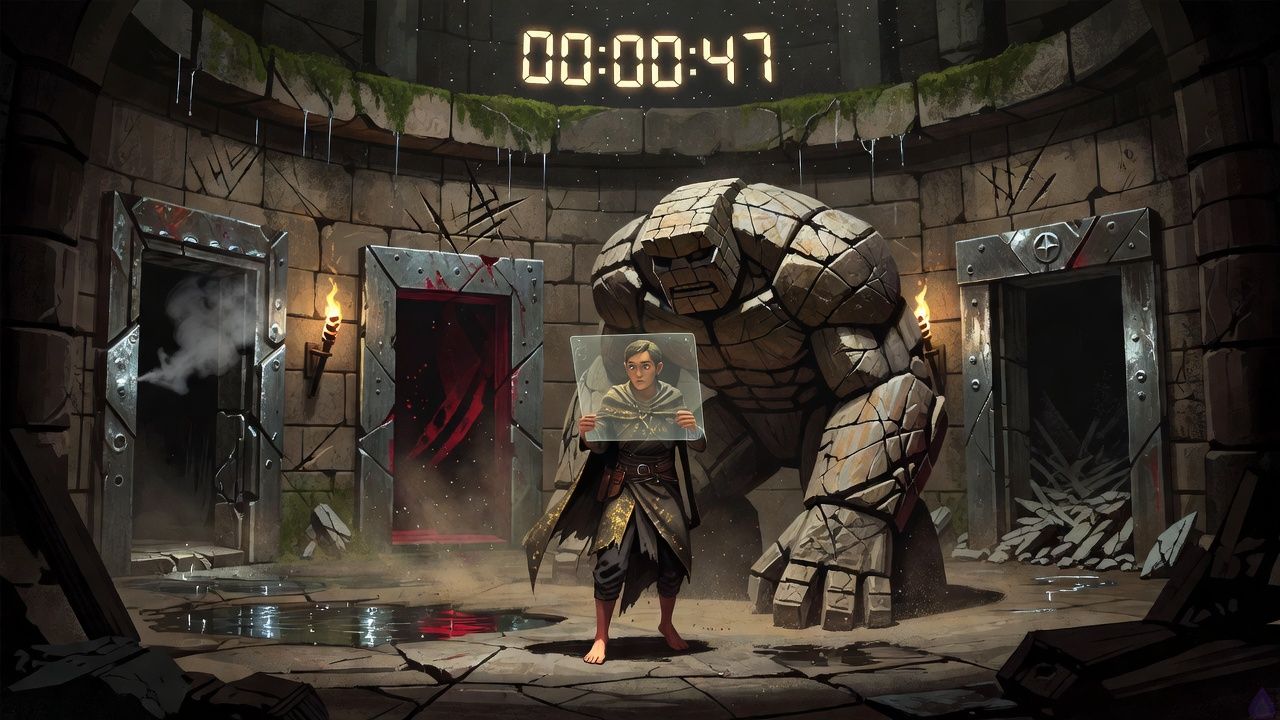
You lean closer. The translucent pane sharpens at once, as if it has been waiting for your attention alone.
The blankness in your head does not lift. Something steadier takes its place. Focus. Shape. Need.
The screen blooms outward in pale blue light, cold enough to prickle your eyes, and for a moment the stone chamber feels smaller, as if the whole floor has drawn in a breath and is holding it with you.
SYSTEM: "Class Selection. Choose wisely. Your starting path will shape survival odds, combat viability, and dungeon response."
Rows of options scroll into view. Some are obvious at a glance — bold, brutal names that promise strength and pay for it in blood and simplicity. Others are stranger. Narrower. Built around tricks, patience, or some deeper understanding you do not yet possess.
You read them one by one, and the screen answers with hard, patient certainty, as if it knows exactly how desperate you are.
Vanguard. High endurance. Strong opening defenses. Slow adaptation.
Scout. High mobility. Trap awareness. Low margin for error.
Sage. Pattern reading. Puzzle attunement. Weak in direct conflict.
Binder. Adaptive utility. Resource manipulation. Unstable early scaling.
A final line shimmers beneath the list, smaller than the rest, almost an afterthought.
SYSTEM: "Tutorial recommendation: avoid classes you do not understand. Survivors favor simplicity."
Brick snorts, or what passes for a snort in a body made of carved stone. The sound is dry as snapped twigs. Cracked. But there is approval in it when he sees you reading instead of freezing.
Brick: "Good. Staring at the dark is how people die stupid. Reading first is rarer than common sense in here."
He shifts one heavy hand. Grains of grit patter from the joints in his knuckles. His gaze stays on the screen, not on you, which somehow makes the moment feel more honest.
Brick: "If you want my honest opinion, which is regrettably free, pick something that keeps you alive long enough to learn the floor. Strength is nice. So is not getting turned inside out by the first thing with teeth."
The class descriptions keep pulsing, each one waiting to be claimed. You can almost feel the shape of yourself trying to settle around one of them, like wet clay pressing into a mold.
The chamber seems to narrow around that choice. Three exits. One class. Twenty-four hours. A voice in the System that sounds amused by all of it.
Then, beneath the classes, a new line unfolds slowly, deliberately, as if the dungeon itself has decided to be helpful in the way a spider is helpful when it tells you exactly where the web is stretched.
SYSTEM: "Note: class selection is irreversible. Some choices will change how the Warden addresses you."
Brick finally looks at you then, and for the first time his sarcasm slips just enough to show concern beneath it.
Brick: "That part matters. Trust me."
The list waits.
And one option at the center of the screen begins to glow a little brighter than the rest, though you cannot tell whether it is an invitation or a warning.
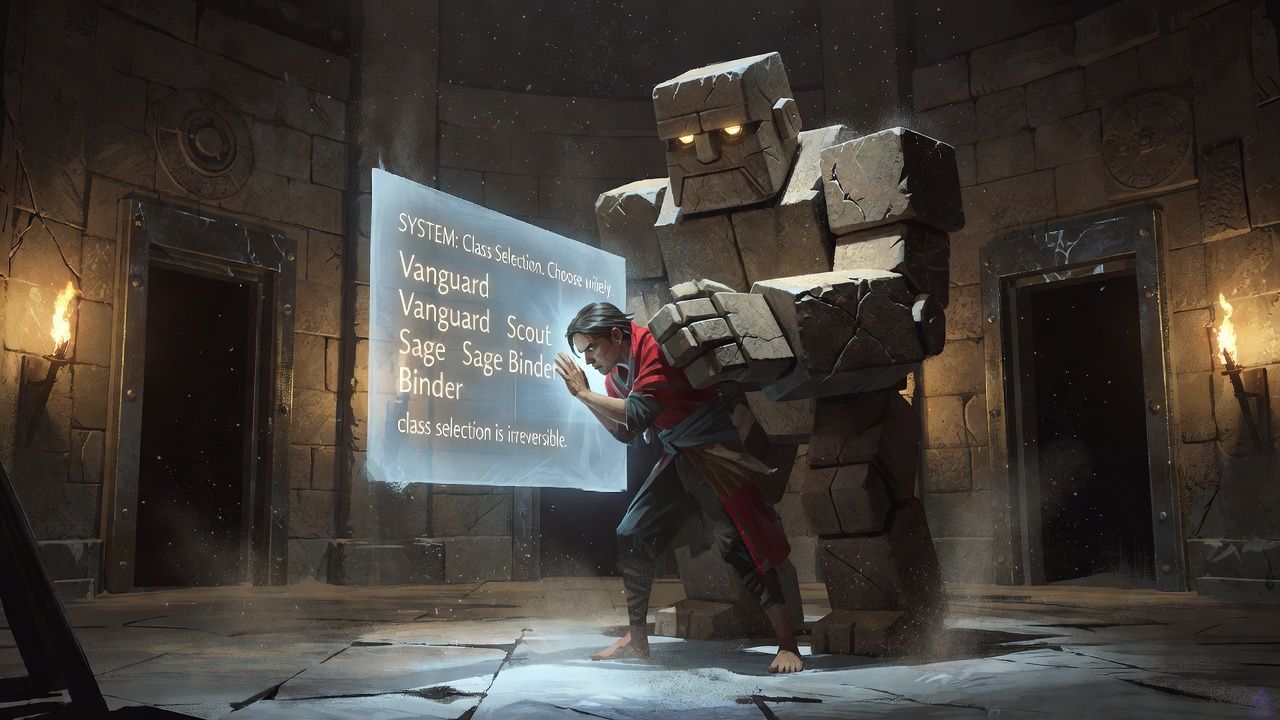
You press your palm against the glowing pane and choose the path that promises the least regret. The screen answers at once, as if it has been waiting for a sensible coward all along. Light runs across your hand in pale threads, then drives under the skin with a brief, cold bite that makes your teeth ring.
SYSTEM: "Class selected: Vanguard. Role emphasis: durability, positioning, threat control. Risk profile: moderate. Survival probability improved."
The words settle over you like a shield you have not yet earned. Not invincible. Not safe. But less breakable than you were a breath ago. The air in the chamber seems to thicken around your shoulders, as if your body has already begun learning the shape of the class. Your stance changes without permission. Feet wider. Knees loose. Weight dropping into the stone floor. The movement feels right in a way that is almost insulting. You do not remember learning it, and yet your body accepts it like old drill and hard rain.
Brick lets out a low grinding sound that might be approval.
Brick: "There. Sensible. Boring, even. I like boring. Boring survives."
A second line flashes beneath the class name, and the light around it hardens into a compact icon: a small shield, plain and severe, edged with sharp angles like something forged for a war no one intended to survive cleanly.
SYSTEM: "New Ability Acquired: Brace. Momentarily stabilize against force, stagger, or impact. Limited duration. Best used before you regret not using it."
The chamber beyond the screen does not shift, but your sense of it does. The iron-cold passage to the left now feels like a mouth waiting to bite something slow. The claw-marked slope looks less like an accident and more like a place where an enemy would try to shove you off balance. The rubble-choked exit remains the most infuriating of the three, which means it probably hides something worth taking. That thought does not arrive like memory. It arrives like judgment, newly born and already suspicious.
Brick steps closer, and for once his massive face is almost level with yours. The stone around his eyes is cracked in fine white lines, old weathering or old damage, hard to tell. He lowers his voice, though there is no one else here to hear.
Brick: "Vanguard gets you through a bad opening, but only if you learn when to stand and when to get out of the way. The floor likes bruises. It loves panic more."
The System flickers again, and this time the Warden’s presence comes through like a smile dragged slowly across glass.
SYSTEM: "Interesting. A defender with no remembered home. Viewers adore contradictions."
Something in that line catches under your ribs. Not pain. Not exactly. A sharp tug of recognition without a shape to hang it on. The feeling is gone so quickly it could be nothing, but Brick sees the way your attention tightens anyway. His gaze slides toward the dark corridor beyond the chamber, then back to you, as if he is measuring whether you are about to bolt, fight, or crack apart.
Brick: "Listen. Now that you’ve got a skin-deep sense of survival, we should use it. There are three exits, and one of them will teach you something useful if it does not kill you first. Your new class makes a difference. Choose the wrong door, and you will get your first lesson in regret very quickly."
The countdown in the corner of your vision keeps ticking. Slow. Patient. The dungeon waits with iron patience and bad intentions. The shield icon glows once, then fades to a dim pulse at the edge of your sight like a promise that can still be broken.
And from somewhere deep in the iron-dark passage, something answers the silence with a slow, deliberate scrape.
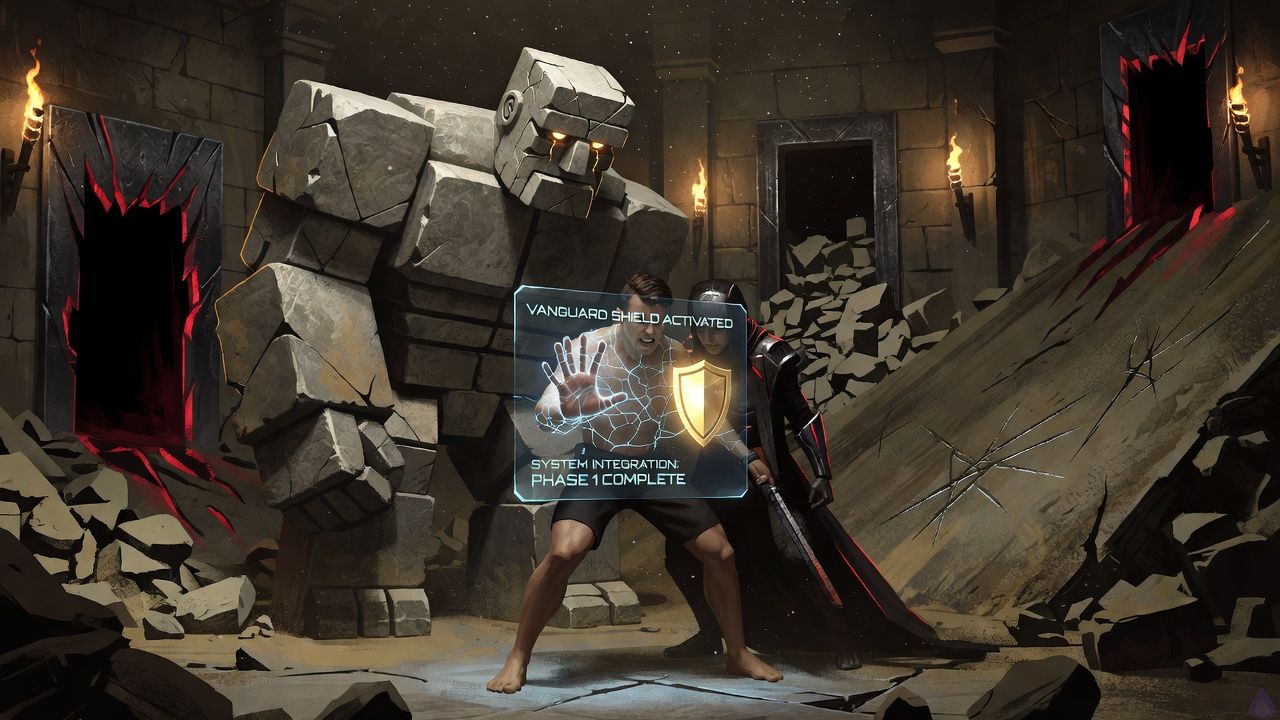
You hold your ground and let the sound from the dark roll past without feeding it your panic. The chamber stays cold around your bare feet, the stone slick with damp and old mineral grit. Brick notices at once. His carved face does something almost human. Approval, maybe. He shifts his massive body, angling himself so the room feels smaller, safer, as if he can physically keep the worst of the floor from getting any closer.
Brick: "Good. Rushing in blind is how the floor gets its dinner. Use the part of your head that still works. Strategy first. Dying later, if at all."
He raps one knuckled finger against the stone beside you. Hard. Then he points, in turn, toward the three exits. The left passage breathes out iron-cold air that tastes faintly of old blood. The middle slope is scored with claw marks, deep enough to catch moonlight from the system glow and split it into pale threads. The right opening is half buried in pale rubble, and Brick pauses on it longer than on the others. Somehow that is worse than any joke.
Brick: "Left smells like a patrol route or a workshop. Means a guard, a machine, or something that thinks like one. Middle path is movement-heavy. Whoever made those marks expected prey to be shoved, chased, or dropped. Right path is annoying. Annoying usually means useful, if you can stand the effort."
His voice changes as he speaks. Less sarcasm. More weight. He is not guessing wildly. He is reading the dungeon the way a veteran reads weather, by pressure, by habit, by the shape of old damage in stone. You find yourself staring at the exits the same way, your new stance holding steady without effort now, knees bent, shoulders set, the memory of the class screen still burning at the edge of your vision. Stand. Brace. Absorb. Then answer.
Brick: "As a Vanguard, you are not supposed to be clever in the elegant way. You are supposed to stay upright long enough for the clever plan to become possible. That means three things. Line of retreat. Something that forces enemies to come to you. And a way to stop yourself from getting surrounded when the floor gets ambitious."
He folds his hands behind his back. Stone grinds softly on stone. For something built like a wall, he has the unsettling habit of sounding like a creature that has watched a great many walls fail.
Brick: "We map the nearest room. We learn what hunts there. We save the shove-down-the-stairs nonsense for when you have options, not before. If the floor gives you a choke point, you use it. If it gives you open ground, you become the obstacle. That is the sermon, more or less."
The chamber feels different after that. Not lighter. Just less random. The exits are no longer holes in stone. They are choices, each with a shape, a smell, a price. Brick waits a heartbeat, then adds, lower now, almost as if the dungeon itself might be listening.
Brick: "If you want my actual recommendation, take the path that lets us see the fight coming. Your class wants time. Deny the dungeon the chance to rush you."
The scrape from the darkness comes again. Softer this time. The silence around it seems deliberate, like the floor is holding its breath. Brick watches your face, steady and unreadable, while the countdown continues to burn overhead.
For the first time since waking, you are not choosing whether to survive.
You are choosing how.
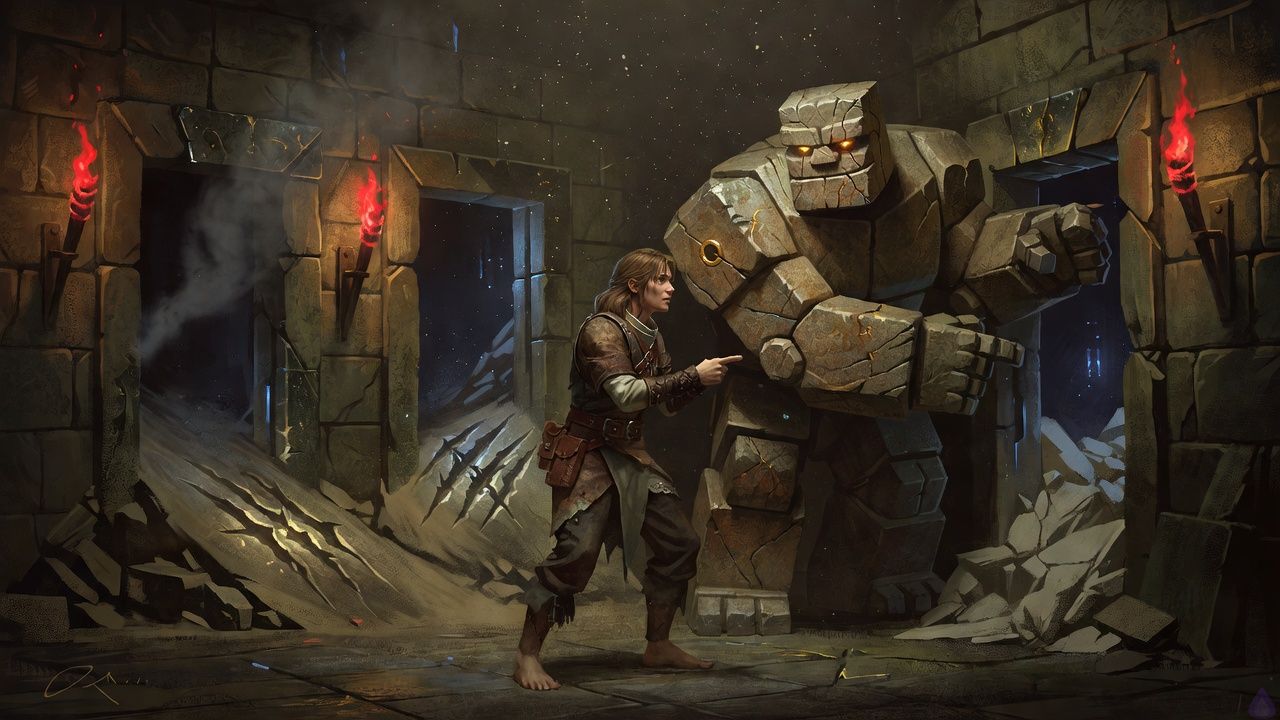
You let the question fall between you plainly, stripped of bravado, and Brick answers the way a man does when he knows a life depends on getting the wording right.
You: “Narrow it down. Safest route. Not best loot, not smartest trap, safest.”
Brick’s head tilts a fraction. Stone dust grates in the seams of his neck. For the first time since you woke, his humor draws back far enough to show the veteran under it.
Brick: “Good. That is a better question than ‘which door is strongest.’ Strong often means obvious. Obvious means dead. Safest is usually the route that gives you room to retreat and does not force a commitment too early.”
He points first to the narrow slope marked with claw gouges.
Brick: “Not that one. The marks are too deep, too clustered. Something faster than one fighter used it, or something that drags prey. Either way, it wants you moving under pressure. Bad first lesson for a Vanguard.”
His hand shifts to the iron-cold passage.
Brick: “Not the left either, unless you enjoy being seen before you are ready. That kind of air means a chamber beyond, or metal, or something that hunts heat and breath. You do not want your first fight to begin with the enemy already facing you.”
Then, after one measured pause, he taps the rubble-choked opening.
Brick: “That one. Ugly. Slow. Probably irritating. Which is exactly why it is safest. Something collapsed there. Collapses make bottlenecks. Bottlenecks mean fewer angles on you. Fewer angles mean your class matters. You can brace at the narrowest point, force anything through one by one, and back out if it turns.”
The answer settles into you with the hard click of a tool fitting a hand. Not comfortable. Useful. The rubble entrance is no prize, but it is the only one that sounds like survival on your terms.
You look over the pale stones, the broken lip of the arch, the dust hanging in soft chalky veils where the collapse happened long ago. It smells dry down there. Old mortar. Cold rock. A faint metallic tang, like wet nails left in a bucket overnight. It will be a crawl at first. Maybe a squeeze. Maybe worse. But it will not let anything encircle you easily, and right now that matters more than comfort.
Brick sees the decision settle in your face. His expression stays carved from stubborn stone, but his voice drops, quieter now, almost private.
Brick: “If we go that way, do not waste your first real panic on noise. Move carefully. Keep your shield side toward whatever space opens first. And if you hear me tell you to stop, stop. I am not in the habit of giving free advice to people I expect to die immediately.”
The System flickers at the edge of your sight, bright and pleased as a knife glinting in firelight.
SYSTEM: “Guidance noted. Tactical alignment improved. Viewer engagement rising.”
The line leaves a sour taste in your mouth, like copper under the tongue. Brick’s gaze jerks upward for a heartbeat, toward the invisible source of the voice, then returns to you. The joke has gone out of him entirely now.
Brick: “There. That sound means the Warden is listening. Annoying.” A beat. “Still better to be annoying and alive than entertaining and leaking.”
He shifts aside so the rubble passage is clear, and you can feel its miserable geometry already: tight, broken, mean. Safer, maybe. Or safer until it isn’t. The choice has become a route. The route has become a commitment.
Brick waits for you to move first, but not before he adds one more thing, low and deliberate.
Brick: “One more truth. ‘Safest’ does not mean ‘easy.’ It means we survive long enough to find out what the floor really wants from you. And I think, unfortunately, it wants more than it has admitted so far.”
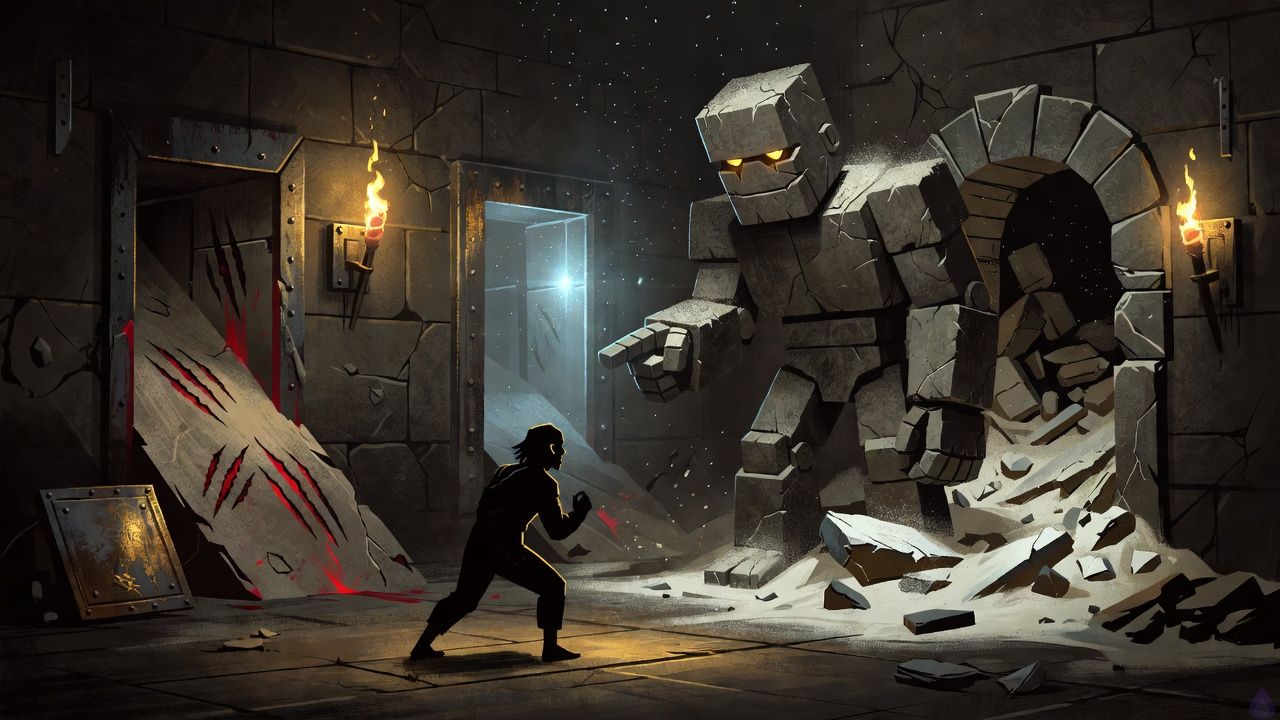
You step into the rubble passage before hesitation can grow teeth.
The broken archway swallows the chamber light in jagged pieces, and the air changes at once, going dry and stale, close enough to taste like old ash. Loose stone shifts under your bare feet. Pebbles skitter away into darkness ahead, and every sound seems to travel farther than it should.
Brick follows close enough that you can feel the heatless pressure of his bulk behind you, a moving wall in the narrow crawl. When your shoulder scrapes the passage, cold grit flakes onto your skin. The tunnel forces you lower. Then lower still. Soon you are half crouched, one hand out for balance, your breath catching in the tight, dust-bitten space. Miserable. Claustrophobic. Exactly what Brick promised.
A bottleneck.
Nothing can come at you from the sides here, not unless it is willing to tear the walls apart first.
Brick’s voice rumbles low behind you. “Good. Slow is alive. Keep your weight centered. If the floor goes hollow, do not try to win against gravity. Brace first, then think about being heroic.”
Ahead, the rubble opens into a cramped chamber where the ceiling has caved in at one corner. Pale dust coats everything. Thin cracks in the stone leak a weak blade of daylight from somewhere above, so faint it looks bruised. For one hopeful heartbeat, the room is empty.
Then you see it.
A skeleton, long dead and half-buried beneath broken masonry, one hand still locked around an iron ring. Behind it, a dark smear stains the wall — old enough to have gone nearly black, as if blood had dried there and been left to bake in the stone. The sight lands with a small, ugly certainty.
Someone was trapped here.
Someone fought here.
Someone did not leave.
The System hums with private amusement.
SYSTEM: “Tutorial assistance available. New environment detected. Warden commentary pending.”
Then a rasp slides through the chamber, speakerless and intimate, as though the voice is coming from inside the cracks themselves.
The Warden: “Resourceful. I do adore when contestants choose the route that makes them feel clever.”
Brick’s posture changes instantly. Hardens. His hand lifts, not protectively, but ready. The bones on the floor do not move, yet the chamber feels watched all the same, and the iron ring in the corpse’s hand gives off a faint, deliberate glint. An object. A trap. Or both.
Your new class settles into you like a measured breath.
Vanguard.
Hold the line. Take the hit. Make the narrow space matter.
Then the far side of the chamber answers with a scrape, deeper than before, and something shifts behind a pile of stones large enough to hide a body. Not fully seen. Not yet. Only a low, patient movement, as if whatever lives here has been waiting for someone foolish enough to walk through the safest door.
Brick angles himself beside you, his whisper stripped bare. “Well. That is inconvenient.” His eyes stay fixed on the shadows. “If you want the ring, you will have to earn the space around it. If you want to live, decide now whether that thing gets the first strike.”
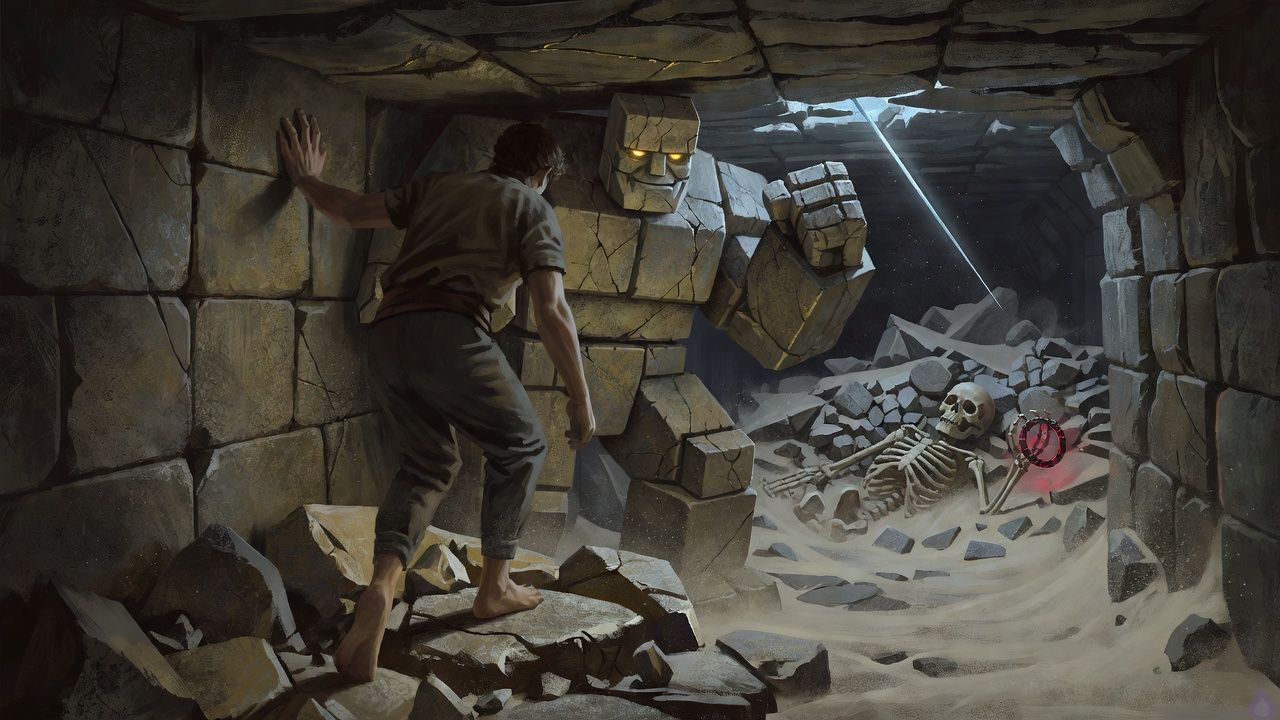
You plant your feet in the narrowest part of the ruin and make the passage yours. The stone under your heels is cold and ridged with grit, slick in one place where rain has seeped through the ceiling and left a dark stain. Your stance settles anyway. Lower. Steadier. Shoulders square to the dark.
The class screen’s lesson feels suddenly practical. Not brave. Not glorious.
Useful.
Brick slides in beside you and just behind, broad enough to close the lane with his body, his weight like a door bolted shut.
Brick: "There it is. That is the shape of a sensible mistake. Hold here. Make it come to you."
Something moves behind the rubble. At first it pretends to be only shifting stone, then the lie breaks. A shape drags itself into the thin spill of light, not fully shown, only enough for you to catch the hard gleam of bone and the wet shine of something clinging to it. Low to the ground. All joints and quick, wrong twitching, built to slip through cracks and strike from angles you cannot guard at once.
Cold runs through your stomach.
You do not step back. You brace.
SYSTEM: "Brace activated. Stability increased. Incoming force resistance improved."
The thing lunges.
You meet it with your shoulder and your stance instead of your face. The impact drives through you like a hammer blow, brutal and sudden, but the class holds. Pain snaps down your arm. Your teeth clack together hard enough to sting the gums. Still, your feet stay rooted. The creature skids sideways against the pressure you refuse to yield, claws shrieking over stone in a spray of sparks and dust.
Brick comes down with a slab-hard fist and catches it across the flank. The blow throws it into the wall with enough force to shake loose a shower of mortar and ancient grit from the ceiling.
The chamber fills with dust. It tastes like chalk and old ash. A bone cracks with a dry, brittle snap.
The creature pulls back, not dead, only hurt, and in the choking haze the shape of the fight becomes clearer. Hungry. Cornered. Desperate to get past you and into the open behind. That will not happen unless you fail.
The thought sharpens everything.
You are not just taking a hit. You are blocking a path.
Then the Warden laughs softly through the System.
The Warden: "Excellent. A defender after my own heart. Stand there a moment longer. I want to see whether courage holds when the ugly part begins."
Brick’s voice comes rough and close, and all at once there is no trace of his earlier joking.
Brick: "Do not listen to the voice. Listen to the floor. It wants you distracted. Keep your center. If it rushes again, take it on the shoulder and shove it back. If it climbs, I will break it."
The creature circles in the dust, dragging one twisted limb. Behind you, the iron ring in the corpse gives a sharp metallic jolt, as if something deeper in the chamber answered the sound of impact. The rubble route was safer than the others, yes, but safety is proving to be a narrow, ugly thing, measured one breath at a time.
Then you hear it.
Another sound beneath the scrape of claws, faint but certain, coming from under the collapsed stones on the far side of the room.
Something else is waking up.
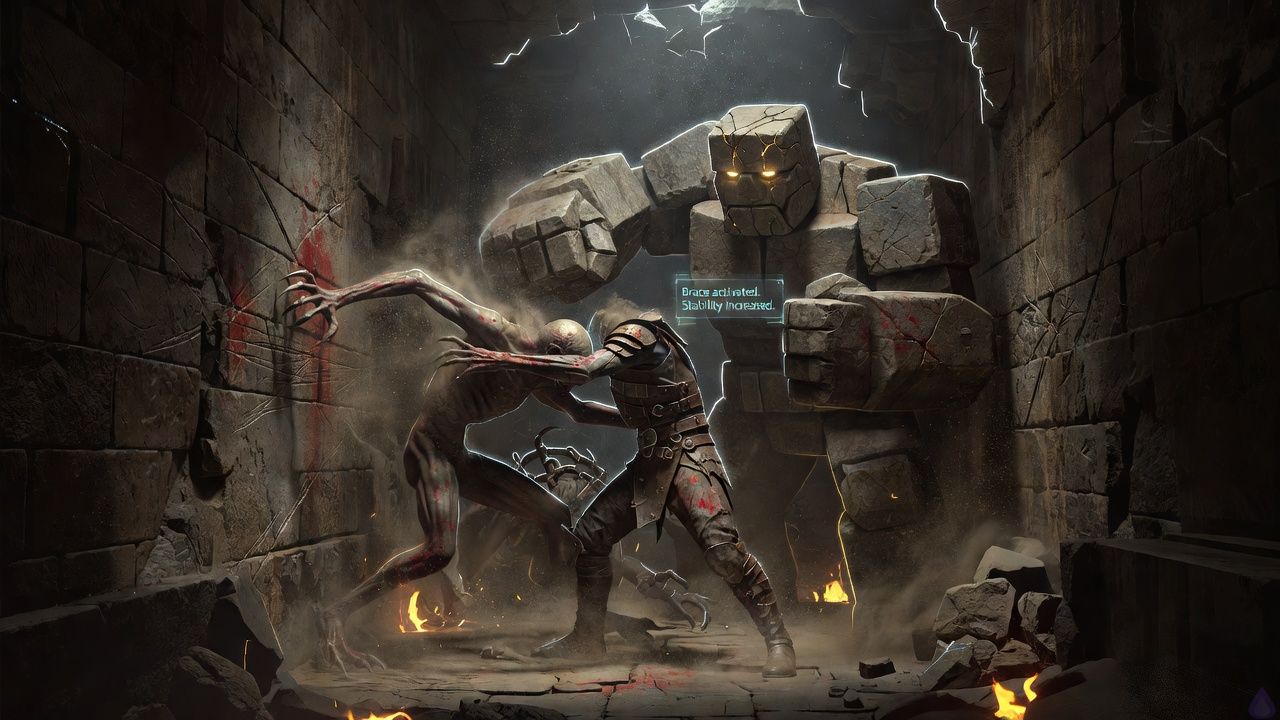
You do not waste breath on doubt. Brick says move, and you move.
The choice settles in you cleanly. Almost gently. As if a knot behind your ribs has been cut with a sharp blade and, all at once, you can breathe around it. Your weight goes forward. Shoulders set. Eyes lock on the twitching thing in the dust.
Stone underfoot. Rust in the air. The wet, mineral stink of the chamber pressing in on your tongue.
The world shrinks to that. And Brick at your back.
He feels your trust at once. He does not waste it on praise.
Brick: “Good. Finally, someone with manners. On my mark, left side. You pin it. I’ll take the head if it offers one.”
The creature hits again before the words have finished leaving him. Faster this time. A blur of bone-white limbs and black, slick hide that catches the weak light like oil over swamp water. You brace and take the blow on your shoulder.
Pain flashes through you. Hot. Blunt. Immediate.
It drives down through your ribs and into your hips, trying to fold you. The Vanguard class answers. You feel it like iron braces snapping into place beneath skin and sinew, holding you upright where lesser flesh would have buckled. Your teeth grind. Your feet stay planted.
Then Brick’s hand slams down.
Stone fist meets the thing with a crack like a pillar breaking in a temple ruin. The impact shudders up your bones. The creature skids sideways, half-spun, enough.
You use the opening.
Your shoulder drives into it again. Not to kill. To deny it ground. To pin it to the narrow passage and make the hallway itself your weapon. There is nowhere for it to slip. No room to circle. The walls close in on both sides, rough rock scraping your sleeve, damp stone dragging at your breath.
It scrabbles, shrieking, claws rasping sparks from the wall.
Brick advances. You feel him coming before you see him, a heavy certainty behind you, and the creature folds under the pressure, trapped between your body and his crushing force.
Then the rubble at the far end shifts.
Not a collapse. Not yet. A shiver. A tremor running through broken stone as something beneath it wakes and turns in its sleep. Old enough to have patience. Angry enough to spend it.
A second shape stirs under the heap.
The Warden: “Yes. Yes, that is the good part. A loyal front line, a clear choke point, and one contestant who finally understands the value of commitment. Delightful.”
His voice slides through the chamber like cold smoke slipping under a door. Not just amused now. Interested.
Hungry.
For the first time, that matters.
Brick’s head turns by a fraction. Not toward the voice. Toward the rubble. He has seen it too. Of course he has. The fear of that is sharper than the fear of the thing in front of you. He knew this room was not done with you.
Brick: “On my count, you hold the center. I am going to break the second one before it reaches the open. Do not chase the first if it bolts. Let it come back through the same mouth. The dungeon keeps teaching the same lesson until people learn it or die bitter.”
Dust thickens around your boots, dry and gritty, coating your tongue when you inhale. The first creature jerks back, not fleeing so much as hunting for an angle, its limbs folding strangely under itself. The buried shape under the rubble shifts harder now. Stone ticks loose. A thin rain of gravel hisses from the ceiling and patters against your shoulders.
The ring in the corpse’s hand gives one sharp metallic jolt.
Then stills.
As if whatever answered it has decided to wait.
You trust Brick. Completely.
Not because you understand the plan. You do not. Not yet. But because he has not wasted a word since you woke. Because he stood beside you when the room narrowed and the dark started moving. Because some part of you, newly forged and still wordless, knows this much at least: surviving this floor may depend less on courage than on choosing, fast and clean, who to believe.
The first creature springs again.
Brick lunges toward the sound beneath the rubble. His stone fist rises like a gate dropping from a castle wall. For one breathless instant, everything hangs there — dust caught in the pale shaft of light, the chamber held taut as a drawn bow, the Warden silent as if leaning closer to hear what you will do.
Then the far wall bursts inward with a wet crack of stone.
Something crawls through.
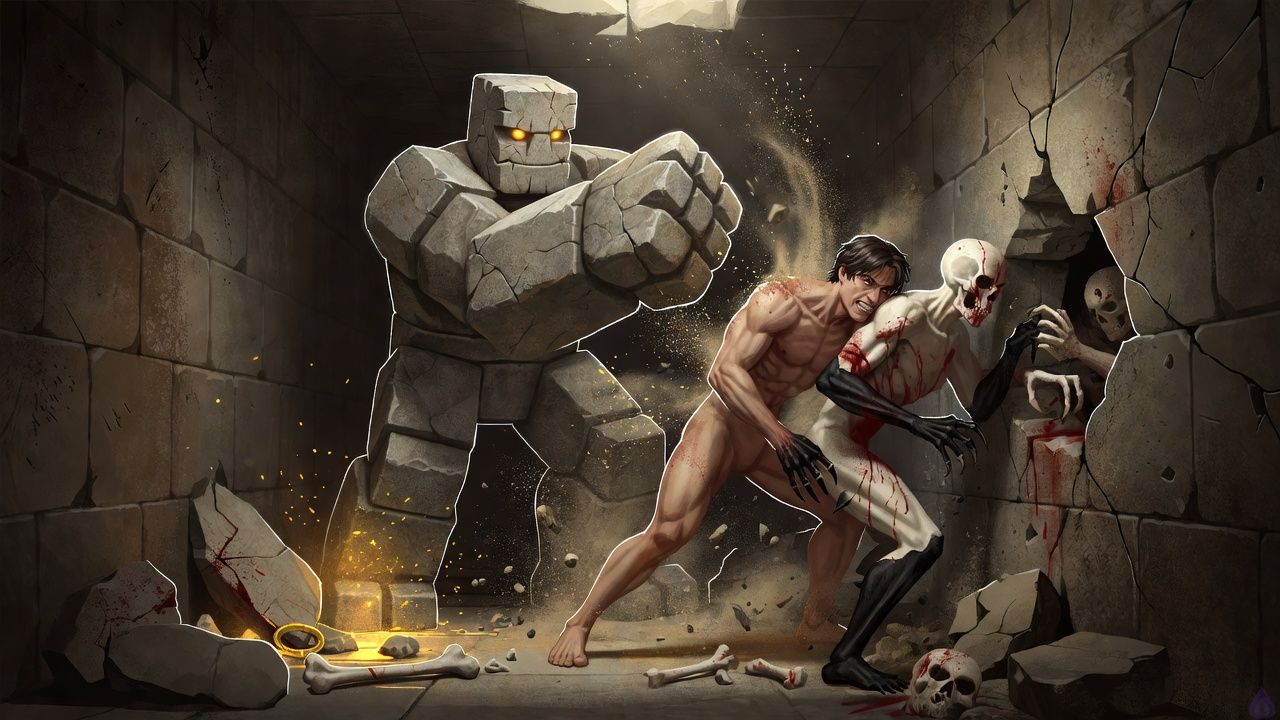
You lock your stance in the center of the passage and become the thing the tunnel cannot move around.
The first creature snaps at the edge of your reach, claws scraping stone, teeth clicking wetly in the dim. You do not follow it. You do not give it the chase it wants. You hold the line where Brick told you to hold it, shoulders squared, weight sunk deep, the narrow stone mouth behind you turning from a corridor into a promise you intend to keep.
Brick meets the breach head-on.
The wall gives way in a burst of shattered mortar and old dust, the air suddenly thick with the chalky bite of it, and something bigger than the first creature forces itself through the break. Not graceful. Not clean. A low-built mass of bone and sinew, all hard angles and jerking joints, with a head that keeps twitching side to side as if it is measuring where best to kill. Brick’s fist comes down like a falling gate.
The impact shakes the chamber. Pebbles rattle across the floor and strike your boots.
The new thing does not die outright. It should have. Instead it folds sideways under the blow, then lashes out with a hooked limb that rakes across Brick’s chest and sends pale stone chips spinning through the air. He grunts. More irritated than wounded, maybe, but the sound is real. He takes the cut and stays upright, driving the creature back into the breach before it can find room to breathe.
The Warden: “Excellent. A true tutorial tableau. The sturdy one at the center, the heavy one at the breach, and all that lovely friction in between. Keep going. I want to see which of you breaks first.”
His voice slides through the chamber like cold oil.
You can hear the satisfaction in it. Not surprise. Anticipation. He wanted the room to open. He wanted you forced into a stance where every choice hurts. And now that the plan has started to slip, the delight in his tone only sharpens.
Then it hits you.
The proof of the class in your bones.
The first creature slams into you again, trying to slip past while Brick is occupied, and your body answers before fear can catch up. You brace. Absorb. Shove it back into the tunnel mouth with a violence that jars your teeth. Pain blooms in your shoulder and ribs, hot and immediate, but it does not fold you. You stay standing. The passage remains yours.
For one thin, murderous moment, that is enough.
Brick tears one arm free and swings. He catches the larger thing across the jaw.
The sound is like a slab of granite splitting.
The creature’s head whips sideways, and it crashes into the broken edge of the wall. The breach widens with a groan of stone on stone, revealing another space beyond it, darker and lower than the chamber you stand in now. Something metallic flashes in there for half a heartbeat — a blade, a hinge, a chain, you cannot tell , before dust swallows it again.
The room goes still.
Wrongly still.
The first creature lies pinned and twitching at your feet, not dead, but broken enough that it will not rush again soon. The larger one has backed half a step into the breach, wounded, furious, and not alone. There is movement in the darkness beyond it. Low. Patient. Waiting.
As if the dungeon has finally decided to answer with something real.
Brick straightens slowly, dust clinging to his stone shoulders like ash.
Brick: “Well. That is new.”
He looks at you once. In that glance there is something fierce, almost pleased, though the danger is far from done.
Brick: “You held. Good. But whatever is behind that wall just learned your shape.”
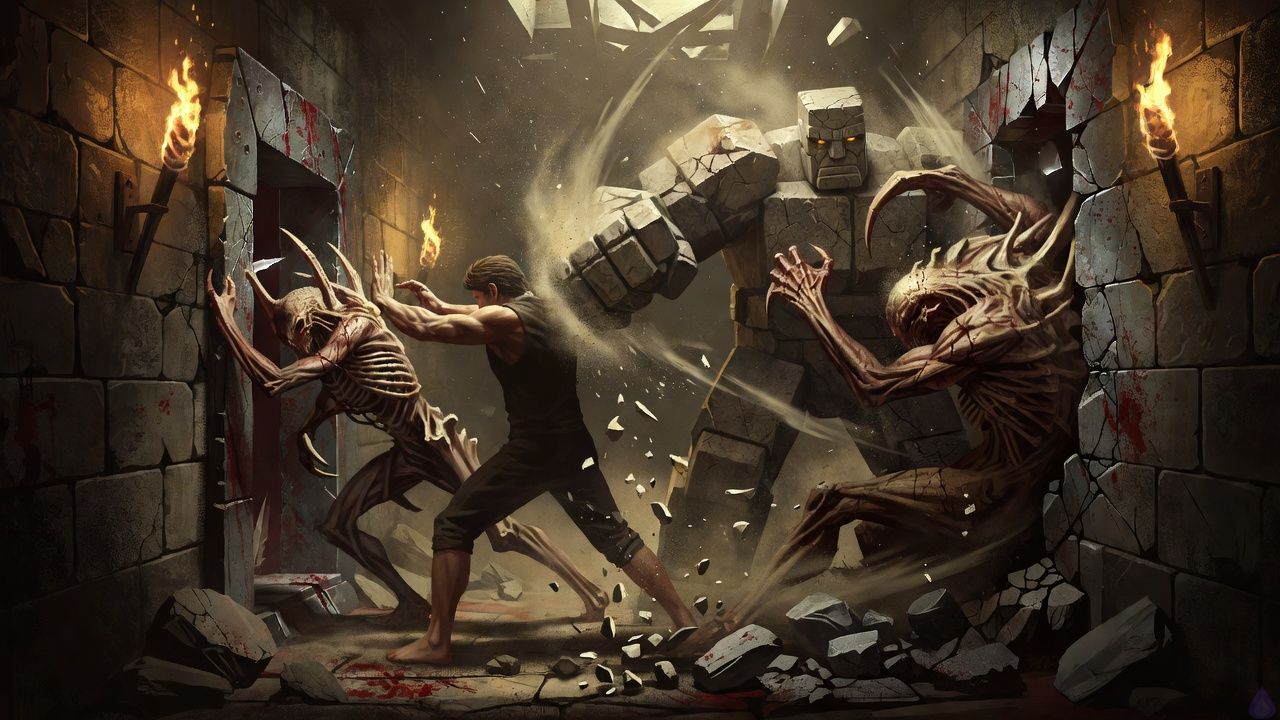
You let the fear come, and then you do not let it lead.
It surges hot in your chest, a thing with teeth, and you force it down into something narrower, harder, useful. In. Out. The Vanguard class answers with no comfort at all, only structure. Your shoulders drop a fraction. Your feet remember the grit under them. Your pulse slows enough to count.
The tunnel stops feeling like a throat.
More like a gate, now. You are still inside it, yes, but no longer trapped inside your own panic. The new rhythm hums through you, stern and practical, like a shield held close to the ribs. Brick notices at once. His battered stone face turns toward you, and for once the joke stays buried.
Brick: “There you are. Thought I might have to drag you back from the edge by your collar. Better. Much better. Fear is fine. Fear is a tool. Let it sit where I can see it, and then use it to keep moving.”
The thing in the breach scrapes backward.
The sound is wrong now. Less sure. It had expected a stumble, a flinch, a break in the line. Instead it meets a standing wall: your planted stance, Brick’s crushing bulk, the narrow choke between broken stone and splintered mortar. One ugly defense. One shared breath. The larger creature hunches and lunges again, but Brick catches it with both hands and slams it into the jagged lip of the wall hard enough to spit white dust from the cracks. You feel the blow through the floorboards and up your legs.
The Warden’s voice slips through the chamber, smooth as oiled glass.
The Warden: “How charming. The contestant learns composure just in time to make the scene less amusing. Still, discipline has a way of drawing out better suffering. Keep going. I insist.”
He sounds pleased.
That makes your stomach knot.
Beyond the breach, the dark opens into a lower chamber you cannot fully see. There, a metallic flash catches the eye again — not a glint now, but shape: a narrow iron mechanism sunk into the far wall, half-swallowed by fallen stone. A lever, maybe. A lock. A trap waiting with patient metal teeth for someone to stand exactly where you stand now.
Brick grunts and shoves the larger creature back another step. It lands wrong, scrabbling for purchase, then retreats into the dark with a sound like claws dragged across old bone. At your feet, the smaller one twitches. Tries to rise. Fails. Not dead. Just spent, breathing shallow through whatever passed for a mouth.
The room has changed.
You can feel it in the damp stone, in the stale copper smell of old blood and broken mortar, in the way the silence now seems to listen back. The choke point has held. The dungeon has been forced to show a little more of itself than it wanted.
Brick looks past you to the iron mechanism, then back again. His voice drops, rough and serious enough to scrape the air raw.
Brick: “That thing in the back is either a way forward or a way to regret being curious. Your fear has steadied. Good. Now we decide whether to press the advantage, check the mechanism, or pull back before the floor gets ideas. Choose quickly. This room is not empty just because it is quiet.”
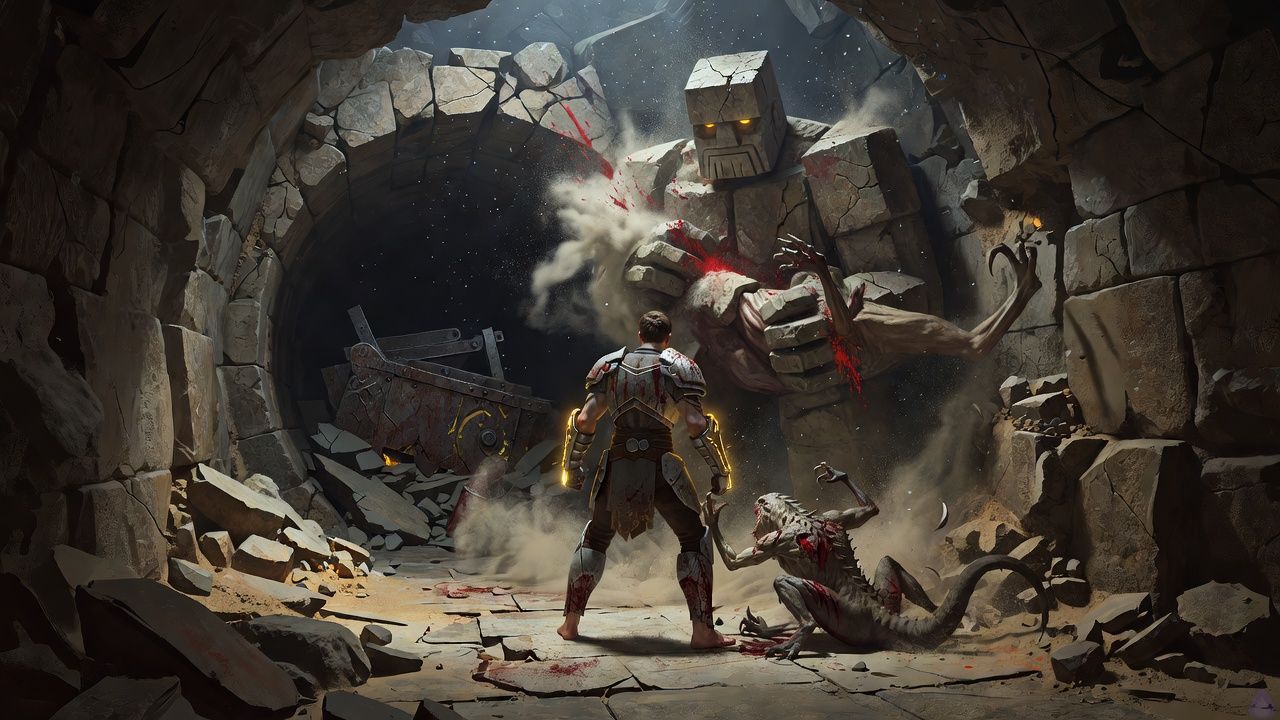
You draw in one slow breath and let it settle instead of sharpen. Dust coats your tongue. Old stone. A thin metal tang, like blood left too long on a blade, hangs in the air beyond the breach. The calm does not make you fearless. It makes you usable. Your shoulders loosen by a hair, just enough to move without burning strength you may need later, and the Vanguard shape in your body locks around that steadiness like a buckle cinched tight.
Brick sees it. His stone-hard face shifts a fraction, and this time the approval is plain.
Brick: “There. That is the pace. Not rushing. Not freezing. Moving like you intend to still be here after the floor is done posturing.”
You step through the broken mouth of the breach with your weight centered and your shield-hand ready. The chamber beyond sits lower than the one behind you, its ceiling bent and cracked into a jagged arch that catches the light in ragged strips. Broken masonry lies in a crescent near the far wall, chalky and sharp underfoot, and in its center waits the iron mechanism you noticed before, half buried but still intact. A lever, yes — but not a simple one. It is tied to a ring of dark metal teeth sunk into the floor, teeth arranged around a square slab that looks too deliberate, too clean-edged, to belong to a ruin gone to rot.
Not a trap in the ordinary sense.
A gate.
Or a seal.
The larger creature is still there, just inside the line of shadow, crouched low and ready. It does not rush. It has changed its mind. Your breathing seems to have reached it in some animal way, because now it hesitates instead of lunging, head angled, limbs tense, weighing you. That hesitation gives Brick the opening he needs. He surges forward with a roar of grinding stone and slams both hands into its side, hurling it into the wall hard enough to spider the plastered rock behind it.
The Warden’s voice slides through the chamber, amused and sharpened with interest.
The Warden: “Yes. That. Much better. A contestant who can make the room wait. Do keep going. I’m fond of progress when it is earned.”
You ignore him and cross to the mechanism. The closer you get, the more the iron ring in the corpse behind you seems to answer, a low vibration felt in your teeth more than heard in your ears. When you crouch, you see the truth of it: the lever was never meant to be pulled alone. It needs pressure on the floor slab beneath it, a paired motion, the kind that would likely open something deeper in the ruin. The square stone is worn at the edges by use, not age alone. Someone has stood here before. Someone expected to return.
Brick steps up beside you, one cracked shoulder dusted white with powder and grit. He looks from the lever to the slab and back again, then drops his voice.
Brick: “That is a mechanism, all right. Old one. Probably a route deeper into the floor, or a lock on whatever is trying to stay buried. If we trigger it, we may get answers. We may also get killed in a more organized way.”
Another scrape comes from the darkness behind the breach. Not the wounded creature. Something else. Something heavier. Slow. Deliberate. The calm breath you took has bought you a moment, and now the moment is thinning.
Brick sets one hand on the lever without pulling. He is waiting for your call, but the tension in the chamber has already changed shape. The floor seems ready to answer. And whatever is coming through the dark has learned enough not to charge blindly.
You have moved forward. Now the ruin is moving with you.
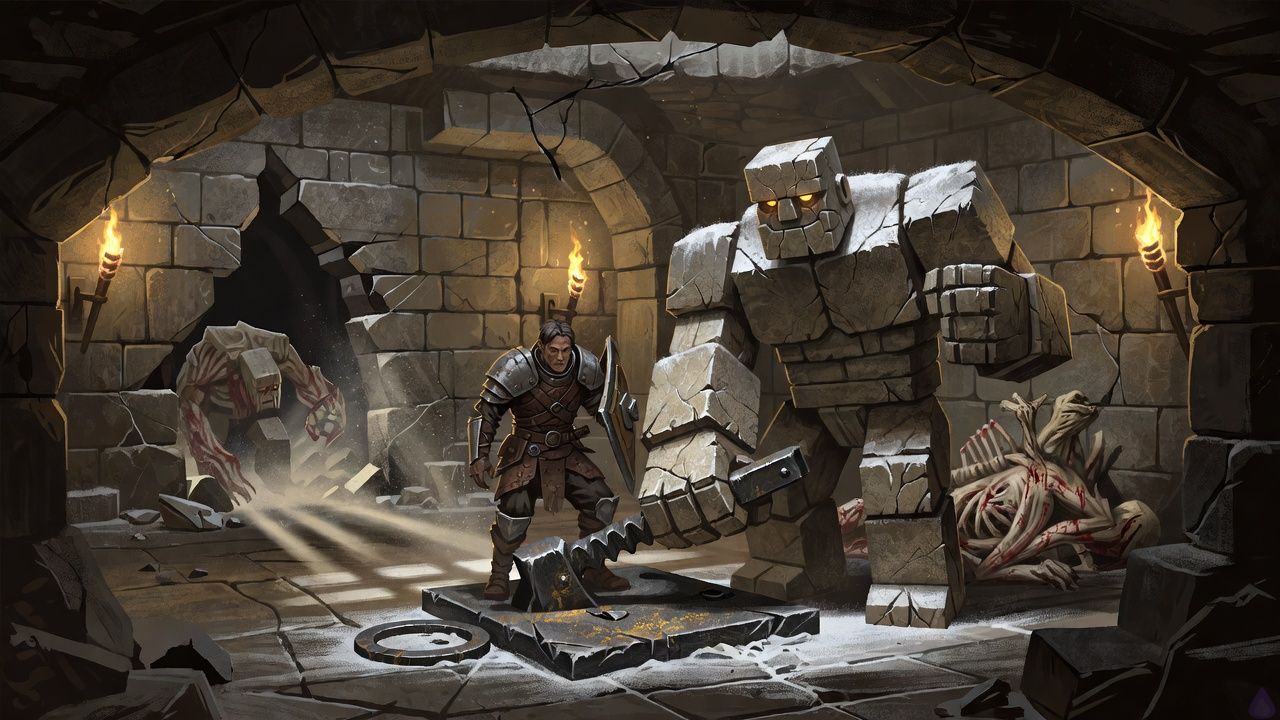
You step back and let Brick take the lead without argument. The choice feels right the instant you make it. Not because you understand the mechanism. Because you understand him. He has the weight, the reach, and the sort of patience that looks like laziness right up until something stupid enough comes close.
Brick plants both massive hands around the iron lever and gives it a slow test pull. The metal is cold enough to sting. Stone grinds under his boots. Somewhere beneath the mechanism, a slab answers with a dull click. Then another. Like old teeth remembering how to bite.
Dust trembles loose from the seams around the square panel. The chamber tightens around the motion. Cold. Metallic. Breathless. Behind you, the ring on the corpse’s hand gives a sharp, sudden shiver — a tiny struck-bell note that makes the back of your neck prickle.
Brick glances over one shoulder, mouth twitching.
“Good call,” he says. “This thing was built for leverage, not bravery. Stand ready. If whatever’s sleeping down there wakes up angry, I’d prefer it be angry at me first.”
He hauls again.
For one brutal heartbeat, the lever refuses him. Then it gives with a shriek of iron dragged over ancient stone. The square slab lowers a finger’s width. Just enough. A breath of stale air leaks up through the crack, carrying wet rust, old ash, and something that has been buried too long to still be called rotten.
Not a dungeon smell.
A kept-secret smell.
The Warden’s voice slips through the chamber, smooth as oil.
“Oh, excellent. You found the interesting part. I do hope you survive long enough to regret opening it.”
The slab drops another inch. Stops. Not open. Not yet. Only a dark seam now, a thin strip of blackness beyond it, blacker than the room, blacker than a closed eye. From the gap comes a low mechanical thrum, deep in the stone below, gears waking after a long sleep. Old machinery. Old purpose.
The larger thing lurking in the shadows recoils from the sound.
It knows it.
And it hates it.
Brick keeps both hands on the lever, every muscle in his shoulders locked hard against the strain. The veins in his forearms stand out like cords under his skin. His voice comes rough and close, aimed at you without taking his eyes off the seal.
“That’s either a door or a warning. Possibly both. I need one more second. If you’ve got a better instinct than I do, now would be a lovely time to use it.”
The chamber holds its breath.
Dust hangs in the pale light. The seam stays dark. Not empty. Occupied. Waiting. Whatever waits below has just been disturbed by your choice, and you can feel it like pressure behind the eyes, like the moment before a storm breaks open.
Brick does not let go.
Neither does the floor.
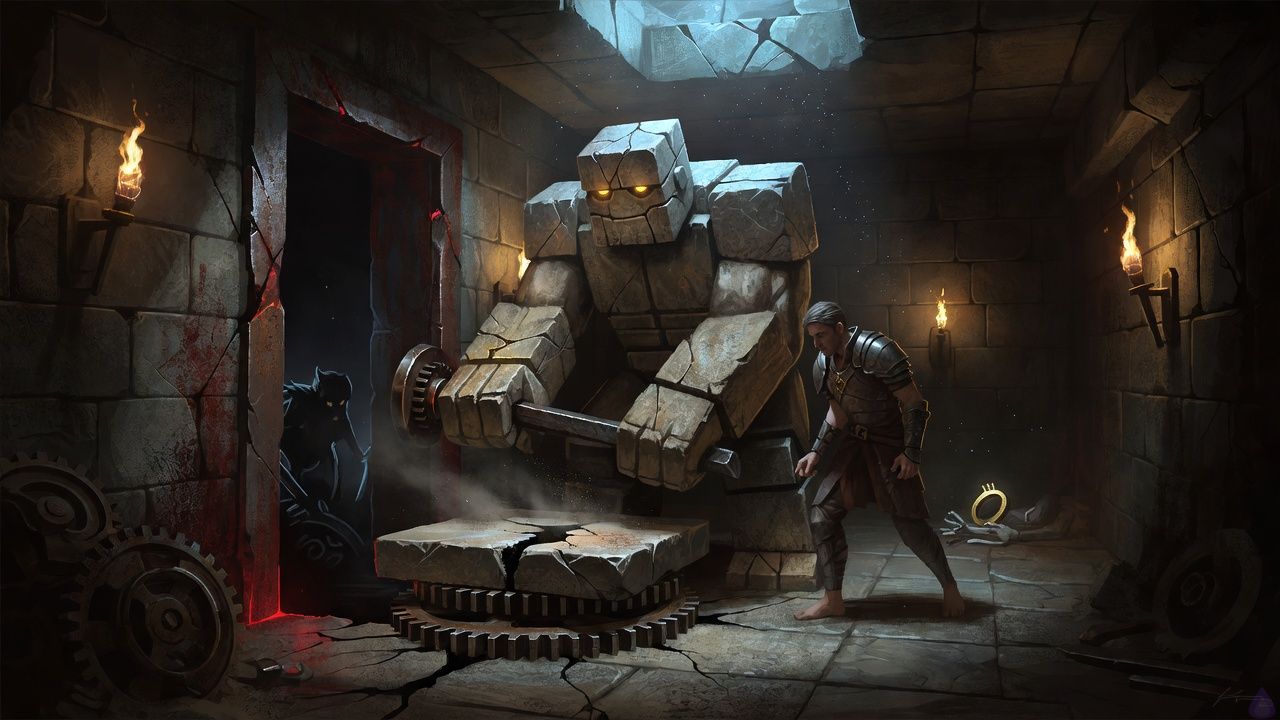
You do not rush the widening seam. You watch it the way Brick would watch a blade come slowly out of a sheath: patient, wary, respectful enough to stay alive.
The black strip beneath the slab deepens by a fraction, then shivers in a rhythm that is almost mechanical. Not random. Repeating. The floor is breathing through gears.
Brick keeps pulling, but only in short, measured increments now, trusting you to read what the dungeon is trying to hide. The lever answers with a grinding complaint that makes your teeth ache, and each sound gives you more to study. A pause. A click. Then a longer drag, as if a row of teeth beneath the stone are lining up in sequence instead of tearing free.
Your breathing settles around it. In. Hold. Out. The danger does not vanish. It becomes legible.
Brick: “There. See it? Not a collapse. A timed release. The room wants us to trip something on purpose, and it is being rude about it.”
You edge closer without crossing the seam, eyes narrowed on the dark below. It is not empty. It swallows most of the light, but not all of it. Something down there catches a thin, greasy gleam now and then, like wet iron under river water. The motion has a cadence. Safer than it has any right to be. A lock waiting for the correct pressure.
When the slab shivers again, you catch the part that matters. Left. Center. Right. A sequence.
If the lever is held at the wrong angle, the teeth below will snap shut. If it is held through the whole cycle, something deeper may give way cleanly.
The Warden’s voice drifts through the chamber, amused and thin as a knife edge.
The Warden: “How touching. The contestant is learning restraint. I wonder if that is courage, or just fear becoming useful.”
Brick gives a low, irritated rumble. He does not look up. He keeps the mechanism under tension while you map the rhythm by sight and sound. One beat. Two. A longer pause. Then, at last, the iron teeth beneath the slab give a synchronized clack, and the black seam widens a finger more on the left before evening out again.
That is it.
Not a trap triggered by force. By interruption.
You point once, sharply, toward Brick’s right hand, then the lever, then the seam. He understands at once. His grip changes from brute strain to controlled pressure, holding the motion just shy of the dangerous edge. The slab answers with a cleaner, more deliberate drop.
Cold air breathes up through the opening.
It smells of damp stone, old rust, and something faintly bitter, like extinguished candles. Somewhere below, a soft metallic chime rings out. Not warning now. Release.
For one brief second, the chamber changes. The ruin is no longer merely broken. It is a machine. Ugly. Hidden. But a machine all the same, with rules that can be read if you are willing to stare long enough and trust your hands not to shake.
Through the narrow gap, you glimpse descending stone and old iron fittings sunk into the walls, corroded rings and brackets spaced like a stair or maintenance shaft built for hands that knew the layout by heart.
Then the wounded thing in the shadows moves too soon.
One scrape. One broken note.
The mechanism under Brick’s hands answers with a hard internal snap. The slab jerks sideways an inch, not enough to slam shut, but enough to make the whole chamber shudder. Dust drops from the ceiling in a gritty curtain. Brick bares his teeth in a stone-grinding snarl and leans harder against the lever, muscles bunching under his skin, to keep the opening from biting down.
Brick: “That was close. Safer, yes. Safe, no. If you want through, the pattern is yours now. But we move before something else decides to use it.”
The hidden stairs below gape open just enough to tempt you. The chamber around you is no longer quiet. Whatever waited under the slab has been stirred. And it is not done with you yet.
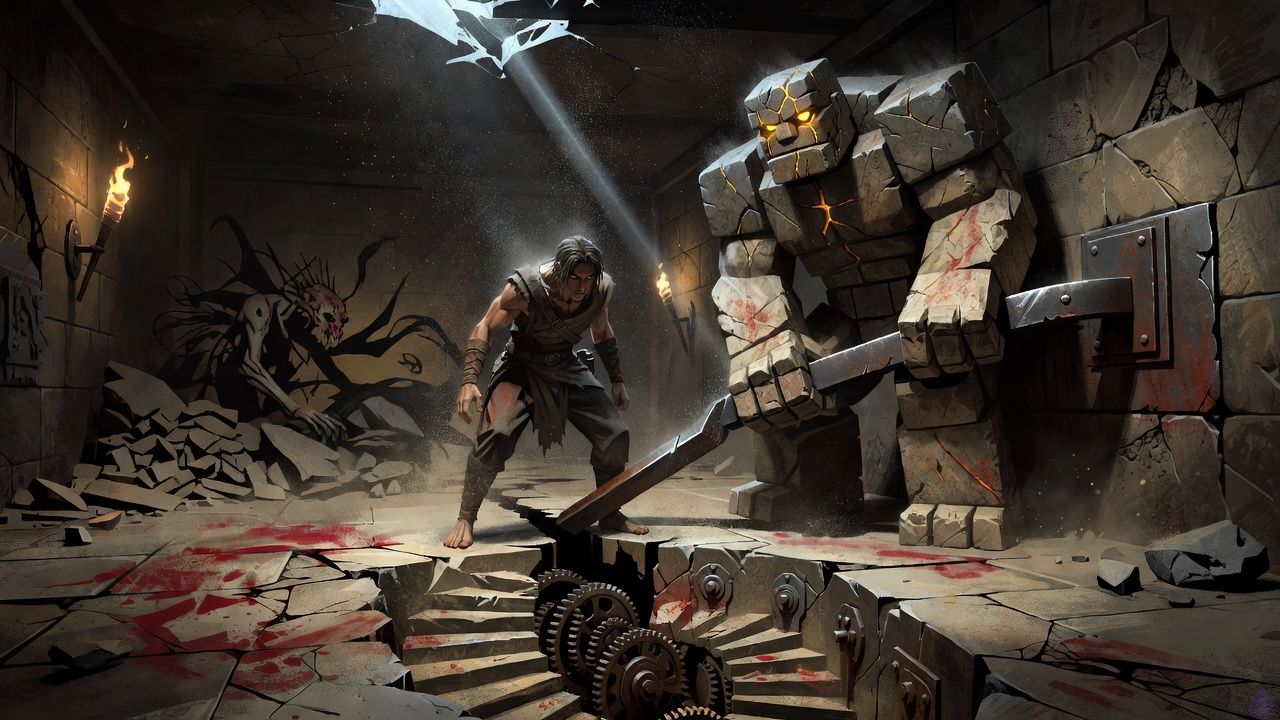
You catch the shift before Brick does and bark the warning through the dust-thick chamber. He moves at once, white-knuckling the lever, while you peel off the center line and sweep wide to the sides, taking the two easiest angles the ruin offers. Simple. Clean. It changes everything.
The room’s weight slides onto your shoulders. The Vanguard steadiness inside you settles again, less like courage than a brace wedged under a failing roof. You taste grit between your teeth. The air is dry enough to scrape your throat raw.
On the left edge of the opening, broken stone leans into shadow. On the right, a crack runs floor to ceiling in a black seam, narrow as a knife cut. Either place could hide a lunge. Either place might still. You plant yourself where the angles meet, half-hidden by the ruin’s own shape, and keep your eyes moving.
The chamber is no longer just a chamber.
It is a threshold.
And you are the first answer to anything trying to cross it.
Brick: “Good eye. Keep it there. If anything comes up the sides, hit it before it gets balance. I have the door.”
He bears down on the lever. Stone grinds against iron with a wet, rasping shriek. The slab beneath you shudders. Dust sifts down in a powdery veil, catching the pale light in slow drifting flecks. Then the pattern you studied clicks into place. Not a slam. A release. A chain of hidden catches gives way one after another, neat as teeth unlocking.
The opening in the floor widens.
Just enough.
A narrow stair appears below, cut straight into the dark. Old iron rails line the descent, orange with rust but still holding. Cold air rises out of the hole, carrying the smell of wet stone, old iron, and something deeper — something buried so long it has soaked into the floor itself.
That is when the creature strikes.
Not at Brick.
Sideways.
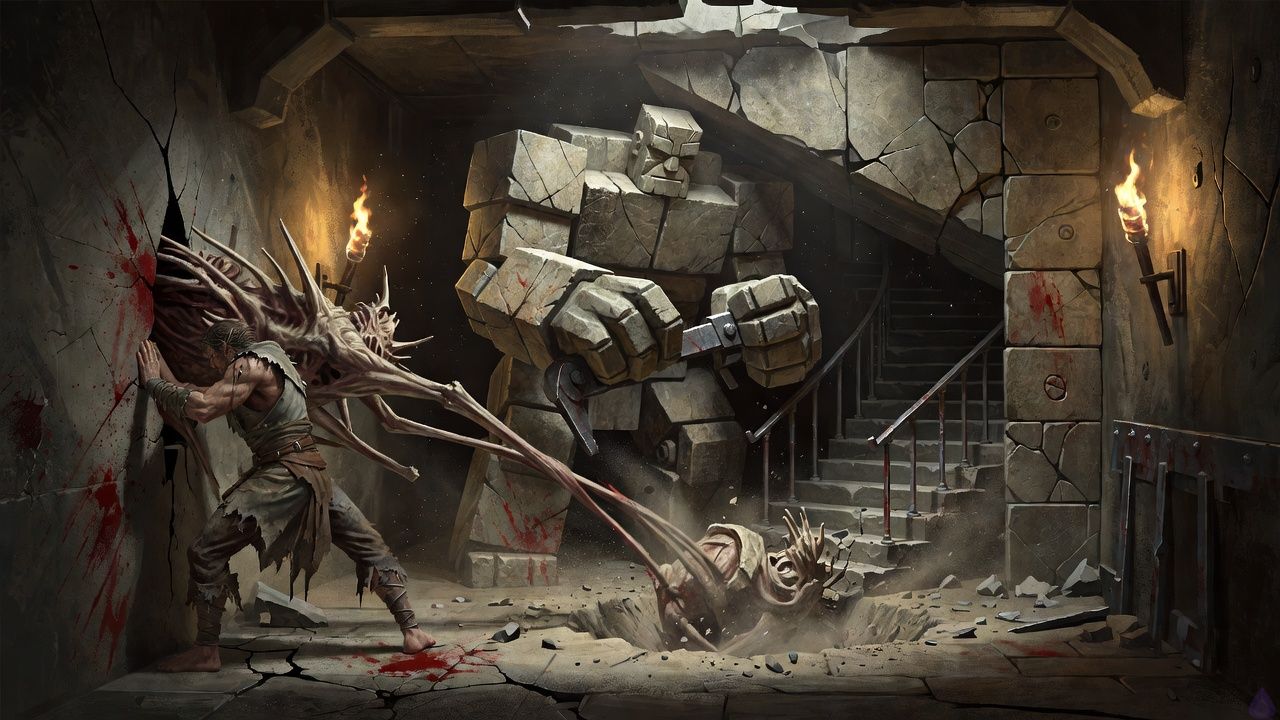
Just as you feared, it bursts from the cracked wall in a snap of bone and sinew, all jagged motion and filthy gray hide. You meet it before it can clear the edge. Shoulder set. Weight dropped. Brace locked hard. The impact punches through your arm, jolts up your spine, rattles your teeth. It hurts. Badly.
You do not give ground.
You turn the force aside and drive it into stone. Brick’s answer comes a heartbeat later, brutal and final: one crushing blow that slams the thing flat against the floor hard enough to leave a shallow crater of dust, broken scrap, and smeared dark ichor.
The Warden: “Excellent. Guard the edges, and the room becomes a cage for your enemies. It is almost like you knew what the floor wanted.”
His voice is pleased, but there’s a sharpness under it now. Irritation, dressed in amusement. The chamber has stopped behaving like his theater. It has become a problem.
Brick holds the lever open one beat longer, just enough for the stair below to breathe clear. Then he eases it back. The slab doesn’t snap shut. It settles into a locked-open position with a heavy, deliberate finality, as if the ruin itself has accepted the order. The hidden passage is real. The thing guarding it is broken.
For a moment, no one speaks.
Dust drifts through the light. The wounded creature lies still at the lip of the stair, no longer a threat. The shadows below remain unseen, but they do not rise. Not yet.
Brick straightens, looking down into the black stairwell, then back at you. There’s pride in him now, rough and unpolished, the kind that comes only after a hard thing is done right.
Brick: “You saved me from turning my back at the wrong time. That matters. More than you know.”
The way forward opens beneath your feet. The chamber that meant to trap you has become an exit instead. And for the first time since you woke on cold stone, the floor doesn’t feel like it’s laughing at you.
It feels checked.
Answered.
Forced to yield.
What ending did you get?
Play the same story and make your own choices. Every path leads to a different ending.