Shared Story
House of the Quiet Mouth
5 segments
The first thing you notice is the silence, because in this house silence is never empty. It waits. It gathers in the cracked corners of the hallway and presses at your throat with patient fingers. You are barefoot on the cold kitchen linoleum, cardigan clutched tight across your ribs, listening to the slow tick of the stove clock and the uneven drag of your father’s boots somewhere upstairs. He has not called for you yet. That is worse than being called.
On the counter, a single plate sits in a dull pool of yellow light. Two eggs, gone cold and rubbery at the edges, have been left there as if someone meant to feed a dog and then remembered, too late, that it might still bite. Maris’s perfume hangs in the room, sweet and cloying, turning the air sour in the back of your throat. You can still see her this morning, immaculate in emerald, calm as a woman in a church pew, smiling with that polished little curve of her mouth while she told you to keep your voice down because Ronan was already irritated. She said it gently. That somehow made it sharper.
You reach for the plate, then stop.
The back door gives a soft click.
Not open. Not shut. Just the sound of the latch shifting, as if fingers you cannot see have tested it from the other side. Your skin goes tight and dry. The window over the sink shows the backyard in pale strips of moonlight, the fence warped and leaning, the patio chair still on its side where Ronan threw it last week and never bothered to right. Something pale lies near the herb patch.
For one stupid breath, your mind insists it is a dish towel.
Then it moves.
Only a twitch. A ripple of white in the grass. Your pulse jerks so hard it hurts. You step closer to the glass and realize it is the envelope you left on the sill yesterday, blown loose by the draft leaking through the frame. Your own name is written across the front in your mother’s old slanted hand, or something close enough to make your stomach drop through the floorboards. You know you never put it there. You know that the way you know the house has started keeping secrets from Ronan.
Upstairs, a drawer slams. Heavy feet cross the landing. Ronan says your name once, not loud, but with that thick warning he uses when he wants the whole house to hear him. The sound crawls down the stairwell and settles over your shoulders like wet wool. From the dining room comes the faint clink of glass, then Maris’s voice, soft and almost amused. She is saying something to him in a tone too low to catch, but one word slips through the wall clean as a blade.
“Tonight.”
The envelope waits in the yard under the dead grass like bait. The back door is latched, not locked. The kitchen light hums above you, thin and insect-bright. The house leans in. You can feel it in the air, in the pressure behind your eyes, in the way the cold seems to come from the walls instead of the floor.
If you go outside, you may finally learn why your mother’s handwriting has found its way back to you in the middle of the night.
If you stay, Ronan will come down angry and smelling of sweat and cigarettes, and Maris will be with him wearing that careful smile, ready to explain the rules you somehow broke without knowing them.
The latch clicks again.
This time, it turns.
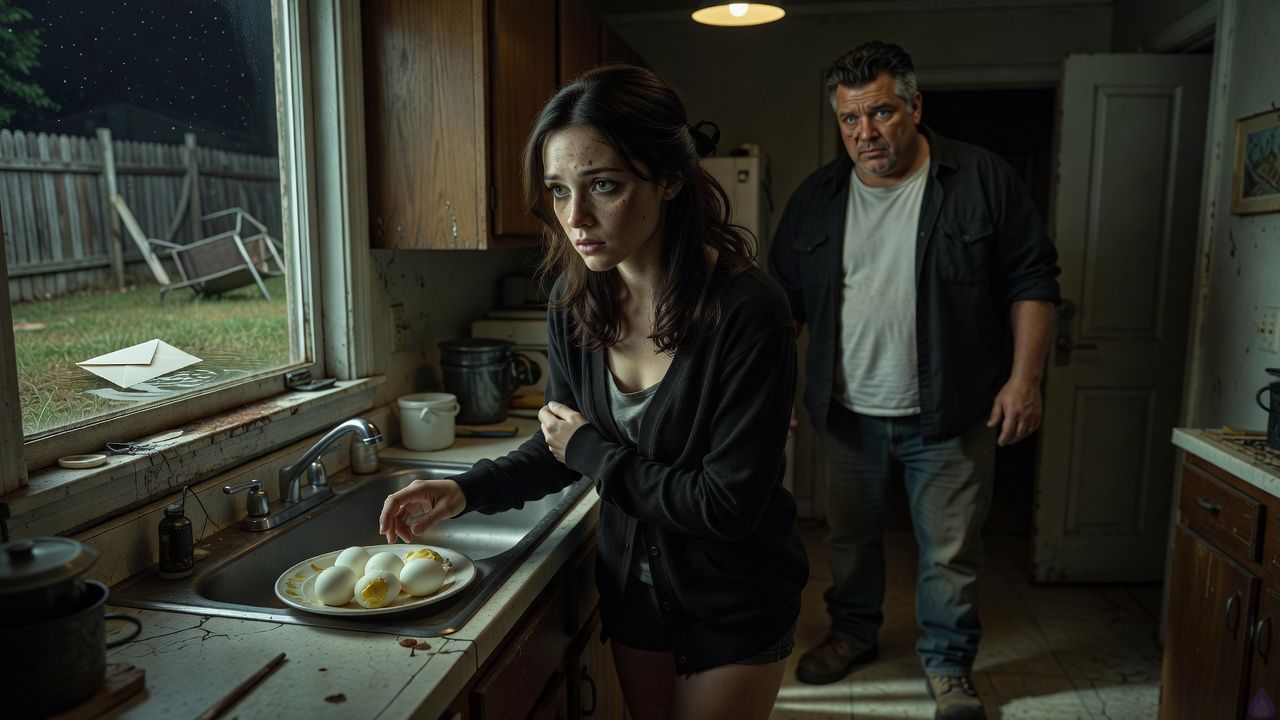
You move on instinct, quiet and careful, the way you learned to move in this house when you were small enough to think invisibility was a kind of prayer. The plate is still warm in the middle. Cold at the rim. You slide it into the sink, tip the eggs into the drain, and turn the faucet just enough to raise a white hiss over the porcelain. The smell goes thin under running water and old pipe rust. By the time the stair creak comes again, there is nothing left on the counter but a damp ring and a kitchen that looks, for one brief second, like it has always belonged to nobody.
You wipe your hands on your jeans and keep your breathing shallow. Not panicked. Not guilty. Just tired. The kind of tired that makes every sound feel too close. The back door clicks once more, then settles. You do not look at the window. You do not look at the grass. If the envelope is still out there, it can wait. If it is gone, that is worse in a different way, and you are not ready to decide which one.
Upstairs, Ronan’s steps stop outside the hall closet. A drawer opens. Closes. Opens again, harder this time, and the ceiling gives a faint sympathetic shiver. He is searching for something or pretending to, which is often the same thing with him. The house answers with a minute groan through the joists, a long wooden complaint that runs from the staircase into the kitchen cabinets. One of the cabinet doors shifts on its hinge. Just enough to tap the frame. You freeze, palm flat against the sink edge. The metal is cold enough to sting.
From the dining room comes Maris’s voice again, smooth as lacquer. You cannot make out the words, only the shape of them, the soft control in every syllable. She is keeping him pointed somewhere else. That should comfort you. Instead it makes the room feel narrower, because Maris only redirects him when she wants something else to happen in the dark. Her perfume drifts under the kitchen door in a thin, expensive thread. Powder. Cut flowers gone sweet at the edges. For one moment you picture her standing perfectly still in candlelight, listening to the same sounds you are hearing, deciding whether tonight is for warning you or using you.
You reach for the dish towel and dry the sink by rote, scrubbing at the last slick trace on the porcelain until your fingers ache. Then, without really deciding to, you tug the envelope free from the gap beside the window frame where it had been resting all along. The paper is soft with damp at one corner. The crease is worn smooth. Your mother’s handwriting curves across it in that familiar slanted way, the letters leaning forward as if they are trying to escape the page. You hold it for a moment. Do not open it. Just feel the weight of it. Small. Impossible. Cold now, though it had been warm against the wood.
A board creaks overhead. Ronan is coming down. Not fast. That would be panic, and he hates giving anyone the satisfaction of seeing him hurry. Slow footsteps. Measured. The kind that make you think of a dog circling before it bites. You slip the envelope under the fruit bowl, then straighten the dishes beside it, arranging the kitchen into a version of itself that says nothing, sees nothing, and certainly did not witness you here at all. When his shadow crosses the top of the stairs, you already have one hand on the counter and your eyes lowered, ready to look like someone who never left the bedroom.
The kitchen light hums overhead as if it knows something you do not. Ronan pauses on the landing, and you can feel his attention drop through the ceiling like a fist. He has not spoken yet. That is the worst part. Somewhere behind him, Maris laughs softly, a sound so light it almost hides the sharpened edge of it. You keep your face still and let the house breathe around you, but your fingers curl once against the counter’s chipped enamel, because the envelope is under the bowl, the door is still unlatched, and tonight has not decided what it wants from you yet.
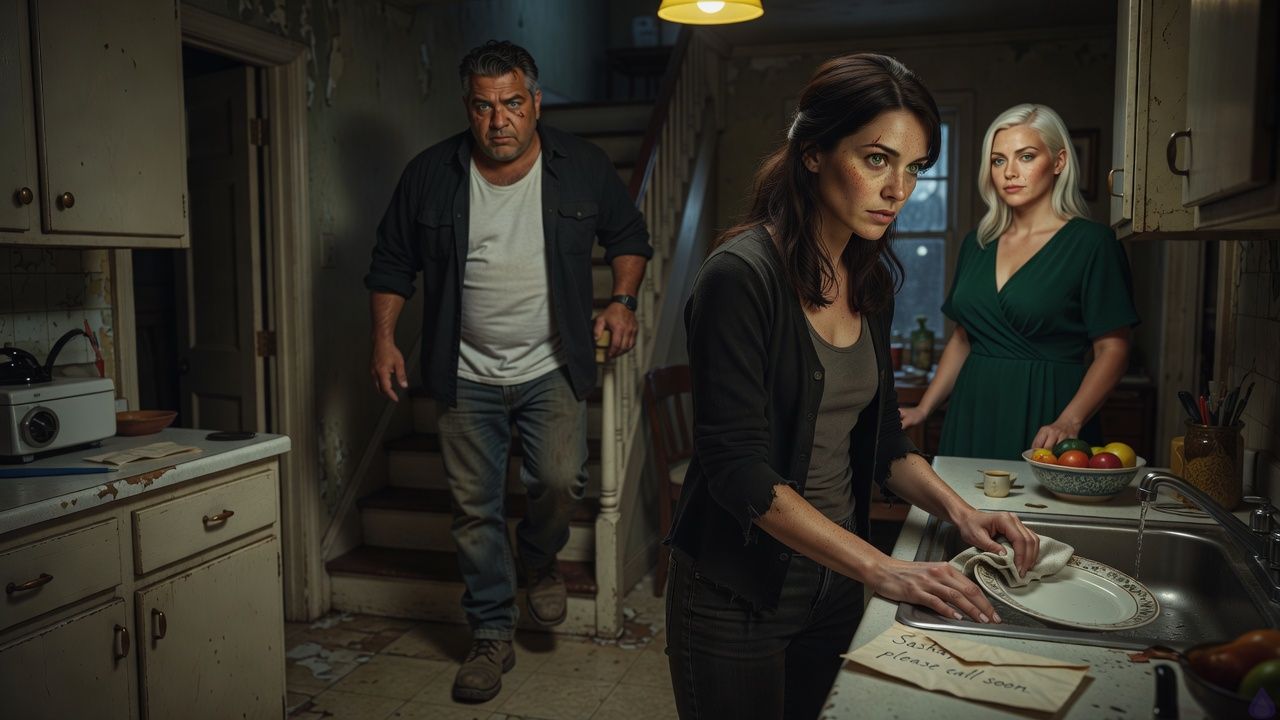
You keep your voice low when Ronan reaches the kitchen doorway, careful enough to sound smaller than you are. The words come out measured and flat, the sort of answer that gives him nothing to seize. His steel-blue eyes move over your face, looking for the usual crack, the usual hesitation, but you give him only a calm surface. He pauses on the threshold, shoulders filling the frame, nicotine and stale work dust clinging to him like a second skin. For a beat, the silence holds. Then his mouth tightens. Not satisfied. Not angry, either. Disappointed, as if obedience only matters when it costs blood.
Ronan Vale: "Good. Keep it that way."
He says it to the room as much as to you. His broken nose catches the kitchen light when he looks past you toward the counter, toward the neat row of dishes, toward the bowl hiding your mother’s envelope. You do not move. You do not look. Stillness is a skill in this house, and you have spent years learning how to hold it without shaking. Ronan’s hand lands on the back of a chair with a dull knock. The thick veins in his wrist twitch once, then settle. He wants a reason. He always wants one. But tonight, maybe because Maris has already taken some of him upstairs, or maybe because the house has begun to worry at the seams of his temper, he lets your silence stand.
Maris appears a moment later in the dining room opening, one manicured hand resting against the frame as if she has come only to admire the arrangement. Her emerald dress catches the low kitchen light like deep water. The perfume reaches you first, then the slight curl of her smile. She looks from Ronan to you, taking inventory with those pale hazel eyes that seem to miss nothing and keep the worst of what they see. There is warning in her expression, but it is wrapped in concern so neatly it could pass for kindness to anyone who didn’t know better. A knife in velvet. Patient. Polite.
Maris Wren: "The kitchen should be calmer at this hour. It unsettles him when people make noise."
Her words are light. Her gaze is not. You understand then, with a cold twist low in your stomach, that this is the quiet she meant when she said tonight. Not peace. Control. The kind that wears manners like perfume and closes around your throat before you notice the pressure. Ronan snorts through his nose, irritated at being managed in front of you, but he does not contradict her. That tells you enough. He hates the leash. He hates that he wears it. He hates, most of all, that the house seems to know the difference.
A cabinet door behind you shifts open by itself, just a finger’s width. The hinge gives a dry, tired creak. A draft slips out carrying the damp-paper smell of the envelope from under the fruit bowl. It touches the back of your throat. Cold. Dusty. Wrong. You feel it like a pulse in the room. Maris’s eyes flick, almost imperceptibly, toward the bowl, then away. She saw it. Of course she did. The knowledge settles between you like a third person standing at the counter, listening. Ronan follows her gaze, frowning, but whatever he notices is cut off by the upstairs hall giving a sharp, hollow creak, as if someone has set a bare foot on a board and held their weight there.
Everyone in the kitchen stills at once. The sound is small. The reaction is not.
Ronan’s jaw works. He wants to bark at the house, at you, at Maris, at the dark between the walls, but he swallows it down and turns the anger into something harder, quieter. He steps closer, close enough that you can smell cigarette ash in the seams of his shirt and the sour metallic edge of old sweat under it.
Ronan Vale: "Stay put. I’m not repeating myself tonight."
He leaves you standing there with the words hanging in the air and climbs halfway toward the stairs, then stops as another soft sound leaks from the dining room, this one from Maris rather than the house. It might be a laugh. It might be a sigh. Either way, it pulls his attention back and makes him look over his shoulder. For one brief second, the balance in the room shifts. You feel it. The old rules bend. The air goes thin and cold around the sink, around the bowl, around your hand resting close enough to touch the enamel if you choose. The envelope is still hidden. The back door remains unlatched somewhere behind you. And Maris, calm as ever, is watching you as if she already knows exactly what you will do with the next silence.
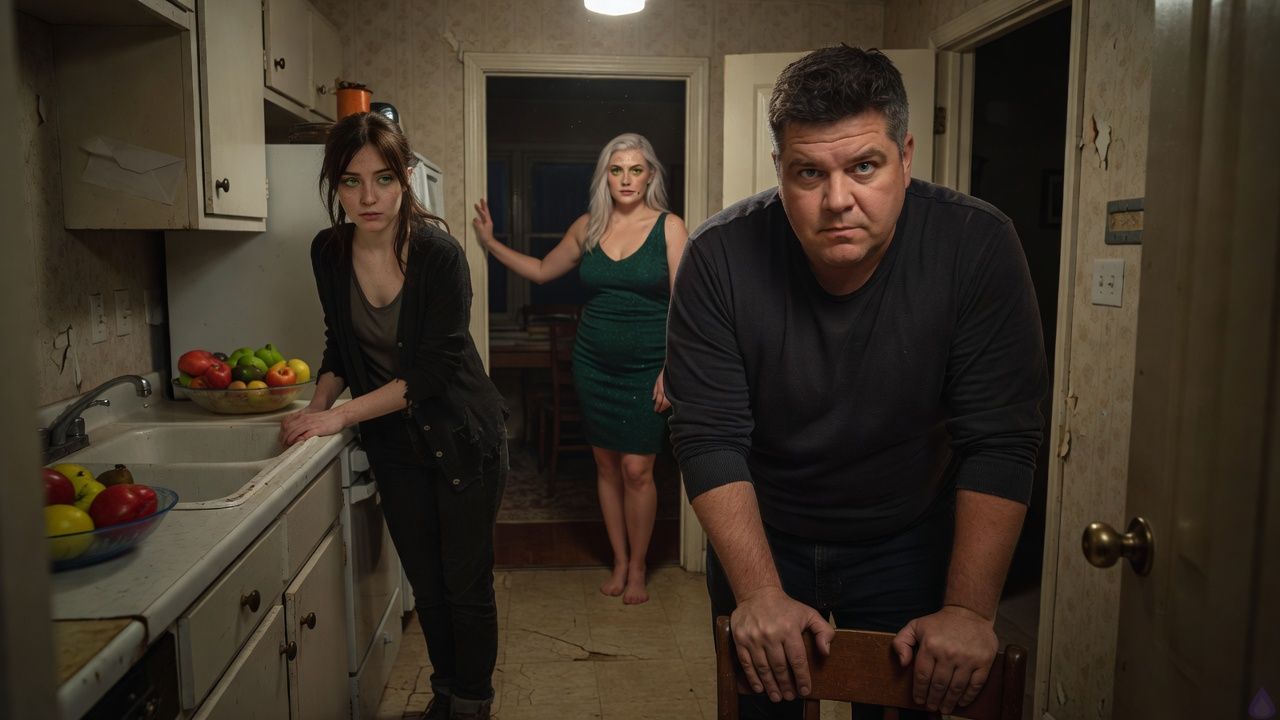
You let the room settle around you and do not reach for anything. Do not speak. Do not even shift your weight until the silence stops feeling like a threat and starts feeling like a blanket pulled too carefully over a fever. Ronan’s shoulders stay rigid for one long beat, then ease by the smallest degree. He hates quiet when it belongs to someone else. He trusts it when it seems to obey him. That is the flaw you use tonight.
You lower your eyes. You soften your breathing. You give him nothing sharp to cut himself on.
The change is immediate. Ugly, too. His hands unclench. The thick veins on the backs of them stop standing out. He glances once toward the stairs, then back to you, and the anger in his face drains into something tired and sour, as if you have not calmed him so much as fed whatever part of him only runs on submission. Maris notices the shift before he does. Of course she does.
She folds her hands at her waist in the doorway, emerald fabric brushing her thighs, and watches the two of you with a look so composed it almost passes for approval.
Maris Wren: "There. Much better."
Her voice is soft enough to be mistaken for kindness. It is not kind. It never is. The words slide over the kitchen tiles and come to rest near the bowl where your mother’s envelope waits, hidden beneath the fruit and the lie of a normal evening. Ronan does not look at her, but he does stop frowning. He drags a hand over his mouth, rubs at the edge of his broken nose, and exhales through his teeth.
For one brief, wrong moment, the house seems to approve.
The cabinet door stills. The stair boards stop their small complaints. Even the refrigerator’s hum feels subdued, as if the walls themselves have accepted the bargain. That is worse than if they had not.
You keep your posture small and steady, arms close, face blank. It works too well. Ronan’s stare loses focus, sliding past you instead of through you, as if he has already decided there is no problem worth naming. He turns half a step toward the hall, then stops when Maris reaches out and smooths a hand over the back of his work shirt.
The touch is light. Proprietary.
His jaw tightens. He allows it anyway.
Something knots deep in your chest. Not jealousy. Something meaner. The sick recognition of a leash being adjusted in plain sight. Maris does not look at you when she speaks again.
Maris Wren: "You should thank her. She understands when to be quiet."
Ronan gives a short, humorless sound that might be agreement. It is enough. The temperature in the kitchen rises by a degree, maybe two, just enough to make the cold on your skin feel imagined. The air smells faintly of onion and dish soap and something under it, something metallic that was not there a minute ago.
The envelope beneath the bowl seems heavier now, as if the paper knows it has been protected by your obedience and resents it.
You keep your hands still at your sides and wait.
Maris’s pale eyes drift, almost lazily, toward the fruit bowl again. This time she does not bother pretending not to see the shape hidden beneath it. She only smiles a fraction wider, like someone who has heard a lock click open without needing to turn the key.
Ronan steps past you at last, close enough that his shoulder nearly brushes your cardigan, and heads toward the hall with the weary authority of a man who believes the house has come back under control. Maris lingers in the doorway, her perfume trailing after her in a thin, expensive cloud that cannot quite cover the smell of old wood and something damp in the walls.
She tilts her head. Studies you.
Then she speaks in a lower voice meant only for you.
Maris Wren: "Tonight is still waiting. Don’t make it harder than it already is."
She follows Ronan out, leaving you in the kitchen with the humming light, the hidden envelope, and the sick sense that your quiet has bought you time, not safety. The back door remains unlatched. The bowl remains on the counter. Somewhere beyond the dining room, the house gives a soft, almost satisfied creak, as if it has heard your silence and is deciding what else it can take from you next.
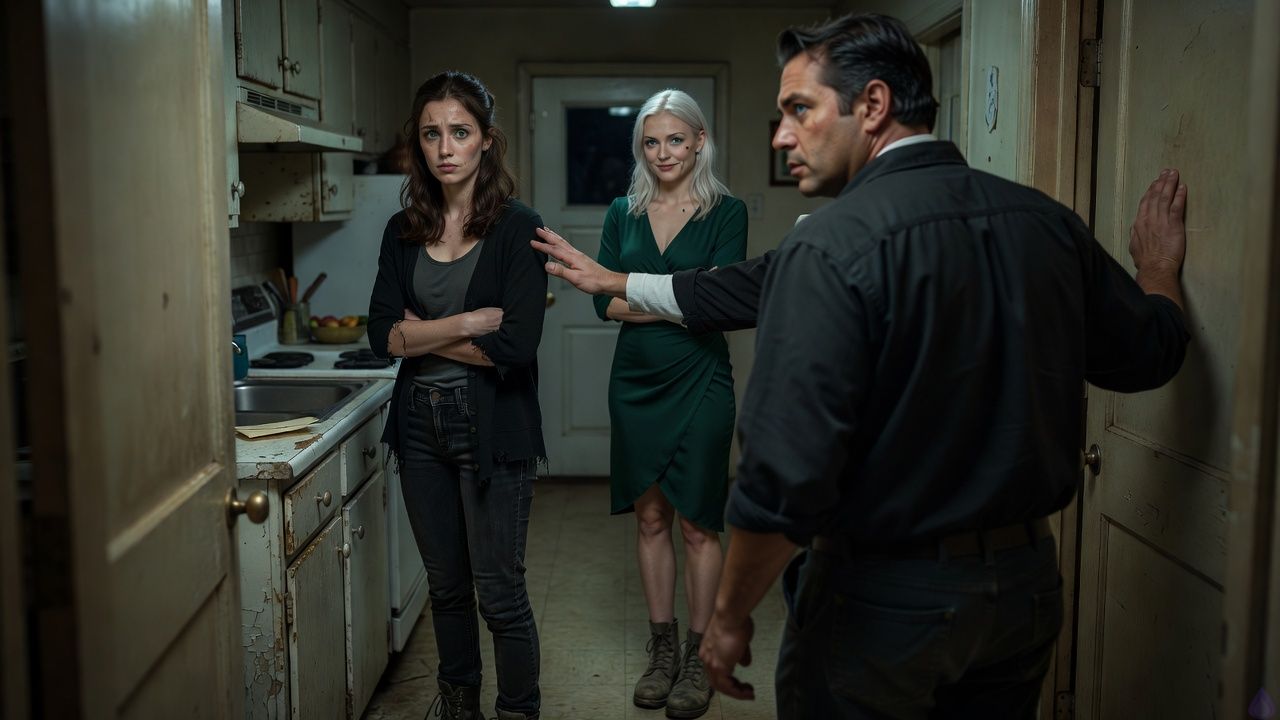
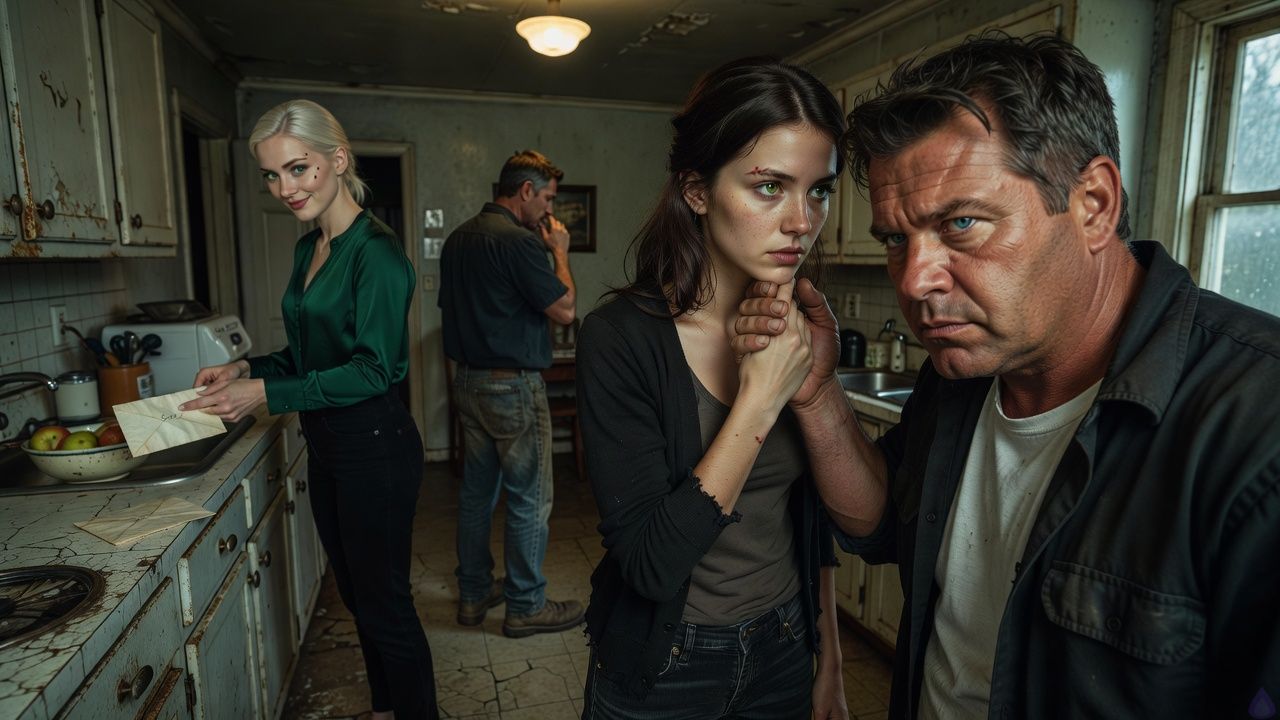
You go still when Ronan’s hand comes down, and the instant he feels it, his grip settles with an ugly confidence. His fingers hook under your chin. Not gentle. Not even close. He turns your face toward the light as if he’s checking a crack in cheap glass, as if you might chip under pressure and he wants to see where.
The words leave you automatically. Small. Obedient. The room takes them without comment.
Ronan’s expression changes at once. The hard line at his mouth loosens, and the anger he has been carrying all evening thins into something smug and tired. He gives a low sound of approval, like you have finally remembered your place. His touch lingers just long enough to make the point. Then his hand falls away, leaving a cold, hard imprint in the skin of your jaw.
Ronan Vale: “That’s better. Don’t get ideas tonight.”
Maris is still in the dining doorway, half-turned as if she meant to leave and decided she would rather not miss this. Her pale hazel eyes flick over your face, then Ronan’s hand, then back to you. No warmth. Only calculation. She looks almost satisfied, which is worse than if she had looked pleased. The whole scene has the feel of something arranged for his benefit, the air smoothed flat around his temper until the house can pretend it has obeyed him again.
You keep your gaze lowered. The quiet costs you, but you already know that. Pride. The sharp little spark that wants to bite back. For now, it also buys you air.
Ronan turns away and rubs his thumb across his knuckles, studying the kitchen as if it has offended him and might apologize. The cabinet door stops creaking. The stairwell goes still. Even the refrigerator’s hum seems to draw in on itself, a machine gone wary.
Then, under the fruit bowl, the envelope shifts.
Barely. Just enough to rasp against the wood with a soft papery scrape that only you seem to hear. Maris hears it too. Her eyes snap to the bowl, quick and precise, and for the first time her composure slips. Only a hairline crack. But you catch it.
Ronan doesn’t. He is still inside the false comfort of your compliance.
Maris smooths her face back into place and steps farther into the kitchen, her heels whispering over the worn linoleum. She passes close enough for her perfume to catch in your throat — sharp flowers, something powdery underneath, and a bitter note that makes your tongue feel dry. When she reaches the counter, she sets one manicured hand beside the bowl, not touching it, only claiming the space around it.
Maris Wren: “Go upstairs, Ronan. Let the girl get on with her work.”
He frowns. Suspicious now, because the edge has gone out of him. But he obeys. It is easier than arguing with her in front of you. He throws one last look your way, warning dressed up as ownership, then leaves the kitchen with heavy, measured steps. The hallway swallows him. The house takes him with it. Boards whisper under his weight, one after another, like something speaking in a low voice just beyond hearing.
When he is gone, Maris looks at you. Her voice stays soft. Almost kind. The kindness is polished cold, like the back of a knife.
Maris Wren: “You’ll stay where you are for now. There are conversations tonight you are not meant to interrupt.”
She lifts the fruit bowl at last, slowly, carefully, revealing the envelope beneath it as if she has known exactly where it would be all along. Your mother’s handwriting stares up at you from the cracked paper. Maris does not open it. She doesn’t have to. The smallest curve touches her mouth, and in that tiny, controlled smile you understand she has known about it from the start.
She sets the bowl aside. Then she slides the envelope toward you with two fingers.
Maris Wren: “Read it later. If you’re wise.”
It stops at the edge of your reach.
The kitchen is very still. Ronan’s footsteps have already vanished upstairs, but the back door remains unlatched, and you can feel the draft from it moving cold along the floorboards around your ankles. The whole house seems to hold itself where it is, listening.
Maris turns and leaves the room, her emerald dress fading into the dim dining hall. You are left alone with the letter, the hush, and the awful, unmistakable sense that obedience has finally bought you the one thing neither of them expected you to have.
Access.
What ending did you get?
Play the same story and make your own choices. Every path leads to a different ending.