Shared Story
The Villainess Resets the Game
6 segments
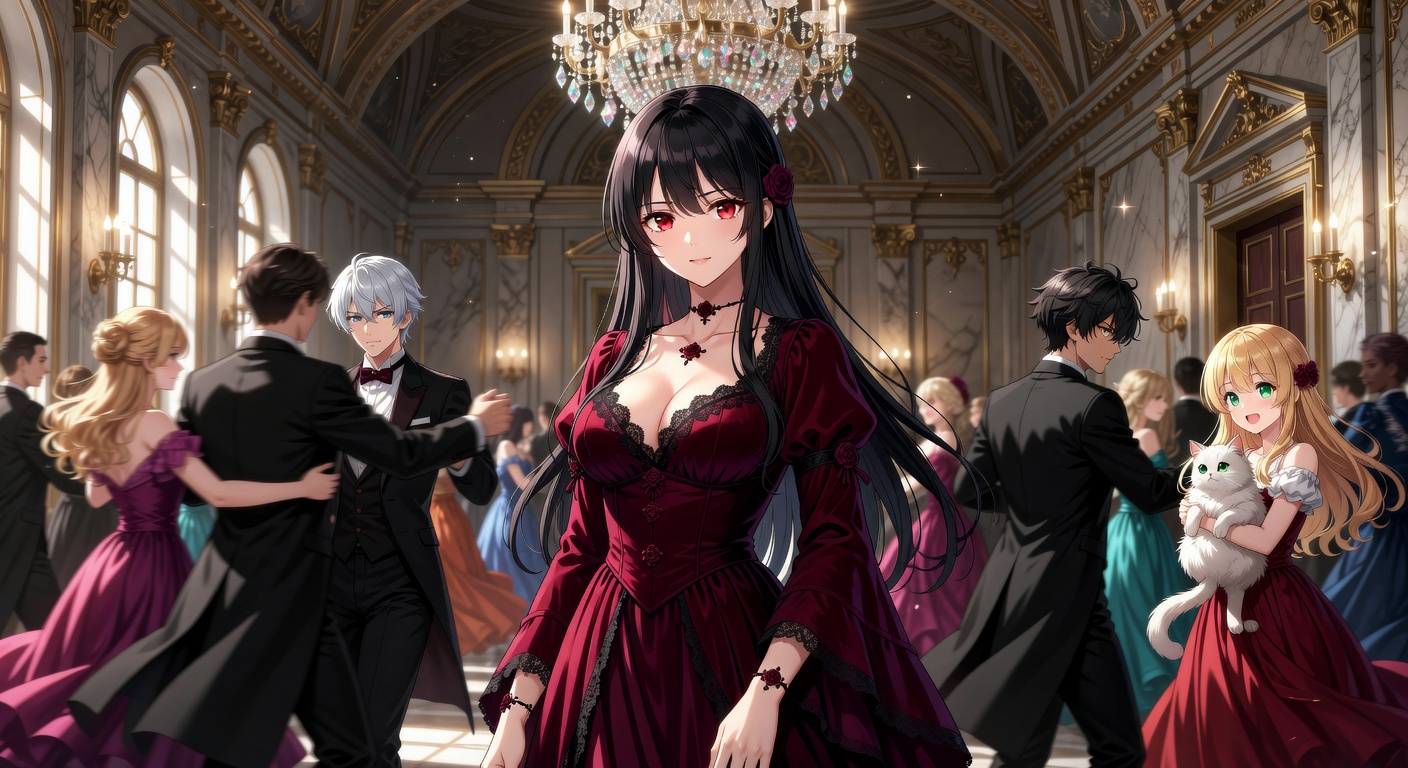
The chandelier catches your eye first, a cascade of enchanted crystal suspended above the ballroom like a frozen waterfall. Each prism holds a tiny spell at its core, scattering light in impossible colors across the vaulted ceiling, across the polished marble, across the upturned faces of a hundred nobles pretending not to watch one another.
Beautiful. Painfully familiar.
Exactly like the loading screen of Starlit Academy, the otome game you've played seventeen times.
Except the loading screen never smelled like roses and beeswax and expensive perfume. It never pressed cold marble through the thin soles of your shoes or made the boning of your gown bite into your ribs every time you breathed too quickly. The champagne in your hand is actual champagne, dry and sharp and fizzing against your lips, and when your fingers tighten around the crystal flute, it does not pixelate or pause or offer a skip button.
The face staring back from the gilded mirror across the ballroom is not yours.
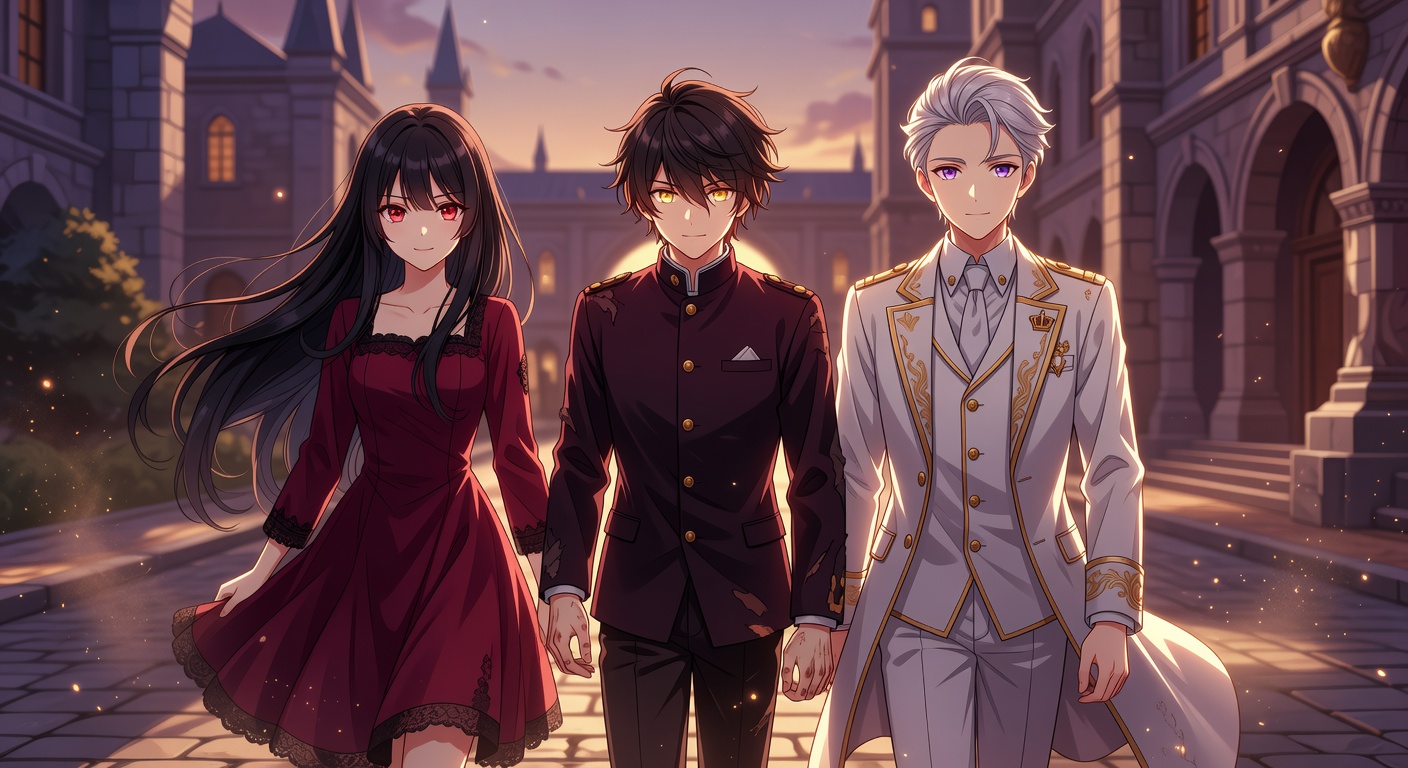
Long black hair falls in immaculate curls over pale shoulders. Crimson eyes gleam beneath lashes dark enough to look painted on. A burgundy gown clings to a body that has never missed a meal, never sprinted for a train, never sat hunched over a phone at three in the morning choosing the wrong dialogue option just to see how bad the bad ending could get. The neckline suggests Lady Seraphina Blackrose has never heard of modesty and wouldn't care if she had.
You are Lady Seraphina Blackrose.
The villainess.
The one who dies in every. Single. Ending.
A laugh rises somewhere to your left, bright as a knife being drawn. Your stomach turns.
Okay. Okay. Don't panic. Panic is how Seraphina loses composure, and losing composure is how the court decides she's dangerous instead of merely unpleasant. You know this game inside and out. You have memorized every route, every affection check, every doom flag, every branching path where Seraphina gets condemned, exiled, poisoned, ruined, or thrown off a cliff in a dress very similar to this one. You can do this. You just need to survive thirty days without being the worst person in the building.
Thirty days until the Condemnation Event. Thirty days until the heroine stands before the academy assembly with tears in her eyes and evidence in her hands. Thirty days until everyone applauds while Seraphina Blackrose is destroyed.
The Spring Ball swirls around you in silk and spellwork. Gowns shimmer with woven moonlight. Jacket cuffs glitter with family crests. The orchestra plays a waltz so sweet it makes the room feel civilized, which is a very convincing lie. Alliances are being forged over champagne. Reputations are being murdered behind fans. Every smile has teeth.
Three faces in the crowd demand your attention with the force of destiny and bad game design.
Prince Ren Ashworth stands by the far wall beneath a row of silver banners, his hair catching the chandelier light until he looks carved from winter. Violet eyes survey the ballroom with the enthusiasm of someone attending their own funeral. Your betrothed. Crown Prince. Main route. Tragic artist locked behind a political engagement and three layers of emotional repression.
In the game, Ren falls for Aurelie because she is the first person who asks what he wants instead of what the kingdom requires. Then he condemns Seraphina publicly, voice cold, expression colder, while the court murmurs that justice has finally arrived. Right now, he glances in your direction and looks away with practiced indifference, as if you are a treaty clause wearing perfume.
Wonderful. My fiancé hates me on sight. Accurate to canon, unfortunately.
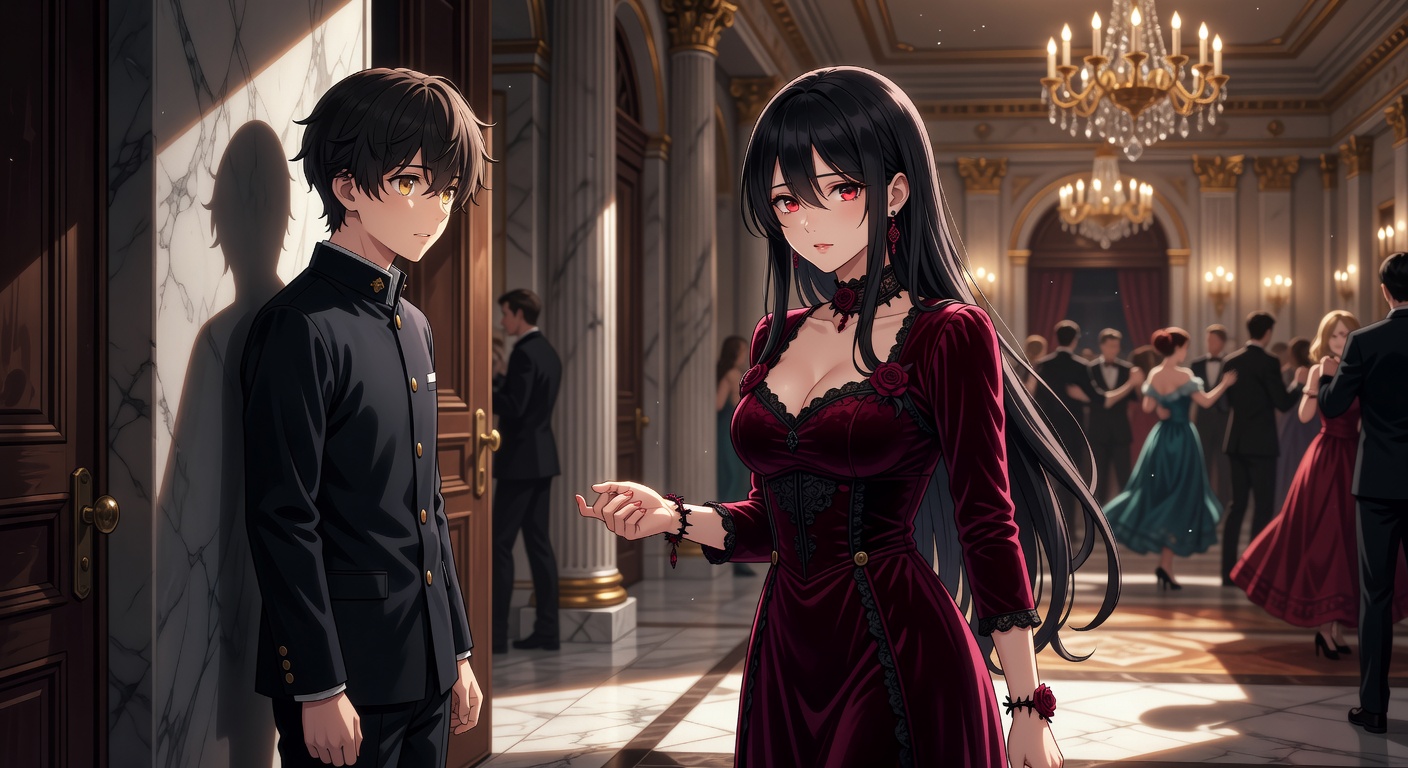
Near the servants' entrance, Kai Nightvale hovers at the edge of the light like he is calculating the fastest route out of the room. Dark hair falls over amber eyes. His academy uniform is clean but a little too tight at the shoulders, the cuffs carefully mended where wealthier students would simply buy new ones. Scholarship student. Hidden genius. Route 3's most devastating slow burn if the player can get past his suspicion stat without stepping on a landmine.
The original Seraphina stepped on all of them.
When your eyes meet, Kai flinches.
Actually flinches.
Not a polite recoil. Not discomfort. Fear, sharp and automatic, before he can hide it. His hand curls around the strap of the satchel at his side, knuckles whitening.
That's guilt talking. The original Seraphina called him a charity case at last year's Harvest Dinner. In front of half the academy. Then she laughed when he dropped his fork. His hands shook for a week after that. The game mentioned it in a flashback, like flavor text. Flavor text. God.
Your champagne suddenly tastes like acid.
And there, at the center of a small constellation of admirers, is Lady Aurelie Starborn.
Golden curls catch the light like a halo. Her pale blue gown seems designed by someone who had a personal grudge against shadows. A small white cat perches on her shoulder, tail curling neatly against her collarbone, somehow as poised as any noble in the room. Aurelie laughs at something a young baron says, lifting one hand to cover her mouth in perfect heroine timing.
She's beautiful. Of course she is. She is soft focus and fluttering lashes and kindness written into the shape of her smile. The kind of girl the narrative bends around like gravity.
She catches you watching.
Her smile turns toward you without hesitation, warm and open and absolutely, unn
Kai Nightvale is near the servants' entrance, exactly where the game always placed him, half-hidden behind a pillar wrapped in spring ivy and floating candlelight. The ballroom has swallowed louder, brighter people whole tonight, dukes' daughters in jeweled gowns, viscounts laughing too hard, professors pretending not to drink too much champagne. Kai should be invisible among them.
He almost is.
Most eyes slide past him as if poverty is contagious. As if the academy uniform he wears, clean but worn thin at the seams, marks him as part of the architecture rather than a guest. He stands with one shoulder angled toward the door, hands clasped in front of him, posture careful enough to be mistaken for calm.
But you know where to look.
You've watched this scene seventeen times from the safety of a screen, clicking through Seraphina's cruelty with the detached horror of someone who thought consequences belonged to pixels. The ballroom had looked pretty then. The music had been a looping waltz. Kai's portrait sprite had trembled, and you'd thought, vaguely, that the writing was effective.
From inside the scene, it is unbearable.
His hands are shaking. Not dramatically, not enough for anyone else to notice, just a faint tremor at the knuckles where his fingers press too tightly together. His sleeves have been let out at the cuffs, the stitching neat but mismatched; he's grown since the uniform was issued, and scholarship students do not get replacements unless benefactors feel generous. One of his gloves has been mended near the thumb. His amber eyes keep moving, not toward the dancers or the chandelier or the champagne trays, but toward exits.
Main doors. Servants' corridor. Garden terrace. Window latch.
Calculating escape routes at a ball.
In the game, this is where Seraphina crosses the room with a glass of champagne and that beautiful, poisonous smile. This is where she says, loud enough for half the nobility to hear, "How quaint. They're letting the charity cases attend the ball now. Tell me, Nightvale, did they make you wash dishes to earn the invitation?"
Your stomach turns.
He drops his glass after that. Everyone laughs. The heroine looks distressed but says nothing, because this is still early Act One and the narrative needs Kai broken enough to be saved later. He stops eating in the dining hall for a month. His affection meter locks below zero unless the player spends six separate events repairing the damage.
And at the Condemnation Event, thirty days from now, Kai Nightvale stands before the entire academy with his shoulders squared and his voice shaking, and says, She made me wish I'd never been born.
That line had hurt even through a screen.
Now it has weight. Breath. A face.
You are ten feet from the boy whose testimony helps destroy Seraphina Blackrose in every route. Ten feet from someone this body has cornered, mocked, humiliated, and trained to flinch at the sound of her heels on marble.
Your champagne glass sweats in your grip. Condensation slips over your glove and chills your palm. The orchestra swells behind you, violins rising in a bright, cruel flourish, and for one wild second you want to turn around and choose Ren, or Aurelie, or literally anyone whose pain is less immediately your fault.
Not your fault, whispers the panicked part of your mind. You didn't do those things. You woke up in the aftermath. You inherited the crime scene.
But Kai doesn't know that. Kai only knows the girl in burgundy silk approaching him with crimson eyes and the Blackrose crest at her throat.
His gaze catches yours.
The color leaves his face.
It happens so quickly, so completely, that your breath snags. He straightens as if someone pulled a wire through his spine. His hands stop trembling because he forces them still. That is somehow worse.
You slow your steps. Not too close. Not trapping him between your body and the wall. Every instinct from seventeen playthroughs screams that positioning matters, affection points hidden behind inches and timing and whether you choose the gentle dialogue option.
This is not a route.
This is a person.
Kai: "Please excuse me, Lady Blackrose, I was just..."
He's already moving backward, one foot sliding toward the servants' corridor. His voice is polite in the way a cornered animal might be polite if it learned manners could lessen the blow.
You stop at a careful distance. Close enough that he can hear you over the music. Far enough that he can leave.
Seraphina: "Kai."
His name comes out softer than intended, almost unsteady.
He freezes.
Of course he does. In three years at Starlit Academy, Seraphina Blackrose has never used his first name unless she was sharpening it into a weapon. Maybe not even then. Maybe he has only ever been Nightvale, scholarship boy, charity case, that inconvenient reminder that talent sometimes enters rooms without permission from bloodline or money.
His eyes lift to yours, wide and wary. Amber under candlelight, bright with suspicion and old fear.
Don't make this about being forgiven. Don't make this about saving yourself. Don't ask him to comfort you for feeling guilty in a body that hurt him.
The champagne flute feels ridiculous in your hand. Elegant stem, golden bubbles, a prop from the worst version of this scene. You set it on the nearest marble ledge without looking away from him. The glass clicks softly, too delicate a sound for how hard your heart is beating.
Seraphina: "I need to,
Kai stares at you for a long time.
The ballroom keeps moving around him, silk skirts turning in bright arcs, polished shoes whispering over marble, crystal glasses chiming as nobles laugh too loudly at jokes that are not funny. The orchestra pours sweetness into the air, violins and harp and flute, all of it arranged to make the Spring Ball feel effortless.
None of it reaches this corner.
Here, near the servants' entrance, the light is dimmer. The enchanted candles burn lower, their gold reflecting in Kai's amber eyes until they look almost molten. He stands with his shoulders drawn in, one hand half curled at his side, as if his body remembers every reason to brace before his mind can decide whether danger has passed.
Of course he doesn't believe me. Why would he?
Seraphina Blackrose has never approached Kai Nightvale without a blade hidden in her words. In the game, this moment is supposed to be simple. The villainess corners the scholarship student. She smiles. She says something cruel enough to make the surrounding nobles laugh, and his humiliation becomes another stone in the foundation of her execution.
Instead, your apology hangs between you like a glass ornament dropped but not yet shattered.
Kai: "You're sorry."
His voice is flat. Careful. Not cold, exactly. Cold would be easier. This is the voice of someone who has learned to make every feeling small enough to hide behind his teeth.
Kai: "Lady Seraphina Blackrose. Who called me a charity case in front of the entire academy. Who had my workshop funding reviewed for irregularities. Who told Professor Helios that I plagiarized my thesis."
Each accusation lands with horrible precision.
Charity case. You remember it with the sick clarity of a cutscene you once skipped because it made you uncomfortable. The banquet hall. The laughter. Kai standing very still while the original Seraphina lifted her fan to hide a smile sharp enough to draw blood.
The funding review was worse because it was quiet. No public spectacle, just a sealed letter and three weeks of panic while he nearly lost access to the only place in the academy that was his.
And the plagiarism accusation.
God. That one almost got him expelled.
In your old life, it had been a line of dialogue, a route obstacle, a reason for Kai to distrust nobility. Here, it is standing in front of you with dark hair falling into his eyes and fingers trembling so slightly that only someone looking for damage would notice.
Kai: "You're sorry."
No question this time. A test. A trap. Maybe a prayer he refuses to admit he is making.
Seraphina: "Yes."
The word feels too small. Ridiculous, almost. How can a single syllable carry the weight of ruined dinners, sabotaged work, sleepless nights, and every time he walked into a room and expected cruelty because Seraphina had taught him to?
It can't.
But it is the only place to begin.
Kai's gaze flicks over your face, searching for the curl of amusement, the hidden audience, the inevitable second strike. Beyond him, a pair of noble girls glance over, curious. One whispers behind a lace glove. You angle your body slightly, blocking their view of him as much as you can without making a performance of it.
His eyes narrow. He notices.
Of course he notices. Kai Nightvale survives by noticing everything.
Kai: "Why now?"
There it is. The question with no safe answer.
Because yesterday I was on my couch at three in the morning trying to unlock your good ending, and tonight I woke up wearing the face of the girl who destroys you.
Because I know that in thirty days you stand in the assembly hall and tell the truth about Seraphina, and every word helps send me to my death.
Because I am terrified. Because I am guilty for things I remember and don't remember, for choices made by a character and harms carried by a real person. Because your pain stopped being lore the second you flinched when I looked at you.
The chandelier light scatters across the marble in fractured stars. Your champagne flute is still in your hand, untouched since you crossed the room. Tiny bubbles rise and burst against the surface, absurdly delicate.
You set the glass on a nearby tray before your grip can tighten enough to crack it.
Seraphina: "Because I finally saw myself the way you see me."
Your voice comes out quieter than expected. Steadier too.
Seraphina: "And I hated what I saw."
Kai says nothing.
For one breath, his expression does not change at all. Then something shifts, so small that the old Seraphina would have missed it. The hard line of his mouth loosens. The defensive lift of his chin lowers by a fraction. Not forgiveness. Not trust. Nothing so clean or generous.
Just a crack in the armor, thin as a hairline fracture.
It hurts more than anger would have.
Kai: "I don't trust you."
Seraphina: "I know."
Kai: "I don't believe people change overnight."
Seraphina: "I know that too."
His eyes sharpen, as if your agreement is somehow more suspicious than any denial could be.
Kai: "Then what do you expect me to do with an apology I can't verify?"
The answer rises immediately, ugly and desperate. Believe me. Give me a chance. Please don't hate me. Please don't testify. Please help me survive.
You swallow all of it.
That would make the apology about you.
And it cannot be about you.
The music swells behind him as the waltz reaches its glittering peak. Nobles turn beneath the chandeliers like pieces
You don't seek Kai out.
That is the first discipline, and somehow the hardest.
The original Seraphina Blackrose would have treated restraint like a foreign language. If someone feared her, she pressed. If someone looked away, she followed until they had no choice but to look back. Power, to her, meant filling every room so completely that no one else could breathe.
So you do the opposite.
You become someone worth watching from a distance.
The next morning, the academy corridors smell faintly of rain and floor polish, sunlight spilling through stained glass in long jeweled bars. A first-year student staggers toward the west lecture hall with a tower of books stacked so high only the top of her blond head is visible. The door starts to swing shut in front of her.
You catch it with one gloved hand.
She freezes.
For one terrible second, she looks convinced this is the opening move of some elaborate humiliation. Her fingers tighten around the books until the leather bindings creak.
"Go on," you say, keeping your voice mild.
She darts through the doorway like a rabbit escaping a snare, then turns back with wide eyes.
First-year: "Thank you, Lady Blackrose."
The words sound startled out of her. You incline your head and keep walking before either of you can make it worse.
Small kindness achieved. No applause. No dramatic music. Just one fewer person expecting the door to hit them.
At lunch, you sit at the common table.
The hall reacts as if you've drawn a knife.
Conversations die in a rippling wave. Forks pause halfway to mouths. Someone actually drops a spoon, the clatter bright and miserable against polished wood. The noble section, with its velvet-backed chairs and invisible borders, waits behind you like a throne abandoned.
You set your tray down between two empty spaces and open your etiquette primer, because apparently Seraphina owns three different books about which fork to use for fish and none about how not to die.
For the first ten minutes, no one speaks above a whisper.
For the next ten, conversation restarts in fragments. Weather. Assignments. Professor Helios's impossible standards. The soup, which is aggressively beige. You do not comment unless spoken to. You do not correct anyone's grammar. You do not mention that one baron's son is wearing last season's cuffs, even though the observation arrives in Seraphina's memory like a poisoned little gift.
By the end of lunch, the table is not relaxed. Not exactly.
But no one has fled.
Progress.
After alchemy, Professor Helios struggles with a crate of brass instruments and crystal measuring rods. His sleeves are rolled up, white hair escaping its ribbon, irritation radiating from him like heat from a furnace. Three students pretend not to notice.
You step forward.
Seraphina: "May I assist, Professor?"
He squints at you over the crate.
Professor Helios: "Is this a prank?"
Seraphina: "No."
Professor Helios: "Are the instruments cursed?"
Seraphina: "Not by me."
A beat.
He grunts and hands you the lighter case.
The walk to the laboratory is quiet except for the clink of glass and the murmur of students parting ahead of you. By evening, half the academy has heard that Lady Blackrose carried equipment like a common assistant and did not even demand witnesses.
Good.
Let them talk.
The days become a careful accumulation of almost-nothings.
You compliment a classmate's green dress because the embroidery really is beautiful, then watch her face cycle through suspicion, terror, and baffled pleasure. You return a dropped quill without inspecting the name engraved on it. You apologize when your sleeve brushes someone's inkpot. You pass Aurelie in the garden and offer only a polite nod, refusing the bait of her flawless smile and the tiny, curious tilt of her head.
And when you pass Kai in the corridor, you give him space.
No approach. No apology repeated until it becomes a demand for absolution. No cornering him beside the library stairs. Just acknowledgment, brief and clean.
The first time, he flinches anyway.
The second, his shoulders tense but he does not step back.
The fifth, his gaze flicks up to your face, sharp and wary beneath dark hair, then down to the books in your arms.
The seventh, he watches you after you've passed.
Doom flag check: Day 5. In the game, this is when Seraphina starts her campaign to sabotage Aurelie's reputation. Anonymous notes. Ruined ribbons. A staged accident with a staircase and a tray of tea. Petty, vicious things dressed up as strategy.
Instead, you spend that afternoon helping rearrange chairs after debate society because no one expects a villainess to understand manual labor.
New route objective: build a reputation that isn't made of knives.
By day ten, your hands have stopped shaking every time someone says your name.
Mostly.
The east courtyard is your refuge because it is unpopular at this hour. Too much shade, too many old stone benches, too many leaves gathering in corners where gardeners have given up the war. Ivy climbs the academy walls in dark green veins. The fountain at the center murmurs over a basin full of copper coins and drowned wishes.
You sit beneath a maple tree with your history text open across your lap, though the words keep blurring into event flags and route conditions.
Thirty days until condemnation. Twenty now.
The number sits behind your ribs like a second heartbeat.
A shadow falls across the page.
You know who it is before you look up.
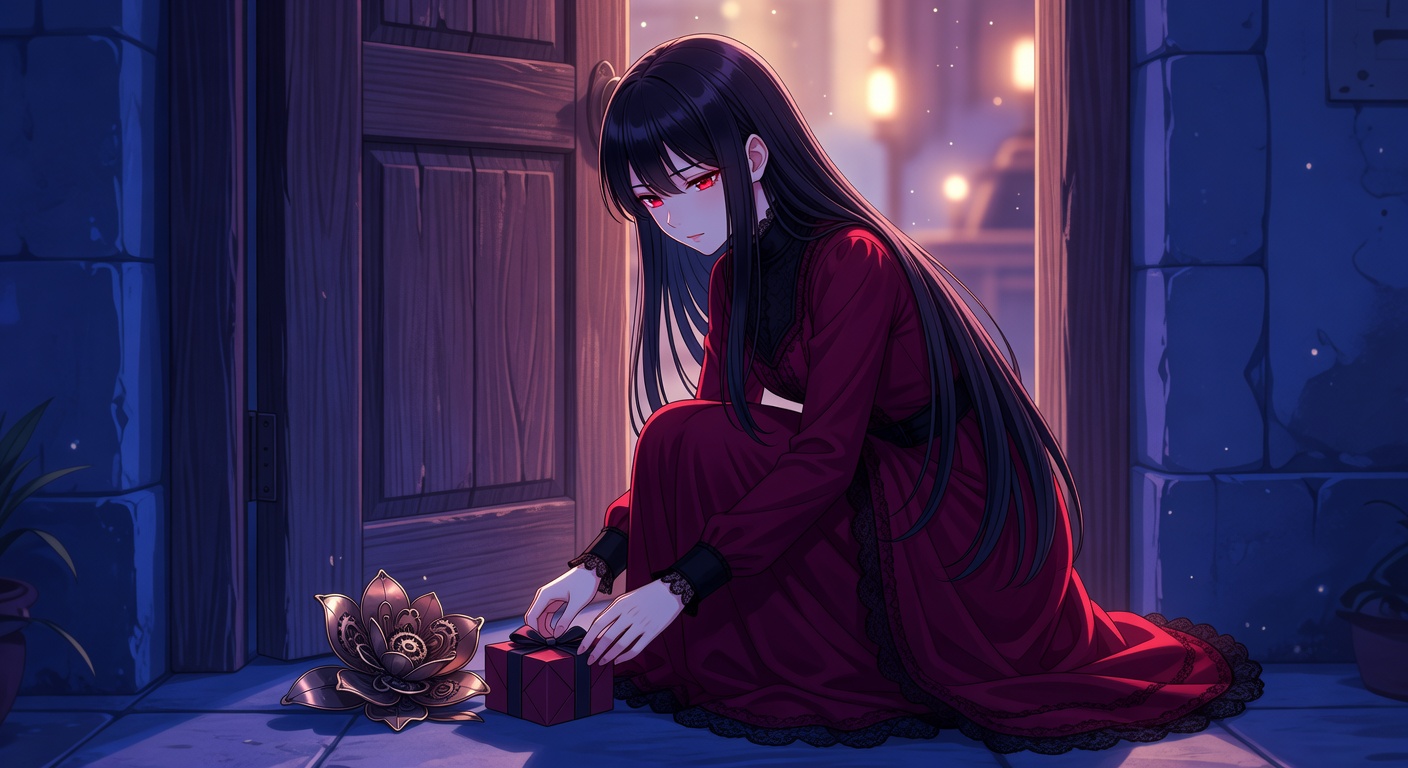
The academy's east tower rooftop is forbidden to students, faculty, visiting nobles, and probably most ghosts.
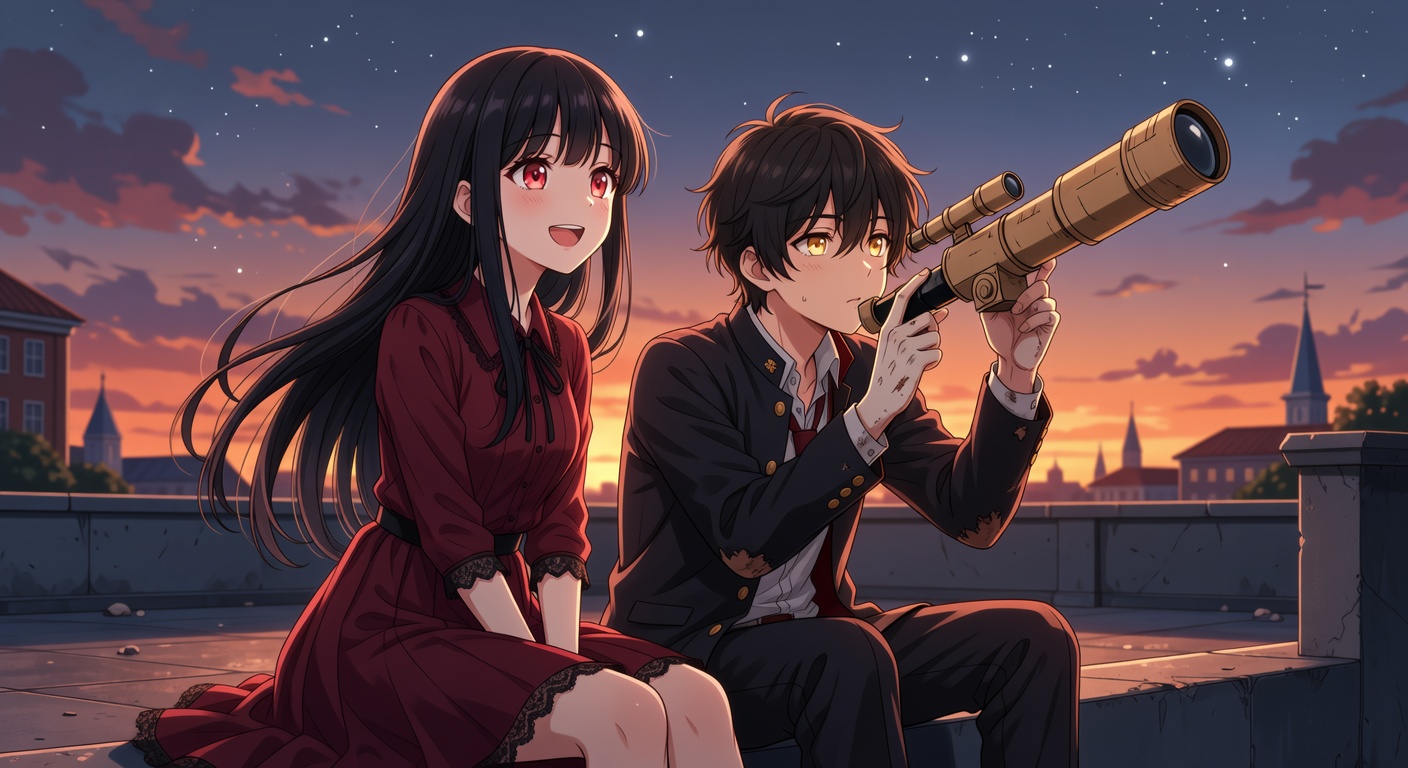
Kai has a key.
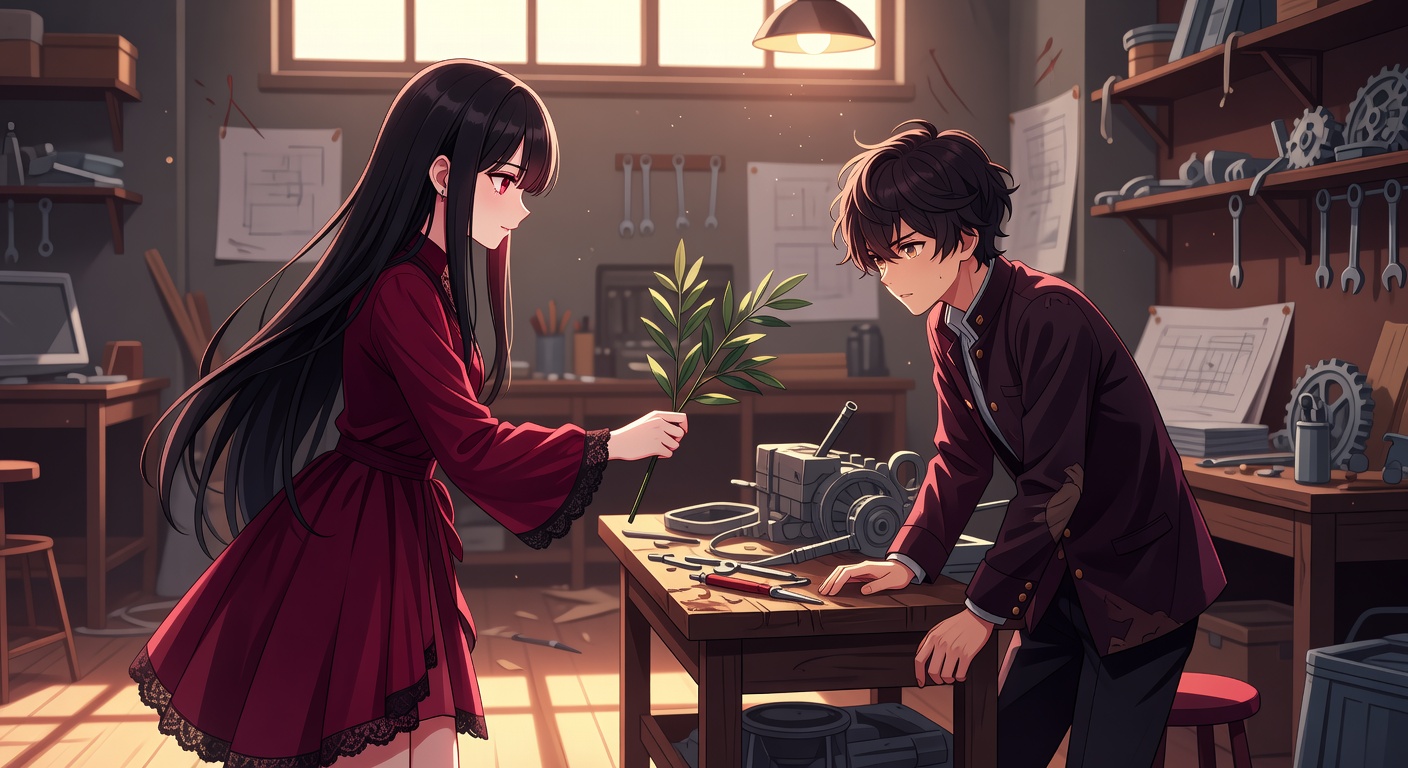
Of course he has a key. In Starlit Academy, Route 3's confession scene only unlocks after three hidden workshop visits, two successful repair minigames, and one conversation where Kai admits he hates formal dances because the music reminds him of machines pretending to be alive. The game never explained how a scholarship student got access to the highest locked door on campus. It just let the scene happen under a sky full of impossible stars and expected you to swoon.
Annoyingly, the developers knew exactly what they were doing.
The rooftop opens above you like the edge of another world. Wind catches your hair the moment Kai pushes the iron door aside, sharp and cold enough to bite through silk. Below, Starlit Academy spills across the hill in towers and bridges and arched windows glowing with enchanted lamplight. The gardens are a dark labyrinth threaded with silver paths. Luminous flowers burn soft blue among the hedges, and the lake beyond the western courtyard holds the moon like a secret it might decide to keep.
Up here, the ballroom politics and corridor whispers seem very far away. Small. Almost survivable.
Kai crosses the rooftop with the ease of someone who has been coming here for years. He sits on the parapet, legs dangling over a drop that makes your borrowed noble instincts recoil and your previous-life common sense scream. His coat flutters in the wind. Moonlight turns his dark hair blue-black and catches along the edges of his face, sharpening cheekbone and jaw, softening everything else.
Kai: "So."
He looks at you, amber eyes steady in a way that feels more dangerous than accusation.
Kai: "Tell me."
There are easier lies. A head injury. A spiritual awakening. A curse broken by moonlight and narrative convenience. Seraphina Blackrose could sell any of them with a lifted chin and a perfectly measured tear.
But Kai knows the weight of things. He knows when metal is flawed by the sound it makes under a hammer. He would hear the false note.
So you give him the truth with the impossible parts cut out.
You tell him about waking up and realizing your life had become something monstrous. About remembering words you had thrown like knives and finally feeling where they landed. About the strange, sick clarity of seeing your own face and understanding why people stepped back when it turned toward them. You tell him that cruelty had once felt like armor because everyone expected Lady Seraphina Blackrose to be untouchable, and you had mistaken being feared for being safe.
You do not tell him about save files. You do not tell him that his future testimony once appeared in ornate gold text before a death ending. You do not tell him that somewhere under your ribs lives the memory of a screen fading to black while Seraphina fell, burned, drowned, vanished, condemned.
But the horror is real. The shame is real. The need to become someone other than the girl he flinched from at the Spring Ball is so real it hurts to breathe around it.
Kai listens without interrupting.
That might be the cruelest mercy. No scoff. No neat forgiveness. No dramatic declaration that the past is past. Just the wind moving between you, the distant chime of the academy clock, and Kai's hands resting on stone, long fingers scarred from tools and wire and work no noble would ever notice.
When your voice finally runs out, the silence stretches.
For a moment, you think you have ruined it. Whatever fragile curiosity had brought him here, whatever thin bridge had formed between apology and trust, maybe you have placed too much weight on it. Maybe this is where he stands, says Lady Blackrose is very good at sounding sorry, and leaves you alone with the stars.
Instead, Kai looks out over the academy.
Kai: "My sister used to say people are like mana crystals."
His voice is quieter now. Not soft, exactly. Careful.
Kai: "Every crystal has a natural frequency. Strike it, and it answers in its own note. You can't change that fundamental resonance. Not without shattering it."
He taps one knuckle lightly against the parapet stone. The sound is almost swallowed by the wind.
Kai: "But you can tune the harmonics. Cut it differently. Set it in a better frame. Change what it amplifies. Same note, different music."
The ache in his words is not only for you. It belongs to basement workshops and unpaid invoices, to uniforms that never quite fit, to years of being told what his place was by people who never built anything with their own hands.
He turns back to you.
This close, his eyes are not simply amber. They are layered, honey and copper and firelight seen through glass. There is suspicion there still. He has not forgotten. He should not forget. But something else has taken root beside it, cautious and living.
Kai: "I think," he says, slowly, as if the conclusion irritates him by being true, "your fundamental note might be different than anyone gave you credit for."
A pause. His mouth tilts, barely.
Kai: "Including you."
The words land somewhere beneath all your practiced composure. For thirty days, you have been running from endings, counting flags, measuring every kindness against the possibility of survival. But Kai is looking at you like you are not a route to clear or a threat to manage. Like change is not proof yet, but it might become proof if given enough4f
You do not take his hand.
For one bright, impossible second, you want to. His fingers are right there against the rooftop stone, grease-smudged and careful, the same hands that coax broken machinery back into motion and sketch impossible equations in the margins of borrowed notebooks. The night wind lifts his dark hair across his eyes. Starlight catches on the copper filings still clinging to his sleeve.
Every route in Starlit Academy taught you to recognize the moment before a confession. The softened music. The charged silence. The choice prompt waiting like a held breath.
But Kai Nightvale is not a route. He is not a prize for the villainess to unlock because she managed thirty days without cruelty. He is a boy who spent years flinching when your shadow crossed his path, and trust like this deserves to grow on its own schedule, not yours.
So you fold your hands in your lap and look up.
Seraphina: "Tell me about the stars. The real ones, not the enchanted ones."
Kai goes very still.
For a heartbeat, you think you miscalculated. That he will hear rejection where you meant respect, distance where you meant patience. Then his mouth curves, small and surprised and almost helplessly genuine.
Not the polite smile he gives professors. Not the wary one he uses when nobles try to be generous. This one is crooked at the edge, like it escaped before he could stop it.
Kai: "The real ones are less obedient."
Seraphina: "That sounds like a recommendation."
Kai: "It is."
He talks until dawn.
At first, his voice is cautious, measured the way it is in the workshop when he is explaining a component he expects someone to mock. He points out the academy's false constellations, the enchanted net of lights maintained by court mages for seasonal festivals, pretty and meaningless. Then he shows you the gaps between them. The true stars hiding past the glamour. The northern anchor. The wandering red point that is not a star at all but a planet with a thirty-seven-year orbit. The faint silver scatter he calls the Ashen River, visible only when the moon sinks low enough.
The rooftop stones are cold through your skirts. Somewhere below, the academy sleeps under its polished domes and perfect hedges, pretending daylight manners matter more than midnight honesty. The air smells of rain left behind and metal from the key still lying between you.
Kai forgets to be guarded by degrees.
He leans back on his palms. He argues with himself about ancient astronomers. He admits, quietly, that when he first arrived at the academy, he used to come here because the sky was the only thing nobody could take away from him. Not his scholarship. Not his reputation. Not the last scraps of dignity the original Seraphina tried so hard to shred.
Your throat tightens.
I am so sorry, you think, but do not say it again. You have said it. More than once. Apologies are only useful if they become architecture, something solid enough for another person to stand on.
So you listen.
You ask questions when he pauses. Real ones. About orbital drift. About why mana storms distort star charts. About the half-built telescope in the east wing workshop and whether the lens distortion is from the crystal or the mounting frame.
His eyes light at that.
Not because you are Lady Seraphina Blackrose. Not because you have money, status, or a name sharp enough to cut through locked doors.
Because you are keeping up.
By the time the horizon pales, Kai is no longer the bullied scholarship student, or the wary stranger, or even the reluctant ally who accepted your help only after carving every possible string away from it.
He is just Kai.
A boy with amber eyes and ink on his cuff, who loves the sky so fiercely that even the approaching dawn looks like it is listening.
The Condemnation Event arrives in a hall bright enough to make honesty look theatrical.
Marble columns. Gilded balconies. Nobles arranged in tiers like an audience that paid dearly for blood. The air tastes of perfume, wax, and anticipation. Aurelie sits with her golden curls perfectly arranged, her small white cat curled in her lap like a prop from a saint's portrait. Her smile is gentle. Flawless.
Thirty days,* you think. *Thirty days of refusing every script they handed me.
Kai sits in the gallery.
He does not stand. He does not deliver dramatic testimony. He does not raise his voice and overturn the trial with one brilliant accusation. His arms are crossed, his expression unreadable, amber eyes fixed on you with the steady attention of someone who has spent a month recalibrating what he thought he knew.
In the game, his testimony seals your death.
Here, his silence is not abandonment. It is choice. He is not your weapon. He is not your shield. He owes you neither.
The Condemnation fails by the breadth of a whisper.
Not cleanly. Not triumphantly. There are too many old rumors, too many sharpened memories, too many people invested in the comfort of hating you. But thirty days have weight. The servant you thanked. The first-year you defended. The records you corrected. The insults you swallowed until they died behind your teeth. Tiny impossible things, accumulating like snow on a branch until the whole shape of it changes.
When the final judgment is read, your knees nearly give out.
You survive.
Afterward, the corridor outside the hall is cool and dim, muffling the roar of disappointed gossip behind carved oak doors. You stand beneath a stained-glass s
What ending did you get?
Play the same story and make your own choices. Every path leads to a different ending.