AI Choose Your Own Adventure: Beyond the Books
If you grew up reading Choose Your Own Adventure books, you already understand the appeal of interactive fiction. You reach a decision point. You pick a path. The story changes based on your choice. That loop, read-choose-discover, is one of the most satisfying things a story can do.
The books had a limitation, though. Every possible branch had to be written in advance. An author could realistically write maybe twenty or thirty endings before the book ran out of pages. That meant most choices were cosmetic. Doors A and B often led to the same hallway. The tree of possibilities looked wide but was actually narrow.
AI changes that constraint entirely. When the story is generated in real time, every branch is genuinely new. There is no pre-written script to converge back to. Your choices produce a story that nobody else has read, because it did not exist until you made those choices.
What the Books Got Right
Before talking about what AI adds, it is worth acknowledging what the original books nailed. Choose Your Own Adventure sold over 250 million copies for a reason.
The choice moment is inherently compelling. Even when the choice was trivial (“turn left or turn right”), the act of deciding created investment. You were not passively reading. You were participating. That shift from observer to participant changes how you engage with a story at a fundamental level.
Short, punchy sections keep the pace up. CYOA books used short passages between choices, usually a page or two. This kept the reading rhythm fast and made the choices feel frequent. You were never more than a minute away from the next decision.
Multiple endings encouraged replay. Finding all the endings was its own game. You would bookmark choice pages and systematically explore every branch. The book became a puzzle as much as a story.
Those three elements, participation, pacing, and replayability, are still what make interactive fiction work. AI did not invent them. R.A. Montgomery and Edward Packard did, fifty years ago.
What AI Adds to the Format
The books had constraints that AI removes. Here is what changes when the story is generated rather than pre-written:
Every Branch Is Real
In a printed CYOA book, the author has to plan every possible path. That limits the tree to maybe thirty or forty nodes before the combinatorics become unmanageable. In practice, most books funneled divergent paths back together after a few pages.
AI-generated stories do not have this constraint. When you choose to trust the stranger in chapter two, the AI generates a chapter three that follows from that trust. When you choose to run, it generates a different chapter three that follows from the escape. Neither path is pre-written. Neither path converges back to the same script. The tree is as wide as the story needs it to be.
The Story Remembers
In the books, each passage was self-contained. It had to be, because you could arrive at any passage from multiple paths. That meant passages could not reference specific earlier choices because the author did not know which choices you had made. CYOA readers got used to flipping back and rereading earlier branches when something felt missing. That workaround was the only continuity the format could offer.
AI stories can track your accumulated decisions. If you were kind to the merchant in chapter one, the merchant remembers in chapter four. If you lied to the guard, the guard’s suspicion carries forward. This is what turns a branching story into a coherent narrative: continuity across choices the printed gamebook could only gesture at.
Illustrations Match Your Story
CYOA books had illustrations, but they were generic, and the budget for a paperback usually ran to a handful of black-and-white spot illustrations per book. The same dragon appeared regardless of which path you took because the illustration was printed in advance, and the print run had to amortize the artist’s fee across thousands of identical copies. AI-generated stories can produce inline images that match the specific scene you are reading. The dragon you encounter looks like the dragon your story described, with the coloring and the setting and the lighting that fit the path you actually took, not the one some other reader picked from the same starting page.
Pacing Adjusts to You
The books had one pace: the pace the author set, with short passages, frequent choices, and quick resolutions. That worked for the adventure genre but felt rushed for mystery or romance.
AI stories can adjust pacing to match the genre and your preferences. A slow-burn romance takes its time building tension. A thriller keeps the choices coming fast. You can control the rhythm of the experience instead of being locked into the author’s tempo.
What an AI Choose Your Own Adventure Looks Like
Here is a playable example. This is a complete interactive story with branching choices, generated illustrations, and pacing control. No account needed:
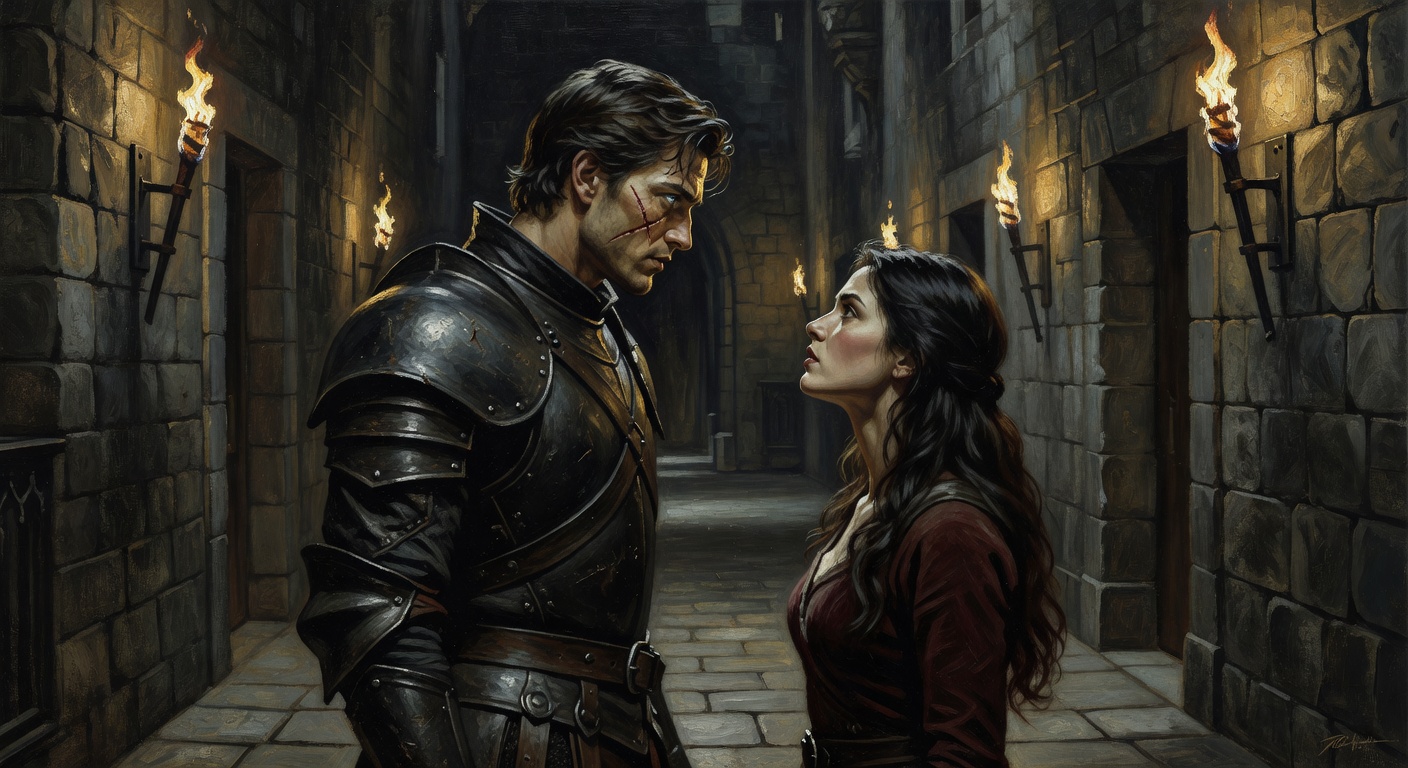
The Thornwood Accord
Two rival houses. One impossible alliance. A scarred commander who doesn't trust you. Enemies-to-lovers romantasy with choices that change everything.
Notice how the choices produce genuinely different story paths, not cosmetic variations on the same outcome. That is the difference between a pre-written branching tree and an AI-generated narrative.
Nine Genres, Not Just Adventure
The original books were almost all adventure stories, because the action-oriented format made short passages and frequent choices feel natural. Mysteries, romances, and horror stories need different pacing, and the CYOA format struggled with genres that required slow buildup.
AI interactive fiction does not have this constraint. NovelFlame generates stories across nine genres (romance, fantasy, horror, sci-fi, thriller, mystery, historical, supernatural, and LitRPG), and each genre has its own editorial approach. A horror story builds dread slowly. A romance lets the tension simmer. A mystery plants fair-play clues. The pacing and prose style adjust to fit what each genre needs.
The People Who Love This
The audience for AI choose your own adventure stories is broader than you might expect. It is not just nostalgia-driven CYOA readers (though they are here too).
Readers who want agency. People who wish they could change the ending of a novel, steer the protagonist away from the obviously bad decision, or explore the road not taken. Interactive fiction gives them that control.
Mobile readers. The short-session, choice-driven format is perfect for reading on a phone during ten minutes on a commute or fifteen minutes before bed. Each session ends at a natural stopping point because the choices create built-in chapter breaks.
Genre fans who have read everything. When you have read every slow-burn enemies-to-lovers romance on your Kindle, an AI that generates a new one shaped by your specific choices is not a replacement for human authors. It is a new kind of reading experience that fills a different slot.
Getting Started
If you came to this page searching for “AI choose your own adventure,” you already know what you want: interactive stories where your choices matter. The question is which platform does it best.
NovelFlame is built for readers, not writers. The stories have structure (beginnings, middles, endings). The choices produce real branches (not cosmetic forks). The illustrations match your specific story. And the AI remembers what you did.
Browse the full collection at the interactive fiction games hub, or try the text adventure games hub if you are coming from the parser-fiction side of the genre.
Get notified about new stories
Related Articles
AI Story Generator With Images: What to Look For in 2026
What separates a real AI story generator with images from a text tool with a separate image tab. Inline illustrations, character consistency, and genre-matched art styles explained.
Interactive Fiction Books: From Print to AI-Powered Stories
How interactive fiction books evolved from page-flipping gamebooks to AI-generated stories with branching narratives, illustrations, and real choices.
AI RPG That Remembers Your Choices (Finally)
Why most AI story games forget what you did three chapters ago, and how story memory changes the experience from a chat log into a real RPG.