Best Text Adventure Games in 2026: From Zork to AI
Text adventure games have been around since the 1970s, and the best ones are still worth playing today. The genre has changed a lot since Zork, but the core appeal has not: you read a story, you make choices, and the world responds.
This is a list of the best text adventure games you can play right now, from the classics that started it all to the AI-powered stories that are pushing the genre forward. Every game on this list is playable today.
The Classics (Still Worth Playing)
Zork (1977)
The one that started it all. Zork drops you outside a white house with a mailbox and lets you type whatever you want. “Open mailbox.” “Go north.” “Attack troll with sword.” The parser understands a surprisingly large vocabulary, and the Great Underground Empire is dense with puzzles, treasure, and ways to die.
Zork holds up because Infocom’s writing was genuinely funny and the puzzle design rewards lateral thinking. The map is confusing by modern standards (bring graph paper), but the sense of discovery is real. You can play it free in your browser through the Internet Archive.
Best for: Anyone who wants to understand where the genre began.
Hitchhiker’s Guide to the Galaxy (1984)
Douglas Adams co-wrote this with Infocom’s Steve Meretzky, and it shows. The game is deliberately unfair in the same way the books are deliberately absurd. You can die in the first room if you do not get out of bed and find your towel. Items you need in the endgame must be picked up hours earlier with no warning.
It is brilliant and infuriating in equal measure. The BBC hosts a free playable version online with updated graphics.
Best for: Fans of the books who want to experience Adams’s sense of humor interactively.
Anchorhead (1998)
A Lovecraftian horror text adventure that proves the genre can do genuine dread. You arrive in a New England town with your husband to settle an estate. Things go wrong immediately and keep getting worse. The writing is atmospheric, the puzzles are fair, and the horror builds slowly instead of relying on cheap surprises.
Anchorhead was originally free interactive fiction, and a polished commercial version was released in 2018. Both versions are excellent.
Best for: Horror fans who want a text adventure with real atmosphere.
Modern Parser Fiction
Counterfeit Monkey (2012)
Emily Short’s masterpiece about a world where language has physical power. You carry a device that can remove letters from objects, turning a “sword” into a “word” or a “pear” into a “pea.” The entire game is built around this single mechanic, and the puzzles are some of the most inventive in the genre’s history.
The writing is sharp, the world is fully realized, and the difficulty curve is generous. Available free through the Interactive Fiction Database.
Best for: Anyone who loves wordplay and wants to see how creative puzzle design can get.
80 Days (2014)
Inkle Studios turned Jules Verne’s novel into a globe-trotting adventure where you choose your route around the world. It is not a parser game (you pick from options rather than typing commands), but the branching is deep enough that most players never see the same journey twice. The writing is excellent and the steampunk-alternate-history setting gives the world more texture than the original novel.
Available on mobile and Steam. One of the games that proved interactive fiction could reach a mainstream audience.
Best for: Readers who want a polished, accessible entry point to modern interactive fiction.
AI Dungeon (2019)
The game that proved AI could generate interactive stories in real time. AI Dungeon lets you type anything and the AI responds with the next part of the story. In its early days, the results were wild and unpredictable, which was part of the charm. The AI would forget characters, contradict itself, and occasionally produce something genuinely surprising.
AI Dungeon is still active and has improved its models over the years. The free tier gives you access to basic generation. The main limitation has always been the story memory problem: characters forget their own names, the AI loses track of who the antagonist is, and the rolling context window means anything older than a few turns drops out of the AI’s awareness entirely. We wrote a longer piece on why AI RPGs forget your story that breaks down what is actually happening under the hood and why it matters for longer reads.
Best for: Players who want maximum freedom and do not mind when the AI goes off the rails.
AI-Powered Text Adventures (2026)
NovelFlame
NovelFlame takes a different approach to AI text adventures. Instead of giving you an open text box and hoping the AI keeps up, it generates structured stories with real narrative arcs: rising action, choices that branch the plot, and endings that land.
The difference you notice first is consistency. Characters stay in character. The world does not forget what happened two chapters ago. If you told the blacksmith you would return with the relic, the blacksmith remembers. The AI tracks your choices across the entire story and generates each new chapter with that full history in mind.
The difference you notice second is the visuals. NovelFlame generates inline illustrations that match the specific scene you are reading, not stock fantasy art. The dragon your character encounters looks like the dragon the story described, down to the coloring and the scars.
Pacing control is the third differentiator. You can set the story to slow burn and the AI takes its time building the world, or fast-paced and it cuts to the choices that matter. Nine genres are supported, from horror to romance to LitRPG, and each one has its own editorial treatment so a mystery reads like a mystery and a thriller reads like a thriller.
The honest limitations: NovelFlame is paid once you want to create your own stories (the demo stories are free to read, then Plus at $8.99 a month), so it is the more expensive option on this list next to AI Dungeon’s free tier or the parser classics that all run free in the browser. The demo library is also smaller than those of community-driven platforms: fewer titles, each with more editorial polish, rather than the breadth of an open creator ecosystem. The bet is that the structured prose, the inline illustrations, and the cinematic video scenes are worth the trade for readers who want a finished story over an open sandbox.
Try it free below. No account needed.
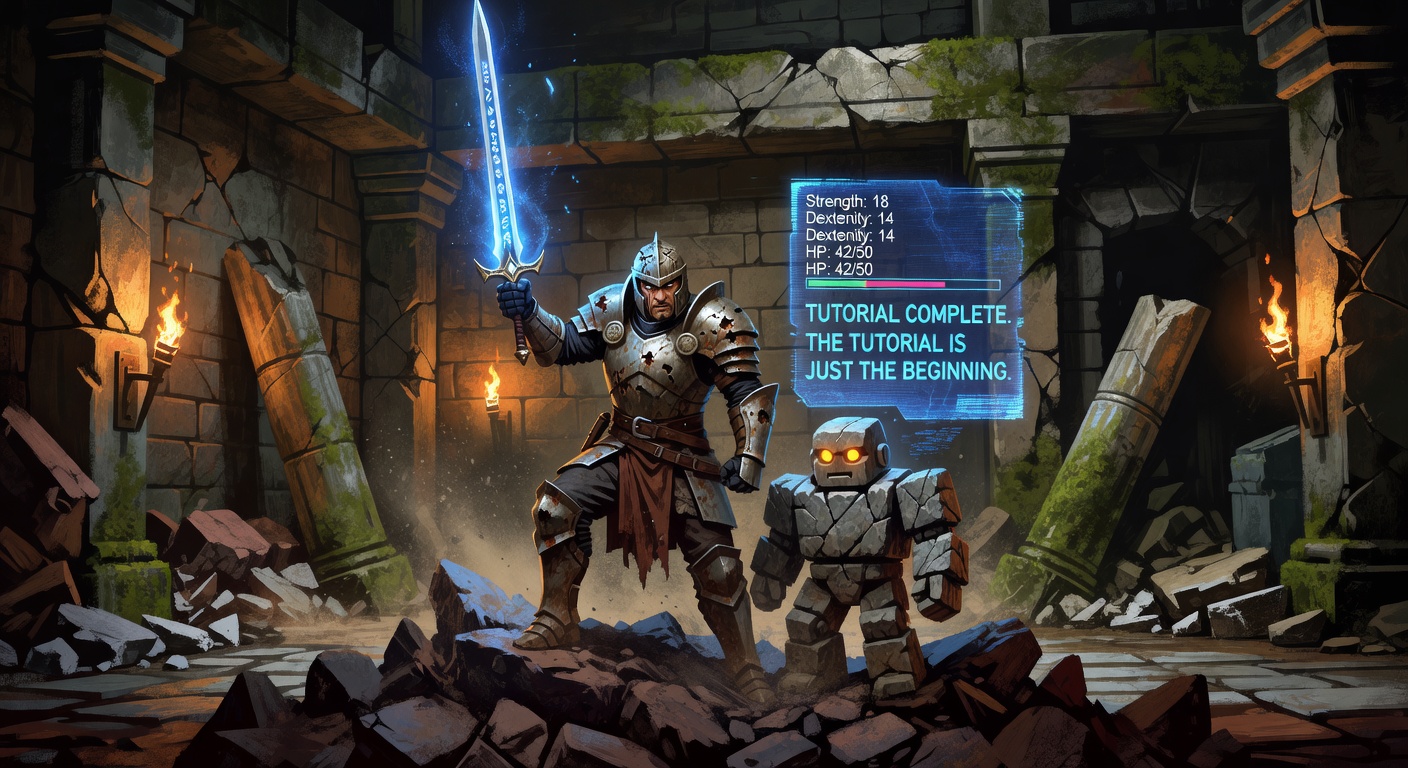
Dungeon Floor Zero
You wake on cold stone with no memory. A character creation screen floats before you. The System gives you 24 hours.
Best for: Readers who want AI-generated stories with the structure and quality of traditional fiction.
Storium
Storium is a collaborative storytelling platform where multiple players contribute to a shared narrative. One player acts as the narrator and sets scenes while others play characters and respond. It is closer to tabletop roleplaying than traditional text adventures, but the format produces surprisingly good stories when the group is committed.
The platform has a library of worlds and genres to choose from, and the card-based system gives structure to the collaboration. It requires other players, which is both its strength (the stories feel co-authored) and its limitation (you need a group).
Best for: Writers who want collaborative storytelling with other people.
How to Choose
The right text adventure game depends on what you are looking for:
- Nostalgia and puzzle-solving: Zork, Hitchhiker’s Guide, Counterfeit Monkey
- Great writing and atmosphere: Anchorhead, 80 Days
- Maximum freedom: AI Dungeon
- Structured AI stories with illustrations: NovelFlame
- Collaborative storytelling: Storium
The genre has never had more range than it does right now. The classics are free and still playable. The modern entries are polished and accessible. And the AI-powered options are doing things that were not possible even five years ago.
If you want to explore more, head to the text adventure games hub for the full collection, or browse interactive fiction games if you are coming from the branching-narrative side of the genre.
Get notified about new stories
Related Articles
AI Story Generator With Images: What to Look For in 2026
What separates a real AI story generator with images from a text tool with a separate image tab. Inline illustrations, character consistency, and genre-matched art styles explained.
Interactive Fiction Books: From Print to AI-Powered Stories
How interactive fiction books evolved from page-flipping gamebooks to AI-generated stories with branching narratives, illustrations, and real choices.
AI Choose Your Own Adventure: Beyond the Books
How AI choose your own adventure stories go beyond the page-flipping format with real branching, generated illustrations, and stories that remember your choices.